
Social Sci LibreTexts

3.5: Coping With the Unexpected

  • Page ID
    348229
  • \( \newcommand{\vecs}[1]{\overset { \scriptstyle \rightharpoonup} {\mathbf{#1}} } \)

    \( \newcommand{\vecd}[1]{\overset{-\!-\!\rightharpoonup}{\vphantom{a}\smash {#1}}} \)

    \( \newcommand{\dsum}{\displaystyle\sum\limits} \)

    \( \newcommand{\dint}{\displaystyle\int\limits} \)

    \( \newcommand{\dlim}{\displaystyle\lim\limits} \)

    \( \newcommand{\id}{\mathrm{id}}\) \( \newcommand{\Span}{\mathrm{span}}\)

    ( \newcommand{\kernel}{\mathrm{null}\,}\) \( \newcommand{\range}{\mathrm{range}\,}\)

    \( \newcommand{\RealPart}{\mathrm{Re}}\) \( \newcommand{\ImaginaryPart}{\mathrm{Im}}\)

    \( \newcommand{\Argument}{\mathrm{Arg}}\) \( \newcommand{\norm}[1]{\| #1 \|}\)

    \( \newcommand{\inner}[2]{\langle #1, #2 \rangle}\)

    \( \newcommand{\Span}{\mathrm{span}}\)

    \( \newcommand{\id}{\mathrm{id}}\)

    \( \newcommand{\Span}{\mathrm{span}}\)

    \( \newcommand{\kernel}{\mathrm{null}\,}\)

    \( \newcommand{\range}{\mathrm{range}\,}\)

    \( \newcommand{\RealPart}{\mathrm{Re}}\)

    \( \newcommand{\ImaginaryPart}{\mathrm{Im}}\)

    \( \newcommand{\Argument}{\mathrm{Arg}}\)

    \( \newcommand{\norm}[1]{\| #1 \|}\)

    \( \newcommand{\inner}[2]{\langle #1, #2 \rangle}\)

    \( \newcommand{\Span}{\mathrm{span}}\) \( \newcommand{\AA}{\unicode[.8,0]{x212B}}\)

    \( \newcommand{\vectorA}[1]{\vec{#1}}      % arrow\)

    \( \newcommand{\vectorAt}[1]{\vec{\text{#1}}}      % arrow\)

    \( \newcommand{\vectorB}[1]{\overset { \scriptstyle \rightharpoonup} {\mathbf{#1}} } \)

    \( \newcommand{\vectorC}[1]{\textbf{#1}} \)

    \( \newcommand{\vectorD}[1]{\overrightarrow{#1}} \)

    \( \newcommand{\vectorDt}[1]{\overrightarrow{\text{#1}}} \)

    \( \newcommand{\vectE}[1]{\overset{-\!-\!\rightharpoonup}{\vphantom{a}\smash{\mathbf {#1}}}} \)

    \( \newcommand{\vecs}[1]{\overset { \scriptstyle \rightharpoonup} {\mathbf{#1}} } \)

    \(\newcommand{\longvect}{\overrightarrow}\)

    \( \newcommand{\vecd}[1]{\overset{-\!-\!\rightharpoonup}{\vphantom{a}\smash {#1}}} \)

    \(\newcommand{\ket}[1]{\left| #1 \right>}\)
    \(\newcommand{\bra}[1]{\left< #1 \right|}\)
    \(\newcommand{\braket}[2]{\left< #1 \vphantom{#2} \right| \left. #2 \vphantom{#1} \right>}\)
    \(\newcommand{\braopket}[3]{\left< #1 \vphantom{#2}\vphantom{#3} \right| #2 \vphantom{#1}\vphantom{#3} \left| #3 \vphantom{#1}\vphantom{#2} \right>}\)
    \(\newcommand{\qmvec}[1]{\mathbf{\vec{#1}}}\)
    \(\newcommand{\op}[1]{\hat{\mathbf{#1}}}\)
    \(\newcommand{\expect}[1]{\langle #1 \rangle}\)
    \(\newcommand{\dfn}[1]{\emph{\textbf{#1}}}\)
    \(\newcommand{\avec}{\mathbf a}\) \(\newcommand{\bvec}{\mathbf b}\) \(\newcommand{\cvec}{\mathbf c}\) \(\newcommand{\dvec}{\mathbf d}\) \(\newcommand{\dtil}{\widetilde{\mathbf d}}\) \(\newcommand{\evec}{\mathbf e}\) \(\newcommand{\fvec}{\mathbf f}\) \(\newcommand{\nvec}{\mathbf n}\) \(\newcommand{\pvec}{\mathbf p}\) \(\newcommand{\qvec}{\mathbf q}\) \(\newcommand{\svec}{\mathbf s}\) \(\newcommand{\tvec}{\mathbf t}\) \(\newcommand{\uvec}{\mathbf u}\) \(\newcommand{\vvec}{\mathbf v}\) \(\newcommand{\wvec}{\mathbf w}\) \(\newcommand{\xvec}{\mathbf x}\) \(\newcommand{\yvec}{\mathbf y}\) \(\newcommand{\zvec}{\mathbf z}\) \(\newcommand{\rvec}{\mathbf r}\) \(\newcommand{\mvec}{\mathbf m}\) \(\newcommand{\zerovec}{\mathbf 0}\) \(\newcommand{\onevec}{\mathbf 1}\) \(\newcommand{\real}{\mathbb R}\) \(\newcommand{\twovec}[2]{\left[\begin{array}{r}#1 \\ #2 \end{array}\right]}\) \(\newcommand{\ctwovec}[2]{\left[\begin{array}{c}#1 \\ #2 \end{array}\right]}\) \(\newcommand{\threevec}[3]{\left[\begin{array}{r}#1 \\ #2 \\ #3 \end{array}\right]}\) \(\newcommand{\cthreevec}[3]{\left[\begin{array}{c}#1 \\ #2 \\ #3 \end{array}\right]}\) \(\newcommand{\fourvec}[4]{\left[\begin{array}{r}#1 \\ #2 \\ #3 \\ #4 \end{array}\right]}\) \(\newcommand{\cfourvec}[4]{\left[\begin{array}{c}#1 \\ #2 \\ #3 \\ #4 \end{array}\right]}\) \(\newcommand{\fivevec}[5]{\left[\begin{array}{r}#1 \\ #2 \\ #3 \\ #4 \\ #5 \\ \end{array}\right]}\) \(\newcommand{\cfivevec}[5]{\left[\begin{array}{c}#1 \\ #2 \\ #3 \\ #4 \\ #5 \\ \end{array}\right]}\) \(\newcommand{\mattwo}[4]{\left[\begin{array}{rr}#1 \amp #2 \\ #3 \amp #4 \\ \end{array}\right]}\) \(\newcommand{\laspan}[1]{\text{Span}\{#1\}}\) \(\newcommand{\bcal}{\cal B}\) \(\newcommand{\ccal}{\cal C}\) \(\newcommand{\scal}{\cal S}\) \(\newcommand{\wcal}{\cal W}\) \(\newcommand{\ecal}{\cal E}\) \(\newcommand{\coords}[2]{\left\{#1\right\}_{#2}}\) \(\newcommand{\gray}[1]{\color{gray}{#1}}\) \(\newcommand{\lgray}[1]{\color{lightgray}{#1}}\) \(\newcommand{\rank}{\operatorname{rank}}\) \(\newcommand{\row}{\text{Row}}\) \(\newcommand{\col}{\text{Col}}\) \(\renewcommand{\row}{\text{Row}}\) \(\newcommand{\nul}{\text{Nul}}\) \(\newcommand{\var}{\text{Var}}\) \(\newcommand{\corr}{\text{corr}}\) \(\newcommand{\len}[1]{\left|#1\right|}\) \(\newcommand{\bbar}{\overline{\bvec}}\) \(\newcommand{\bhat}{\widehat{\bvec}}\) \(\newcommand{\bperp}{\bvec^\perp}\) \(\newcommand{\xhat}{\widehat{\xvec}}\) \(\newcommand{\vhat}{\widehat{\vvec}}\) \(\newcommand{\uhat}{\widehat{\uvec}}\) \(\newcommand{\what}{\widehat{\wvec}}\) \(\newcommand{\Sighat}{\widehat{\Sigma}}\) \(\newcommand{\lt}{<}\) \(\newcommand{\gt}{>}\) \(\newcommand{\amp}{&}\) \(\definecolor{fillinmathshade}{gray}{0.9}\)

    Learning Outcomes

    • Identify common difficulties that may fluster even experienced speakers.
    • Describe some basic strategies for dealing with unexpected events during a public speech.
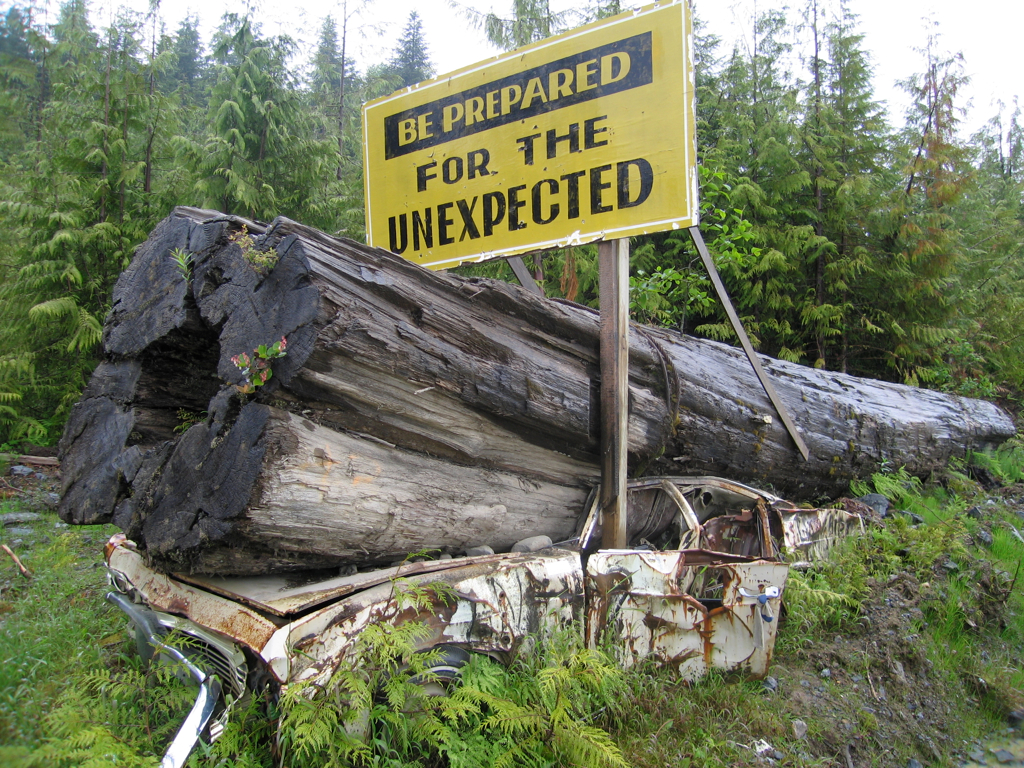
    A large yellow roadside sign reads “BE PREPARED FOR THE UNEXPECTED” in bold black letters. Ironically, directly beneath the sign, a massive fallen tree has crushed an old, rusted car. The vehicle is severely flattened under the weight of the log, with parts of the car barely recognizable. The scene is set in a lush, forested area with dense green trees surrounding the wreckage. The image humorously emphasizes the message on the sign through a dramatic and unexpected real-life example.
    Image by Brodie Guy on Flickr

    Even the most prepared, confident public speaker may encounter unexpected challenges during the speech. This section discusses some common unexpected events and addresses some general strategies for combating the unexpected when you encounter it in your own speaking.

    Speech Content Issues

    Nearly every experienced speaker has gotten to the middle of a presentation and realized that a key notecard is missing or that they skipped important information from the beginning of the speech. When encountering these difficulties, a good strategy is to pause for a moment to think through what you want to do next. Is it important to include the missing information, or can it be omitted without hurting the audience’s ability to understand the rest of your speech? If it needs to be included, do you want to add the information now, or will it fit better later in the speech? It is often difficult to remain silent when you encounter this situation, but pausing for a few seconds will help you to figure out what to do and may be less distracting to the audience than sputtering through a few “ums” and “uhs.”

    Technical Difficulties

    Technology has become a very useful aid in public speaking, allowing us to use audio or video clips, presentation software, or direct links to websites. However, one of the best-known truisms about technology is that it does break down. Web servers go offline, Wi-Fi signals disappear or become glitchy, files will not download in a timely manner, and media are incompatible with the computer in the presentation room. I’m sure we’ve all seen someone who wanted to plug in their laptop only to realize they don’t have the right connector (HDMI, USB-C, etc.). Or the speaker has a MAC and the local equipment is a PC, and the speaker doesn’t have a way to convert their presentation to PowerPoint or Google Slides on the fly. It is important to always have a backup plan, developed in advance, in case of technical difficulties with your presentation materials. As you develop your speech and visual aids, think through what you will do if you cannot show a particular graph or if your presentation slides are hopelessly garbled. Although your beautifully prepared chart may be superior to the oral description you can provide, your ability to provide a succinct oral description when technology fails can give your audience the information they need.

    External Distractions

    Although many public speaking instructors directly address audience etiquette during speeches, you’re still likely to encounter an audience member who walks in late, a ringing cell phone, or even a car alarm going off outside your classroom. If you are distracted by external events like these, it is often useful, and sometimes necessary (as in the case of the loud car alarm), to pause and wait so that you can regain the audience’s attention and be heard.

    Whatever the unexpected event, your most important job as a speaker is to maintain your composure. It is important not to get upset or angry because of these types of glitches—and, once again, the key to this is being fully prepared. If you keep your cool and quickly implement a “plan B” for moving forward with your speech, your audience is likely to be impressed and may listen even more attentively to the rest of your presentation.

    Key Takeaways

    • Plan ahead for how to cope with unexpected difficulties such as forgetting part of your speech content, having technical trouble with visual aids, or being interrupted by external distractions.

    Exercises

    • Talk to people who engage in public speaking regularly (e.g., teachers and professionals) and find out what unexpected events have happened when they were giving speeches. What did they do to deal with these unexpected happenings?
    • Fill out the Personal Report of Communication Apprehension (PRCA24). The measure can be found at.

    This page titled 3.5: Coping With the Unexpected was last modified on Sun, 05 Apr 2026 07:12:04 GMT and is shared under a CC BY-NC-SA 4.0 license and was authored, remixed, and/or curated by Jason Wrench, Anne Goding, Danette Ifert Johnson, and Bernardo Alexander Attias via source content that was edited to the style and standards of the LibreTexts platform.