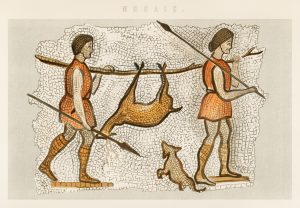
Anthropologists have spent the better part of the last 100 years studying tribal societies around the world that have remained apart from the technological advances that shape so much of our lives today. What they have found is that there are striking differences between hunter and gatherer societies that tend to be nomadic as they move with changing seasons to find food and hunt wild animals compared to herding and agricultural societies who tend to remain in one general area. What many anthropologists have concluded is that hunter-gatherers tend to be more egalitarian, meaning there are less social divides, especially along gendered lines–the best hunter and the best gatherer would take on these roles regardless. On the other hand, societies that tend to remain in one general location place greater emphasis on property–who do the herds of animals belong to and who will get the land when someone dies? This focus on property is believed to be connected to the greater emphasis on social stratification and divisions of wealth in societies. Rather than being egalitarian, matriarchal and patriarchal societies allowed for property to be passed down based on family connections to the women (matriarchal) or men (patriarchal) in a society. The most common being patriarchal but some examples of matriarchal societies exist currently. Studies based on current tribes and archaeological digs have shown that hunter-gathers and herding/agricultural groups displayed some of these social differences. Archaeological digs uncovering burial sites often provide clues as to what the social structure was like. Questions existed, like were men buried with more objects or were the women buried with more objects? What was the placement of the bodies and what remnants of clothing were found? What kind of art or relics were also found?
As with everything in life, we also must be careful in overgeneralizing some of these things, such as “all hunter and gatherer societies are like this” and “all agricultural societies are like this.” In more recent studies, the idea of a spectrum of subsistence strategies has emerged in which the two distinct categories of hunters-gatherers and herding/agriculture are being questioned because many societies actually display characteristics of both, complicating this oversimplified model (Arnold et al., 2016). However, what can be seen is that in societies that shared wealth and resources more fluidly, they also tended to be more egalitarian. In others that passed land and belongings down family lines, social stratification and gender roles became more prevalent (Arnold et al., 2016).
Ancient Perspectives
Keep in mind that it is difficult to truly understand the thought processes and perspectives of these ancient civilizations and that archeologists and anthropologists can only make guesses about the materials they have uncovered. Art and writings are the most commonly preserved items that are used to make assumptions about these time periods. A problem that often arises is that we try to use today’s perspective regarding gender and sexuality which biases the way we make sense of the past. In reality, unless we develop time travel, we will never know the full realities of what gender and sexuality looked like in antiquity. When we look back across time, the term HIStory is very fitting as well because the public and private lives of men dominate, and the perspectives of women are often not focused upon as much (Carroll, 2017). If men are the main artists and writers in a society, which is often the case and elements of this are still present in our society today, this shapes the narratives being told and passed down. Additionally, many societies relied on oral traditions that have been lost through the process of colonization because the stories have faded with the erasure of people and their cultures.
The following information is based on Carroll (2017).
Egypt (approx. 1100 B.C.): Erotic images found on carvings and papyrus. Temple prostitutes would have sex with pagan worshippers as sex was seen as a connection to the spiritual. Some depictions of possible gay sexual relationships between men have been found, such as a tomb uncovered featuring two males in close contact similar to how straight relationships were depicted. Early archaeologists and anthropologists said they were probably brothers, but this has been an area recently reviewed and perceived differently.
Greeks (1000-200 B.C.): Pedastery was commonly practiced, which is when an older man would mentor a postpubescent boy in his studies and in his sexual development. This was seen as a rite of passage. Sexual relations between soldiers were also normalized as it was believed that males with close relationships would fight harder for each other in battle. The male body was idolized and Plato is attributed with exploring how nonsexual love between two men was viewed as the ideal love. This is where we get the current day term for “platonic love,” or love without a sexual element. The female Greek poet Sappho, who lived on the Isle of Lesbos, wrote erotic poetry about women. This is where we get the term “lesbian” from.
The Hebrews (1000-200 B.C.): The Hebrew Bible outlines the rules around sexual behavior. Adultery and homosexuality between men (women are not mentioned) were both viewed as being wrong. Some scholars think this was because women were viewed as property, so the idea of a man having sex with another man would reduce one of them to the position of the other’s property. Others, however, believe this is meant to be taken literally and that it should now include lesbianism and other non-heterosexual acts. Marital sexuality was grounded in a focus on procreation rather than pleasure and this stance was adopted by Christianity which would go on to form the groundwork for sexual attitudes in the West, such as the current-day United States.
India (400 B.C.): The Kamasutra is an erotic text that is a detailed manual meticulously containing information about any imaginable sexual position, love, family life, and moral frameworks. Sexuality and spirituality were viewed as connected. While there are stories of powerful women rulers, the society was mostly patriarchal with male lives being valued more than female lives. Female infanticide was not uncommon and killing a woman was not regarded as a serious crime. Hijras, or a third gender in which a person originally designated a male at birth takes on a feminine role in society which often included castration, were also mentioned in the Kamasutra and were given central roles in many religious ceremonies. Marginalization and stigma for these individuals are believed to have become more prevalent through the British colonization of India in the early 1500s.
China (200 B.C.): Balance and harmony between all parts of nature are at the core of Toaist and Confucian thought. Yin (female essence) was viewed as endless whereas yang (male essence contained in semen) needed to be controlled and maintained through prolonged contact with yin. Sex manuals were common teaching men how to experience orgasm without ejaculation to preserve their sperm, while brides were given texts on how to pleasure their husbands. Female orgasm was viewed as important in order to receive the maximum benefit from yin essence. Even though a balance between yin and yang was valued within each individual, yin was viewed as more passive and subservient and, since women were believed to have more of this essence naturally, they were expected to be subservient to the men in their lives–fathers, husbands and sons. Polygamy, a male with multiple wives and concubines, was commonly practiced.
Optional additional resources if you would like to explore these topics further:
Hufnail, M. (2014). History of sex. Eastern world. New York, NY: A & E Television Networks. video permalink
McClure, L. (2002). Sexuality and gender in the classical world : Readings and sources . Oxford, UK ; Malden, MA, USA: Blackwell. eBook permalink
Younger, J. (2005). Sex in the ancient world from A to Z. London; New York: Routledge. eBook permalink
Voss, B., & Casella, E. C. (eds.) (2012). The archaeology of colonialism intimate encounters and sexual effects. Cambridge; New York: Cambridge University Press. eBook permalink