

6.2: Indigenous Worlds- Diversity, Resilience, and Russian Nation-Building
- Page ID
- 147519
\( \newcommand{\vecs}[1]{\overset { \scriptstyle \rightharpoonup} {\mathbf{#1}} } \)
\( \newcommand{\vecd}[1]{\overset{-\!-\!\rightharpoonup}{\vphantom{a}\smash {#1}}} \)
\( \newcommand{\dsum}{\displaystyle\sum\limits} \)
\( \newcommand{\dint}{\displaystyle\int\limits} \)
\( \newcommand{\dlim}{\displaystyle\lim\limits} \)
\( \newcommand{\id}{\mathrm{id}}\) \( \newcommand{\Span}{\mathrm{span}}\)
( \newcommand{\kernel}{\mathrm{null}\,}\) \( \newcommand{\range}{\mathrm{range}\,}\)
\( \newcommand{\RealPart}{\mathrm{Re}}\) \( \newcommand{\ImaginaryPart}{\mathrm{Im}}\)
\( \newcommand{\Argument}{\mathrm{Arg}}\) \( \newcommand{\norm}[1]{\| #1 \|}\)
\( \newcommand{\inner}[2]{\langle #1, #2 \rangle}\)
\( \newcommand{\Span}{\mathrm{span}}\)
\( \newcommand{\id}{\mathrm{id}}\)
\( \newcommand{\Span}{\mathrm{span}}\)
\( \newcommand{\kernel}{\mathrm{null}\,}\)
\( \newcommand{\range}{\mathrm{range}\,}\)
\( \newcommand{\RealPart}{\mathrm{Re}}\)
\( \newcommand{\ImaginaryPart}{\mathrm{Im}}\)
\( \newcommand{\Argument}{\mathrm{Arg}}\)
\( \newcommand{\norm}[1]{\| #1 \|}\)
\( \newcommand{\inner}[2]{\langle #1, #2 \rangle}\)
\( \newcommand{\Span}{\mathrm{span}}\) \( \newcommand{\AA}{\unicode[.8,0]{x212B}}\)
\( \newcommand{\vectorA}[1]{\vec{#1}} % arrow\)
\( \newcommand{\vectorAt}[1]{\vec{\text{#1}}} % arrow\)
\( \newcommand{\vectorB}[1]{\overset { \scriptstyle \rightharpoonup} {\mathbf{#1}} } \)
\( \newcommand{\vectorC}[1]{\textbf{#1}} \)
\( \newcommand{\vectorD}[1]{\overrightarrow{#1}} \)
\( \newcommand{\vectorDt}[1]{\overrightarrow{\text{#1}}} \)
\( \newcommand{\vectE}[1]{\overset{-\!-\!\rightharpoonup}{\vphantom{a}\smash{\mathbf {#1}}}} \)
\( \newcommand{\vecs}[1]{\overset { \scriptstyle \rightharpoonup} {\mathbf{#1}} } \)
\(\newcommand{\longvect}{\overrightarrow}\)
\( \newcommand{\vecd}[1]{\overset{-\!-\!\rightharpoonup}{\vphantom{a}\smash {#1}}} \)
\(\newcommand{\ket}[1]{\left| #1 \right>}\)
\(\newcommand{\bra}[1]{\left< #1 \right|}\)
\(\newcommand{\braket}[2]{\left< #1 \vphantom{#2} \right| \left. #2 \vphantom{#1} \right>}\)
\(\newcommand{\braopket}[3]{\left< #1 \vphantom{#2}\vphantom{#3} \right| #2 \vphantom{#1}\vphantom{#3} \left| #3 \vphantom{#1}\vphantom{#2} \right>}\)
\(\newcommand{\qmvec}[1]{\mathbf{\vec{#1}}}\)
\(\newcommand{\op}[1]{\hat{\mathbf{#1}}}\)
\(\newcommand{\expect}[1]{\langle #1 \rangle}\)
\(\newcommand{\dfn}[1]{\emph{\textbf{#1}}}\)
- Analyze how Russian nation-building influenced the Indigenous populations of the Arctic Region.
- Describe Central Asia’s cultural diversity.
The Arctic Region
The global Arctic Region is home to numerous Indigenous groups. Figure 6.2.1 shows the Indigenous Population of the Arctic Region as a total share of the population in each location. Humans have inhabited present-day Siberia for more than 40,000 years.[1] Across the far north, numerous ethnic groups with distinct languages and cultural practices thrived. The word shaman originates in the Tungusic language of Siberia and represents a “worldview of people living in close connection to the environment with all its animate features including spirits” (p. 121).[2] As recently as 2014, shamanism was recognized as an official religion in the Sakha Republic in Russia.

The International Work Group for Indigenous Affairs (IWGIA) reports that there are more than 160 Indigenous groups in present-day Russia yet only 40 are officially recognized. The natural world provides materially and spiritually for the peoples of the Arctic. The relationship between humans and their environment is deep and multi-faceted. In the worldviews of indigenous people, it is a two-way relationship, with obligations and expectations for all beings that are part of the system. These groups traditionally relied on fishing and hunting, and reindeer herding in the north of the territory (Figure 6.2.2). Today, Indigenous peoples compose less than 1% of Russia’s total population.[3]

Like in other parts of the world, Indigenous groups in Russia continue to endure hardships and dispossession. Many of Russia’s natural resources are found on Indigenous lands and recent laws allow local authorities to overrule Indigenous land tenure in favor of resource extraction (Figure 6.2.3). Recent crackdowns on independent media and Indigenous activists and their supporters has caused a“second wave of repression against indigenous peoples in Russia’s history”.[4] The first happened during years of industrialization in the 20th century, when the Soviets colonized the Arctic and Siberia, subordinating them to the needs of the country. With few other options available, reindeer herders were simply resettled in reservations, while those who rebelled were sent to the Levashovo Wasteland, now a memorial site. This was how it happened in Murmansk Oblast, where the map of Sámi cemeteries shows that the native people were squeezed into the center of the Kola peninsula.
 Figure \(\PageIndex{3}\): Map of Selected Indigenous regions with mines and pipelines. (CC BY-NC-ND 4.0; Waverly Ray adapted from Encyclopedia of Russia and EIA).
At the time of the Great Terror political purges in 1936-1938, 125 of the 2,000 Kola Sámi were arrested by Soviet authorities and the majority of them shot; 55 were sent to the Gulag. Only five survived. Those arrested included almost all of the Sámi leadership and the creator of the first Sámi primer. Few in number, the Sámi submitted meekly. Meanwhile, the Nenets people of the Yamal peninsula rose up, in a movement they called the Mandalada, outright refusing to surrender their reindeer to the state. Being left in the tundra without reindeer is equivalent to death. A 10-year sentence in a prison camp was meted out on the same day as the trial, without any investigation. The first Mandalada was relatively successful, and its leaders even held direct talks with the government. They issued an ultimatum: re-establish the rights of the shamans, equality between the kulaks (wealthier peasants who owned land) and the poor, abolition of food-supply restrictions, and almost total elimination of Soviet power in the Yamal. As a result, the Mandalada itself was liquidated, without bloodshed. The second uprising, in the 1940s, was brutally repressed. The Dolgan people, living in the north of the present-day Krasnoyarsk region, also revolted against the division between the kulaks and the poor.
The act of maintaining cultural ways is also a form of resistance. The preservation of Indigenous languages is of particular importance for cultural survival. Scholars have identified Eastern Siberia as a language hotspot, meaning that it is an area with high levels of endangered languages combined with high levels of linguistic diversity, and low levels of documentation of the endangered languages. Programs to preserve and revive languages strengthen the intergenerational cultural bonds.
Linguists with the Living Tongues Institute for Endangered Languages are working with Ös speakers to record speakers, publish books, and create a written form of the language. The Ös documentation project explains:
Middle Chulym or Ös has become endangered in part as a result of open hostility from the state during the twentieth century. Unlike most native Siberian languages, it was never committed to writing. In the 1940s, with the establishment of the ‘second mother tongue’ policy, children were rounded up into boarding schools and forbidden to speak their mother tongue. This led to rapid abandonment of the language.
In addition, Ös [Chulym Turkic] people were dropped from census statistics as a distinct ethnic group after 1959, regaining separate ethnic identity only in 1999. In the 1970’s, they were forcibly consolidated into larger, Russian-speaking settlements, thus losing their population base and traditional language milieu.[5]
Russification
Much like the expansion of European settlers throughout North America and the dispossession (depriving people of their land and property) and forced assimilation (an involuntary process where religious or ethnic groups are forced to adopt the language and culture of another group) of native peoples, contemporary North and Central Asia is shaped by the expansionist historical legacy of the Russian Federation. Its vast territory is the product of more than 700 years of conquest that has expanded Russian control southward and eastward across Eurasia.
Ethnic Russians
Ethnic Russians are a Slavic group with roots before recorded history. The term "Slavs" designates an ethnic group of people who share a long-term cultural continuity and who speak a set of related languages known as the Slavic languages (all of which belong to the Indo-European language family). Little is known about the Slavs before they are mentioned in Byzantine records of the 6th century CE, and most of what we know about them prior to this time is mainly derived from archeological and linguistic studies (Figure 6.2.4).
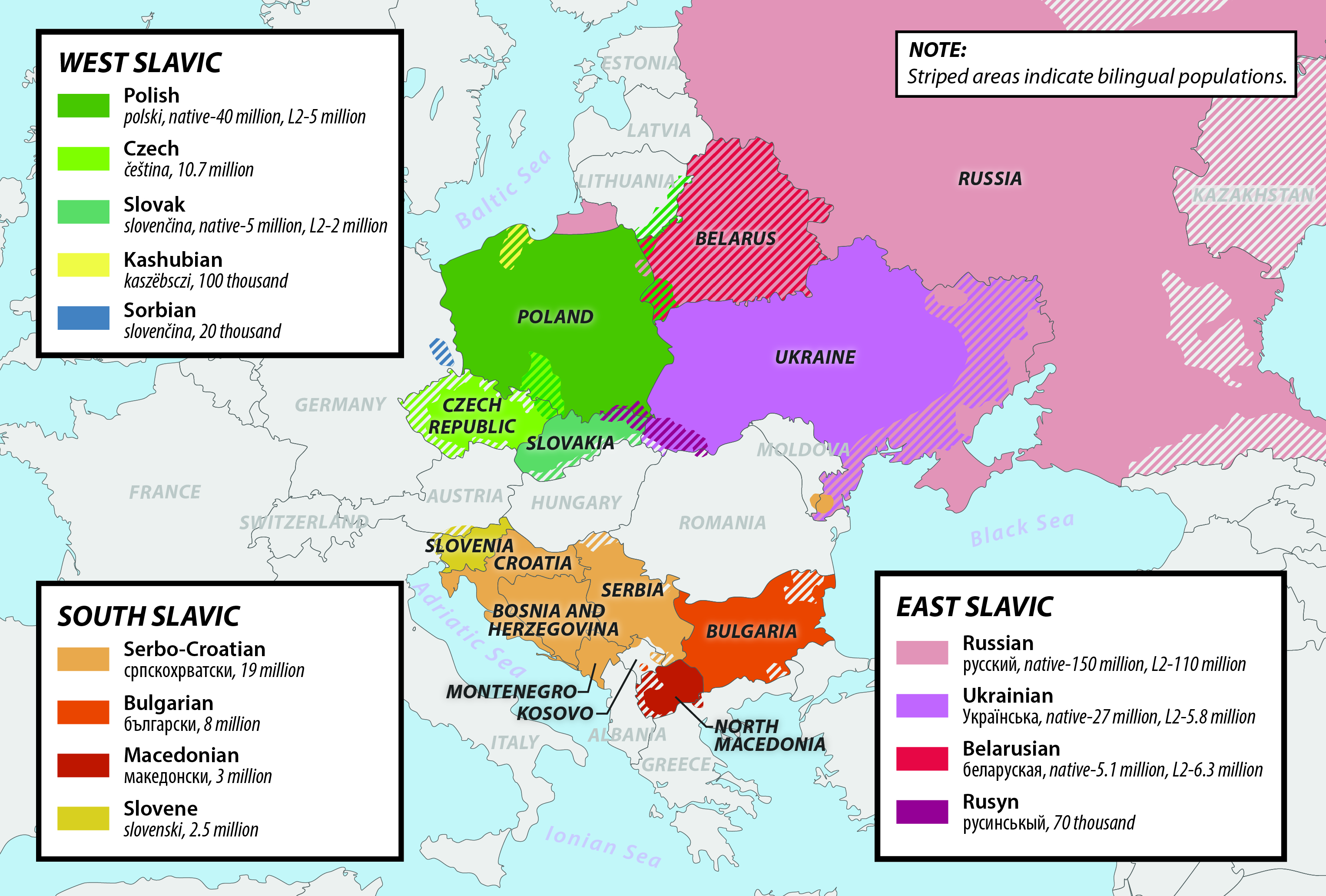
Figure \(\PageIndex{4}\): Map of East, West, and South Slavic languages. (CC BY-NC-ND 4.0; Waverly Ray adapted from Rezonansowy via Wikimedia Commons).
Linguistic evidence suggests that at some stage during their early times, the territory of the Slavs reached into the western region of Russia and the southern Russian steppes, where they came in contact with Iranian speaking groups. This is based on Slavic languages sharing a striking number of words with the Iranian languages, which can only be explained through diffusion from Iranian into Slavic. Later on, as they moved westward, they came into contact with German tribes and again borrowed several additional terms from Germanic languages. Interestingly, a Polish thinker named Józef Rostafiński had noticed that in all Slavic languages the words for beech, larch, and yew are borrowed from foreign languages, which implies that during early times these type of trees were unknown to the Slavs, a suggestion that could be used as a clue to determine where the Slavic culture originated.
Religion adds to the cultural diversity of the Slavic peoples. The Great Schism refers to formal institutional separation in 1054 CE between the Eastern Church of the Byzantine Empire (into the Orthodox Church, now called the Eastern Orthodox Church) and the Western Church of the Holy Roman Empire (into the Catholic Church, now called the Roman Catholic Church). Figure 6.2.5 shows the separation between the two main church bodies. This separation served as a basis for present-day nation state boundaries.

Figure \(\PageIndex{5}\): East-West Schism in 1054 CE. (CC0 1.0; Tobi85 via Wikimedia Commons).
In the 19th century, the Pan-Slavism movement sought to unify Slavic peoples in order to strengthen cultural and political ties in part to protect against Austro-Hungarian and Turkish interference in Slavic-dominant nation states. The main idea of Pan-Slavism can be identified as an attempt to transcend a more isolated national identity and create a greater, “pan-national,” identity, including, in the spirit of the geopolitics of the time, a territory larger than the area of a nation state. However, even at the time of its greatest popularity, the concept of unity of the various Slavic nations did not come to be clearly defined and was challenged by low practical feasibility. The Pan-Slavism movement contributed to the implementation of russification in the region as the Russian Empire capitalized on these cultural connections to justify its cause.
The Russian Empire
Most of the territory that makes up today’s Russian Federation came from the conquests of the Russian Empire, which mostly took shape in the 14th and 16th Century. Under the direction of powerful czars (sometimes spelled tsars), or autocratic leaders of the Pre-1917 Russian Empire, the Russian territory expanded from a small area in the vicinities of modern-day Moscow to a vast land area. By the 19th Century, the Russian Empire had amassed many territorial conquests and reached its peak geographical extent: its borders stretched from the Northern Coast of Asia, to Eastern Europe to include the area that is now Ukraine (the north side of the Black Sea), to Central Asia (what is now Kazakhstan, Uzbekistan, and the other Central Asian republics), to Alaska (which Russia later sold to the United States), and from the Bering Sea to the eastern border of Germany in the west. The Russian Empire is considered the third largest in history, covering a total of 8.8 million square miles during its peak[6] (Figure 6.2.6). By 1922, the Russian Empire disintegrated and was replaced by the Soviet Union (the Union of Soviet Socialist Republics of USSR) who continued to seek to expand and strengthen control over its vast territory from Eastern Europe to the Pacific Ocean.

Both the Russian Empire and the Soviet Union were imperial powers. In other words, these governments ruled a large variety of ethnic groups in distant places: people who spoke many languages, people who worshiped different gods in different ways, people who had various skin and hair colors, and people who did not consider themselves to be Russian. As an attempt to unify this diverse and immense empire under their central rule, Russian czars implemented a policy of Russification, or an attempt to diffuse and superimpose Russian culture and authority, to minimize cultural differences and turn all Russian subjects into Russians, or at least to make them as Russian as possible. The czars ruled this empire with Russification and the sword. As they were all subject to the Russian czars, people were taught the Russian language and were encouraged to convert to Russian Orthodoxy. Russification was not very successful, and the farther people were from Moscow the less likely they were to be Russified. When the Soviets took over the Russian Empire, millions of Muslims still lived in Central Asia, on the Crimean peninsula of southern Ukraine, in the Caucasus Mountains, and elsewhere.
The Soviet Era
The Soviets took a different tack when it came to taming the diversity of the empire. Instead of emphasizing unity under the Russian czar, the Russian language, and the Russian Orthodox religion, the Soviets decided to organize—and thus try to control—the diversity of ethnic groups found in the Soviet Union. They chose some of the major groups (Uzbek, Kazakh, and so forth) and established Soviet Socialist Republics that corresponded to these major groups. Thus they created the Uzbek Soviet Socialist Republic (Uzbek SSR), the Kazakh Soviet Socialist Republic (Kazakh SSR), the Ukrainian Soviet Socialist Republic (Ukrainian SSR), and a different republic for each of fourteen ethnic groups, plus the Russian Soviet Federative Socialist Republic (Figure 6.2.7). About eighty-five other ethnic groups were not given their own republics, although some of them were allocated regions within the Russian Republic. In theory, each of the Soviet Socialist Republics was an independent state choosing to ally with the Soviet Union. In practice, of course, these republics were part of a totalitarian, centrally ruled state with far fewer autonomous rights than states in the United States.

The creation of these republics strengthened certain ethnic/national identities and weakened others. There had not been a fully developed Uzbek national identity before the formation of the Uzbek SSR. The same was true for the Kazakh SSR, the Turkmen SSR, and others. Although people in a certain area might have spoken the same language, they did not think of themselves as belonging to a nation of fellow Uzbeks, Kazakhs, or Turkmen until they were put into one by the Soviet rulers. In 1991, when the Soviet Union collapsed, these Soviet Socialist Republics were able to declare their independence from Russia, and the national identities fostered during the Soviet era came to fruition.
At the same time that the Soviets were organizing minority ethnic groups into republics, they were also sending ethnic Russians to live in non-Russian parts of the Soviet Union. Some were sent by force—such as Russians who were sent to prison camps in Siberia and stayed in the area after they were eventually freed. Other Russians were sent around the empire to work in factories, power plants, and other industries, or they were sent to help administer the government. By sending Russians to the far reaches of the Soviet Union, the Russian government hoped to consolidate its control over the various republics and to dilute the strength of the minority ethnicities. This policy also had unintended consequences: when the Soviet Union collapsed after 1991 and the various republics became independent countries, they each had to deal with sizable Russian minorities. For example, at the time of its independence, nearly as many ethnic Russians lived in Kazakhstan (38 percent) as ethnic Kazakhs (40 percent). In the twenty years since then, many Russians moved to Russia from the former Soviet republics. In 2010, Kazakhstan’s population was only about 24 percent ethnic Russian.
The Russian Federation
The Russian federation was created with eighty-three federal subjects: two autonomous federal cities; forty-six provinces (oblasts) and nine territories (krais) that function in the same way and are the most common type of federal unit; twenty-one republics; four autonomous districts (okrugs); and one autonomous oblast (Figure 6.2.8). Moscow and St. Petersburg are the two federal cities that function as their own units. The oblasts and krais each have a governor appointed by the central government and a locally elected legislature. The governorship was an elected position in the 1990s, but President Vladimir Putin changed the structure to strengthen the power of the central state. The republics, designed to be home to certain ethnic minorities, are allowed to have their own constitutions and governments and to select an official language that will be used besides Russian, but they are not considered independent countries with the right to secession. The autonomous districts were also formed for ethnic minorities and are administered either by the central state or by the province or territory in which they are located. The only autonomous oblast was created in the 1930s to be a home for Jews in the Russian Far East, but only about 1 percent of the population remains Jewish today.

Central Asia at the Crossroads
Historically, the Central Asian region served as the crossroads to the Silk Road. The Silk Road was a network of ancient trade routes, formally established during the Han Dynasty of China in 130 BCE, which linked the regions of the ancient world in commerce between 130 BCE-1453 CE (Figure 6.2.9). Note that the Silk Road was not a single route from east to west, rather there were several routes spanning across southern Eurasia. While many different kinds of merchandise traveled along the network of trade of the Silk Road, the name comes from the popularity of Chinese silk with the west, especially with Rome. The Silk Road routes stretched from present-day China through India, Turkey, up throughout Southwest Asia, to Africa, and Europe. The greatest value of the Silk Road was the exchange of culture. Art, religion, philosophy, technology, language, science, architecture, and every other element of civilization was exchanged along these routes, carried with the commercial goods the merchants traded from country to country.

Many groups of Central Asia were nomadic peoples who rode horses and herded livestock on the region’s vast steppes. This way of life continued until the 1920s, when the Soviet Union forced many of the groups to abandon their lifestyle and settle on collective farms and in cities. Most of the people of Central Asia continue to identify culturally with their nomadic past. Central Asians who live in cities often demonstrate a mix of local and Russian culture in terms of dress and food because of the massive influx of Russian populations in the region. More than six million Russians and Ukrainians were resettled into Central Asia during Soviet rule. Russian is often used as a lingua franca, a language that is adopted as a common language between speakers whose native languages are different. Despite the area being part of the Soviet Union, where religious activities were discouraged, Islam was and still is the dominant religion.
Figure 6.2.10 shows a 1993 map created by the U.S. Central Intelligence agency showing the major ethnic groups in Central Asia. This map helps to provide a cursory understanding of the spatial distribution of Slavic, Indo-European, and Turkic peoples in the region. Today the region’s overall population of about 73 million is ethnically diverse and predominantly under 30 years of age; the majority religion in Central Asia is Sunni Islam, and the region is also home to religious minority groups including Shia Muslims and various Christian denominations, primarily Russian Orthodox. In addition to the local Turkic and Persian languages, Russian remains spoken throughout the region to varying degrees.

Figure \(\PageIndex{10}\): Major ethnic groups of Central Asia. (public domain; U.S. Central Intelligence Agency via Library of Congress).
References:
[1] Sikora, M., et al. 2019. The population history of northeastern Siberia since the Pliestocene. Nature, 570: 182-197.
[2] Nordic Council of Ministers. 2014. Arctic Human Development Report. Denmark.
[3] International Work Group for Indigenous Affairs. 2022. The Indigenous World 2022.
[4] Transitions Online. 222. New colonization in Russia's Arctic threatens indigenous rights.
[5] Living Tongues Institute for Endangered Languages. 2021. Ös (Chulym).
[6] McCarthy, N. 2020. The Biggest Empires in Human History. Statista.
Attributions:
“Indigenous Worlds” is adapted from Connections Between Arctic Peoples and Their Environment by Henry P. Huntington (CC BY-SA 3.0 IGO).
“Indigenous Worlds” is adapted from New colonization in Russia’s Arctic threatens indigenous rights by Transitions Online (CC BY 3.0).
“Russification” is adapted from World Regional Geography by University of Minnesota (CC BY-NC-SA 4.0).
“Russification" is adapted from Slavs by Cristian Violatti for the World History Encyclopedia (CC BY-NC-SA 4.0).
“Russification" is adapted from Revisiting Pan-Slavism in the Contemporary Perspective by Vladimir Đorđević et al. in Nationalities Papers (CC BY 4.0).
"Russification" is adapted from The Great Schism of 1054 by Lumen Learning (CC BY-SA 4.0).
“Central Asia at the Crossroads” is adapted from the Silk Roads Programme by the World History Encyclopedia (CC BY-NC-SA 4.0).
“Central Asia at the Crossroads” is adapted from the Central Asia by Adam Dastrup (CC BY-NC-SA 4.0).
"Central Asia at the Crossroads" is adapted from Central Asia: Background and U.S. Relations by the Congressional Research Service (public domain).