

10.2: Sociological Perspectives on the Family
- Page ID
- 299541

\( \newcommand{\vecs}[1]{\overset { \scriptstyle \rightharpoonup} {\mathbf{#1}} } \)
\( \newcommand{\vecd}[1]{\overset{-\!-\!\rightharpoonup}{\vphantom{a}\smash {#1}}} \)
\( \newcommand{\dsum}{\displaystyle\sum\limits} \)
\( \newcommand{\dint}{\displaystyle\int\limits} \)
\( \newcommand{\dlim}{\displaystyle\lim\limits} \)
\( \newcommand{\id}{\mathrm{id}}\) \( \newcommand{\Span}{\mathrm{span}}\)
( \newcommand{\kernel}{\mathrm{null}\,}\) \( \newcommand{\range}{\mathrm{range}\,}\)
\( \newcommand{\RealPart}{\mathrm{Re}}\) \( \newcommand{\ImaginaryPart}{\mathrm{Im}}\)
\( \newcommand{\Argument}{\mathrm{Arg}}\) \( \newcommand{\norm}[1]{\| #1 \|}\)
\( \newcommand{\inner}[2]{\langle #1, #2 \rangle}\)
\( \newcommand{\Span}{\mathrm{span}}\)
\( \newcommand{\id}{\mathrm{id}}\)
\( \newcommand{\Span}{\mathrm{span}}\)
\( \newcommand{\kernel}{\mathrm{null}\,}\)
\( \newcommand{\range}{\mathrm{range}\,}\)
\( \newcommand{\RealPart}{\mathrm{Re}}\)
\( \newcommand{\ImaginaryPart}{\mathrm{Im}}\)
\( \newcommand{\Argument}{\mathrm{Arg}}\)
\( \newcommand{\norm}[1]{\| #1 \|}\)
\( \newcommand{\inner}[2]{\langle #1, #2 \rangle}\)
\( \newcommand{\Span}{\mathrm{span}}\) \( \newcommand{\AA}{\unicode[.8,0]{x212B}}\)
\( \newcommand{\vectorA}[1]{\vec{#1}} % arrow\)
\( \newcommand{\vectorAt}[1]{\vec{\text{#1}}} % arrow\)
\( \newcommand{\vectorB}[1]{\overset { \scriptstyle \rightharpoonup} {\mathbf{#1}} } \)
\( \newcommand{\vectorC}[1]{\textbf{#1}} \)
\( \newcommand{\vectorD}[1]{\overrightarrow{#1}} \)
\( \newcommand{\vectorDt}[1]{\overrightarrow{\text{#1}}} \)
\( \newcommand{\vectE}[1]{\overset{-\!-\!\rightharpoonup}{\vphantom{a}\smash{\mathbf {#1}}}} \)
\( \newcommand{\vecs}[1]{\overset { \scriptstyle \rightharpoonup} {\mathbf{#1}} } \)
\(\newcommand{\longvect}{\overrightarrow}\)
\( \newcommand{\vecd}[1]{\overset{-\!-\!\rightharpoonup}{\vphantom{a}\smash {#1}}} \)
\(\newcommand{\ket}[1]{\left| #1 \right>}\)
\(\newcommand{\bra}[1]{\left< #1 \right|}\)
\(\newcommand{\braket}[2]{\left< #1 \vphantom{#2} \right| \left. #2 \vphantom{#1} \right>}\)
\(\newcommand{\braopket}[3]{\left< #1 \vphantom{#2}\vphantom{#3} \right| #2 \vphantom{#1}\vphantom{#3} \left| #3 \vphantom{#1}\vphantom{#2} \right>}\)
\(\newcommand{\qmvec}[1]{\mathbf{\vec{#1}}}\)
\(\newcommand{\op}[1]{\hat{\mathbf{#1}}}\)
\(\newcommand{\expect}[1]{\langle #1 \rangle}\)
\(\newcommand{\dfn}[1]{\emph{\textbf{#1}}}\)
| Theoretical perspective | Major assumptions |
|---|---|
| Functionalism | The family performs several essential functions for society. It socializes children, it provides emotional and practical support for its members, it helps regulate sexual activity and sexual reproduction, and it provides its members with a social identity. Family problems stem from sudden or far-reaching changes in the family’s structure or processes; these problems threaten the family’s stability and weaken society. |
| Conflict theory | The family contributes to social inequality by reinforcing economic inequality and by reinforcing patriarchy. Family problems stem from economic inequality and from patriarchal ideology. The family can also be a source of conflict, including physical violence and emotional cruelty, for its own members. |
| Symbolic interactionism | The interaction of family members and intimate couples involves shared understandings of their situations. Wives and husbands have different styles of communication, and social class affects the expectations that spouses have of their marriages and of each other. Family problems stem from different understandings and expectations that spouses have of their marriage. |
Social Functions of the Family
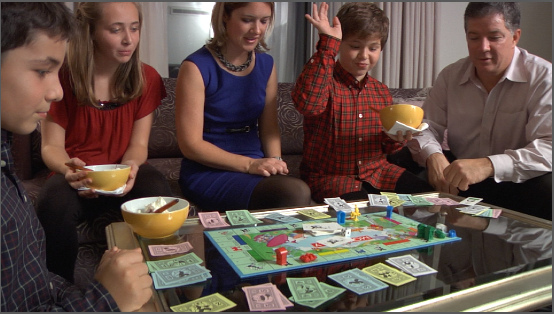
The Family and Conflict
Applying Social Research
A growing amount of social science research documents social class differences in how well a family functions: the quality of its relationships and the cognitive, psychological, and social development of its children. This focus reflects the fact that what happens during the first months and years of life may have profound effects on how well a newborn prospers during childhood, adolescence, and beyond. To the extent this is true, the social class differences that have been found have troublesome implications.
According to sociologist Frank E. Furstenberg Jr., “steep differences exist across social classes” in mothers’ prenatal experiences, such as the quality of their diet and health care, as well as in the health care that their infants receive. As a result, he says, “children enter the world endowed unequally.” This inequality worsens after they are born for several reasons.
First, low-income families are much more likely to experience negative events, such as death, poor health, unemployment, divorce, and criminal victimization. When these negative events do occur, says Furstenberg, “social class affects a family’s ability to cushion their blow…Life is simply harder and more brutish at the bottom.” These negative events produce great amounts of stress; as Chapter 2 discussed, this stress in turn causes children to experience various developmental problems.
Second, low-income parents are much less likely to read and speak regularly to their infants and young children, who thus are slower to develop cognitive and reading skills; this problem in turn impairs their school performance when they enter elementary school.
Third, low-income parents are also less able to expose their children to cultural experiences (e.g., museum visits) outside the home, to develop their talents in the arts and other areas, and to otherwise be involved in the many nonschool activities that are important for a child’s development. In contrast, wealthier parents keep their children very busy in these activities in a pattern that sociologist Annette Lareau calls concerted cultivation. These children’s involvement in these activities provides them various life skills that help enhance their performance in school and later in the workplace.
Fourth, low-income children grow up in low-income neighborhoods, which often have inadequate schools and many other problems, including toxins such as lead paint, that impair a child’s development. In contrast, says Furstenberg, children from wealthier families “are very likely to attend better schools and live in better neighborhoods. It is as if the playing field for families is tilted in ways that are barely visible to the naked eye.”
Fifth, low-income families are less able to afford to send a child to college, and they are more likely to lack the social contacts that wealthier parents can use to help their child get a good job after college.
For all these reasons, social class profoundly shapes how children fare from conception through early adulthood and beyond. Because this body of research documents many negative consequences of living in a low-income family, it reinforces the need for wide-ranging efforts to help such families.
Sources: Bandy, Andrews, & Moore, 2012; Furstenberg, 2010; Lareau, 2010Bandy, T., Andrews, K.M., & Moore, K.A. (2012). Disadvantaged families and child outcomes: The importance of emotional support for mothers. Washington, DC: Child Trends; Furstenberg, F. E., Jr. (2010). Diverging development: The not-so-invisible hand of social class in the United States. In B. J. Risman (Ed.), Families as they really are (pp. 276–294). New York, NY: W. W. Norton; Lareau, A. (2010). Unequal childhoods: Inequalities in the rhythms of daily life. In B. J. Risman (Ed.), Families as they really are (pp. 295–298). New York: W. W. Norton.
Families and Social Interaction
Social interactionist perspectives on the family examine how family members and intimate couples interact on a daily basis and arrive at shared understandings of their situations. Studies grounded in social interactionism give us a keen understanding of how and why families operate the way they do.
Some studies, for example, focus on how husbands and wives communicate and the degree to which they communicate successfully (Tannen, 2001).Tannen, D. (2001). You just don’t understand: Women and men in conversation. New York, NY: Quill. A classic study by Mirra Komarovsky (1964)Komarovsky, M. (1964). Blue-collar marriage. New York, NY: Random House. found that wives in blue-collar marriages liked to talk with their husbands about problems they were having, while husbands tended to be quiet when problems occurred. Such gender differences are less common in middle-class families, where men are better educated and more emotionally expressive than their working-class counterparts, but gender differences in communication still exist in these families. Another classic study by Lillian Rubin (1976)Rubin, L. B. (1976). Worlds of pain: Life in the working-class family. New York, NY: Basic Books. found that wives in middle-class families say that ideal husbands are ones who communicate well and share their feelings, while wives in working-class families are more apt to say that ideal husbands are ones who do not drink too much and who go to work every day.
According to the symbolic interactionist perspective, family problems often stem from the different understandings, perceptions, and expectations that spouses have of their marriage and of their family. When these differences become too extreme and the spouses cannot reconcile their disagreements, spousal conflict and possibly divorce may occur (Kaufman & Taniguchi, 2006).Kaufman, G., & Taniguchi, H. (2006). Gender and marital happiness in later life. Journal of Family Issues, 27(6), 735–757.