

4.4: Justice - Beyond the Courts
- Page ID
- 292381

\( \newcommand{\vecs}[1]{\overset { \scriptstyle \rightharpoonup} {\mathbf{#1}} } \)
\( \newcommand{\vecd}[1]{\overset{-\!-\!\rightharpoonup}{\vphantom{a}\smash {#1}}} \)
\( \newcommand{\dsum}{\displaystyle\sum\limits} \)
\( \newcommand{\dint}{\displaystyle\int\limits} \)
\( \newcommand{\dlim}{\displaystyle\lim\limits} \)
\( \newcommand{\id}{\mathrm{id}}\) \( \newcommand{\Span}{\mathrm{span}}\)
( \newcommand{\kernel}{\mathrm{null}\,}\) \( \newcommand{\range}{\mathrm{range}\,}\)
\( \newcommand{\RealPart}{\mathrm{Re}}\) \( \newcommand{\ImaginaryPart}{\mathrm{Im}}\)
\( \newcommand{\Argument}{\mathrm{Arg}}\) \( \newcommand{\norm}[1]{\| #1 \|}\)
\( \newcommand{\inner}[2]{\langle #1, #2 \rangle}\)
\( \newcommand{\Span}{\mathrm{span}}\)
\( \newcommand{\id}{\mathrm{id}}\)
\( \newcommand{\Span}{\mathrm{span}}\)
\( \newcommand{\kernel}{\mathrm{null}\,}\)
\( \newcommand{\range}{\mathrm{range}\,}\)
\( \newcommand{\RealPart}{\mathrm{Re}}\)
\( \newcommand{\ImaginaryPart}{\mathrm{Im}}\)
\( \newcommand{\Argument}{\mathrm{Arg}}\)
\( \newcommand{\norm}[1]{\| #1 \|}\)
\( \newcommand{\inner}[2]{\langle #1, #2 \rangle}\)
\( \newcommand{\Span}{\mathrm{span}}\) \( \newcommand{\AA}{\unicode[.8,0]{x212B}}\)
\( \newcommand{\vectorA}[1]{\vec{#1}} % arrow\)
\( \newcommand{\vectorAt}[1]{\vec{\text{#1}}} % arrow\)
\( \newcommand{\vectorB}[1]{\overset { \scriptstyle \rightharpoonup} {\mathbf{#1}} } \)
\( \newcommand{\vectorC}[1]{\textbf{#1}} \)
\( \newcommand{\vectorD}[1]{\overrightarrow{#1}} \)
\( \newcommand{\vectorDt}[1]{\overrightarrow{\text{#1}}} \)
\( \newcommand{\vectE}[1]{\overset{-\!-\!\rightharpoonup}{\vphantom{a}\smash{\mathbf {#1}}}} \)
\( \newcommand{\vecs}[1]{\overset { \scriptstyle \rightharpoonup} {\mathbf{#1}} } \)
\(\newcommand{\longvect}{\overrightarrow}\)
\( \newcommand{\vecd}[1]{\overset{-\!-\!\rightharpoonup}{\vphantom{a}\smash {#1}}} \)
\(\newcommand{\ket}[1]{\left| #1 \right>}\)
\(\newcommand{\bra}[1]{\left< #1 \right|}\)
\(\newcommand{\braket}[2]{\left< #1 \vphantom{#2} \right| \left. #2 \vphantom{#1} \right>}\)
\(\newcommand{\braopket}[3]{\left< #1 \vphantom{#2}\vphantom{#3} \right| #2 \vphantom{#1}\vphantom{#3} \left| #3 \vphantom{#1}\vphantom{#2} \right>}\)
\(\newcommand{\qmvec}[1]{\mathbf{\vec{#1}}}\)
\(\newcommand{\op}[1]{\hat{\mathbf{#1}}}\)
\(\newcommand{\expect}[1]{\langle #1 \rangle}\)
\(\newcommand{\dfn}[1]{\emph{\textbf{#1}}}\)
Justice as a Social and Political Process
Justice is often imagined as something that happens in courtrooms, delivered by judges, codified in law, and enforced by the state. Yet this narrow view obscures the broader reality that justice is a social and political process, one that unfolds across multiple arenas of life. To understand justice in a global context, we must move beyond legal institutions and consider how fairness, equity, and accountability are negotiated within societies. Philosopher John Rawls (1971) famously defined justice as fairness, grounded in equal basic liberties and opportunities structured to benefit the least advantaged. His framework has profoundly shaped modern democratic theory, offering a vision of a just society built on impartial principles. Yet critics have pointed out that formal equality often coexists with deep structural inequality. Laws may guarantee rights, but access to those rights is unevenly distributed.
Social and Economic Justice
Economic inequality is one of the most pressing challenges to justice today. According to Oxfam (2023), the concentration of wealth has reached unprecedented levels, with the richest individuals capturing a disproportionate share of global resources. Such disparities undermine not only economic stability but also democratic legitimacy. When citizens perceive systems as fundamentally unfair, trust erodes and participation declines (Piketty, 2014). Efforts to address these inequalities take many forms, from redistributive policies to social movements advocating for economic justice. The Nordic welfare states are often cited as examples of how robust social protections can coexist with market economies, fostering both equity and social trust (Esping-Andersen, 1990). Yet even these models face pressures from globalization, migration, and fiscal constraints.
Transitional and Restorative Justice
In societies emerging from conflict or authoritarian rule, justice takes on additional dimensions. It becomes not only a matter of accountability but also of healing and reconciliation. Transitional justice mechanisms, such as truth commissions, aim to uncover past abuses, acknowledge victims’ experiences, and lay the foundation for a more inclusive future (Hayner, 2011). Restorative justice offers an alternative approach, emphasizing dialogue, accountability, and the repair of harm (Zehr, 2002). Rooted in Indigenous traditions, it challenges punitive models of justice by prioritizing relationships and community well-being. These approaches highlight the importance of empathy and recognition in building sustainable peace.
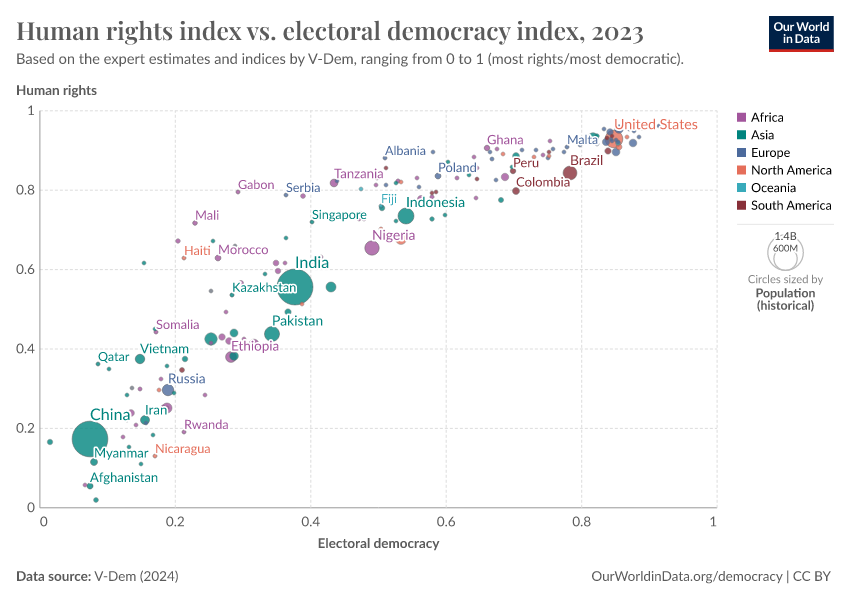
Figure \(\PageIndex{1}\) is a scatter plot comparing the Human Rights Index on the vertical axis with the Electoral Democracy Index on the horizontal axis for countries in 2025. Each point represents a country and is color-coded by world region. The data show a strong positive correlation, indicating that countries with higher levels of electoral democracy tend to have stronger human rights protections. Countries such as Belgium and Australia appear in the upper-right corner with high scores on both indices. Countries such as Afghanistan, Myanmar, and China appear in the lower-left corner with comparatively low scores on both measures. Overall, the chart suggests that greater electoral democracy is associated with stronger human rights outcomes
| Aspect | Observation |
|---|---|
| Graph Type | Scatter plot comparing countries on two indices. |
| Horizontal Axis | Electoral Democracy Index (0 to 1). |
| Vertical Axis | Human Rights Index (0 to 1). |
| General Trend | Countries with higher electoral democracy scores generally have higher human rights scores. |
| Highest Values | Countries such as Denmark, Australia, and Croatia appear in the upper-right region of the graph. |
| Intermediate Values | Countries including Indonesia, Thailand, India, and Bangladesh occupy the middle range of both indices. |
| Lowest Values | Countries such as Afghanistan, Myanmar, and China appear near the lower-left region of the graph. |
| Variation | Countries with similar democracy scores may differ in human rights scores, showing some variation around the overall trend. |
| Key Takeaway | Higher levels of electoral democracy are generally associated with stronger protection of human rights. |
The interactive app is unfortunately not accessible.
Global Justice and Moral Responsibility
At the global level, justice raises questions about the responsibilities of states and institutions in addressing inequality and harm. Thomas Pogge (2008) argues that global economic systems often perpetuate poverty, implicating affluent countries in structural injustice. Amartya Sen (2009), in contrast, emphasizes expanding human capabilities, and focusing on what individuals are actually able to do and be.
To help understand and differentiate the types of Justice, we can think in four questions. Distributive justice asks how benefits and burdens are allocated. Procedural justice asks who participates and how decisions are made. Recognitional justice asks whose identities, histories, and knowledge are respected. Restorative or reparative justice asks how institutions should respond to past and continuing harm. These perspectives shift the conversation from abstract ideals to practical outcomes. Justice is not only about principles but about lived realities. It is measured not by laws alone but by the extent to which people can lead dignified, flourishing lives.