

6.4: Sustainability, Environment, and the Future of Food
- Page ID
- 292403

\( \newcommand{\vecs}[1]{\overset { \scriptstyle \rightharpoonup} {\mathbf{#1}} } \)
\( \newcommand{\vecd}[1]{\overset{-\!-\!\rightharpoonup}{\vphantom{a}\smash {#1}}} \)
\( \newcommand{\dsum}{\displaystyle\sum\limits} \)
\( \newcommand{\dint}{\displaystyle\int\limits} \)
\( \newcommand{\dlim}{\displaystyle\lim\limits} \)
\( \newcommand{\id}{\mathrm{id}}\) \( \newcommand{\Span}{\mathrm{span}}\)
( \newcommand{\kernel}{\mathrm{null}\,}\) \( \newcommand{\range}{\mathrm{range}\,}\)
\( \newcommand{\RealPart}{\mathrm{Re}}\) \( \newcommand{\ImaginaryPart}{\mathrm{Im}}\)
\( \newcommand{\Argument}{\mathrm{Arg}}\) \( \newcommand{\norm}[1]{\| #1 \|}\)
\( \newcommand{\inner}[2]{\langle #1, #2 \rangle}\)
\( \newcommand{\Span}{\mathrm{span}}\)
\( \newcommand{\id}{\mathrm{id}}\)
\( \newcommand{\Span}{\mathrm{span}}\)
\( \newcommand{\kernel}{\mathrm{null}\,}\)
\( \newcommand{\range}{\mathrm{range}\,}\)
\( \newcommand{\RealPart}{\mathrm{Re}}\)
\( \newcommand{\ImaginaryPart}{\mathrm{Im}}\)
\( \newcommand{\Argument}{\mathrm{Arg}}\)
\( \newcommand{\norm}[1]{\| #1 \|}\)
\( \newcommand{\inner}[2]{\langle #1, #2 \rangle}\)
\( \newcommand{\Span}{\mathrm{span}}\) \( \newcommand{\AA}{\unicode[.8,0]{x212B}}\)
\( \newcommand{\vectorA}[1]{\vec{#1}} % arrow\)
\( \newcommand{\vectorAt}[1]{\vec{\text{#1}}} % arrow\)
\( \newcommand{\vectorB}[1]{\overset { \scriptstyle \rightharpoonup} {\mathbf{#1}} } \)
\( \newcommand{\vectorC}[1]{\textbf{#1}} \)
\( \newcommand{\vectorD}[1]{\overrightarrow{#1}} \)
\( \newcommand{\vectorDt}[1]{\overrightarrow{\text{#1}}} \)
\( \newcommand{\vectE}[1]{\overset{-\!-\!\rightharpoonup}{\vphantom{a}\smash{\mathbf {#1}}}} \)
\( \newcommand{\vecs}[1]{\overset { \scriptstyle \rightharpoonup} {\mathbf{#1}} } \)
\(\newcommand{\longvect}{\overrightarrow}\)
\( \newcommand{\vecd}[1]{\overset{-\!-\!\rightharpoonup}{\vphantom{a}\smash {#1}}} \)
\(\newcommand{\ket}[1]{\left| #1 \right>}\)
\(\newcommand{\bra}[1]{\left< #1 \right|}\)
\(\newcommand{\braket}[2]{\left< #1 \vphantom{#2} \right| \left. #2 \vphantom{#1} \right>}\)
\(\newcommand{\braopket}[3]{\left< #1 \vphantom{#2}\vphantom{#3} \right| #2 \vphantom{#1}\vphantom{#3} \left| #3 \vphantom{#1}\vphantom{#2} \right>}\)
\(\newcommand{\qmvec}[1]{\mathbf{\vec{#1}}}\)
\(\newcommand{\op}[1]{\hat{\mathbf{#1}}}\)
\(\newcommand{\expect}[1]{\langle #1 \rangle}\)
\(\newcommand{\dfn}[1]{\emph{\textbf{#1}}}\)
The Food Climate Nexus
If food systems reveal how the world is organized and health reveals their consequences, sustainability reveals their limits. The global food system today stands at a critical crossroads. It has achieved unprecedented levels of productivity, feeding billions of people across vast distances. Yet this achievement has come at significant environmental cost. The same systems that produce abundance are also driving climate change, biodiversity loss, water scarcity, and ecological degradation. The question is no longer simply how to produce more food. It is how to produce food differently.
The relationship between food systems and the environment is both profound and reciprocal. Agriculture is not only affected by climate change. It is one of its primary drivers. The global food system is responsible for nearly one-third of all greenhouse gas emissions, with livestock production, land-use change, and fertilizer use among the largest contributors (Crippa et al., 2021). Deforestation for agricultural expansion, particularly in regions such as the Amazon, further accelerates carbon emissions and biodiversity loss. From a political ecology perspective, these environmental impacts are not simply technical problems. They are the result of economic systems that prioritize efficiency, scale, and profit over ecological balance. Industrial agriculture relies on fossil fuels, chemical inputs, and long-distance supply chains, embedding environmental costs within the production of food. At the same time, climate change feeds back into food systems. Rising temperatures, changing precipitation patterns, and increased frequency of extreme weather events threaten agricultural productivity. Droughts reduce crop yields, floods damage infrastructure, and shifting growing seasons disrupt traditional farming practices (IPCC, 2022). This creates a feedback loop. Food systems contribute to climate change, and climate change destabilizes food systems.
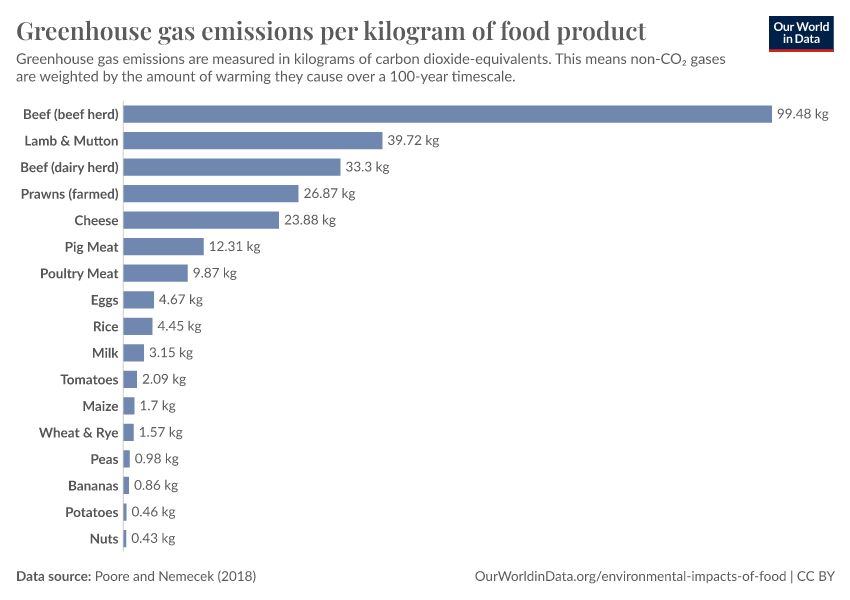
Figure \(\PageIndex{1}\): The bar chart above shows how much green house gases growing different kinds of food generates. Nuts are at the bottom of the list generating the least amount of greenhouse gases and beef is at the top of the list generating the most greenhouse gases per kilogram.
The Water, Energy, Food Nexus
To understand sustainability, it is necessary to move beyond isolated sectors and consider the interconnections between resources. The water–energy–food nexus highlights how food production depends on both water and energy systems. Agriculture accounts for approximately 70 percent of global freshwater use, making it the largest consumer of water resources (UN Water, 2023). At the same time, energy is required at every stage of food production, from irrigation and fertilizer manufacturing to processing and transportation. From a systems thinking perspective, these interdependencies mean that changes in one sector affect others. Water scarcity can limit food production, while energy shortages can disrupt supply chains. Conversely, innovations that improve efficiency in one area can generate benefits across the system. Countries facing resource constraints increasingly adopt integrated approaches. Solar-powered irrigation, drip irrigation systems, and water-efficient farming practices demonstrate how technological innovation can address multiple challenges simultaneously. Sustainability, in this sense, is not about optimizing individual components. It is about managing relationships.
From Industrial to Regenerative Agriculture
The environmental challenges associated with industrial agriculture have prompted growing interest in alternative approaches. Among the most prominent is agroecology, which views farming as an ecological process rather than an industrial one. Agroecology integrates biodiversity, local knowledge, and ecological principles to create resilient and sustainable food systems (Altieri & Nicholls, 2020). It emphasizes crop diversity, soil health, and reduced reliance on chemical inputs. From a resilience perspective, agroecological systems are better able to withstand environmental shocks. Diverse cropping systems are less vulnerable to pests and climate variability, while healthy soils retain water and nutrients more effectively. Closely related is the concept of regenerative agriculture, which focuses on restoring degraded ecosystems. Practices such as crop rotation, composting, and reduced tillage enhance soil carbon storage, contributing to climate mitigation (Lal, 2020). These approaches challenge the dominant model of industrial agriculture. They shift the focus from maximizing short-term yields to sustaining long-term ecological health.
Indigenous Knowledge and Sustainable Systems
Long before sustainability became a global concern, Indigenous communities developed agricultural practices that maintained ecological balance. From a decolonial and political ecology perspective, Indigenous knowledge systems offer valuable insights into sustainable food production. Agroforestry systems in the Amazon and Sahel, for example, integrate crops, trees, and livestock in ways that enhance biodiversity and soil fertility (Altieri & Toledo, 2011). These systems are not only environmentally sustainable. They are also culturally embedded, reflecting relationships between communities and their environments. Recognizing Indigenous land rights and knowledge is therefore both an environmental and ethical imperative. Sustainability cannot be achieved without addressing historical and ongoing injustices.
Biotechnology, Innovation, and Ethical Trade-Offs
Technological innovation continues to play a central role in shaping the future of food systems. Advances in biotechnology, including genetically modified crops and genome editing technologies such as CRISPR, offer the potential to increase yields, improve nutritional content, and enhance climate resilience. From a modernization perspective, these technologies represent solutions to global food challenges. However, from a critical political economy perspective, they also raise concerns about power and control. Patents and intellectual property rights concentrate control over seeds and technologies in the hands of a few corporations. This can limit access for smallholder farmers and reinforce existing inequalities. Debates over crops such as Golden Rice illustrate these tensions. While proponents highlight its potential to address vitamin deficiencies, critics argue that technological fixes do not address underlying issues of access, diversity, and inequality. Innovation, therefore, is not inherently equitable. Its outcomes depend on how it is governed.
Alternative Proteins and the Future of Diets
One of the most visible areas of innovation in food systems is the development of alternative proteins. Plant-based and cultured meat products are increasingly promoted as sustainable alternatives to conventional livestock production. From an environmental perspective, these alternatives have the potential to reduce land use, water consumption, and greenhouse gas emissions. However, their long-term sustainability depends on factors such as energy use, production methods, and consumer acceptance. Cultural factors also play a significant role. Diets are deeply embedded in traditions and identities, and changes in consumption patterns must navigate these contexts. Insects, for example, are widely consumed in many parts of the world and offer a highly efficient source of protein. Yet cultural perceptions limit their acceptance in other regions.The future of food is therefore not only a technological question. It is also a cultural one.
Food Waste and the Circular Economy
A significant portion of global food production is never consumed. Approximately one-third of all food produced is lost or wasted, representing a major inefficiency within the system (FAO, 2019). From a circular economy perspective, waste is not simply a byproduct. It is a resource that can be reintegrated into the system. Reducing food waste can improve efficiency, reduce environmental impact, and enhance food security. The causes of food waste vary across contexts. In low-income regions, losses often occur during production and storage due to inadequate infrastructure. In high-income regions, waste is more likely to occur at the retail and consumer levels. Policy interventions, technological solutions, and behavioral changes all play a role in addressing this issue. However, reducing waste requires rethinking how value is defined within food systems.
Technology, Data, and the Digitalization of Agriculture
The integration of digital technologies into agriculture is transforming food production. Precision agriculture uses data from sensors, drones, and satellite imagery to optimize inputs such as water and fertilizer, increasing efficiency and reducing environmental impact. From a technological systems perspective, these innovations have the potential to improve sustainability. However, access to technology is uneven. Smallholder farmers may lack the resources or infrastructure to adopt these tools, creating new forms of digital inequality. Vertical farming and controlled environment agriculture represent another frontier. These systems enable food production in urban environments, reducing transportation distances and resource use. However, their energy demands raise questions about overall sustainability. Blockchain technology is also being used to improve transparency in supply chains, allowing consumers to trace food from production to consumption. This has implications for food safety, accountability, and trust. Technology, like other aspects of food systems, reflects broader patterns of inequality and power.
Global Governance and Sustainable Food Futures
Addressing the environmental challenges of food systems requires coordinated global action. International frameworks such as the Paris Agreement and the UN Food Systems Summit highlight the role of agriculture in achieving climate and development goals. From a global governance perspective, these initiatives aim to align policies across sectors and scales. However, tensions remain between different actors, including states, corporations, and civil society organizations. Critics argue that global initiatives often prioritize technological solutions and corporate involvement, potentially sidelining local knowledge and community-based approaches. Sustainability, therefore, is not only a technical challenge. It is a political one.
Youth, Social Movements, and Changing Narratives
The future of food systems is also being shaped by social movements and changing cultural narratives. Young people, in particular, are driving new conversations about sustainability, climate change, and ethical consumption. From a social movement perspective, these efforts reflect a broader shift toward viewing consumption as a form of activism. Choices related to diet, waste, and sourcing become expressions of values and identity. At the same time, these movements highlight the limitations of individual action. Structural change is necessary to transform food systems at scale.
Conclusion: Reimagining Food Systems for the Future
The global food system is at a turning point. The challenges it faces are complex, interconnected, and urgent. Climate change, environmental degradation, and resource scarcity threaten the stability of food production, while existing inequalities limit access to nutritious food. Yet these challenges also create opportunities for transformation.Sustainable food systems must balance productivity with ecological integrity, innovation with equity, and global coordination with local autonomy. They must move beyond extractive models toward systems rooted in resilience, diversity, and care. Food, as always, sits at the center of these transformations. It is both a reflection of the world as it is and a pathway to what it could become.