

1.3: Social Movements and Social Change
- Page ID
- 291102

\( \newcommand{\vecs}[1]{\overset { \scriptstyle \rightharpoonup} {\mathbf{#1}} } \)
\( \newcommand{\vecd}[1]{\overset{-\!-\!\rightharpoonup}{\vphantom{a}\smash {#1}}} \)
\( \newcommand{\dsum}{\displaystyle\sum\limits} \)
\( \newcommand{\dint}{\displaystyle\int\limits} \)
\( \newcommand{\dlim}{\displaystyle\lim\limits} \)
\( \newcommand{\id}{\mathrm{id}}\) \( \newcommand{\Span}{\mathrm{span}}\)
( \newcommand{\kernel}{\mathrm{null}\,}\) \( \newcommand{\range}{\mathrm{range}\,}\)
\( \newcommand{\RealPart}{\mathrm{Re}}\) \( \newcommand{\ImaginaryPart}{\mathrm{Im}}\)
\( \newcommand{\Argument}{\mathrm{Arg}}\) \( \newcommand{\norm}[1]{\| #1 \|}\)
\( \newcommand{\inner}[2]{\langle #1, #2 \rangle}\)
\( \newcommand{\Span}{\mathrm{span}}\)
\( \newcommand{\id}{\mathrm{id}}\)
\( \newcommand{\Span}{\mathrm{span}}\)
\( \newcommand{\kernel}{\mathrm{null}\,}\)
\( \newcommand{\range}{\mathrm{range}\,}\)
\( \newcommand{\RealPart}{\mathrm{Re}}\)
\( \newcommand{\ImaginaryPart}{\mathrm{Im}}\)
\( \newcommand{\Argument}{\mathrm{Arg}}\)
\( \newcommand{\norm}[1]{\| #1 \|}\)
\( \newcommand{\inner}[2]{\langle #1, #2 \rangle}\)
\( \newcommand{\Span}{\mathrm{span}}\) \( \newcommand{\AA}{\unicode[.8,0]{x212B}}\)
\( \newcommand{\vectorA}[1]{\vec{#1}} % arrow\)
\( \newcommand{\vectorAt}[1]{\vec{\text{#1}}} % arrow\)
\( \newcommand{\vectorB}[1]{\overset { \scriptstyle \rightharpoonup} {\mathbf{#1}} } \)
\( \newcommand{\vectorC}[1]{\textbf{#1}} \)
\( \newcommand{\vectorD}[1]{\overrightarrow{#1}} \)
\( \newcommand{\vectorDt}[1]{\overrightarrow{\text{#1}}} \)
\( \newcommand{\vectE}[1]{\overset{-\!-\!\rightharpoonup}{\vphantom{a}\smash{\mathbf {#1}}}} \)
\( \newcommand{\vecs}[1]{\overset { \scriptstyle \rightharpoonup} {\mathbf{#1}} } \)
\(\newcommand{\longvect}{\overrightarrow}\)
\( \newcommand{\vecd}[1]{\overset{-\!-\!\rightharpoonup}{\vphantom{a}\smash {#1}}} \)
\(\newcommand{\ket}[1]{\left| #1 \right>}\)
\(\newcommand{\bra}[1]{\left< #1 \right|}\)
\(\newcommand{\braket}[2]{\left< #1 \vphantom{#2} \right| \left. #2 \vphantom{#1} \right>}\)
\(\newcommand{\braopket}[3]{\left< #1 \vphantom{#2}\vphantom{#3} \right| #2 \vphantom{#1}\vphantom{#3} \left| #3 \vphantom{#1}\vphantom{#2} \right>}\)
\(\newcommand{\qmvec}[1]{\mathbf{\vec{#1}}}\)
\(\newcommand{\op}[1]{\hat{\mathbf{#1}}}\)
\(\newcommand{\expect}[1]{\langle #1 \rangle}\)
\(\newcommand{\dfn}[1]{\emph{\textbf{#1}}}\)
The impact of social movements can be seen across law, culture, and identity. Legally, movements have achieved reforms such as civil rights legislation, workplace protections, marriage equality, and environmental standards. Culturally, they shift public attitudes — as when feminism challenged rigid gender roles, or when environmentalism made recycling and conservation part of everyday life. Movements also create new political identities. “Asian American,” “Chicano,” and “LGBTQ+” are identities forged in the crucible of activism, transforming how people see themselves and how they are recognized in society.
Even movements that appear to fail leave important legacies. The Occupy Wall Street encampments of 2011 ended without major policy changes, but the language of “the 99%” and “the 1%” reshaped how Americans talk about inequality. The Populist movement of the 1800s collapsed politically, but many of its demands — regulation of railroads, direct election of senators — were later realized.
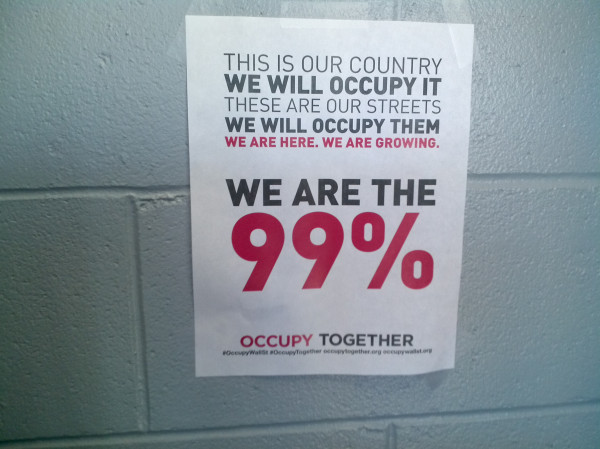
An Occupy Wall Street protest poster. (CC0 1.0 Universal Public Domain Dedication)
Social movements demonstrate that democracy is not limited to voting or institutions. It is also lived out when ordinary people organize, protest, and demand change. In California, the history of movements from the UFW to the Black Panthers to digital campaigns around immigration and police reform reminds us that the future of democracy depends on the willingness of people to act collectively.
Conclusion
Social movements are organized, collective efforts to promote or resist social change. They differ from crowds or interest groups by being purposeful, sustained, and oriented toward transformation. Movements matter because they expand rights, transform culture, and create new political identities. They can be categorized as alternative, redemptive, reformative, or revolutionary, and they often move through recognizable stages from emergence to decline or transformation. Theories of political opportunity, resource mobilization, and framing help explain their development, while new social movement theory highlights the importance of identity and culture. In California and across the world, social movements remind us that collective action is a vital part of democracy and a driving force of history.