Social Sci LibreTexts

8: Gaining Experience Outside the Classroom

  • Page ID
    107773
  • \( \newcommand{\vecs}[1]{\overset { \scriptstyle \rightharpoonup} {\mathbf{#1}} } \)

    \( \newcommand{\vecd}[1]{\overset{-\!-\!\rightharpoonup}{\vphantom{a}\smash {#1}}} \)

    \( \newcommand{\dsum}{\displaystyle\sum\limits} \)

    \( \newcommand{\dint}{\displaystyle\int\limits} \)

    \( \newcommand{\dlim}{\displaystyle\lim\limits} \)

    \( \newcommand{\id}{\mathrm{id}}\) \( \newcommand{\Span}{\mathrm{span}}\)

    ( \newcommand{\kernel}{\mathrm{null}\,}\) \( \newcommand{\range}{\mathrm{range}\,}\)

    \( \newcommand{\RealPart}{\mathrm{Re}}\) \( \newcommand{\ImaginaryPart}{\mathrm{Im}}\)

    \( \newcommand{\Argument}{\mathrm{Arg}}\) \( \newcommand{\norm}[1]{\| #1 \|}\)

    \( \newcommand{\inner}[2]{\langle #1, #2 \rangle}\)

    \( \newcommand{\Span}{\mathrm{span}}\)

    \( \newcommand{\id}{\mathrm{id}}\)

    \( \newcommand{\Span}{\mathrm{span}}\)

    \( \newcommand{\kernel}{\mathrm{null}\,}\)

    \( \newcommand{\range}{\mathrm{range}\,}\)

    \( \newcommand{\RealPart}{\mathrm{Re}}\)

    \( \newcommand{\ImaginaryPart}{\mathrm{Im}}\)

    \( \newcommand{\Argument}{\mathrm{Arg}}\)

    \( \newcommand{\norm}[1]{\| #1 \|}\)

    \( \newcommand{\inner}[2]{\langle #1, #2 \rangle}\)

    \( \newcommand{\Span}{\mathrm{span}}\) \( \newcommand{\AA}{\unicode[.8,0]{x212B}}\)

    \( \newcommand{\vectorA}[1]{\vec{#1}}      % arrow\)

    \( \newcommand{\vectorAt}[1]{\vec{\text{#1}}}      % arrow\)

    \( \newcommand{\vectorB}[1]{\overset { \scriptstyle \rightharpoonup} {\mathbf{#1}} } \)

    \( \newcommand{\vectorC}[1]{\textbf{#1}} \)

    \( \newcommand{\vectorD}[1]{\overrightarrow{#1}} \)

    \( \newcommand{\vectorDt}[1]{\overrightarrow{\text{#1}}} \)

    \( \newcommand{\vectE}[1]{\overset{-\!-\!\rightharpoonup}{\vphantom{a}\smash{\mathbf {#1}}}} \)

    \( \newcommand{\vecs}[1]{\overset { \scriptstyle \rightharpoonup} {\mathbf{#1}} } \)

    \(\newcommand{\longvect}{\overrightarrow}\)

    \( \newcommand{\vecd}[1]{\overset{-\!-\!\rightharpoonup}{\vphantom{a}\smash {#1}}} \)

    \(\newcommand{\ket}[1]{\left| #1 \right>}\)
    \(\newcommand{\bra}[1]{\left< #1 \right|}\)
    \(\newcommand{\braket}[2]{\left< #1 \vphantom{#2} \right| \left. #2 \vphantom{#1} \right>}\)
    \(\newcommand{\braopket}[3]{\left< #1 \vphantom{#2}\vphantom{#3} \right| #2 \vphantom{#1}\vphantom{#3} \left| #3 \vphantom{#1}\vphantom{#2} \right>}\)
    \(\newcommand{\qmvec}[1]{\mathbf{\vec{#1}}}\)
    \(\newcommand{\op}[1]{\hat{\mathbf{#1}}}\)
    \(\newcommand{\expect}[1]{\langle #1 \rangle}\)
    \(\newcommand{\dfn}[1]{\emph{\textbf{#1}}}\)

    \(\newcommand{\avec}{\mathbf a}\) \(\newcommand{\bvec}{\mathbf b}\) \(\newcommand{\cvec}{\mathbf c}\) \(\newcommand{\dvec}{\mathbf d}\) \(\newcommand{\dtil}{\widetilde{\mathbf d}}\) \(\newcommand{\evec}{\mathbf e}\) \(\newcommand{\fvec}{\mathbf f}\) \(\newcommand{\nvec}{\mathbf n}\) \(\newcommand{\pvec}{\mathbf p}\) \(\newcommand{\qvec}{\mathbf q}\) \(\newcommand{\svec}{\mathbf s}\) \(\newcommand{\tvec}{\mathbf t}\) \(\newcommand{\uvec}{\mathbf u}\) \(\newcommand{\vvec}{\mathbf v}\) \(\newcommand{\wvec}{\mathbf w}\) \(\newcommand{\xvec}{\mathbf x}\) \(\newcommand{\yvec}{\mathbf y}\) \(\newcommand{\zvec}{\mathbf z}\) \(\newcommand{\rvec}{\mathbf r}\) \(\newcommand{\mvec}{\mathbf m}\) \(\newcommand{\zerovec}{\mathbf 0}\) \(\newcommand{\onevec}{\mathbf 1}\) \(\newcommand{\real}{\mathbb R}\) \(\newcommand{\twovec}[2]{\left[\begin{array}{r}#1 \\ #2 \end{array}\right]}\) \(\newcommand{\ctwovec}[2]{\left[\begin{array}{c}#1 \\ #2 \end{array}\right]}\) \(\newcommand{\threevec}[3]{\left[\begin{array}{r}#1 \\ #2 \\ #3 \end{array}\right]}\) \(\newcommand{\cthreevec}[3]{\left[\begin{array}{c}#1 \\ #2 \\ #3 \end{array}\right]}\) \(\newcommand{\fourvec}[4]{\left[\begin{array}{r}#1 \\ #2 \\ #3 \\ #4 \end{array}\right]}\) \(\newcommand{\cfourvec}[4]{\left[\begin{array}{c}#1 \\ #2 \\ #3 \\ #4 \end{array}\right]}\) \(\newcommand{\fivevec}[5]{\left[\begin{array}{r}#1 \\ #2 \\ #3 \\ #4 \\ #5 \\ \end{array}\right]}\) \(\newcommand{\cfivevec}[5]{\left[\begin{array}{c}#1 \\ #2 \\ #3 \\ #4 \\ #5 \\ \end{array}\right]}\) \(\newcommand{\mattwo}[4]{\left[\begin{array}{rr}#1 \amp #2 \\ #3 \amp #4 \\ \end{array}\right]}\) \(\newcommand{\laspan}[1]{\text{Span}\{#1\}}\) \(\newcommand{\bcal}{\cal B}\) \(\newcommand{\ccal}{\cal C}\) \(\newcommand{\scal}{\cal S}\) \(\newcommand{\wcal}{\cal W}\) \(\newcommand{\ecal}{\cal E}\) \(\newcommand{\coords}[2]{\left\{#1\right\}_{#2}}\) \(\newcommand{\gray}[1]{\color{gray}{#1}}\) \(\newcommand{\lgray}[1]{\color{lightgray}{#1}}\) \(\newcommand{\rank}{\operatorname{rank}}\) \(\newcommand{\row}{\text{Row}}\) \(\newcommand{\col}{\text{Col}}\) \(\renewcommand{\row}{\text{Row}}\) \(\newcommand{\nul}{\text{Nul}}\) \(\newcommand{\var}{\text{Var}}\) \(\newcommand{\corr}{\text{corr}}\) \(\newcommand{\len}[1]{\left|#1\right|}\) \(\newcommand{\bbar}{\overline{\bvec}}\) \(\newcommand{\bhat}{\widehat{\bvec}}\) \(\newcommand{\bperp}{\bvec^\perp}\) \(\newcommand{\xhat}{\widehat{\xvec}}\) \(\newcommand{\vhat}{\widehat{\vvec}}\) \(\newcommand{\uhat}{\widehat{\uvec}}\) \(\newcommand{\what}{\widehat{\wvec}}\) \(\newcommand{\Sighat}{\widehat{\Sigma}}\) \(\newcommand{\lt}{<}\) \(\newcommand{\gt}{>}\) \(\newcommand{\amp}{&}\) \(\definecolor{fillinmathshade}{gray}{0.9}\)

    An important part of your educational experience at Diablo Valley College (DVC)  is to gain as much experience as you can, both inside the classroom as well as outside the classroom. You will gain valuable knowledge in the classroom through your required coursework and it is equally important to gain "hands-on" experience outside the classroom in the career field you are pursuing. This can be done through work experience, community-based learning, volunteer work, and/or internships.

    If you have carried a part-time or full-time job, you have gained valuable work experience that contributes to building your resume and proving to employers that you have acquired transferable skills. Oftentimes, employers want to see work experience and this is something you can gain through a part-time job while in college. If looking for a part-time job while attending college, consider trying to get something related to your career interest. Oftentimes taking an introductory course in college can help you get your foot in the door for an entry-level position. 

    Some courses at DVC integrate community based learning in the classroom. Community-Based Learning (CBL) is a teaching and learning strategy that integrates meaningful community service with instruction and reflection to enrich the learning experience, teach civic responsibility, and strengthen communities. As defined by the Chancellor's Office, Community Based Learning:

    • Links service to the community with academic study.
    • Includes structured reflection to integrate study and service.
    • Emphasizes working with individuals and groups on needs defined by the community.
    • Includes civic responsibility, service and learning, reflection, and critical thinking as part of the course.
    • May also include clarification of career objectives and acquisition of work-related skills.

    You may be given an opportunity to engage in a CBL experience as a project for this course. If given the opportunity to engage in CBL, you are highly encouraged to do so. This will definitely help you learn more about yourself and contribute to your vision of where you see yourself in this world of work, while giving back to your community and making a difference. It is a win/win situation for everyone involved. For more information go to Learning by Doing - Connecting Education to Work (dvc.edu)

    Volunteer work is another great way for you to gain experience and network. Take a minute and view the YouTube video titled "Volunteering May Help You Find Your Next Job."

    A screenshot of the "Volunteering May Help You Find Your Next Job" video
    Figure 4.6 – Watch "Volunteering May Help You Find Your Next Job" (link: https://www.youtube.com/watch?time_continue=5&v=s1KOIjKJzDU)

    The Value of Internships

    Another way to gain valuable experience outside the classroom is through internships. Internships are short-term opportunities that allow students to gain valuable work experience in a particular career. Throughout this course, you have been researching different career possibilities using online resources and informational interviews. Now it is time to consider doing a “test drive.” It is difficult to decide on something without trying it out. Internships allow you to “test drive” your career of choice. The more you know and the more you experience, the more confident you will be with deciding on your career choice.

    There are many benefits to participating in an internship:

    • Internships allow you to gain valuable hands-on experience to help build your resume.
    • It is a great way to confirm if the career you have selected is a good fit for you and at the same time also allows you to determine if the field is not a good fit.
    • They provide you with opportunities to network and meet professionals in the industry you wish to join.
    • Oftentimes employers will hire their interns upon graduation.

    Some internships are paid and some are unpaid. Regardless, the experience you gain is priceless. Oftentimes employers are looking to hire individuals with specific work experience. This can be difficult for a recent college graduate however, internships provide the necessary experience to help build your resume and show employers you do have hands-on, behind-the-scenes experience.

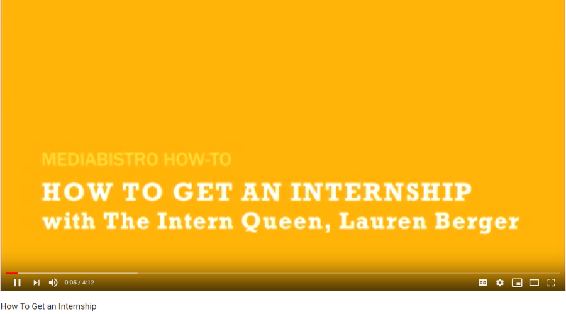
    View the YouTube video below for tips on how to get an internship by The Intern Queen, Lauren Berger.

    A screenshot of the "How to Get an Internship" video
    Figure 4.9 – Watch “How to Get an Internship” (link: https://www.youtube.com/watch?time_continue=30&v=6Ryyv7aAkgk)

    Reach out to the Internship Program at DVC for assistance with your internship search! Get started early so you give yourself enough time to prepare your resume, apply and interview!

    The Value of Apprenticeships

    Another opportunity that allows you to combine BOTH classroom instructional experience with on-the-job field experience is apprenticeship training programs. An apprentice is usually a full-time employee who is learning while earning. There are many apprentice training programs in high-wage technical professions ranging from agriculture, automotive, carpentry, civil services, electrical, heating/ventilation and air conditioning, plumbing, and surveyor, just to name a few. The beginning salary is usually about half the salary of a fully trained worker and increases as the apprentice learns and performs more complex tasks. Once the apprentice program is completed, the student has earned industry credentials and enters the field as a certified professional. DVC offers a Pre-Apprenticeship program to prepare students for a fast-paced career in the trades.

     

    A screenshot of the "Young workers skip college for apprenticeships" video
    Figure 4.10 – Watch “Young workers skip college for apprenticeships” (link: https://www.youtube.com/watch?v=uaG5ckBoC8Y&feature=player_embedded)

    For information on how to locate apprentice training programs, visit the State of California Department of Industrial Relations.


    This page titled 8: Gaining Experience Outside the Classroom was last modified on Mon, 05 Jul 2021 21:48:56 GMT and is shared under a not declared license and was authored, remixed, and/or curated by Graciela Martinez and Elizabeth Shaker.