demonstrate congruent, credible nonverbals and adapt cross-culturally.
Defining Nonverbal Communication
Your partner flashes a big smile when you surprise them for their birthday, even though they secretly are embarrassed. You send an emoji “face with tears of joy” to your BFF after getting a good grade on a rhetorical criticism paper. You kiss someone on a first date. What do these scenarios have in common? Nonverbal communication of course -- an essential but frequently misunderstood dimension of interpersonal relations (Gifford, 2011). Nonverbal communication is often simply defined as communication without words. Others have noted that nonverbal communication includes “all behaviors that are not words” (Guerrero & Floyd, 2006, p. 4). Regardless of the deceiving simplicity of its definition, know that nonverbal communication is very complex.
In everyday life, nonverbal communication is multimodal and multifunctional in nature. It is closely linked to how we feel about our relationships with others and how we manage those relationships. In interpersonal interaction, nonverbal messages can be found in facial expressions, eyes, body language, and touch as well as clothing, tone of voice, posture, and even spatial distance. Indeed, you can say a lot without saying anything, or as psychologist and philosopher Paul Watzlawick (1978) observed in the first axiom of his interpersonal communication theory that you cannot not communicate. The inevitability of sending and receiving messages is extremely important to understand because it means that each of us is a type of “transmitter” that cannot be shut off. Nonverbal behaviors are implicated in messages of intimacy, arousal, composure, dominance, formality, and task or social orientation. Whether intentional or unintentional, deceitful or sincere, no matter what we do, we give off information about ourselves. In short, nonverbal communication is an important part of human interaction and always present in face-to-face interactions.
If I say, “Nice to see you!” to someone and roll my eyes at the same time, they will likely doubt my sincerity. This example illustrates one of the more interesting effects of nonverbal messages: most people tend to believe the nonverbal message over the verbal message if the two appear to be in disagreement (Knapp, 1972; Knapp, Earnest, Griffin, & McGlone, 2020; Malandro & Barker, 1983; Mehrabian, 1981). People seem to believe that actions really do speak louder than words. As a result, they place a disproportionate emphasis on the nonverbalresponse -- therefore it’s always a good idea to make nonverbal behavior consistent with our verbal messages (Hackman & Johnson, 2000).
So, welcome to the world of nonverbal communication. Its types, its contexts, and its impacts -- all of these will be explored in the pages that follow.
The Process
Is nonverbal communication its own type of language? Yes and no. Like language, the fundamental process of nonverbal communication consists of a message encoded in a selected medium (body language, for example) that is then decoded. When you form language and speak it, your brain encodes a thought into words and intelligible sounds. For example, if you want to tell someone to leave the room, you can simply speak the words, “Please leave the room.” Nonverbally, you can also encode an extra layer of “illustration” by first pointing at the person and then at the door.
Some forms of nonverbal communication are emblematic in nature, where the performance stands for a concrete idea. Emblems are gestures like pointing, giving a thumbs up, or signing “OK” in specific contexts where those gestures are intelligible. Other nonverbal emblems include wearing a uniform to indicate team membership or sporting a tattoo that has a literal, unambiguous meaning. The most famous emblem of all, of course, may be the infamous “middle finger.”
However, not all nonverbal communication is emblematic. If you sway in your chair during a lecture, the meaning of that behavior may not be immediately obvious. Perhaps you need to go to the bathroom. Maybe you’re just restless. You could even be doing light exercises to help stay awake. Without asking you, any interpretation would be tentative -- a guess. In fact, you might not even know the answer to what your behavior means. It turns out that some people perform nonverbal gestures without realizing them. When some people speak before an audience, for example, they might look down a lot, move their legs a lot, or put their hands behind their backs -- all without realizing it. These are “adaptive” behaviors designed to subconsciously help the speaker feel better (more comfortable) about the situation they’re in.
How aware (or not) someone is of their nonverbal behavior raises the important question of intention. Certainly, some aspects of nonverbal are intentionally performed. Chances are, your clothing and hairstyle at the moment you’re reading this were intentional choices, but what about your posture and the position of your hands and arms? There are aspects of nonverbal communication that we may convey without meaning to. Goffman (1952) called the intentional aspects of nonverbal performance as “cues given” and the unintentional aspects as “cues given off.” Whether intentional or not, these cues can be communicated via a variety of “media” (all of them associated with you) -- your eyes, smell, tone of voice, facial expressions, and gestures to name a few. Increasing your competence in nonverbal communication means learning to pay more attention to these unintentional aspects.
The Impact
You might have heard that 93% of communication is nonverbal. That figure comes from a famous study by Merhabian and Ferris (1967). Participants in their study were read aloud single words that they previously rated as either positive, neutral, or negative on-paper. When they were read aloud, they were read vocal tones that were previously rated as either neutral or positive. Then the experiment was repeated using facial cues, where the experimenter read the words while displaying certain facial cues (Mehrabian & Wiener, 1967). Mehrabian utilized the results to calculate the listener’s perceived attitudes, which were a combination of three cues in the following proportion: 7% verbal, 38% vocal (tone), and 55% facial expression.
Notice that these studies were focused on the utterance of single words, not complete sentences within a context. We know that our typical social interactions occur in contexts of complete thoughts and actions, not just single words. These studies, therefore, face issues with external validity (the ability to apply to actual social situations). This criticism (among others concerning sample size and possible participant biases) was expressed by Burgoon, Woodall, and Ferris (1989). Though you may hear the 93% number frequently expressed in popular culture, you now know that this is based on a very limited study. So if it isn’t 93%, how much of communication is nonverbal? The only thing that scholars agree on is that it matters, and that it matters in many contexts.
Differences Between Verbal Communication and Nonverbal Communication
Verbal and nonverbal behaviors work together within our communication package in complementary ways, yet each has characteristics not shared with the other.
Nonverbal communication is more ambiguous; thus, it is more context dependent. Because most nonverbal gestures and actions are less well defined than the words, we get a sense of what those variables mean only within the broader context of other nonverbal clues and the verbal communication. While words can stand alone, we cannot take nonverbal clues in isolation; rather, we must see them as part of the whole package, and we must use all the incoming stimuli to generate a more accurate interpretation.
Nonverbal is continuous and inevitable. Because of nonverbal communication, "we cannot not communicate." Although we can quit sending verbal messages, we never stop sending nonverbal messages such as appearance, posture, or overall demeanor. Even if we are totally unaware of being observed, we are sending messages. Our absence can even have communication value. If a person is noticeably missing at a meeting or a party, the others may speculate about the absence and what is going on; in other words, not being present also sends messages. The lack of a reply to a text may stimulate all sorts of messages.
Nonverbal is more multi-channeled. We have five senses, and all of the senses can be used to experience nonverbal clues. Verbal communication primarily relies on hearing (in oral communication) or sight (in reading). Nonverbal communication clues can be smelled, tasted, touched, seen, or heard.
Nonverbal is more emotionally revealing. Although phrases such as "I'm angry" can give the listener a broad sense of what the speaker means, it is the addition of the nonverbal communication, the vocal characteristics, posture, and eye contact, which really gives us a sense of just how angry the person is. The verbal communication points the listener in the direction of the speaker's thoughts, but the nonverbal "paints the picture," adding the richness and nuances of what they mean.
Nonverbal is more believable. Realistically, telling a lie verbally is quite easy; however, demonstrating a lie with all our nonverbal traits is far more difficult. Hence, we tend to assume that when we receive a mixed message, the nonverbal communication is the true or accurate message. The sheer amount of nonverbal can overwhelm the verbal.
Figure \(\PageIndex{1}\): Image 1
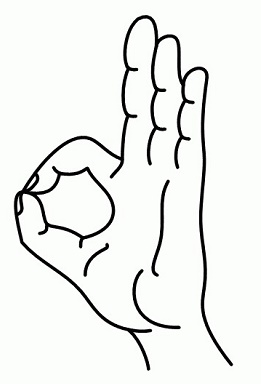
Nonverbal is more culturally specific. Languages can change from culture to culture, but nonverbal communication changes to an even higher degree. How words are said, vocal patterns, gestures, distance, and other factors vary to a much greater degree between cultures. For example, in the Middle East, it is more common for men in platonic relationships to engage in behaviors such as handholding and kissing. The famous photo of President Bush and Saudi Crown Prince Abdullah holding hands (Image 1) illustrates how important knowledge of these cultural differences can be for successful interaction (Graham, 2007) . In Image 2, the U.S. gesture for "okay" means different things in different countries:
U.S. – “okay”
France – “zero,” or “worthless
Japan – “money”
Germany and Brazil – vulgarity
Figure \(\PageIndex{2}\): From Verderber, Interact 14th ed, 2016.Image 2
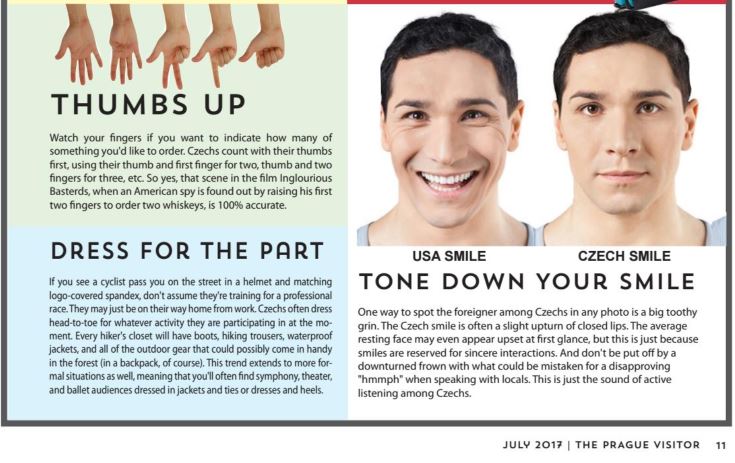
Even something as simple as smiling can vary by culture. In Marina Krakovsky’s (2009) article, “Global Psyche: National Poker Face,” she reports on how smiling is viewed differently in Russia than in the U.S. She states, “Just as Americans mistake Russian reserve for surliness, Russians find friendly American smiles phony" (para. 5). In The Prague Visitor, 2017, July (Image 3), Americans are advised to alter their smiles to better fit into the Czech culture (p. 11).
Figure \(\PageIndex{3}\): Image 3
Perceptions of time also vary by culture. According to Rick Vecchio (2007), in the nation of Peru, the movement, “La Hora sin Demora,” attempted to move from a highly polychronic mindset to a more monochronic mindset. However, such perceptions of time “may be too ingrained to change” (para. 3).
Nonverbal cues don’t just decorate our words—they steer how we’re understood. When your face, voice, posture, and space align with your message (and the culture you’re in), you gain clarity, credibility, and connection. Read on to become fluent in this language you’ve been speaking all along.