Why you're searching for sources
In the previous section, you found citations. Sometimes this feels overwhelming because although you want to find sources, you’re now inundated with citations and aren’t sure which are worth taking the time to read. In this chapter, I’ll discuss what to notice about citations at this stage in your literature review process.
First, take a few minutes to consider how you evaluate sources.
To evaluate whether a source is worth reading, you need to first know why you’re searching for sources. At this point, you’re primarily searching to refine your topic. Therefore, the question is not really whether you’ll use the source in your final literature review. Rather, it is whether the source will help you on your quest toward finalizing your topic.
Note
You're searching now to refine your topic, not for the perfect article.
Rather you’re gathering context of what has been done and where the gaps exist, which will help you further refine your topic and eventually generate your literature review. At this point, you might have only a very rough idea of your topic. Even if you have a more detailed topic, it might shift as you find more sources.
What to look for in citations
As you scroll through the results list you just did in the previous section, look primarily just at the titles. A good title should provide enough information about whether you might later want to glance through more of the resource.
Things to note in the titles:
- Does the source seem to cover at least 2 of your Venn diagram circles? It doesn’t need to cover more than 2, necessarily. In our example, I could read sources on just best practices for therapy treating trauma, in general. I don’t need to include every source if the type of trauma covered by the article seems quite different from intergenerational trauma. But if the type of trauma looks related, perhaps the source could be interesting, such as “racial trauma” or even broader “emotional trauma”, and therapy.
- Do the titles provoke any emotions in you? Perhaps you think some sound exciting, or some frustrate you. Pay attention to your reactions.
- Are there things the articles are covering which you hadn’t considered, but which now seem interesting? Add more circles to your Venn diagram.
- Are there other terms the articles used which you hadn’t considered? Write down those terms for future searching.
- Does something you actively do not want to study keep popping up? Sometimes I still need to include that in the literature review if there’s not anything on our topic of interest. This can show a gap.
How to read the abstract:
If the title is unclear, only then should you bother with the abstract at this point. If the title is clear enough, don't read the abstract yet, just move on to the next citation.
- The first sentence of the abstract is usually just a general statement - generally not helpful.
- Unless you're particularly interested in methodology at this stage, skip the middle portion too.
- Start about two-thirds of the way down the abstract and scan for words like "In conclusion", "Therefore", "Study found", "Results". These sentences will explain what the study found, which helps you know whether the article is interesting for your topic.
Other things to note in the citation at this stage:
- Journal title: Most databases will also display the journal title in this initial list. Glance at that to get a sense of which discipline is publishing in this area (many literature reviews will include sources outside the researcher’s discipline. For example, my topic might be covered by psychology, education, library science, which are all useful fields for my topic. However, it might also be covered by fields completely outside my area (e.g. medical or engineering). These might still be relevant, but I want to be aware that their focus might be slightly different from what I expected.
- Author(s): Just get a sense of who is publishing. Don't belabor reading their names at this step.
- Subject headings the database applied to that source. If any subject headings look interesting and you haven't used it yet, write it down. We'll return to it later.
In Practice
Let's put the theory into practice to make it more concrete.
Example: Evaluate citations
Using the example topic, I searched: "graduate students" and (emotions or affect or perceptions) and "research process"). Below are the first four results with a few bullet points on how I quickly consider each one in light of my interests.
Citation #1: Reactions
- Initial, quick thoughts about the article:
- Peer reviewed article
- Mentions an emotion - "anxiety", "insecurity". Do I want to narrow my focus to just anxiety?
- Mentions a specific aspect to research: "develop a research problem" - I might consider whether I'd want to narrow my topic to just the stage of developing a topic
- Field is political science. Do I care what field?
- Journal is European - since my topic does not cover laws or regulations, this would still be interesting to me
- Date (2024) is recent.
- How this impacts my topic:
- Consider specifying a discipline? No, I think I want to stay broad
- Consider narrowing to just anxiety? No, I think I want to stay broad
Decision - should I save this article?
- Yes, I'll save this article and will read it.
- Even if I don't specify in the exact ways this source does, it might still provide a sense of what research has been done on my topic
Citation #2: Reactions
- Initial, quick thoughts about the article:
- Peer reviewed article
- Mentions emotions in general - I'm interested to learn which ones
- Population is postgraduate students. My topic is graduate students. If I'm unfamiliar with the new term, I can Google it and realize this is a synonym, so I might add the synonym to my searches: (postgraduate or "graduate students")
- Journal is about teaching, which I realize excites me. Do I want to add "teaching" to my Venn diagram and then add it to my searches? I see under subjects there's a subject heading in this database for Teaching Methods, so I'll note that.
- Date (2025) is very recent.
- How this impacts my topic:
- I will add "teaching or teaching methods" as a circle in my Venn diagram
- Decision - should I save this article?
- Yes, I'll save this article and will read it. It looks very interesting.
Citation #3: Reactions
- Initial, quick thoughts about the article:
- Peer reviewed article
- This article is not about emotions. Instead, I found it because the abstract uses the word "affects", but they aren't using it as a synonym of emotion, but rather as the verb of effect. So this is not as interesting to me.
- Even though the article itself is not interesting, I'm now intrigued by the mention of Generative Artificial Intelligence.
- Date (2025) is very recent.
- How this impacts my topic:
- I might add AI as a circle
Decision - should I save this article?
- No, this article is not relevant, even if I add AI as a circle
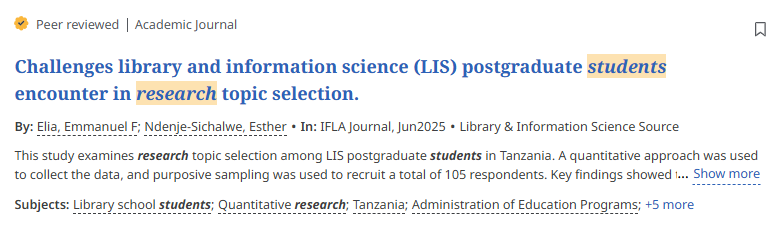
Citation #4: Reactions
- Initial, quick thoughts about the article:
- Peer reviewed article
- Mentions "challenges" and "topic selection". I'll note these and write them down.
- Population is library students, which is not a discipline I want to study. However, I might consider grabbing this article and reading it only if I don't find enough on other disciplines.
- Date (2025) is recent.
- How this impacts my topic:
- I'll add "challenges" and "topic selection" to my Venn diagram
- Decision - should I save this article?
- Yes, but I'll wait to read it. If I find more relevant sources, I will not read this one.
General reactions
None of the first four sources are books or book chapters, which makes it easier for me. But if I do find citations of book chapters, I might want to consider them, depending on how well the book overall fits into my topic.
Many of the citations are quite recent. Several of the sources gave me more ideas on how to narrow my topic, which I wrote down to consider for later (we'll come back to how to use these in 4.9 Iterative Process.
Your turn: Evaluate citations
Now that you have a sense of how I'd consider the results in a database search on my topic, you can evaluate your results in terms of your topic.
Activity: Evaluate citations \(\PageIndex{1}\)
Scroll through your database results list from the search you constructed in the previous section, considering the bullet points above.
Remember to just read the article and journal titles at this step, and only glance at the abstract if the title is not clear enough. If any look interesting, select them as you scroll. Most databases allow you to check boxes or add the citations to a folder and then keep scrolling until you have read the titles of all the results you found. Saving sources now does not commit you to reading them later.
- As you evaluate the citations, write down any new terms you’re finding or add them as circles in your Venn diagram.

Next Steps
The next section will discuss why and how to save your citations and searches so be sure to read that prior to leaving your database searches!