

9.2: Interview Techniques
- Last updated
- Save as PDF
- Page ID
- 124589

- Anonymous
- LibreTexts
Learning Objectives
- Identify the primary aim of interviews.
- Describe what makes interview techniques unique.
- Define the term interview guide and describe how to construct an interview guide.
- Outline the guidelines for constructing good interview questions.
- Define the term focus group and identify one benefit of focus groups.
- Identify and describe the various stages of interview data analysis.
- Identify the strengths and weaknesses of interviews.
Conducting Interviews
Interviews might feel more like a conversation than an interview to respondents, but the researcher is in fact usually guiding the conversation with the goal in mind of gathering information from a respondent. Interviews contain open-ended questions. The meaning of this term is of course implied by its name, but just so that we’re sure to be on the same page, I’ll tell you that open-ended questions are questions that a researcher poses but does not provide answer options for. Open-ended questions are more demanding of participants than closed-ended questions, for they require participants to come up with their own words, phrases, or sentences to respond.
In an interview, the researcher usually develops a guide in advance that he or she then refers to during the interview (or memorizes in advance of the interview). An interview guide is a list of topics or questions that the interviewer hopes to cover during the course of an interview. It is called a guide because it is simply that—it is used to guide the interviewer, but it is not set in stone. Think of an interview guide like your agenda for the day or your to-do list—both probably contain all the items you hope to check off or accomplish, though it probably won’t be the end of the world if you don’t accomplish everything on the list or if you don’t accomplish it in the exact order that you have it written down. Perhaps new events will come up that cause you to rearrange your schedule just a bit, or perhaps you simply won’t get to everything on the list.
Interview guides should outline issues that a researcher feels are likely to be important, but because participants are asked to provide answers in their own words, and to raise points that they believe are important, each interview is likely to flow a little differently. While the opening question in an in-depth interview may be the same across all interviews, from that point on what the participant says will shape how the interview proceeds. This, I believe, is what makes in-depth interviewing so exciting. It is also what makes in-depth interviewing rather challenging to conduct. It takes a skilled interviewer to be able to ask questions; actually listen to respondents; and pick up on cues about when to follow up, when to move on, and when to simply let the participant speak without guidance or interruption.
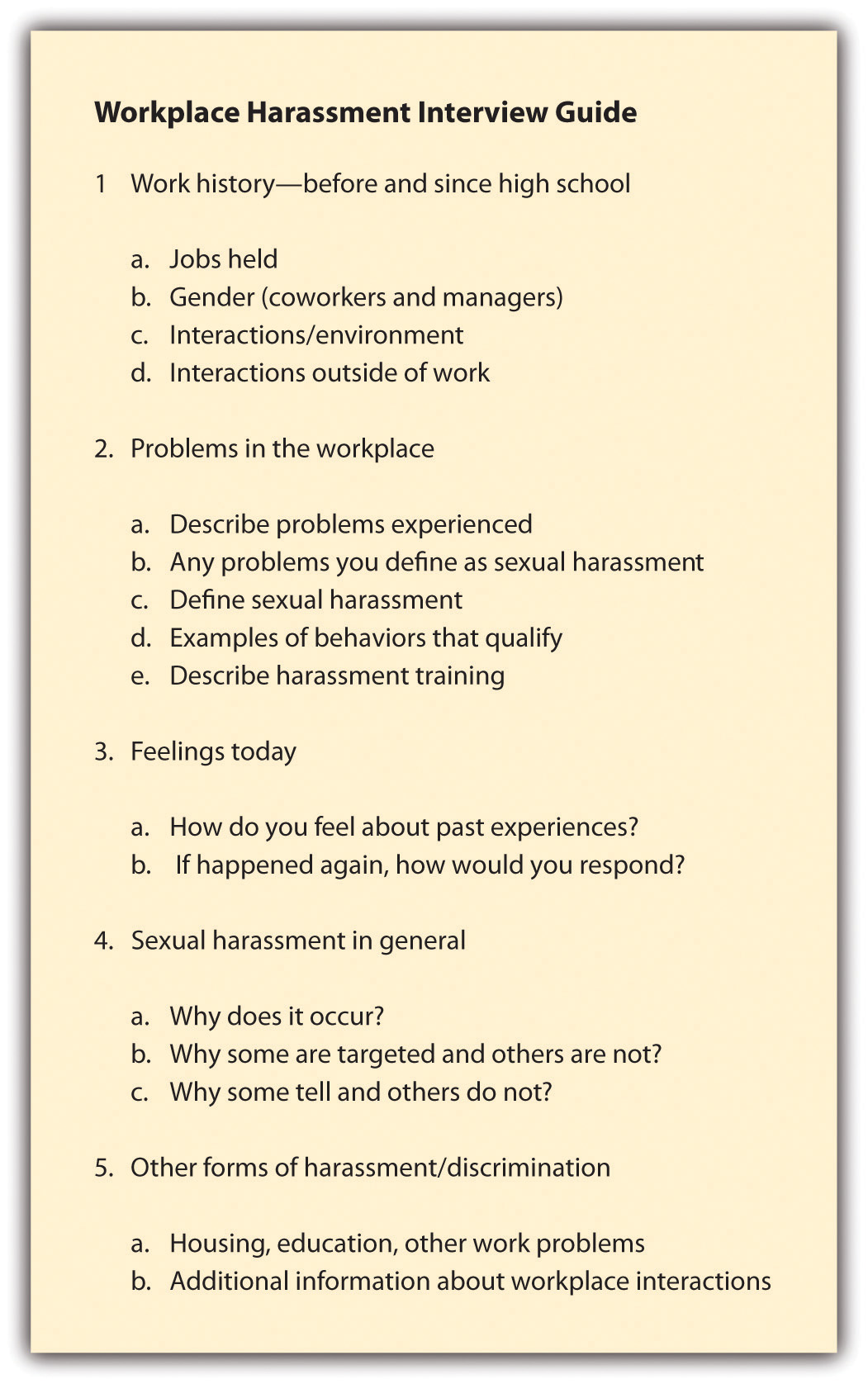
I’ve said that interview guides can list topics or questions. The specific format of an interview guide might depend on your style, experience, and comfort level as an interviewer or with your topic. I have conducted interviews using different kinds of guides. In my interviews of young people about their experiences with workplace sexual harassment, the guide I used was topic based. There were few specific questions contained in the guide. Instead, I had an outline of topics that I hoped to cover, listed in an order that I thought it might make sense to cover them, noted on a sheet of paper. That guide can be seen in Figure 9.1.
Figure 9.1 Interview Guide Displaying Topics Rather Than Questions
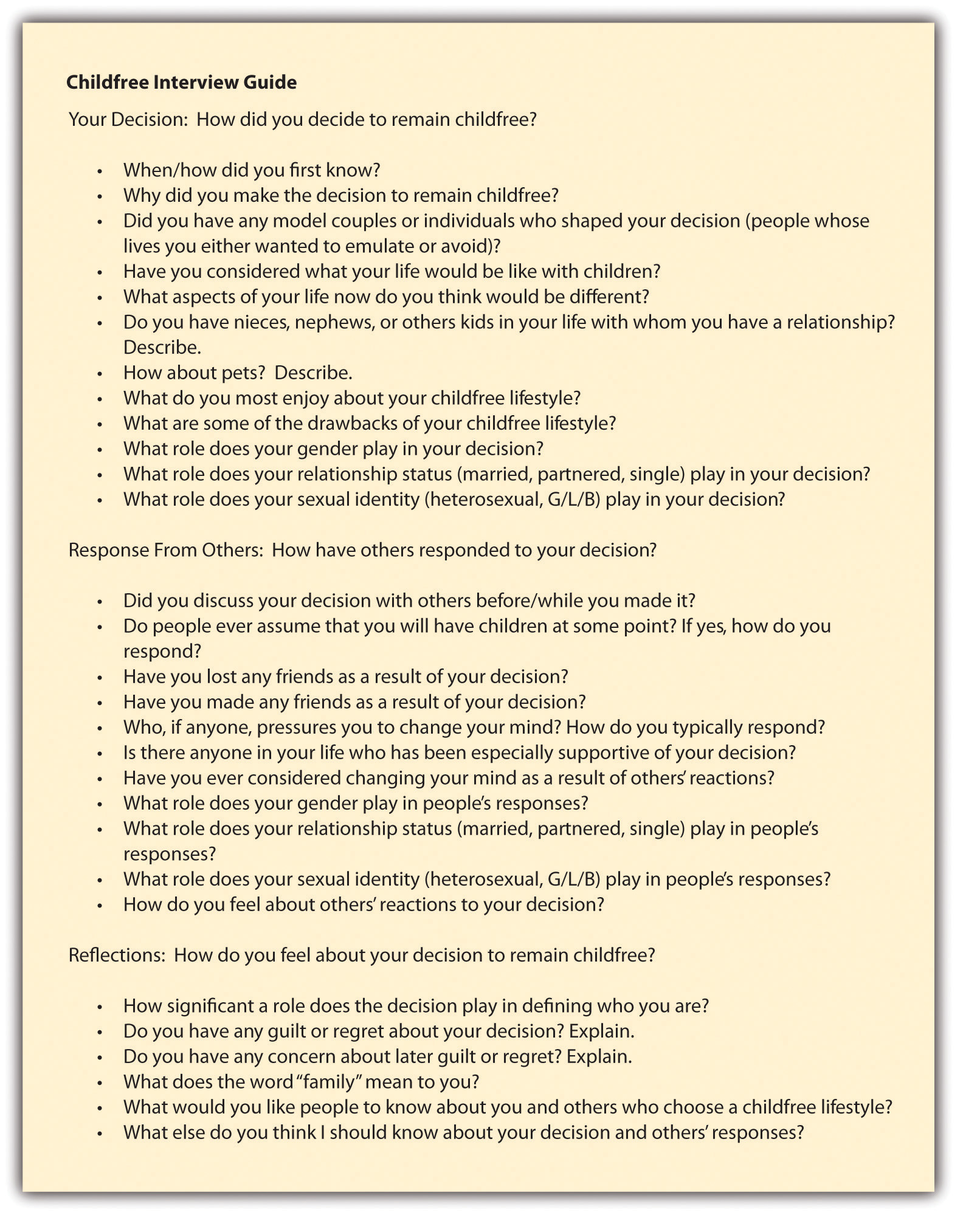
In my interviews with child-free adults, the interview guide contained questions rather than brief topics. One reason I took this approach is that this was a topic with which I had less familiarity than workplace sexual harassment. I’d been studying harassment for some time before I began those interviews, and I had already analyzed much quantitative survey data on the topic. When I began the child-free interviews, I was embarking on a research topic that was entirely new for me. I was also studying a topic about which I have strong personal feelings, and I wanted to be sure that I phrased my questions in a way that didn’t appear biased to respondents. To help ward off that possibility, I wrote down specific question wording in my interview guide. As I conducted more and more interviews, and read more and more of the literature on child-free adults, I became more confident about my ability to ask open-ended, nonbiased questions about the topic without the guide, but having some specific questions written down at the start of the data collection process certainly helped. The interview guide I used for the child-free project is displayed in Figure 9.2.
Figure 9.2 Interview Guide Displaying Questions Rather Than Topics
As you might have guessed, interview guides do not appear out of thin air. They are the result of thoughtful and careful work on the part of a researcher. As you can see in both of the preceding guides, the topics and questions have been organized thematically and in the order in which they are likely to proceed (though keep in mind that the flow of an interview is in part determined by what a respondent has to say). Sometimes interviewers may create two versions of the interview guide: one version contains a very brief outline of the interview, perhaps with just topic headings, and another version contains detailed questions underneath each topic heading. In this case, the researcher might use the very detailed guide to prepare and practice in advance of actually conducting interviews and then just bring the brief outline to the interview. Bringing an outline, as opposed to a very long list of detailed questions, to an interview encourages the researcher to actually listen to what a participant is telling her. An overly detailed interview guide will be difficult to navigate through during an interview and could give respondents the misimpression that the interviewer is more interested in her questions than in the participant’s answers.
When beginning to construct an interview guide, brainstorming is usually the first step. There are no rules at the brainstorming stage—simply list all the topics and questions that come to mind when you think about your research question. Once you’ve got a pretty good list, you can begin to pare it down by cutting questions and topics that seem redundant and group like questions and topics together. If you haven’t done so yet, you may also want to come up with question and topic headings for your grouped categories. You should also consult the scholarly literature to find out what kinds of questions other interviewers have asked in studies of similar topics. As with quantitative survey research, it is best not to place very sensitive or potentially controversial questions at the very beginning of your interview guide. You need to give participants the opportunity to warm up to the interview and to feel comfortable talking with you. Finally, get some feedback on your interview guide. Ask your friends, family members, and your professors for some guidance and suggestions once you’ve come up with what you think is a pretty strong guide. Chances are they’ll catch a few things you hadn’t noticed.
In terms of the specific questions you include on your guide, there are a few guidelines worth noting. First, try to avoid questions that can be answered with a simple yes or no, or if you do choose to include such questions, be sure to include follow-up questions. Remember, one of the benefits of interviews is that you can ask participants for more information—be sure to do so. While it is a good idea to ask follow-up questions, try to avoid asking “why” as your follow-up question, as this particular question can come off as confrontational, even if that is not how you intend it. Often people won’t know how to respond to “why,” perhaps because they don’t even know why themselves. Instead of “why,” I recommend that you say something like, “Could you tell me a little more about that?” This allows participants to explain themselves further without feeling that they’re being doubted or questioned in a hostile way.
Also, try to avoid phrasing your questions in a leading way. For example, rather than asking, “Don’t you think that most people who don’t want kids are selfish?” you could ask, “What comes to mind for you when you hear that someone doesn’t want kids?” Or rather than asking, “What do you think about juvenile delinquents who drink and drive?” you could ask, “How do you feel about underage drinking?” or “What do you think about drinking and driving?” Finally, as noted earlier in this section, remember to keep most, if not all, of your questions open ended. The key to a successful interview is giving participants the opportunity to share information in their own words and in their own way.
Even after the interview guide is constructed, the interviewer is not yet ready to begin conducting interviews. The researcher next has to decide how to collect and maintain the information that is provided by participants. It is probably most common for interviewers to take audio recordings of the interviews they conduct.
Recording interviews allows the researcher to focus on her or his interaction with the interview participant rather than being distracted by trying to take notes. Of course, not all participants will feel comfortable being recorded and sometimes even the interviewer may feel that the subject is so sensitive that recording would be inappropriate. If this is the case, it is up to the researcher to balance excellent note-taking with exceptional question asking and even better listening. I don’t think I can understate the difficulty of managing all these feats simultaneously. Whether you will be recording your interviews or not (and especially if not), practicing the interview in advance is crucial. Ideally, you’ll find a friend or two willing to participate in a couple of trial runs with you. Even better, you’ll find a friend or two who are similar in at least some ways to your sample. They can give you the best feedback on your questions and your interview demeanor.
All interviewers should be aware of, give some thought to, and plan for several additional factors, such as where to conduct an interview and how to make participants as comfortable as possible during an interview.
Although our focus here has been on interviews for which there is one interviewer and one respondent, this is certainly not the only way to conduct an interview. Sometimes there may be multiple respondents present, and occasionally more than one interviewer may be present as well. When multiple respondents participate in an interview at the same time, this is referred to as a focus group. Focus groups can be an excellent way to gather information because topics or questions that hadn’t occurred to the researcher may be brought up by other participants in the group. Having respondents talk with and ask questions of one another can be an excellent way of learning about a topic; not only might respondents ask questions that hadn’t occurred to the researcher, but the researcher can also learn from respondents’ body language around and interactions with one another. Of course, there are some unique ethical concerns associated with collecting data in a group setting.
Analysis of Interview Data
Analysis of interview data typically begins with a set of transcripts of the interviews conducted. Obtaining said transcripts requires having either taken exceptionally good notes during an interview or, preferably, recorded the interview and then transcribed it. Transcribing interviews is usually the first step toward analyzing interview data. To transcribe an interview means that you create, or someone whom you’ve hired creates, a complete, written copy of the recorded interview by playing the recording back and typing in each word that is spoken on the recording, noting who spoke which words. In general, it is best to aim for a verbatim transcription, one that reports word for word exactly what was said in the recorded interview. If possible, it is also best to include nonverbals in an interview’s written transcription. Gestures made by respondents should be noted, as should the tone of voice and notes about when, where, and how spoken words may have been emphasized by respondents.
If you have the time (or if you lack the resources to hire others), I think it is best to transcribe your interviews yourself. I never cease to be amazed by the things I recall from an interview when I transcribe it myself. If the researcher who conducted the interview transcribes it himself or herself, that person will also be able to make a note of nonverbal behaviors and interactions that may be relevant to analysis but that could not be picked up by audio recording. I’ve seen interviewees roll their eyes, wipe tears from their face, and even make obscene gestures that spoke volumes about their feelings but that could not have been recorded had I not remembered to include these details in their transcribed interviews.
The goal of analysis is to reach some inferences, lessons, or conclusions by condensing large amounts of data into relatively smaller, more manageable bits of understandable information. Analysis of interview data often works inductively (Glaser & Strauss, 1967; Charmaz, 2006). To move from the specific observations an interviewer collects to identifying patterns across those observations, interviewers will often begin by reading through transcripts of their interviews and trying to identify codes. A code is a shorthand representation of some more complex set of issues or ideas. In this usage, the word code is a noun. But it can also be a verb. The process of identifying codes in one’s qualitative data is often referred to as coding. Coding involves identifying themes across interview data by reading and rereading (and rereading again) interview transcripts until the researcher has a clear idea about what sorts of themes come up across the interviews.
Qualitative researcher and textbook author Kristin Esterberg (2002)Esterberg, K. G. (2002). Qualitative methods in social research. Boston, MA: McGraw-Hill. describes coding as a multistage process. Esterberg suggests that there are two types of coding: open coding and focused coding. To analyze interview data, one can begin by open coding transcripts. This means that you read through each transcript, line by line, and make a note of whatever categories or themes seem to jump out to you. At this stage, it is important that you not let your original research question or expectations about what you think you might find cloud your ability to see categories or themes. It’s called open coding for a reason—keep an open mind. Open coding will probably require multiple go-rounds. As you read through your transcripts, it is likely that you’ll begin to see some commonalities across the categories or themes that you’ve jotted down. Once you do, you might begin focused coding.
Focused coding involves collapsing or narrowing themes and categories identified in open coding by reading through the notes you made while conducting open coding. Identify themes or categories that seem to be related, perhaps merging some. Then give each collapsed/merged theme or category a name (or code), and identify passages of data that fit each named category or theme. To identify passages of data that represent your emerging codes, you’ll need to read through your transcripts yet again (and probably again). You might also write up brief definitions or descriptions of each code. Defining codes is a way of making meaning of your data and of developing a way to talk about your findings and what your data mean. Guess what? You are officially analyzing data!
As tedious and laborious as it might seem to read through hundreds of pages of transcripts multiple times, sometimes getting started with the coding process is actually the hardest part. If you find yourself struggling to identify themes at the open coding stage, ask yourself some questions about your data. The answers should give you a clue about what sorts of themes or categories you are reading. In their text on analyzing qualitative data, Lofland and Lofland (1995)Lofland, J., & Lofland, L. H. (1995). Analyzing social settings: A guide to qualitative observation and analysis (3rd ed.) Belmont, CA: Wadsworth. identify a set of questions that I find very useful when coding qualitative data. They suggest asking the following:
- Of what topic, unit, or aspect is this an instance?
- What question about a topic does this item of data suggest?
- What sort of answer to a question about a topic does this item of data suggest (i.e., what proposition is suggested)?
Asking yourself these questions about the passages of data that you’re reading can help you begin to identify and name potential themes and categories.
Still feeling uncertain about how this process works? Sometimes it helps to see how interview passages translate into codes. In Table 9.1, I present two codes that emerged from the inductive analysis of transcripts from my interviews with child-free adults. I also include a brief description of each code and a few (of many) interview excerpts from which each code was developed.
| Code | Code description | Interview excerpts |
|---|---|---|
| Reify gender | Participants reinforceheteronormative ideals in two ways: (a) by calling up stereotypical images of gender and family and (b) by citing their own “failure” to achieve those ideals. | “The woman is more involved with taking care of the child. [As a woman] I’d be the one waking up more often to feed the baby and more involved in the personal care of the child, much more involved. I would have more responsibilities than my partner. I know I would feel that burden more than if I were a man.” |
| “I don’t have that maternal instinct.” | ||
| “I look at all my high school friends on Facebook, and I’m the only one who isn’t married and doesn’t have kids. I question myself, like if there’s something wrong with me that I don’t have that.” | ||
| “I feel badly that I’m not providing my parents with grandchildren.” | ||
| Resist Gender | Participants resist gender norms in two ways: (a) by pushing back against negative social responses and (b) by redefining family for themselves in a way that challenges normative notions of family. | “Am I less of a woman because I don’t have kids? I don’t think so!” |
| “I think if they’re gonna put their thoughts on me, I’m putting it back on them. When they tell me, ‘Oh, Janet, you won’t have lived until you’ve had children. It’s the most fulfilling thing a woman can do!’ then I just name off the 10 fulfilling things I did in the past week that they didn’t get to do because they have kids.” | ||
| “Family is the group of people that you want to be with. That’s it.” | ||
| “The whole institution of marriage as a transfer of property from one family to another and the supposition that the whole purpose in life is to create babies is pretty ugly. My definition of family has nothing to do with that. It’s about creating a better life for ourselves.” |
As you might imagine, wading through all these data is quite a process. Just as quantitative researchers rely on the assistance of special computer programs designed to help with sorting through and analyzing their data, so, too, do qualitative researchers. Where quantitative researchers have SPSS and MicroCase (and many others), qualitative researchers have programs such as NVivo (http://www.qsrinternational.com) and Atlasti (http://www.atlasti.com). These are programs specifically designed to assist qualitative researchers with organizing, managing, sorting, and analyzing large amounts of qualitative data. The programs work by allowing researchers to import interview transcripts contained in an electronic file and then label or code passages, cut and paste passages, search for various words or phrases, and organize complex interrelationships among passages and codes.
In sum, the following excerpt, from a paper analyzing the workplace sexual harassment interview data I have mentioned previously, summarizes how the process of analyzing interview data often works:
All interviews were tape recorded and then transcribed and imported into the computer program NVivo. NVivo is designed to assist researchers with organizing, managing, interpreting, and analyzing non-numerical, qualitative data. Once the transcripts, ranging from 20 to 60 pages each, were imported into NVivo, we first coded the data according to the themes outlined in our interview guide. We then closely reviewed each transcript again, looking for common themes across interviews and coding like categories of data together. These passages, referred to as codes or “meaning units” (Weiss, 2004),Weiss, R. S. (2004). In their own words: Making the most of interviews. Contexts, 3, 44–51. were then labeled and given a name intended to succinctly portray the themes present in the code. For this paper, we coded every quote that had something to do with the labeling of harassment. After reviewing passages within the “labeling” code, we placed quotes that seemed related together, creating several sub-codes. These sub-codes were named and are represented by the three subtitles within the findings section of this paper.Our three subcodes were the following: (a) “It’s different because you’re in high school”: Sociability and socialization at work; (b) Looking back: “It was sexual harassment; I just didn’t know it at the time”; and (c) Looking ahead: New images of self as worker and of workplace interactions. Once our sub-codes were labeled, we re-examined the interview transcripts, coding additional quotes that fit the theme of each sub-code. (Blackstone, Houle, & Uggen, 2006)Blackstone, A., Houle, J., & Uggen, C. “At the time, I thought it was great”: Age, experience, and workers’ perceptions of sexual harassment. Presented at the Annual Meeting of the American Sociological Association, Montreal, QC, August 2006. Currently under review.
Strengths and Weaknesses of Interviews
As the preceding sections have suggested, interviews are an excellent way to gather detailed information. Whatever topic is of interest to the researcher employing this method can be explored in much more depth than with almost any other method. Not only are participants given the opportunity to elaborate in a way that is not possible with other methods such as survey research, but they also are able share information with researchers in their own words and from their own perspectives rather than being asked to fit those perspectives into the perhaps limited response options provided by the researcher. And because interviews are designed to elicit detailed information, they are especially useful when a researcher’s aim is to study social processes, or the “how” of various phenomena. Yet another, and sometimes overlooked, benefit of interviews that occurs in person is that researchers can make observations beyond those that a respondent is orally reporting. A respondent’s body language, and even her or his choice of time and location for the interview, might provide a researcher with useful data.
Of course, all these benefits do not come without some drawbacks. As with quantitative survey research, interviews rely on respondents’ ability to accurately and honestly recall whatever details about their lives, circumstances, thoughts, opinions, or behaviors are being asked about. As Esterberg (2002) puts it, “If you want to know about what people actually do, rather than what they say they do, you should probably use observation [instead of interviews].”Esterberg, K. G. (2002). Qualitative methods in social research. Boston, MA: McGraw-Hill. Further, as you may have already guessed, interviewing is time intensive and can be quite expensive. Creating an interview guide, identifying a sample, and conducting interviews are just the beginning. Transcribing interviews is labor intensive—and that’s before coding even begins. It is also not uncommon to offer respondents some monetary incentive or thank-you for participating. Keep in mind that you are asking for more of participants’ time than if you’d simply mailed them a questionnaire containing closed-ended questions. Conducting interviews is not only labor intensive but also emotionally taxing. When I interviewed young workers about their sexual harassment experiences, I heard stories that were shocking, infuriating, and sad. Seeing and hearing the impact that harassment had had on respondents was difficult. Researchers embarking on a interview project should keep in mind their own abilities to hear stories that may be difficult to hear.
KEY TAKEAWAYS
- Interview guides can vary in format but should contain some outline of the topics you hope to cover during the course of an interview.
- NVivo and Atlas.ti are computer programs that qualitative researchers use to help them with organizing, sorting, and analyzing their data.
- Interviews allow respondents to share information in their own words and are useful for gathering detailed information and understanding social processes.
- Drawbacks of interviews include reliance on respondents’ accuracy and their intensity in terms of time, expense, and possible emotional strain.
Exercises
- Based on a research question you have identified through earlier exercises in this text, write a few open-ended questions you could ask were you to conduct in-depth interviews on the topic. Now critique your questions. Are any of them yes/no questions? Are any of them leading?
- Read the open-ended questions you just created, and answer them as though you were an interview participant. Were your questions easy to answer or fairly difficult? How did you feel talking about the topics you asked yourself to discuss? How might respondents feel talking about them?