

10.1: What Is It and When to Use It?
- Page ID
- 124593

\( \newcommand{\vecs}[1]{\overset { \scriptstyle \rightharpoonup} {\mathbf{#1}} } \)
\( \newcommand{\vecd}[1]{\overset{-\!-\!\rightharpoonup}{\vphantom{a}\smash {#1}}} \)
\( \newcommand{\dsum}{\displaystyle\sum\limits} \)
\( \newcommand{\dint}{\displaystyle\int\limits} \)
\( \newcommand{\dlim}{\displaystyle\lim\limits} \)
\( \newcommand{\id}{\mathrm{id}}\) \( \newcommand{\Span}{\mathrm{span}}\)
( \newcommand{\kernel}{\mathrm{null}\,}\) \( \newcommand{\range}{\mathrm{range}\,}\)
\( \newcommand{\RealPart}{\mathrm{Re}}\) \( \newcommand{\ImaginaryPart}{\mathrm{Im}}\)
\( \newcommand{\Argument}{\mathrm{Arg}}\) \( \newcommand{\norm}[1]{\| #1 \|}\)
\( \newcommand{\inner}[2]{\langle #1, #2 \rangle}\)
\( \newcommand{\Span}{\mathrm{span}}\)
\( \newcommand{\id}{\mathrm{id}}\)
\( \newcommand{\Span}{\mathrm{span}}\)
\( \newcommand{\kernel}{\mathrm{null}\,}\)
\( \newcommand{\range}{\mathrm{range}\,}\)
\( \newcommand{\RealPart}{\mathrm{Re}}\)
\( \newcommand{\ImaginaryPart}{\mathrm{Im}}\)
\( \newcommand{\Argument}{\mathrm{Arg}}\)
\( \newcommand{\norm}[1]{\| #1 \|}\)
\( \newcommand{\inner}[2]{\langle #1, #2 \rangle}\)
\( \newcommand{\Span}{\mathrm{span}}\) \( \newcommand{\AA}{\unicode[.8,0]{x212B}}\)
\( \newcommand{\vectorA}[1]{\vec{#1}} % arrow\)
\( \newcommand{\vectorAt}[1]{\vec{\text{#1}}} % arrow\)
\( \newcommand{\vectorB}[1]{\overset { \scriptstyle \rightharpoonup} {\mathbf{#1}} } \)
\( \newcommand{\vectorC}[1]{\textbf{#1}} \)
\( \newcommand{\vectorD}[1]{\overrightarrow{#1}} \)
\( \newcommand{\vectorDt}[1]{\overrightarrow{\text{#1}}} \)
\( \newcommand{\vectE}[1]{\overset{-\!-\!\rightharpoonup}{\vphantom{a}\smash{\mathbf {#1}}}} \)
\( \newcommand{\vecs}[1]{\overset { \scriptstyle \rightharpoonup} {\mathbf{#1}} } \)
\(\newcommand{\longvect}{\overrightarrow}\)
\( \newcommand{\vecd}[1]{\overset{-\!-\!\rightharpoonup}{\vphantom{a}\smash {#1}}} \)
\(\newcommand{\ket}[1]{\left| #1 \right>}\)
\(\newcommand{\bra}[1]{\left< #1 \right|}\)
\(\newcommand{\braket}[2]{\left< #1 \vphantom{#2} \right| \left. #2 \vphantom{#1} \right>}\)
\(\newcommand{\braopket}[3]{\left< #1 \vphantom{#2}\vphantom{#3} \right| #2 \vphantom{#1}\vphantom{#3} \left| #3 \vphantom{#1}\vphantom{#2} \right>}\)
\(\newcommand{\qmvec}[1]{\mathbf{\vec{#1}}}\)
\(\newcommand{\op}[1]{\hat{\mathbf{#1}}}\)
\(\newcommand{\expect}[1]{\langle #1 \rangle}\)
\(\newcommand{\dfn}[1]{\emph{\textbf{#1}}}\)
-
Define the term field research.
-
Define participant observation and describe the continuum of participant observation.
-
Discuss at least two examples of field research.
Why Field Research?
Whether observing how elementary students negotiate grades or how couples divide household chores, scholars who conduct this type of work must immerse themselves in the settings that they study. What all field researchers have in common is their participation in "the field."
Field research is a qualitative method of data collection aimed at understanding, observing, and interacting with people in their natural settings. Thus, when social scientists talk about being in "the field," they are talking about being out in the real world and involved in the everyday lives of the people they are studying. Sometimes researchers use the terms "ethnography" or "participant observation" to refer to this method of data collection; the former is most commonly used in anthropology, while the latter is used commonly in sociology. This text utilizes two main terms: field research and participant observation. Field research functions as an umbrella term that includes the myriad activities that field researchers engage in when they collect data. They participate, they observe, they usually interview some of the people they observe, and they typically analyze documents or artifacts created by the people they observe; see Figure 10.1.
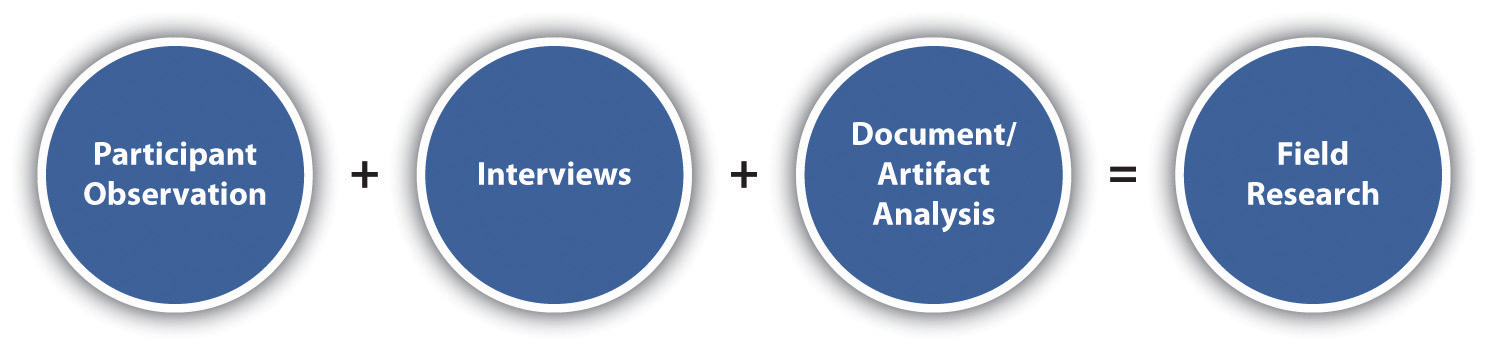
Like field research, participant observation also has multiple meanings. Researchers conducting participant observation vary in the extent to which they participate or observe. As originally conceptualized by Junker (1960), there is a theoretical continuum of participant observation, where complete observation lies at one end of the continuum and complete participation lies at the other end.
For example, in her study of the daily operations of a sperm bank and an egg donation agency, Rene Almeling (2011) rested near the complete observation end of the continuum. Rather than pretending to be a medical patient or a donor, Almeling observed clinic operations and staff interactions overtly without taking on clinic duties. Conversely, in her research on the global elite party circuit, Ashley Mears (2020) operated near the complete participation end of the continuum. As a former fashion model, Mears actively participated as a "VIP girl" in exclusive clubs, fully immersing herself in the social ecosystem she was studying alongside promoters and billionaires. Modern methodologists continuously debate how researchers should navigate this continuum, noting that a researcher's visible and invisible traits significantly impact how they move between observation and participation.
There are pros and cons associated with both aspects of the participant observer’s role. Complete observers may miss important aspects of group interaction and lack the opportunity to fully grasp what life is like for the people they observe. At the same time, sitting back and observing may grant them opportunities to see interactions that they would miss were they more involved. Complete participation has the benefit of allowing researchers a real taste of life in the group that they study. Some argue that participation is the only way to understand what it is that researchers investigate. On the other hand, complete participants may find themselves in situations that they would rather not face but cannot excuse themselves from because they have adopted the role of complete participant. Also, complete participants who do not overtly reveal themselves as researchers must face the ethical quandary of deceiving their subjects. In reality, most field research projects lie somewhere near the middle of the observer-participant continuum. Field researchers typically participate to at least some extent in their field sites, but there are also times when they may just observe.
As you might have imagined based on the examples of Almeling's and Mears's work, field research is well equipped to answer "how" kinds of questions. Whereas survey researchers often aim to answer "why" questions, field researchers ask how the processes they study occur, how the people they spend time with in the field interact, and how events unfold. Table 10.1 presents examples of the kinds of questions field researchers have asked in contemporary projects along with a brief summary of where and what role those researchers took in the field. The examples presented in Table 10.1 by no means represent an exhaustive list of the variations of questions field researchers have asked or of the range of field research projects that have been conducted over the years, but they do provide a snapshot of the kinds of work modern sociological field researchers engage in.
| Question | Researcher role | Author (year) |
|---|---|---|
| How do extreme poverty and eviction shape the lives of the urban poor? | Extensive participant observation living in a mobile home park and a rooming house in Milwaukee while observing landlords and tenants. | Matthew Desmond, Evicted: Poverty and Profit in the American City (2016) |
| How do police and the urban poor interact on a daily basis in hyper-policed neighborhoods? | Five years of participant observation alongside police officers and residents in Los Angeles's Skid Row. | Forrest Stuart, Down, Out, and Under Arrest: Policing and Everyday Life in Skid Row (2016) |
| How do middle-class and working-class students navigate educational inequalities? | Three years of participant observation in elementary school classrooms, observing interactions between students, teachers, and parents. | Jessica McCrory Calarco, Negotiating Opportunities: How the Middle Class Secures Advantages in School (2018) |
| How do young people navigate neighborhood violence and identity in the digital age? | Extensive digital and physical participant observation tracking how gang activity and youth socialization migrate onto social media platforms. | Jeffrey Lane, The Digital Street (2019) |
| How is elite status and wealth displayed and consumed in the global party circuit? | Eighteen months of complete participation as a VIP model in exclusive clubs around the world. | Ashley Mears, Very Important People: Status and Beauty in the Global Party Circuit (2020) |
| How do race and class impact how defendants navigate the criminal justice system? | Extensive observation of attorney-client interactions and court proceedings in the Boston area. | Matthew Clair, Privilege and Punishment: How Race and Class Matter in Criminal Court (2020) |
-
Methodological Scope: Field research typically involves a combination of participant observation, interviewing, and document or artifact analysis.
-
The Continuum: Different participant observation projects rest in different places on the continuum of complete observer to complete participant; most lie near the middle of the continuum.
-
Origins: Field research has its historical origins in anthropology before being adapted and modernized by sociologists.