Social Sci LibreTexts

6.6: Child Care

  • Page ID
    105489
  • \( \newcommand{\vecs}[1]{\overset { \scriptstyle \rightharpoonup} {\mathbf{#1}} } \)

    \( \newcommand{\vecd}[1]{\overset{-\!-\!\rightharpoonup}{\vphantom{a}\smash {#1}}} \)

    \( \newcommand{\dsum}{\displaystyle\sum\limits} \)

    \( \newcommand{\dint}{\displaystyle\int\limits} \)

    \( \newcommand{\dlim}{\displaystyle\lim\limits} \)

    \( \newcommand{\id}{\mathrm{id}}\) \( \newcommand{\Span}{\mathrm{span}}\)

    ( \newcommand{\kernel}{\mathrm{null}\,}\) \( \newcommand{\range}{\mathrm{range}\,}\)

    \( \newcommand{\RealPart}{\mathrm{Re}}\) \( \newcommand{\ImaginaryPart}{\mathrm{Im}}\)

    \( \newcommand{\Argument}{\mathrm{Arg}}\) \( \newcommand{\norm}[1]{\| #1 \|}\)

    \( \newcommand{\inner}[2]{\langle #1, #2 \rangle}\)

    \( \newcommand{\Span}{\mathrm{span}}\)

    \( \newcommand{\id}{\mathrm{id}}\)

    \( \newcommand{\Span}{\mathrm{span}}\)

    \( \newcommand{\kernel}{\mathrm{null}\,}\)

    \( \newcommand{\range}{\mathrm{range}\,}\)

    \( \newcommand{\RealPart}{\mathrm{Re}}\)

    \( \newcommand{\ImaginaryPart}{\mathrm{Im}}\)

    \( \newcommand{\Argument}{\mathrm{Arg}}\)

    \( \newcommand{\norm}[1]{\| #1 \|}\)

    \( \newcommand{\inner}[2]{\langle #1, #2 \rangle}\)

    \( \newcommand{\Span}{\mathrm{span}}\) \( \newcommand{\AA}{\unicode[.8,0]{x212B}}\)

    \( \newcommand{\vectorA}[1]{\vec{#1}}      % arrow\)

    \( \newcommand{\vectorAt}[1]{\vec{\text{#1}}}      % arrow\)

    \( \newcommand{\vectorB}[1]{\overset { \scriptstyle \rightharpoonup} {\mathbf{#1}} } \)

    \( \newcommand{\vectorC}[1]{\textbf{#1}} \)

    \( \newcommand{\vectorD}[1]{\overrightarrow{#1}} \)

    \( \newcommand{\vectorDt}[1]{\overrightarrow{\text{#1}}} \)

    \( \newcommand{\vectE}[1]{\overset{-\!-\!\rightharpoonup}{\vphantom{a}\smash{\mathbf {#1}}}} \)

    \( \newcommand{\vecs}[1]{\overset { \scriptstyle \rightharpoonup} {\mathbf{#1}} } \)

    \(\newcommand{\longvect}{\overrightarrow}\)

    \( \newcommand{\vecd}[1]{\overset{-\!-\!\rightharpoonup}{\vphantom{a}\smash {#1}}} \)

    \(\newcommand{\avec}{\mathbf a}\) \(\newcommand{\bvec}{\mathbf b}\) \(\newcommand{\cvec}{\mathbf c}\) \(\newcommand{\dvec}{\mathbf d}\) \(\newcommand{\dtil}{\widetilde{\mathbf d}}\) \(\newcommand{\evec}{\mathbf e}\) \(\newcommand{\fvec}{\mathbf f}\) \(\newcommand{\nvec}{\mathbf n}\) \(\newcommand{\pvec}{\mathbf p}\) \(\newcommand{\qvec}{\mathbf q}\) \(\newcommand{\svec}{\mathbf s}\) \(\newcommand{\tvec}{\mathbf t}\) \(\newcommand{\uvec}{\mathbf u}\) \(\newcommand{\vvec}{\mathbf v}\) \(\newcommand{\wvec}{\mathbf w}\) \(\newcommand{\xvec}{\mathbf x}\) \(\newcommand{\yvec}{\mathbf y}\) \(\newcommand{\zvec}{\mathbf z}\) \(\newcommand{\rvec}{\mathbf r}\) \(\newcommand{\mvec}{\mathbf m}\) \(\newcommand{\zerovec}{\mathbf 0}\) \(\newcommand{\onevec}{\mathbf 1}\) \(\newcommand{\real}{\mathbb R}\) \(\newcommand{\twovec}[2]{\left[\begin{array}{r}#1 \\ #2 \end{array}\right]}\) \(\newcommand{\ctwovec}[2]{\left[\begin{array}{c}#1 \\ #2 \end{array}\right]}\) \(\newcommand{\threevec}[3]{\left[\begin{array}{r}#1 \\ #2 \\ #3 \end{array}\right]}\) \(\newcommand{\cthreevec}[3]{\left[\begin{array}{c}#1 \\ #2 \\ #3 \end{array}\right]}\) \(\newcommand{\fourvec}[4]{\left[\begin{array}{r}#1 \\ #2 \\ #3 \\ #4 \end{array}\right]}\) \(\newcommand{\cfourvec}[4]{\left[\begin{array}{c}#1 \\ #2 \\ #3 \\ #4 \end{array}\right]}\) \(\newcommand{\fivevec}[5]{\left[\begin{array}{r}#1 \\ #2 \\ #3 \\ #4 \\ #5 \\ \end{array}\right]}\) \(\newcommand{\cfivevec}[5]{\left[\begin{array}{c}#1 \\ #2 \\ #3 \\ #4 \\ #5 \\ \end{array}\right]}\) \(\newcommand{\mattwo}[4]{\left[\begin{array}{rr}#1 \amp #2 \\ #3 \amp #4 \\ \end{array}\right]}\) \(\newcommand{\laspan}[1]{\text{Span}\{#1\}}\) \(\newcommand{\bcal}{\cal B}\) \(\newcommand{\ccal}{\cal C}\) \(\newcommand{\scal}{\cal S}\) \(\newcommand{\wcal}{\cal W}\) \(\newcommand{\ecal}{\cal E}\) \(\newcommand{\coords}[2]{\left\{#1\right\}_{#2}}\) \(\newcommand{\gray}[1]{\color{gray}{#1}}\) \(\newcommand{\lgray}[1]{\color{lightgray}{#1}}\) \(\newcommand{\rank}{\operatorname{rank}}\) \(\newcommand{\row}{\text{Row}}\) \(\newcommand{\col}{\text{Col}}\) \(\renewcommand{\row}{\text{Row}}\) \(\newcommand{\nul}{\text{Nul}}\) \(\newcommand{\var}{\text{Var}}\) \(\newcommand{\corr}{\text{corr}}\) \(\newcommand{\len}[1]{\left|#1\right|}\) \(\newcommand{\bbar}{\overline{\bvec}}\) \(\newcommand{\bhat}{\widehat{\bvec}}\) \(\newcommand{\bperp}{\bvec^\perp}\) \(\newcommand{\xhat}{\widehat{\xvec}}\) \(\newcommand{\vhat}{\widehat{\vvec}}\) \(\newcommand{\uhat}{\widehat{\uvec}}\) \(\newcommand{\what}{\widehat{\wvec}}\) \(\newcommand{\Sighat}{\widehat{\Sigma}}\) \(\newcommand{\lt}{<}\) \(\newcommand{\gt}{>}\) \(\newcommand{\amp}{&}\) \(\definecolor{fillinmathshade}{gray}{0.9}\)

    According to the U.S. Census Bureau in 2011, over sixty percent of families with children under five relied on regular child care arrangements. Around a quarter of those families used organized child care facilities as their primary arrangement.24

    Child care involves supervising a child or children, usually from infancy to age thirteen, and typically refers to work done by somebody outside the child's immediate family. Child care is a broad topic covering a wide spectrum of contexts, activities, social and cultural conventions, and institutions. The majority of child care institutions that are available require that child care providers have extensive training in first aid and are CPR certified. In addition, background checks, drug testing, and reference verification are normally required.

    It is traditional in Western society for children to be cared for by their parents or their legal guardians. In families where children live with one or both of their parents, the child care role may also be taken on by the child's extended family. If a parent or extended family is unable to care for the children, orphanages and foster homes are a way of providing for children's care, housing, and schooling.

    Child Care in the United States

    Formal child care options include center-based care and family child care homes. Each state has different regulations for licensing child care centers, including teacher requirements. In some states, teaching in a child care center requires an associate’s degree in child development. States with quality standards built into their licensing programs may have higher requirements for support staff, such as teacher assistants. Head Start (a federally funded child care program for income qualified families) lead teachers must have a bachelor’s degree in Early Childhood Education. States vary in other standards set for daycare providers, such as teacher to child ratios.

    clipboard_e4f9dce4fcb3f64d51efea7ab0ac431ba.png
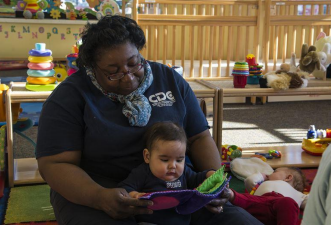
    Figure 6.15 – A caretaker reading to an infant. (Image by the Air Force Medical Service is in the public domain)

    State legislation may regulate the number and ages of children allowed before the home is considered an official family child care program and subject to licensing regulations. Often the nationally recognized Child Development Associate credential is the minimum standard for the individual leading this home care program.

    clipboard_ef34b4a413726ab0a56fa0214645f5a1e.png
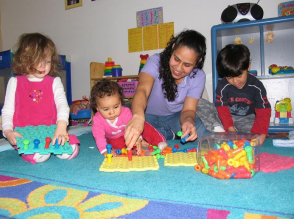
    Figure 6.16 – A caretaker playing with a group of children. (Image by the U.S. Air Force is in the public domain)

    In addition to these licensed options, parents may also choose to find their own caregiver or arrange childcare exchanges/swaps with another family. This care is typically provided by nannies, au pairs, or friends and family. The child is watched inside their own home or the caregiver's home, reducing exposure to outside children and illnesses. Depending on the number of children in the home, the children utilizing in-home care can enjoy the greatest amount of interaction with their caregiver and form a close bond.

    There are no required licensing or background checks for this type of in-home care, making parental vigilance essential in choosing an appropriate caregiver. The cost of in-home care is the highest of childcare options per child, though a household with many children may find this the most convenient and affordable option. 27

    Play-Based Programs in Early Childhood Education

    In 1989, UNICEF ( United Nations International Children's Emergency Fund) recognizes play’s significance. Children have a right to play.  According to The UN Convention on the Rights of the Child’s Article 31 states the following:

    “States Parties recognize the right of the child to rest and leisure, to engage in play and recreational activities appropriate to the age of the child and to participate freely in cultural life and the arts. States Parties shall respect and promote the right of the child to participate fully in cultural and artistic life and shall encourage the provision of appropriate and equal opportunities for cultural, artistic, recreational and leisure activity.”

    (UNICEF) 28
    Children are hard-wired for play.  Play is the context in which children optimally learn.  Play based programs are child-led (based on their interests), more than teacher directed.  An important element in nurturing a happy, well-formed child—but which often gets overlooked in the search for a preschool—is the idea of playful discovery, and creativity.  Playful learning is as important to intellectual and personal growth as academics. Play based programs can be center-based or home-based.  Through playful discoveries children find joy in learning that they may, or may not, experience in traditional educational settings.  Every program is unique and different, even those under the same name (e.g. Reggio Inspired, Montessori, Head Start, etc.) because these programs are staffed with educated humans, who have different teaching styles, different ways of motivating children, different play experiences themselves which can provide various ways to work and play with children.  A few things that stand out to help identify play based programs are the following:
    • One that incorporates the children's natural interest
    • Outdoor and indoor opportunities to learn
    • A number of play spaces available, like blocks, water, sensory, art, light areas, to name a few.
    • Children get to decide where thy want to play (experience and materials to use). 29


    Contributors and Attributions

    24. Who's Minding the Kids by the U.S. Census Bureau is in the public domain

    27. Lifespan Development - Module 4: Infancy by Lumen Learning references Psyc 200 Lifespan Psychology by Laura Overstreet, licensed under CC BY 4.0

    28. "UNICEF" by Humanium is licensed under CC BY 4.0

    29. "The Science of Play" by Best Chance is licensed under CC BY 4.0


    This page titled 6.6: Child Care is shared under a CC BY 4.0 license and was authored, remixed, and/or curated by Paris, Ricardo, Rymond, & Johnson (College of the Canyons) .