

5.5: Accuracy and Inaccuracy in Perception
- Page ID
- 352320

\( \newcommand{\vecs}[1]{\overset { \scriptstyle \rightharpoonup} {\mathbf{#1}} } \)
\( \newcommand{\vecd}[1]{\overset{-\!-\!\rightharpoonup}{\vphantom{a}\smash {#1}}} \)
\( \newcommand{\dsum}{\displaystyle\sum\limits} \)
\( \newcommand{\dint}{\displaystyle\int\limits} \)
\( \newcommand{\dlim}{\displaystyle\lim\limits} \)
\( \newcommand{\id}{\mathrm{id}}\) \( \newcommand{\Span}{\mathrm{span}}\)
( \newcommand{\kernel}{\mathrm{null}\,}\) \( \newcommand{\range}{\mathrm{range}\,}\)
\( \newcommand{\RealPart}{\mathrm{Re}}\) \( \newcommand{\ImaginaryPart}{\mathrm{Im}}\)
\( \newcommand{\Argument}{\mathrm{Arg}}\) \( \newcommand{\norm}[1]{\| #1 \|}\)
\( \newcommand{\inner}[2]{\langle #1, #2 \rangle}\)
\( \newcommand{\Span}{\mathrm{span}}\)
\( \newcommand{\id}{\mathrm{id}}\)
\( \newcommand{\Span}{\mathrm{span}}\)
\( \newcommand{\kernel}{\mathrm{null}\,}\)
\( \newcommand{\range}{\mathrm{range}\,}\)
\( \newcommand{\RealPart}{\mathrm{Re}}\)
\( \newcommand{\ImaginaryPart}{\mathrm{Im}}\)
\( \newcommand{\Argument}{\mathrm{Arg}}\)
\( \newcommand{\norm}[1]{\| #1 \|}\)
\( \newcommand{\inner}[2]{\langle #1, #2 \rangle}\)
\( \newcommand{\Span}{\mathrm{span}}\) \( \newcommand{\AA}{\unicode[.8,0]{x212B}}\)
\( \newcommand{\vectorA}[1]{\vec{#1}} % arrow\)
\( \newcommand{\vectorAt}[1]{\vec{\text{#1}}} % arrow\)
\( \newcommand{\vectorB}[1]{\overset { \scriptstyle \rightharpoonup} {\mathbf{#1}} } \)
\( \newcommand{\vectorC}[1]{\textbf{#1}} \)
\( \newcommand{\vectorD}[1]{\overrightarrow{#1}} \)
\( \newcommand{\vectorDt}[1]{\overrightarrow{\text{#1}}} \)
\( \newcommand{\vectE}[1]{\overset{-\!-\!\rightharpoonup}{\vphantom{a}\smash{\mathbf {#1}}}} \)
\( \newcommand{\vecs}[1]{\overset { \scriptstyle \rightharpoonup} {\mathbf{#1}} } \)
\(\newcommand{\longvect}{\overrightarrow}\)
\( \newcommand{\vecd}[1]{\overset{-\!-\!\rightharpoonup}{\vphantom{a}\smash {#1}}} \)
\(\newcommand{\ket}[1]{\left| #1 \right>}\)
\(\newcommand{\bra}[1]{\left< #1 \right|}\)
\(\newcommand{\braket}[2]{\left< #1 \vphantom{#2} \right| \left. #2 \vphantom{#1} \right>}\)
\(\newcommand{\braopket}[3]{\left< #1 \vphantom{#2}\vphantom{#3} \right| #2 \vphantom{#1}\vphantom{#3} \left| #3 \vphantom{#1}\vphantom{#2} \right>}\)
\(\newcommand{\qmvec}[1]{\mathbf{\vec{#1}}}\)
\(\newcommand{\op}[1]{\hat{\mathbf{#1}}}\)
\(\newcommand{\expect}[1]{\langle #1 \rangle}\)
\(\newcommand{\dfn}[1]{\emph{\textbf{#1}}}\)
The eyes, ears, nose, tongue, and skin sense the world around us, and in some cases perform preliminary information processing on the incoming data. But by and large, we do not experience sensation—we experience the outcome of perception—the total package that the brain puts together from the pieces it receives through our senses and that the brain creates for us to experience. When we look out the window at a view of the countryside, or when we look at the face of a good friend, we don’t just see a jumble of colors and shapes—we see, instead, an image of a countryside or an image of a friend (Goodale & Milner, 2006).
How the Perceptual System Interprets the Environment
This meaning-making involves the automatic operation of a variety of essential perceptual processes. One of these is sensory interaction—the working together of different senses to create experience. Sensory interaction is involved when taste, smell, and texture combine to create the flavor we experience in food. It is also involved when we enjoy a movie because of the way the images and the music work together.
Although you might think that we understand speech only through our sense of hearing, it turns out that the visual aspect of speech is also important. One example of sensory interaction is shown in the McGurk effect—an error in perception that occurs when we misperceive sounds because the audio and visual parts of the speech are mismatched. You can witness the effect yourself by viewing the following video.
Video Clip: The McGurk Effect. The McGurk effect is an error in sound perception that occurs when there is a mismatch between the senses of hearing and seeing. https://youtu.be/jtsfidRq2tw
Other examples of sensory interaction include the experience of nausea that can occur when the sensory information being received from the eyes and the body does not match information from the vestibular system (Flanagan, May, & Dobie, 2004) and synesthesia—an experience in which one sensation (e.g., hearing a sound) creates experiences in another (e.g., vision). Most people do not experience synesthesia, but those who do link their perceptions in unusual ways, for instance, by experiencing color when they taste a particular food or by hearing sounds when they see certain objects (Ramachandran, Hubbard, Robertson, & Sagiv, 2005).
Another important perceptual process is selective attention—the ability to focus on some sensory inputs while tuning out others. View Note 4.71 “Video Clip: Selective Attention” and count the number of times the people playing with the ball pass it to each other. You may find that, like many other people who view it for the first time, you miss something important because you selectively attend to only one aspect of the video (Simons & Chabris, 1999).
Video Clip: Selective Attention. https://youtu.be/vJG698U2Mvo
Watch this video and carefully count how many times the people pass the ball to each other.
Selective attention also allows us to focus on a single talker at a party while ignoring other conversations that are occurring around us (Broadbent, 1958; Cherry, 1953). Without this automatic selective attention, we’d be unable to focus on the single conversation we want to hear. But selective attention is not complete; we also at the same time monitor what’s happening in the channels we are not focusing on. Perhaps you have had the experience of being at a party and talking to someone in one part of the room, when suddenly you hear your name being mentioned by someone in another part of the room. This cocktail party phenomenon shows us that although selective attention is limiting what we processes, we are nevertheless at the same time doing a lot of unconscious monitoring of the world around us—you didn’t know you were attending to the background sounds of the party, but evidently you were.
Illusions
Although our perception is very accurate, it is not perfect. Illusions occur when the perceptual processes that normally help us correctly perceive the world around us are fooled by a particular situation so that we see something that does not exist or that is incorrect.
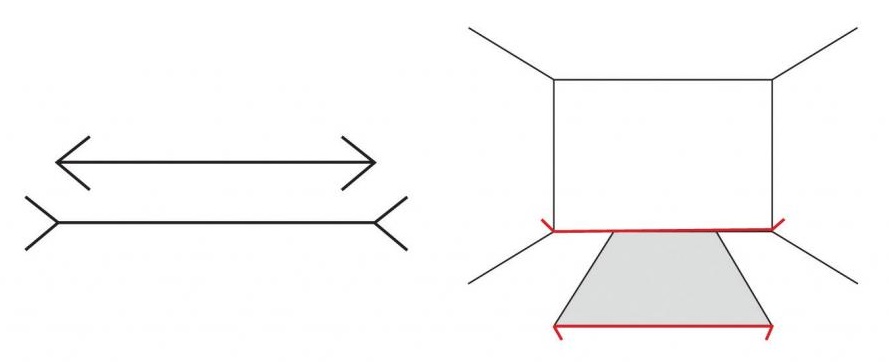
One well-known illusion is the Mueller-Lyer illusion (Figure \(\PageIndex{35}\)). The line segment in the bottom arrow looks longer to us than the one on the top, even though they are both actually the same length. It is likely that the illusion is, in part, the result of the failure of monocular depth cues—the bottom line looks like an edge that is normally farther away from us, whereas the top one looks like an edge that is normally closer.
The moon illusion refers to the fact that the moon is perceived to be about 50% larger when it is near the horizon than when it is seen overhead, despite the fact that both moons are the same size and cast the same size retinal image. The monocular depth cues of position and aerial perspective create the illusion that things that are lower and more hazy are farther away. The skyline of the horizon (trees, clouds, outlines of buildings) also gives a cue that the moon is far away, compared to a moon at its zenith. If we look at a horizon moon through a tube of rolled up paper, taking away the surrounding horizon cues, the moon will immediately appear smaller.
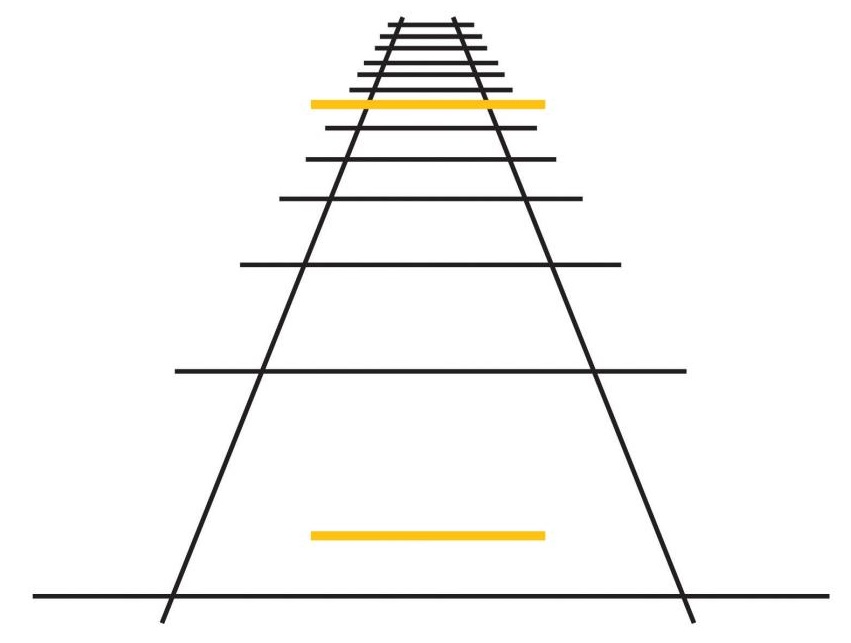
The Ponzo illusion operates on the same principle. As you can see in Figure \(\PageIndex{37}\), the top yellow bar seems longer than the bottom one, but if you measure them you’ll see that they are exactly the same length. The monocular depth cue of linear perspective leads us to believe that, given two similar objects, the distant one can only cast the same size retinal image as the closer object if it is larger. The topmost bar therefore appears longer.
Illusions demonstrate that our perception of the world around us may be influenced by our prior knowledge. But the fact that some illusions exist in some cases does not mean that the perceptual system is generally inaccurate—in fact, humans normally become so closely in touch with their environment that that the physical body and the particular environment that we sense and perceive becomes embodied—that is, built into and linked with—our cognition, such that the worlds around us become part of our brain (Calvo & Gamila, 2008). The close relationship between people and their environments means that, although illusions can be created in the lab and under some unique situations, they may be less common with active observers in the real world (Runeson, 1988).
The Important Role of Expectations in Perception
Our emotions, mind-set, expectations, and the contexts in which our sensations occur all have a profound influence on perception. People who are warned that they are about to taste something bad rate what they do taste more negatively than people who are told that the taste won’t be so bad (Nitschke et al., 2006), and people perceive a child and adult pair as looking more alike when they are told that they are parent and child (Bressan & Dal Martello, 2002). Similarly, participants who see images of the same baby rate it as stronger and bigger when they are told it is a boy as opposed to when they are told it is a girl (Stern & Karraker, 1989),and research participants who learn that a child is from a lower-class background perceive the child’s scores on an intelligence test as lower than people who see the same test taken by a child they are told is from an upper-class background (Darley & Gross, 1983). Plassmann, O’Doherty, Shiv, and Rangel (2008)< found that wines were rated more positively and caused greater brain activity in brain areas associated with pleasure when they were said to cost more than when they were said to cost less. And even experts can be fooled: Professional referees tended to assign more penalty cards to soccer teams for videotaped fouls when they were told that the team had a history of aggressive behavior than when they had no such expectation (Jones, Paull, & Erskine, 2002).
Our perceptions are also influenced by our desires and motivations. When we are hungry, food-related words tend to grab our attention more than non-food-related words (Mogg, Bradley, Hyare, & Lee, 1998), we perceive objects that we can reach as bigger than those that we cannot reach (Witt & Proffitt, 2005), and people who favor a political candidate’s policies view the candidate’s skin color more positively than do those who oppose the candidate’s policies (Caruso, Mead, & Balcetis, 2009). Even our culture influences perception. Chua, Boland, and Nisbett (2005) showed American and Asian graduate students different images, such as an airplane, an animal, or a train, against complex backgrounds. They found that (consistent with their overall individualistic orientation) the American students tended to focus more on the foreground image, while Asian students (consistent with their interdependent orientation) paid more attention to the image’s context. Furthermore, Asian-American students focused more or less on the context depending on whether their Asian or their American identity had been activated.
References
Bressan, P., & Dal Martello, M. F. (2002). Talis pater, talis filius: Perceived resemblance and the belief in genetic relatedness. Psychological Science, 13, 213–218.
Broadbent, D. E. (1958). Perception and communication. New York, NY: Pergamon.
Calvo, P., & Gomila, T. (Eds.). (2008). Handbook of cognitive science: An embodied approach. San Diego, CA: Elsevier.
Caruso, E. M., Mead, N. L., & Balcetis, E. (2009). Political partisanship influences perception of biracial candidates’ skin tone. PNAS Proceedings of the National Academy of Sciences of the United States of America, 106(48), 20168–20173.
Cherry, E. C. (1953). Some experiments on the recognition of speech, with one and with two ears. Journal of the Acoustical Society of America, 25, 975–979.
Chua, H. F., Boland, J. E., & Nisbett, R. E. (2005). Cultural variation in eye movements during scene perception. Proceedings of the National Academy of Sciences, 102, 12629–12633.
Darley, J. M., & Gross, P. H. (1983). A hypothesis-confirming bias in labeling effects. Journal of Personality and Social Psychology, 44, 20–33.
Flanagan, M. B., May, J. G., & Dobie, T. G. (2004). The role of vection, eye movements, and postural instability in the etiology of motion sickness. Journal of Vestibular Research: Equilibrium and Orientation, 14(4), 335–346.
Goodale, M., & Milner, D. (2006). One brain—Two visual systems. Psychologist, 19(11), 660–663.
Jones, M. V., Paull, G. C., & Erskine, J. (2002). The impact of a team’s aggressive reputation on the decisions of association football referees. Journal of Sports Sciences, 20, 991–1000.
Kraft, C. (1978). A psychophysical approach to air safety: Simulator studies of visual illusions in night approaches. In H. L. Pick, H. W. Leibowitz, J. E. Singer, A. Steinschneider, & H. W. Steenson (Eds.), Psychology: From research to practice. New York, NY: Plenum Press.
Lee, J., & Strayer, D. (2004). Preface to the special section on driver distraction. Human Factors, 46(4), 583.
McCann, J. J. (1992). Rules for color constancy. Ophthalmic and Physiologic Optics, 12(2), 175–177.
Mogg, K., Bradley, B. P., Hyare, H., & Lee, S. (1998). Selective attention to food related stimuli in hunger. Behavior Research & Therapy, 36(2), 227–237.
Nickerson, R. S. (1998). Applied experimental psychology. Applied Psychology: An International Review, 47, 155–173.
Nitschke, J. B., Dixon, G. E., Sarinopoulos, I., Short, S. J., Cohen, J. D., Smith, E. E.,…Davidson, R. J. (2006). Altering expectancy dampens neural response to aversive taste in primary taste cortex. Nature Neuroscience 9, 435–442.
Plassmann, H., O’Doherty, J., Shiv, B., & Rangel, A. (2008). Marketing actions can moderate neural representations of experienced pleasantness. Proceedings of the National Academy of Sciences, 105(3), 1050–1054.
Proctor, R. W., & Van Zandt, T. (2008). Human factors in simple and complex systems (2nd ed.). Boca Raton, FL: CRC Press.
Ramachandran, V. S., Hubbard, E. M., Robertson, L. C., & Sagiv, N. (2005). The emergence of the human mind: Some clues from synesthesia. In Synesthesia: Perspectives From Cognitive Neuroscience (pp. 147–190). New York, NY: Oxford University Press.
Runeson, S. (1988). The distorted room illusion, equivalent configurations, and the specificity of static optic arrays. Journal of Experimental Psychology: Human Perception and Performance, 14(2), 295–304.
Silverstein, L. D., Krantz, J. H., Gomer, F. E., Yeh, Y., & Monty, R. W. (1990). The effects of spatial sampling and luminance quantization on the image quality of color matrix displays. Journal of the Optical Society of America, Part A, 7, 1955–1968.
Silverstein, L. D., & Merrifield, R. M. (1985). The development and evaluation of color systems for airborne applications: Phase I Fundamental visual, perceptual, and display systems considerations (Tech. Report DOT/FAA/PM085019). Washington, DC: Federal Aviation Administration.
Simons, D. J., & Chabris, C. F. (1999). Gorillas in our midst: Sustained inattentional blindness for dynamic events. Perception, 28(9), 1059–1074.
Stern, M., & Karraker, K. H. (1989). Sex stereotyping of infants: A review of gender labeling studies. Sex Roles, 20(9–10), 501–522.
Witt, J. K., & Proffitt, D. R. (2005). See the ball, hit the ball: Apparent ball size is correlated with batting average. Psychological Science, 16(12), 937–938.
Yarbus, A. L. (1967). Eye movements and vision. New York, NY: Plenum Press.