{ "6.01:_Introduction" : "property get [Map MindTouch.Deki.Logic.ExtensionProcessorQueryProvider+<>c__DisplayClass234_0.<PageSubPageProperty>b__1]()", "6.02:_What_Is_Learning" : "property get [Map MindTouch.Deki.Logic.ExtensionProcessorQueryProvider+<>c__DisplayClass234_0.<PageSubPageProperty>b__1]()", "6.03:_Classical_Conditioning" : "property get [Map MindTouch.Deki.Logic.ExtensionProcessorQueryProvider+<>c__DisplayClass234_0.<PageSubPageProperty>b__1]()", "6.04:_Operant_Conditioning" : "property get [Map MindTouch.Deki.Logic.ExtensionProcessorQueryProvider+<>c__DisplayClass234_0.<PageSubPageProperty>b__1]()", "6.05:_Observational_Learning_(Modeling)" : "property get [Map MindTouch.Deki.Logic.ExtensionProcessorQueryProvider+<>c__DisplayClass234_0.<PageSubPageProperty>b__1]()" }
{ "00:_Front_Matter" : "property get [Map MindTouch.Deki.Logic.ExtensionProcessorQueryProvider+<>c__DisplayClass234_0.<PageSubPageProperty>b__1]()", "01:_Introduction_to_Psychology" : "property get [Map MindTouch.Deki.Logic.ExtensionProcessorQueryProvider+<>c__DisplayClass234_0.<PageSubPageProperty>b__1]()", "02:_Brains_Bodies_and_Behavior" : "property get [Map MindTouch.Deki.Logic.ExtensionProcessorQueryProvider+<>c__DisplayClass234_0.<PageSubPageProperty>b__1]()", "03:_States_of_Consciousness" : "property get [Map MindTouch.Deki.Logic.ExtensionProcessorQueryProvider+<>c__DisplayClass234_0.<PageSubPageProperty>b__1]()", "04:_Growing_and_Developing" : "property get [Map MindTouch.Deki.Logic.ExtensionProcessorQueryProvider+<>c__DisplayClass234_0.<PageSubPageProperty>b__1]()", "05:_Sensation_and_Perception" : "property get [Map MindTouch.Deki.Logic.ExtensionProcessorQueryProvider+<>c__DisplayClass234_0.<PageSubPageProperty>b__1]()", "06:_Learning" : "property get [Map MindTouch.Deki.Logic.ExtensionProcessorQueryProvider+<>c__DisplayClass234_0.<PageSubPageProperty>b__1]()", "07:_Memory" : "property get [Map MindTouch.Deki.Logic.ExtensionProcessorQueryProvider+<>c__DisplayClass234_0.<PageSubPageProperty>b__1]()", "08:_Thinking_and_Language" : "property get [Map MindTouch.Deki.Logic.ExtensionProcessorQueryProvider+<>c__DisplayClass234_0.<PageSubPageProperty>b__1]()", "09:_Intelligence" : "property get [Map MindTouch.Deki.Logic.ExtensionProcessorQueryProvider+<>c__DisplayClass234_0.<PageSubPageProperty>b__1]()", "10:_Motivation_and_Emotion" : "property get [Map MindTouch.Deki.Logic.ExtensionProcessorQueryProvider+<>c__DisplayClass234_0.<PageSubPageProperty>b__1]()", "11:_Stress_Lifestyle_and_Health" : "property get [Map MindTouch.Deki.Logic.ExtensionProcessorQueryProvider+<>c__DisplayClass234_0.<PageSubPageProperty>b__1]()", "12:_Social_Psychology" : "property get [Map MindTouch.Deki.Logic.ExtensionProcessorQueryProvider+<>c__DisplayClass234_0.<PageSubPageProperty>b__1]()", "13:_Personality" : "property get [Map MindTouch.Deki.Logic.ExtensionProcessorQueryProvider+<>c__DisplayClass234_0.<PageSubPageProperty>b__1]()", "14:_Psychological_Disorders" : "property get [Map MindTouch.Deki.Logic.ExtensionProcessorQueryProvider+<>c__DisplayClass234_0.<PageSubPageProperty>b__1]()", "15:_Therapy" : "property get [Map MindTouch.Deki.Logic.ExtensionProcessorQueryProvider+<>c__DisplayClass234_0.<PageSubPageProperty>b__1]()", "zz:_Back_Matter" : "property get [Map MindTouch.Deki.Logic.ExtensionProcessorQueryProvider+<>c__DisplayClass234_0.<PageSubPageProperty>b__1]()" }
Tue, 30 Jun 2026 22:00:15 GMT
6.5: Observational Learning (Modeling)
352326
352326
Sherry Schnake
{ }
Anonymous
Anonymous User
2
false
false
[ "article:topic", "authorname:openstax", "model", "observational learning", "vicarious punishment", "vicarious reinforcement", "license:ccby", "showtoc:no", "program:openstax", "licenseversion:40", "stage:review", "source@https://openstax.org/details/books/psychology-2e", "author@Rose M. Spielman, William J. Jenkins, Marilyn D. Lovett, et al.", "source[1]-socialsci-76904", "Bandura" ]
[ "article:topic", "authorname:openstax", "model", "observational learning", "vicarious punishment", "vicarious reinforcement", "license:ccby", "showtoc:no", "program:openstax", "licenseversion:40", "stage:review", "source@https://openstax.org/details/books/psychology-2e", "author@Rose M. Spielman, William J. Jenkins, Marilyn D. Lovett, et al.", "source[1]-socialsci-76904", "Bandura" ]
Previous sections of this chapter focused on classical and operant conditioning, which are forms of associative learning. In observational learning, we learn by watching others and then imitating, or modeling, what they do or say. For instance, have you ever gone to YouTube to find a video showing you how to do something? The individuals performing the imitated behavior are called models. Research suggests that this imitative learning involves a specific type of neuron, called a mirror neuron (Hickock, 2010; Rizzolatti, Fadiga, Fogassi, & Gallese, 2002; Rizzolatti, Fogassi, & Gallese, 2006).
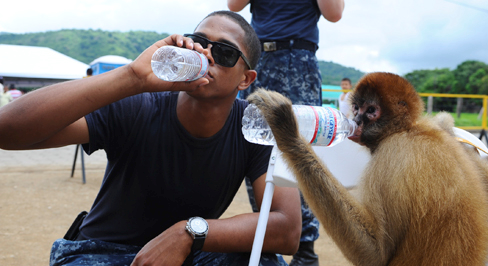
Humans and other animals are capable of observational learning. As you will see, the phrase “monkey see, monkey do” really is accurate (Figure 6.16). The same could be said about other animals. For example, in a study of social learning in chimpanzees, researchers gave juice boxes with straws to two groups of captive chimpanzees. The first group dipped the straw into the juice box, and then sucked on the small amount of juice at the end of the straw. The second group sucked through the straw directly, getting much more juice. When the first group, the “dippers,” observed the second group, “the suckers,” what do you think happened? All of the “dippers” in the first group switched to sucking through the straws directly. By simply observing the other chimps and modeling their behavior, they learned that this was a more efficient method of getting juice (Yamamoto, Humle, and Tanaka, 2013).
Figure 6.16 This spider monkey learned to drink water from a plastic bottle by seeing the behavior modeled by a human. (credit: U.S. Air Force, Senior Airman Kasey Close)
Imitation is much more obvious in humans, but is imitation really the sincerest form of flattery? Consider Claire’s experience with observational learning. Claire’s nine-year-old son, Jay, was getting into trouble at school and was defiant at home. Claire feared that Jay would end up like her brothers, two of whom were in prison. One day, after yet another bad day at school and another negative note from the teacher, Claire, at her wit’s end, beat her son with a belt to get him to behave. Later that night, as she put her children to bed, Claire witnessed her four-year-old daughter, Anna, take a belt to her teddy bear and whip it. Claire was horrified, realizing that Anna was imitating her mother. It was then that Claire knew she wanted to discipline her children in a different manner.
Bandura's Research
Bandura researched modeling behavior, particularly children’s modeling of adults’ aggressive and violent behaviors (Bandura, Ross, & Ross, 1961). He conducted an experiment with a five-foot inflatable doll that he called a Bobo doll. In the experiment, children’s aggressive behavior was influenced by whether the teacher was punished for her behavior. In one scenario, a teacher acted aggressively with the doll, hitting, throwing, and even punching the doll, while a child watched. There were two types of responses by the children to the teacher’s behavior. When the teacher was punished for her bad behavior, the children decreased their tendency to act as she had. When the teacher was praised or ignored (and not punished for her behavior), the children imitated what she did, and even what she said. They punched, kicked, and yelled at the doll.
What are the implications of this study? Bandura concluded that we watch and learn, and that this learning can have both prosocial and antisocial effects. Prosocial (positive) models can be used to encourage socially acceptable behavior. Parents in particular should take note of this finding. If you want your children to read, then read to them. Let them see you reading. Keep books in your home. Talk about your favorite books. If you want your children to be healthy, then let them see you eat right and exercise, and spend time engaging in physical fitness activities together. The same holds true for qualities like kindness, courtesy, and honesty. The main idea is that children observe and learn from their parents, even their parents’ morals, so be consistent and toss out the old adage “Do as I say, not as I do,” because children tend to copy what you do instead of what you say. Besides parents, many public figures, such as Martin Luther King, Jr. and Mahatma Gandhi, are viewed as prosocial models who are able to inspire global social change. Can you think of someone who has been a prosocial model in your life?
The antisocial effects of observational learning are also worth mentioning. As you saw from the example of Claire at the beginning of this section, her daughter viewed Claire’s aggressive behavior and copied it. Research suggests that this may help to explain why abused children often grow up to be abusers themselves (Murrell, Christoff, & Henning, 2007). In fact, about 30% of abused children become abusive parents (U.S. Department of Health & Human Services, 2013). We tend to do what we know. Abused children, who grow up witnessing their parents deal with anger and frustration through violent and aggressive acts, often learn to behave in that manner themselves. Sadly, it’s a vicious cycle that’s difficult to break.
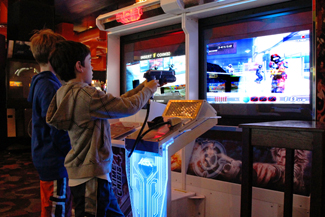
Some studies suggest that violent television shows, movies, and video games may also have antisocial effects (Figure 6.18) although further research needs to be done to understand the correlational and causational aspects of media violence and behavior. Some studies have found a link between viewing violence and aggression seen in children (Anderson & Gentile, 2008; Kirsch, 2010; Miller, Grabell, Thomas, Bermann, & Graham-Bermann, 2012). These findings may not be surprising, given that a child graduating from high school has been exposed to around 200,000 violent acts including murder, robbery, torture, bombings, beatings, and rape through various forms of media (Huston et al., 1992). Not only might viewing media violence affect aggressive behavior by teaching people to act that way in real life situations, but it has also been suggested that repeated exposure to violent acts also desensitizes people to it. Psychologists are working to understand this dynamic.
Figure 6.18 Can video games make us violent? Psychological researchers study this topic. (credit: "woodleywonderworks"/Flickr)
Does watching violent media or playing violent video games cause aggression? Albert Bandura's early studies suggested television violence increased aggression in children, and more recent studies support these findings. For example, research by Craig Anderson and colleagues (Anderson, Bushman, Donnerstein, Hummer, & Warbuten, 2015; Anderson et al., 2010; Bushman et al., 2016) found extensive evidence to suggest a causal link between hours of exposure to violent media and aggressive thoughts and behaviors. However, studies by Christopher Ferguson and others suggests that while there may be a link between violent media exposure and aggression, research to date has not accounted for other risk factors for aggression including mental health and family life (Ferguson, 2011; Gentile, 2016). What do think?
References
Listed at the end of the book in the Back Matter section.