Hello and Welcome
My first order of business to express gratitude to the many other educators and researchers that have shared their expertise to make this book possible. Their contributions are noted through proper research citations and references to articles, books, and journals that were used to create this text. It is mostly a collection of their work that I am curating, with periodic side-bars and chapters that I have contributed.

I also had help from wonderful people who have helped my at every step of my academic career. This includes my mother, who insisted I went to college, my father, who once loaned me money to go even when we were barely speaking to one another at the time, my wonderful teachers, especially Dr. Mary Copelin of Bakersfield College, Dr. Stephen Weiss of CSU Bakersfield, and Dr. Bill Freeman of CSU Northridge, as well as my many supervisors at various jobs in the fields of journalism, public relations, and finally academia. I could list dozens more, but I will spare you save one last shout-out to my wife of 40+ years, Dr. Karin Lightfoot. She has been a source of inspiration as I struggled to find my way into and through a career in the field of communications until I found a perfect fit in the community college system. I owe her everything, and any student I have ever helped has benefited because of her steady support as I changed careers and went back to school not once but twice, leaving her to be the sole support of our family. She rocks.
All right, now a bit about me.
I'm Robb Lightfoot, and I have been a college educator for 40-plus years. Before that I was a journalist and worked in public relations for a history museum. I hold advanced degrees both in communication and recreation administration with coursework in ethical and sustainable tourism. I've also worked in the travel industry. I mention this to give you a perspective on how I approach learning--notice I don't say teaching. Every time I engage with students, I come away with a deeper understanding of this thrilling experience we call learning. And after all these years, I still bring enthusiasm, joy, respect for diversity, and a sense of wonder to my work. I hope too instill these feelings in you, too.
You will me a part of that process this semester!
My passion is travel, but I also love humor. I am a generalist in communication, and have taught augmentation, public speaking, interpersonal communication small group communication, mass communication, journalism, and multi-media production. I'll be bringing in pertinent and helpful ideas from each of those areas. I invite you to bring your life-experiences and insights to our discussions, too.
This class begins with this textbook as a source of shared information. It has statistics gained from research, theories that help us understand, and case studies and stories, too. You also can expect to see video in the class portal to supplement the text, graphics, and images here. My work is informed by my professional and teaching experience, as well as memberships in various organizations, such as the Society for Intercultural Education and Training-SIETA, the Society of Professional Journalists, SPJ, and Rotary International, to name but a few.
Stories Are A Pathway To Understanding
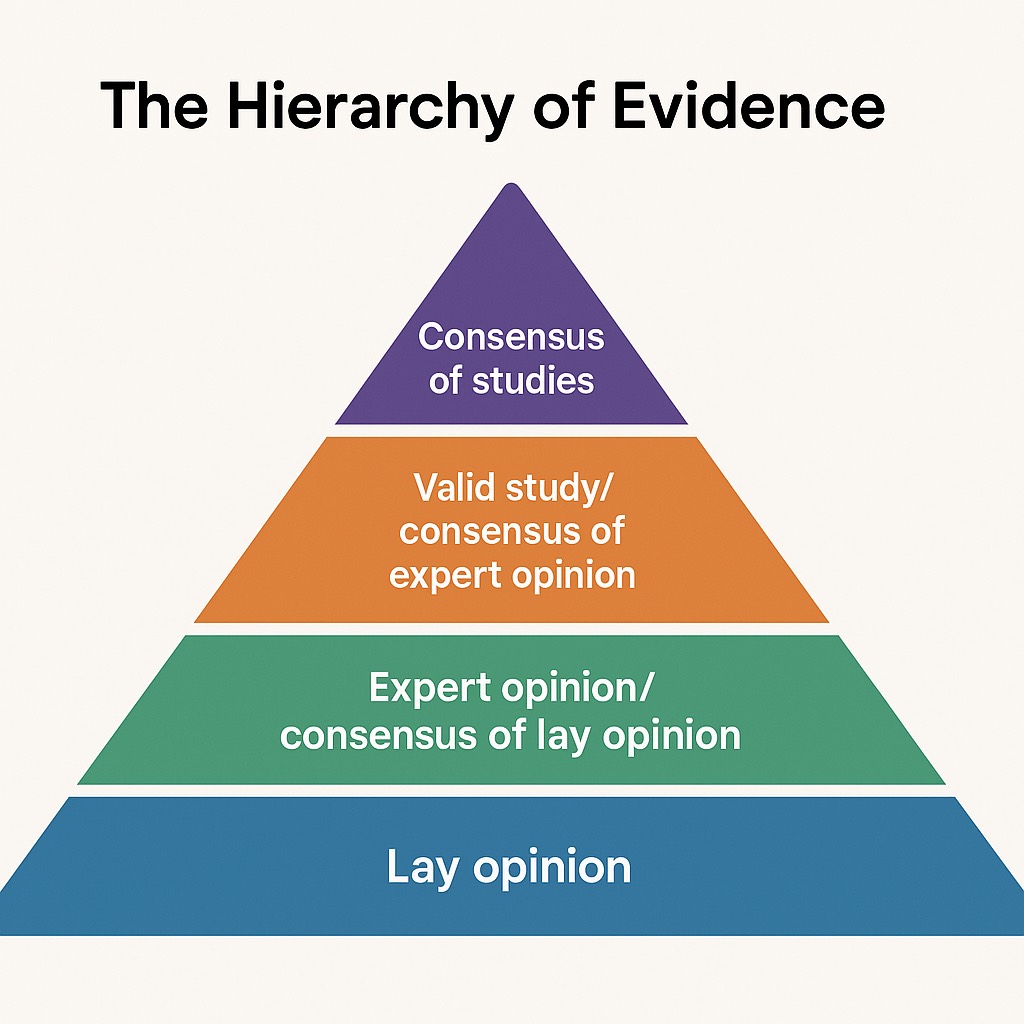
In my experience, stories are the most compelling and memorable "way-in" to understanding others and unpacking culture. This is my perspective, and could be said to be a bias of sorts. Stories can be weak in that a single story does not "prove" a theory. The world in full of competing stories and anecdotes that support contradictory ideas. I've taught and coached debate, and there is an idea called the hierarchy of evidence, which is its power to prove. A single example is weak proof. A series of facts, carefully collected with valid research methods, often points to patterns. These are often expressed in the form of statistics, which are a more powerful form of proof. Likewise, a single study is more powerful than a single expert's opinion, but a consensus of expert opinion is on the same level as a study. A consensus of studies is better still.
Another pertinent concept is the cogency of evidence, or the degree to which it proves what the person sharing it thinks it proves. Simply put, some evidence is weak because it is irrelevant, inaccurate, or outdated. So, research is an ongoing effort in every field of study.
All this research typically takes time. Lots of it. In my work as a daily journalist, I came across a variety of people with stories to tell, and frankly, some of them were fabricated or seen through biases that had to be noted in my narrative. This is what led me, for my first graduate degree, to study "competing narratives." My thesis looked at the competing stories of the Navajo and Hopi tribes as they sought to gain control over disputed lands. The theory I applied was The Narrative Paradigm by Walter Fisher. In his 1978 work, he advanced the idea that we understand our world by arranging our experiences and perceptions into stories, and, in turn, express our understanding of the world in stories. We try to win others over by telling stories and urging others to see the world as we do. This is a core belief for me, but in saying this, I will admit that it has weaknesses--as noted above--and that there are competing theories of understanding that are newer, more empirically based, and specifically focused on intercultural communication.
Theory & Practice
We will see many of those theories here, as we should.
But before we wrap up this brief chapter, let me call attention to the title I have chosen for this text: The Intercultural Toolkit. The word "toolkit" is a deliberate choice and not just a cute affectation. It's here to remind you that this book has a variety of ideas that may fit you better than others, or describe some situations more aptly. Unlike mathematics, work in the social sciences often, perhaps usually, has more than one answer. Some answers are more useful and compelling than others, but there are multiple ways of "being in the world" and seeing it through the many world-views we'll discuss here.
I hope you find this material helpful and understandable. I've edited much of what is here to have it be readable and--dare I say it--fun. This is my training as a journalist as well as an educator. I don't dumb-down the work, but I do realize that a text for college undergraduates does not need to dwell on the peer-to-peer discussions of experts. The goal here is to have a working understanding of this topic and, I hope, kindle an interest that will encourage you to persist and learn for yourself. You'll notice that many of the assignments ask you to go out and search and then bring back material to share with the class. I expect you will find treasures, and probably some trash, too. That's OK. We can learn from material that is flawed so long as we give it a critical examination.
And we will do exactly that--apply critical thinking and the many useful tools that are contained in these pages.
The Design of This Book
One of the challenges of teaching a class in intercultural communication is that for some students, this will be their one-and-only class. Yet, for others, even those who are not communication majors, it may be one of several classes.
What to do?
The approach I've taken in this textbook is to split the text into two parts. The initial chapters are foundational, looking at communication in a general sense, often leaning into a Western world-view, and then offer a second section that deals more specifically with what is unique to intercultural communication.
I have done this to make sure that a student new to this field can get all the important foundational work, while those that are ready to jump into the areas that are unique to intercultural and really take off.
If you are a student in one of my classes, you'll see that I let students take and retake quizzes on the basic material repeatedly so they can quickly get up to speed, but that most of the lecture-videos, discussions, and assignments all focus on the topics that apply intercultural concepts to scenarios and situation in their lives or circumstances they are likely to encounter.
How To Use This Book
I've been teaching for decades, and I am honored to have worked within the California Community College system of higher education, the largest in the world. I have taken scores of training in subjects ranging from technology to student success. So, I'm concerned with offering material that is appropriate, interesting, and effective.
This book has many chapters, and you may find that some of them may be skipped over or only covered in quizzes. This is because there are many foundational chapters, and if you are a communications major, you may have already mastered this material. Good for you! In that case, take the quiz and move on to material that is new and probably more challenging.
Each chapter contains a "Key Terms" section that has words that are, well, key to understanding. These words have concise definitions, and it may be helpful for you to go to the end of the chapter, review the terms, and then read the chapter. You also may want to go to the index of subjects in back of the book in the "Back Matter," a bland but accurate description if there ever was one. Often a topic is treated in more than one place, and you can find links to the places that idea occurs in this text. Usually the later treatments are more in-depth or look sideways to related ideas. It's worth poking around if you find something intriguing.
You'll see, too, that there are References for Further Reading." These are resources that underpin and substantiate the assertions and ideas in the chapter. The list may also include additional reading for advanced study.
Tips for Upper Division & Graduate Students
This is offered for those who are in upper division or even graduate work. If that describes you, then I have a suggestion: Find out how to gain access to the Social Science Citation Index. This is a tool for what I would describe as "lateral" research on a topic. All too often students simply Google a term or use a library card catalog to find "stuff." Then, if you're like me when I was an undergrad (before the Internet), you'll give a sigh of relief and grab the material so you can knock out a report. But if you are looking to advance to an expert level, then you should know about the SSI. It allows you to look up a source and see where it is referenced by others--a good sign--or refuted and challenged. That's also good to know but may temper how much you lean on it as a resource. The bad news is that not all college libraries have access to this expensive resource, but the California State University and University of California do. If you live in another state, chances are that your premier universities do. Many of this will allow you to use this source, but with an inconvenient catch-you have to show up with a current student ID. Given this, this may be a source you use when you are in your upper division studies. But it is still good to know that it exists and to "play with it" if you get the chance.
Two other tips for advanced research. If you find yourself with a book in hand and it's giving you wonderful material, look to the front part of the book, just after the title page, and you'll find the "CIP," or Library of Congress Cataloging‑in‑Publication data block. It has not only the author and title, which you'd expect, but something called "tracings." Tracings are an old-school way of listing the subject headings under which the book is cross referenced by, ahem, subject. In this day and age of the net, these are equivalent to "tags." It's helpful to know what subjects or tags are pertinent because you might not have thought to search under those terms, and knowing them can take you into new and interesting territory.
Finally, a tip on how to use an Encyclopedia, which is a Latin term for "circle of knowledge." Some teachers discourage the use of an encyclopedia because they fear it will be a one-stop shop. That can happen, but a good encyclopedia is actually an excellent place to start. Most give a quick overview and key terms that will, again, get you going. They also usually have a nugget of gold hidden in plain sight: the list of authors. Think about it. The publisher, say Britannica, had to decide who is best to write their authoritative entry. So, they go to the world's leading authorities, and now you have their names. This gives you something else to search on and rise above the clutter of a search. So, even if you end up at Google Scholar, you have a name that will take you in the direction of better, vetted, material.
One last tip on academic research, again looking encyclopedias. Look for specialized encyclopedias in your chosen subject. There is, for example, an Encyclopedia of Philosophy. You can look up a famous philosopher, such as Socrates, Plato, or Aristotle, and not only will it give you their bios-spoiler alert, they're all dead--it also will give you outlined summaries of their major works and the criticisms or responses that later philosophers had. It's Cliff Notes for free!
If you haven't gathered by now. I love research. I love to dig in. My thanks to the late, great Mona McCormick, a reference librarian at UCLA who taught me all the above when I was taking a class in "Rapid Research for Journalists." I used these tips extensively when I coached my debate teams in state and national competition. I owe her a great deal. She made academic research fun, a combination treasure hunt under and mystery to be solved before the time ran out. I only hope that you are lucky enough to have a librarian such as her in your life. I still do in the friendship I have with one of my college's librarian, Cheryl Cruse. If you haven't done so already, go strike up a friendship with a librarian. I'm serious about this. They are without exception, well-read and interesting people. Every time I've had a challenge tracking down a rare or out of print book, or finding quality information--not BS or fake garbage--they've helped me. I could list more than a dozen names. But these two top the list. So, I'll leave it at that.
Stories, Again?
Finally, let me encourage you to be a student journalist/reporter to your own life and history in the making. Keep a journal. Take notes. Record your impressions and take photos. Then, bring all this to class! You'll find that your experience may confirm, contradict, or somehow expand upon the ideas in this book. You will become a part of the Academic community!
Let's Begin!
I am glad you on board for this journey, and you'll notice that I encourage you to consider, too, many non-academic sources such as novels, movies, songs, and short video clips. Pay attention to anything that lights you up. It also can be in other areas such as food or travel and first-hand experiences. Keep your eyes open. Take notes. Bring back to our "tribe" the fruits of your cultural expeditions. And remember that the goal is to be a more compassionate and effective communicator. This begins, as it must always, with assuming that other people have what they believe to be valid reasons for being the way they are, even if it is initially baffling and disturbing to you. This book will allow you the room to chose your way of being in the world as it also seeks to build bridges of understanding.
And, yes, we have our work cut out for us. But let's have fun doing it. And do reach out to me, at my email address, Email: Robb Lightfoot, if you have comments, corrections, or suggestions. Note: Some of the images and graphics in this text have been generated with AI, but none of the chapter narratives in my portions has used generative AI.