The good news is that intercultural communication isn't completely different. If you have had a class in communication, some of this material should be familiar. If so, you can speed through the quizzes and focus on the lectures and assignments, which are all keyed to how all these ideas apply and play out in an intercultural communication context.
The study of intercultural communication emerged in the 1970s, and one of the first textbooks was written by Larry Samovar in 1977. You will no doubt notice that some of the theories we apply come from other fields and some reach back decades earlier into the first days of communication as its own academic discipline. Research tends to build on research and many academics and journalists work their entire lives to add "their piece of the puzzle" to deepen our understanding.
Edward T. Hall was an American Anthropologist who did some of the most import early work in the field of Cultural Anthropology.
His books looked at how different cultures see and operate in their very different understandings of time and space. He introduced the field of proxemics, the use of personal space, and polychronic and monochronic times.
He also pioneered the study of low-context and high-context cultures.
We'll be doing dep-dives into all those topics and more.
The chapters ahead will prepare us to take a deeper dive into the complexities of communication that can't be fully explained by looking at "the number of people in the room" or their purpose(s) in being there. We will develop an understanding of the basics, including models of communication, mindfulness, and ethics, and will then be in a much better position to grapple with and unpack the additional complexities and nuances of intercultural communication.
Anyone who consumes any kind of media, or wanders into their town, can se that we live in a rapidly changing world with larger forces driving us to interact with others who are culturally different from ourselves. National disasters, technology, business and educational opportunities are some of the many forces that lead to intercultural interaction. It would be easy to be overcome by the complexities of the things that you do not know or understand about another culture, but regardless of who we are communicating with, one fact is important to remember: the communication choices we make determine the personal, national, and international outcomes that follow. When we communicate well, we create happy memories, satisfying relationships, and desired outcomes. When we communicate poorly, we can create conflict, bitterness or frustration. By studying intercultural communication, you can acquire knowledge and skills to boost your communication competence, while improving your quality of life.
Figure \(\PageIndex{1}\): Secretary-General Ban Ki-moon meets with Mr. Lassina Zerbo, Executive Secretary, Comprehensive Nuclear-Test-Ban Treaty Organization.
This book is combines aspects of intrapersonal, interpersonal, and small-group communication. We'll move quickly through these areas, but even a basic understanding will provide a better framework for understanding--and applying--communication tactics and strategies.
The foundational chapters include the basic principles that underlie the communication process and building blocks of culture. The element chapters explore the parts or elements that must be considered when understanding the bigger picture of intercultural communication.
The context chapters show us how specific contexts or environments are impacted by the foundations and elements. These occur later in the text, but you may want to jump ahead and take a peek. Sometimes, the best comes last, and my cultural background says it is OK to "Eat dessert first!"
As you encounter people from different cultures, an understanding of the foundations, elements, and contexts of intercultural communication studies will prove to be invaluable to your success and happiness when communicating cross-culturally.
What is your reason for studying intercultural communication? Maybe it was a requirement on the road to achieving your major, and you dutifully signed up without having given it much thought. Maybe you’ve spent time overseas or enjoyed spending time with an exchange student at your high school. Martin & Nakayama (2011) believe that all our varied reasons can fall into six categories that they call imperatives. For our purposes, an imperative will be an important or compelling reason. Martin & Nakayama (2011) identify the six imperative categories as peace, demographic, economic, technological, self-awareness, and ethical.
Human civilization is familiar with conflict. History is full of conflict over politics, religion, language, resources, and more. The bottom line for the peace imperative is a question. Can individuals of different races, ethnicities, language, and cultures co-exist on this planet? It would be naïve to assume that simply understanding intercultural communication issues would end war and conflict, but this question does underscore the need for all of us to learn more about cultural groups other than our own.
The term demographics means the characteristics of a population, as classified by race, ethnicity, age, sex, income, and more. U.S. demographics, as well as those around the world, are changing dramatically. According to the Population Reference Bureau (2019), which computes a “diversity index,” the states in the US south, southwest, and west will see the biggest impact from immigration. Many of those immigrants will be economic refugees directly impacted by climate change. They will come searching for new ways to support themselves and their families. Others will be victims of violence and political instability.
The United States has an interesting history in relationship to its’ immigrants. A commonly used metaphor called the melting pot assumes that immigrants and cultural minorities are assimilated into the US majority culture, losing their original cultures. Most researchers believe that the melting pot is a myth, and a better metaphor would be the tossed salad or rather the diversity of immigrants and minorities is still apparent, but part of a nourishing whole.
Vocabulary important to the demographic imperative are heterogeneous and homogeneous. If a population is considered heterogeneous, there are differences in the group, culture, or population. If a population is considered homogeneous, there are similarities in the group, culture, or population.Diversity is the quality of being different. A nativistic group is extremely patriotic to the point of being anti-immigrant.
The demographic imperative is not only about immigration though, it’s also about an aging workforce, and economic pressure. Most families need two incomes to live what is consider a middle-class existence or to generate savings enough to retire on. As the demographics change, culture changes.
The recent trend toward globalization or the creation of a world market in goods, services, labor, capital, and technology is dramatic. To be effective in this new global market, we must understand how business is conducted in other countries and cultures because more and more of our domestic economic growth depends on global success. An accurate understanding of the economies around the world is also crucial to compete on the world stage. The bottom line when considering the economic imperative is the ultimate impact of globalization on the average person.
In 1967, a futurist named Marshall McLuhan coined the iconoclastic term, global village, which has become the vanguard for the technology imperative. The term refers to a world in which communication technology unites people in remote parts of the world. As you know, it was decades later before personal computing came into existence, but today new technology is introduced almost daily. Technology has made communication easier. Information is so easy to access and manipulate, that we are now confronted with the impact of fake news and purposeful disinformation.
Technology is not just about ease of use though, it’s also about increasing contact with others. We can increase contact with people who are different than us, but we can also increase contact with people who are the same as us. In fact, research tells us that humans prefer to use technology to contact those who are homogeneous. Diasporic groups,ethnic and/or national groups that are geographically dispersed throughout the world, are using technology to maintain contact as they disperse from refugee camps to host nations. Technology is also an identity management tool. Individuals use technology to make sense of their multiple images concerning their sense of self in different social contexts.
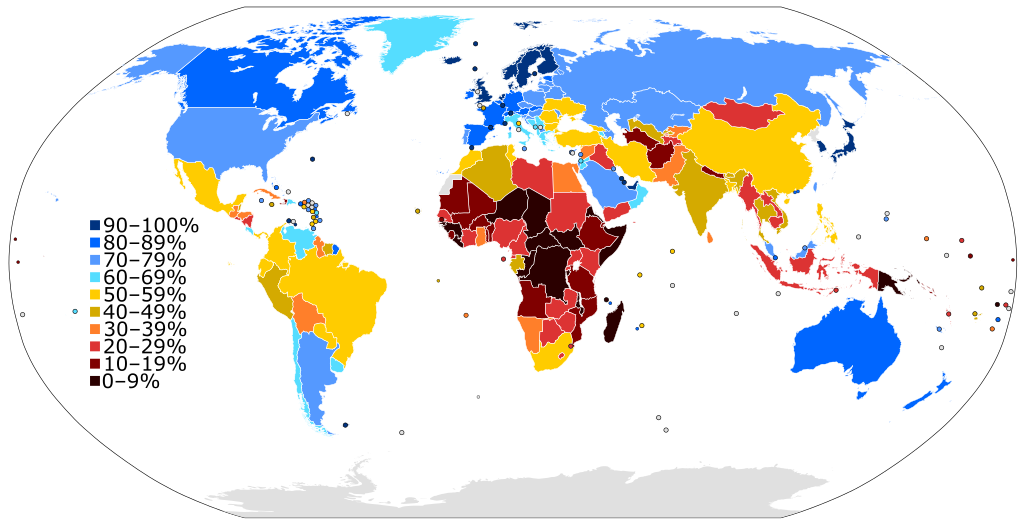
Communication technology has become so important and so intertwined with the economic imperative that the term, digital divide, has come into being. Digital natives, or people who grew up using technology, are often citizens of wealthy nations that live lives of privilege and have better economic prospects because of their technological access. People who grew up in poorer nations without technological skills and access, often have fewer economic opportunities. At the end of the last century, this idea was captured in the statement, “they live on the other side of the tracks.” The other side of the train tracks referred to a less desirable location. In today’s world, the “tracks” have been replaced by technology, and the digital divide.
Figure \(\PageIndex{2}\): A world map colored to show the level of Internet penetration as of 2016
Does the digital divide lead you to ponder ethical issues of privilege and wealth? Ethics, the principles of conduct that help govern behaviors of individuals and groups, often create cultural questions that lead to our understanding of the ethical imperative. Ethical principles often arise from community consensus of what is good or bad, right or wrong, and what “ought” to be as opposed to what “is.” Some ethical issues are explicit or clearly stated within a culture, while other are implicit or not clearly stated.
When pondering ethical situations and cultural mores, there are two ways humans view the situation, relativistically or universally. If you are a relativist, you believe that no cultural pattern is inherently right or wrong, everything depends on perspective. In other words, you might not make the same choice yourself, but are willing to understand why others would make that choice. If you are a universalist, you believe that cultural differences are only superficial, and that fundamental notions of right and wrong are universal. In other words, everyone should be making the same choices for the same reasons. Although universalism and relativism are thought of as an either/or choice (non-dualistic), realistically most people are a combination of both (dualistic). There are some issues you might hold strict opinions about while other issues you are willing to be more open about.
One of the most important reasons for studying intercultural communication is the awareness it raises of our own cultural identity and background. The self-awareness imperative helps us to gain insights into our own culture along with our intercultural experiences. All cultures are ethnocentric by their very natures. Ethnocentrism is a tendency to think that our own culture is superior to other cultures. Most of us don’t even realize that we think this way, but we do. Sure, we might admit that our culture isn’t perfect, yet we still think that we’re doing better than that culture to the north or south of us. Ethnocentrism can lead to stereotyping, prejudice, and discrimination. It will be discussed in greater depth in coming chapters.
The opposite of ethnocentrism is self-reflexivity and mindful-communication or the process of learning to understand oneself and one’s position in society. Learning about others helps us to understand ourselves. Real people with real lives struggle with decisions just like you do. They have values, and beliefs that govern their choices. Listening to the voices of people who are different can lead to different ways of seeing the world. Developing self-awareness may also lead to an increased awareness of being caught up in the political, economic, and historical systems that are not associated with an individual’s choice.
As you ponder your reasons for studying intercultural communication, it is hoped that you make a conscious effort to become more aware of the communication practices of yourself and others. Much of the communication principles and theories that you learn about in this book occur at a subconscious level. As you learn more, challenge yourself to develop observation skills so you can “see” more. As you learn more, become more flexible in your interpretation of the messages that you are receiving from others. As you learn more, begin to create meaning “with” others and avoid dictating “to” others. The study of intercultural communication is the study of the variation of your story within the human story. Let’s get started.
Key Terms
Intercultural Communication – The study of how culture influences communication behaviors and interpretations.
Proxemics – Edward T. Hall’s concept describing how people use personal space.
High-Context Culture – Cultures where meaning is derived heavily from context, relationships, and nonverbal cues.
Low-Context Culture – Cultures where meaning is conveyed primarily through explicit verbal messages.
Monochronic Time – A cultural orientation that values doing one task at a time and adhering to schedules.
Polychronic Time – A cultural orientation that values multitasking and flexible time use.
Imperatives – Six compelling reasons to study intercultural communication: peace, demographic, economic, technological, ethical, and self-awareness.
Peace Imperative – The need to understand cultural differences to reduce conflict and improve coexistence.
Demographic Imperative – The impact of changing population patterns, immigration, and diversity on communication.
Economic Imperative – The need to understand global markets and cultural differences to function in a globalized economy.
Technological Imperative – How technology increases global contact and shapes identity, access, and communication patterns.
Ethical Imperative – The need to understand cultural values and moral frameworks when making decisions across cultures.
Self-Awareness Imperative – Understanding one’s own cultural identity and biases to communicate more effectively.
Ethnocentrism – The belief that one’s own culture is superior to others.
Self-Reflexivity – The process of examining one’s own cultural assumptions and social position.
Heterogeneous – A population or group characterized by cultural differences.
Homogeneous – A population or group characterized by cultural similarities.
Melting Pot – A metaphor suggesting immigrants assimilate into a dominant culture (considered a myth by most researchers).
Tossed Salad – A metaphor suggesting cultural groups retain distinct identities while contributing to a larger whole.
Diasporic Groups – Ethnic or national groups dispersed across different countries who maintain cultural connections through communication.
References for Futher Reading:
Hall, E. T. (1959). The silent language. Doubleday.
Hall, E. T. (1966). The hidden dimension. Doubleday.
Hall, E. T. (1976). Beyond culture. Anchor Books.
Martin, J. N., & Nakayama, T. K. (2011). Experiencing intercultural communication (5th ed.). New York: McGraw-Hill Higher Education.
Samovar, L. A., & Porter, R. E. (1977). Intercultural communication: A reader. Wadsworth Publishing.



 Edward T. Hall was an American Anthropologist who did some of the most import early work in the field of Cultural Anthropology.

 The United States has an interesting history in relationship to its’ immigrants. A commonly used metaphor called the melting pot assumes that immigrants and cultural minorities are assimilated into the US majority culture, losing their original cultures. Most researchers believe that the melting pot is a myth, and a better metaphor would be the tossed salad or rather the diversity of immigrants and minorities is still apparent, but part of a nourishing whole.