

8: Supreme Court Selection Process
- Page ID
- 231673
\( \newcommand{\vecs}[1]{\overset { \scriptstyle \rightharpoonup} {\mathbf{#1}} } \)
\( \newcommand{\vecd}[1]{\overset{-\!-\!\rightharpoonup}{\vphantom{a}\smash {#1}}} \)
\( \newcommand{\dsum}{\displaystyle\sum\limits} \)
\( \newcommand{\dint}{\displaystyle\int\limits} \)
\( \newcommand{\dlim}{\displaystyle\lim\limits} \)
\( \newcommand{\id}{\mathrm{id}}\) \( \newcommand{\Span}{\mathrm{span}}\)
( \newcommand{\kernel}{\mathrm{null}\,}\) \( \newcommand{\range}{\mathrm{range}\,}\)
\( \newcommand{\RealPart}{\mathrm{Re}}\) \( \newcommand{\ImaginaryPart}{\mathrm{Im}}\)
\( \newcommand{\Argument}{\mathrm{Arg}}\) \( \newcommand{\norm}[1]{\| #1 \|}\)
\( \newcommand{\inner}[2]{\langle #1, #2 \rangle}\)
\( \newcommand{\Span}{\mathrm{span}}\)
\( \newcommand{\id}{\mathrm{id}}\)
\( \newcommand{\Span}{\mathrm{span}}\)
\( \newcommand{\kernel}{\mathrm{null}\,}\)
\( \newcommand{\range}{\mathrm{range}\,}\)
\( \newcommand{\RealPart}{\mathrm{Re}}\)
\( \newcommand{\ImaginaryPart}{\mathrm{Im}}\)
\( \newcommand{\Argument}{\mathrm{Arg}}\)
\( \newcommand{\norm}[1]{\| #1 \|}\)
\( \newcommand{\inner}[2]{\langle #1, #2 \rangle}\)
\( \newcommand{\Span}{\mathrm{span}}\) \( \newcommand{\AA}{\unicode[.8,0]{x212B}}\)
\( \newcommand{\vectorA}[1]{\vec{#1}} % arrow\)
\( \newcommand{\vectorAt}[1]{\vec{\text{#1}}} % arrow\)
\( \newcommand{\vectorB}[1]{\overset { \scriptstyle \rightharpoonup} {\mathbf{#1}} } \)
\( \newcommand{\vectorC}[1]{\textbf{#1}} \)
\( \newcommand{\vectorD}[1]{\overrightarrow{#1}} \)
\( \newcommand{\vectorDt}[1]{\overrightarrow{\text{#1}}} \)
\( \newcommand{\vectE}[1]{\overset{-\!-\!\rightharpoonup}{\vphantom{a}\smash{\mathbf {#1}}}} \)
\( \newcommand{\vecs}[1]{\overset { \scriptstyle \rightharpoonup} {\mathbf{#1}} } \)
\(\newcommand{\longvect}{\overrightarrow}\)
\( \newcommand{\vecd}[1]{\overset{-\!-\!\rightharpoonup}{\vphantom{a}\smash {#1}}} \)
\(\newcommand{\avec}{\mathbf a}\) \(\newcommand{\bvec}{\mathbf b}\) \(\newcommand{\cvec}{\mathbf c}\) \(\newcommand{\dvec}{\mathbf d}\) \(\newcommand{\dtil}{\widetilde{\mathbf d}}\) \(\newcommand{\evec}{\mathbf e}\) \(\newcommand{\fvec}{\mathbf f}\) \(\newcommand{\nvec}{\mathbf n}\) \(\newcommand{\pvec}{\mathbf p}\) \(\newcommand{\qvec}{\mathbf q}\) \(\newcommand{\svec}{\mathbf s}\) \(\newcommand{\tvec}{\mathbf t}\) \(\newcommand{\uvec}{\mathbf u}\) \(\newcommand{\vvec}{\mathbf v}\) \(\newcommand{\wvec}{\mathbf w}\) \(\newcommand{\xvec}{\mathbf x}\) \(\newcommand{\yvec}{\mathbf y}\) \(\newcommand{\zvec}{\mathbf z}\) \(\newcommand{\rvec}{\mathbf r}\) \(\newcommand{\mvec}{\mathbf m}\) \(\newcommand{\zerovec}{\mathbf 0}\) \(\newcommand{\onevec}{\mathbf 1}\) \(\newcommand{\real}{\mathbb R}\) \(\newcommand{\twovec}[2]{\left[\begin{array}{r}#1 \\ #2 \end{array}\right]}\) \(\newcommand{\ctwovec}[2]{\left[\begin{array}{c}#1 \\ #2 \end{array}\right]}\) \(\newcommand{\threevec}[3]{\left[\begin{array}{r}#1 \\ #2 \\ #3 \end{array}\right]}\) \(\newcommand{\cthreevec}[3]{\left[\begin{array}{c}#1 \\ #2 \\ #3 \end{array}\right]}\) \(\newcommand{\fourvec}[4]{\left[\begin{array}{r}#1 \\ #2 \\ #3 \\ #4 \end{array}\right]}\) \(\newcommand{\cfourvec}[4]{\left[\begin{array}{c}#1 \\ #2 \\ #3 \\ #4 \end{array}\right]}\) \(\newcommand{\fivevec}[5]{\left[\begin{array}{r}#1 \\ #2 \\ #3 \\ #4 \\ #5 \\ \end{array}\right]}\) \(\newcommand{\cfivevec}[5]{\left[\begin{array}{c}#1 \\ #2 \\ #3 \\ #4 \\ #5 \\ \end{array}\right]}\) \(\newcommand{\mattwo}[4]{\left[\begin{array}{rr}#1 \amp #2 \\ #3 \amp #4 \\ \end{array}\right]}\) \(\newcommand{\laspan}[1]{\text{Span}\{#1\}}\) \(\newcommand{\bcal}{\cal B}\) \(\newcommand{\ccal}{\cal C}\) \(\newcommand{\scal}{\cal S}\) \(\newcommand{\wcal}{\cal W}\) \(\newcommand{\ecal}{\cal E}\) \(\newcommand{\coords}[2]{\left\{#1\right\}_{#2}}\) \(\newcommand{\gray}[1]{\color{gray}{#1}}\) \(\newcommand{\lgray}[1]{\color{lightgray}{#1}}\) \(\newcommand{\rank}{\operatorname{rank}}\) \(\newcommand{\row}{\text{Row}}\) \(\newcommand{\col}{\text{Col}}\) \(\renewcommand{\row}{\text{Row}}\) \(\newcommand{\nul}{\text{Nul}}\) \(\newcommand{\var}{\text{Var}}\) \(\newcommand{\corr}{\text{corr}}\) \(\newcommand{\len}[1]{\left|#1\right|}\) \(\newcommand{\bbar}{\overline{\bvec}}\) \(\newcommand{\bhat}{\widehat{\bvec}}\) \(\newcommand{\bperp}{\bvec^\perp}\) \(\newcommand{\xhat}{\widehat{\xvec}}\) \(\newcommand{\vhat}{\widehat{\vvec}}\) \(\newcommand{\uhat}{\widehat{\uvec}}\) \(\newcommand{\what}{\widehat{\wvec}}\) \(\newcommand{\Sighat}{\widehat{\Sigma}}\) \(\newcommand{\lt}{<}\) \(\newcommand{\gt}{>}\) \(\newcommand{\amp}{&}\) \(\definecolor{fillinmathshade}{gray}{0.9}\)We turn our attention now to the third branch of government: the judiciary, and in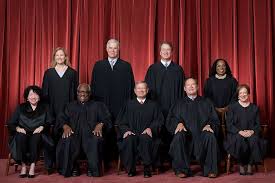 particular, the Supreme Court of the United States (SCOTUS).
Article III of the Constitution -the thinnest article of the three covering the branches of government- does not specify much in terms of the requirements for nominees to this important post, nor does it set aside as many powers as the other branches enjoy. Nevertheless, SCOTUS is a formidable force in our democracy as it has the final say on the laws Congress pass -what their wording means, and indeed, whether or not they are constitutional. It is therefore crucial to staff the bench with justices who can rise to the task, uphold our democratic values, keep advancing our civil rights and liberties, and move our nation toward greater justice and fairness for all.
Our nation's legal system is greatly impacted by the intensely political and closely watched process of choosing justices for the U.S. Supreme Court. The Senate confirms the president's nominations, and candidates are usually assessed according to their legal knowledge, judicial philosophy, and ideological affinities. To guarantee that the Court represents the demographics and lived experiences of the country, there has been an increasing focus in recent years on integrating diversity, equity, and inclusion (DEI) in the selection process.
The module examines the following essential elements:
1. How the president chooses Supreme Court candidates through a selection process that considers legal qualifications, judicial beliefs, and political factors such as race, ethnicity, and gender.
2. The detailed evaluation process nominees face, which includes background investigations and Senate Judiciary Committee hearings before receiving a Senate vote.
3. How the selection process for Supreme Court justices depends on political ideology along with legal experience, past rulings, and public opinion.
The Selection Process in a Nutshell 
1. A vacancy occurs on the court either because a justice dies, retires, or new bench seats are added by the Congress (though the latter has not happened since 1869).
2. The president receives the curricula vitae (resumes) of candidates.
3. The president creates their first short list: their top 24 candidates are selected based on ideology, age, gender, ethnicity, race, and experience.
4. The shortlisted candidates' files are forwarded to the Federal Bureau of Investigation (FBI) for thorough background checks.
5. A second shortlist of 12 is created and ranked #1, #2, #3.
6. In a press conference the president announces and introduces their top pick for the vacancy.
7. Usually, this is followed by a two week waiting period, giving the media and the public a chance to do their own research, and weigh in on the fitness of candidate to the office.
8. If the candidate 'survives' the two week period, they get sent to the Hill for Senate confirmation hearings with the Judiciary Committee.
9. After the hearings, the Senate Judiciary Committee votes for the candidate, before the whole Senate does.
10. If the nominee is approved, they are seated at the bench, if denied, the president may move on to the #2 on their list
SCOTUS and DEI
For decades, if not centuries, the majority of justices confirmed and even considered were white, male, and from prestigious legal backgrounds. In its 230+-year history, there have only been three Black justices and five women. Critics contend that the Court's capacity to comprehend cases involving gender, race, disability, and other equity issues is constrained by this homogeneity. DEI proponents stress that diverse justices, regardless of their gender, race, professional experience, or socioeconomic background, contribute a range of viewpoints that improve deliberations and the public's confidence in the judiciary.
Read about the nomination process in greater detail in the next section, and contemplate the value of a diverse court. In our classroom activity, you get to participate in a mock nomination hands-on, and our homework assignment challenges you to assimilate all that you have learned in an analytical essay.
Student Learning Outcomes
- Process Mastery: Trace the 10-step Supreme Court nomination process from vacancy to Senate confirmation, identifying key decision points where politics and qualifications intersect.
- Constitutional Context: Explain how Article III's minimal requirements for justices have allowed evolving standards for judicial appointments over time.
- DEI Analysis: Evaluate how factors like race, gender, and professional background (e.g., public defense vs. corporate law) influence modern nomination shortlists.
- Historical Assessment: Compare demographic data of past SCOTUS benches to demonstrate underrepresentation of women and minorities in judicial history.
- Case Impact: Analyze how diverse justices like Thurgood Marshall or Ketanji Brown Jackson have shaped landmark civil rights rulings.
- Stakeholder Perspectives: Defend or critique the role of Senate hearings, media scrutiny, and public opinion in vetting nominees' "fitness" for office.
- Reform Proposal: Design an evidence-based reform to improve diversity in nominations without compromising judicial expertise.