

3.2.1: Respect for Diversity
- Page ID
- 188178

\( \newcommand{\vecs}[1]{\overset { \scriptstyle \rightharpoonup} {\mathbf{#1}} } \)
\( \newcommand{\vecd}[1]{\overset{-\!-\!\rightharpoonup}{\vphantom{a}\smash {#1}}} \)
\( \newcommand{\dsum}{\displaystyle\sum\limits} \)
\( \newcommand{\dint}{\displaystyle\int\limits} \)
\( \newcommand{\dlim}{\displaystyle\lim\limits} \)
\( \newcommand{\id}{\mathrm{id}}\) \( \newcommand{\Span}{\mathrm{span}}\)
( \newcommand{\kernel}{\mathrm{null}\,}\) \( \newcommand{\range}{\mathrm{range}\,}\)
\( \newcommand{\RealPart}{\mathrm{Re}}\) \( \newcommand{\ImaginaryPart}{\mathrm{Im}}\)
\( \newcommand{\Argument}{\mathrm{Arg}}\) \( \newcommand{\norm}[1]{\| #1 \|}\)
\( \newcommand{\inner}[2]{\langle #1, #2 \rangle}\)
\( \newcommand{\Span}{\mathrm{span}}\)
\( \newcommand{\id}{\mathrm{id}}\)
\( \newcommand{\Span}{\mathrm{span}}\)
\( \newcommand{\kernel}{\mathrm{null}\,}\)
\( \newcommand{\range}{\mathrm{range}\,}\)
\( \newcommand{\RealPart}{\mathrm{Re}}\)
\( \newcommand{\ImaginaryPart}{\mathrm{Im}}\)
\( \newcommand{\Argument}{\mathrm{Arg}}\)
\( \newcommand{\norm}[1]{\| #1 \|}\)
\( \newcommand{\inner}[2]{\langle #1, #2 \rangle}\)
\( \newcommand{\Span}{\mathrm{span}}\) \( \newcommand{\AA}{\unicode[.8,0]{x212B}}\)
\( \newcommand{\vectorA}[1]{\vec{#1}} % arrow\)
\( \newcommand{\vectorAt}[1]{\vec{\text{#1}}} % arrow\)
\( \newcommand{\vectorB}[1]{\overset { \scriptstyle \rightharpoonup} {\mathbf{#1}} } \)
\( \newcommand{\vectorC}[1]{\textbf{#1}} \)
\( \newcommand{\vectorD}[1]{\overrightarrow{#1}} \)
\( \newcommand{\vectorDt}[1]{\overrightarrow{\text{#1}}} \)
\( \newcommand{\vectE}[1]{\overset{-\!-\!\rightharpoonup}{\vphantom{a}\smash{\mathbf {#1}}}} \)
\( \newcommand{\vecs}[1]{\overset { \scriptstyle \rightharpoonup} {\mathbf{#1}} } \)
\(\newcommand{\longvect}{\overrightarrow}\)
\( \newcommand{\vecd}[1]{\overset{-\!-\!\rightharpoonup}{\vphantom{a}\smash {#1}}} \)
\(\newcommand{\avec}{\mathbf a}\) \(\newcommand{\bvec}{\mathbf b}\) \(\newcommand{\cvec}{\mathbf c}\) \(\newcommand{\dvec}{\mathbf d}\) \(\newcommand{\dtil}{\widetilde{\mathbf d}}\) \(\newcommand{\evec}{\mathbf e}\) \(\newcommand{\fvec}{\mathbf f}\) \(\newcommand{\nvec}{\mathbf n}\) \(\newcommand{\pvec}{\mathbf p}\) \(\newcommand{\qvec}{\mathbf q}\) \(\newcommand{\svec}{\mathbf s}\) \(\newcommand{\tvec}{\mathbf t}\) \(\newcommand{\uvec}{\mathbf u}\) \(\newcommand{\vvec}{\mathbf v}\) \(\newcommand{\wvec}{\mathbf w}\) \(\newcommand{\xvec}{\mathbf x}\) \(\newcommand{\yvec}{\mathbf y}\) \(\newcommand{\zvec}{\mathbf z}\) \(\newcommand{\rvec}{\mathbf r}\) \(\newcommand{\mvec}{\mathbf m}\) \(\newcommand{\zerovec}{\mathbf 0}\) \(\newcommand{\onevec}{\mathbf 1}\) \(\newcommand{\real}{\mathbb R}\) \(\newcommand{\twovec}[2]{\left[\begin{array}{r}#1 \\ #2 \end{array}\right]}\) \(\newcommand{\ctwovec}[2]{\left[\begin{array}{c}#1 \\ #2 \end{array}\right]}\) \(\newcommand{\threevec}[3]{\left[\begin{array}{r}#1 \\ #2 \\ #3 \end{array}\right]}\) \(\newcommand{\cthreevec}[3]{\left[\begin{array}{c}#1 \\ #2 \\ #3 \end{array}\right]}\) \(\newcommand{\fourvec}[4]{\left[\begin{array}{r}#1 \\ #2 \\ #3 \\ #4 \end{array}\right]}\) \(\newcommand{\cfourvec}[4]{\left[\begin{array}{c}#1 \\ #2 \\ #3 \\ #4 \end{array}\right]}\) \(\newcommand{\fivevec}[5]{\left[\begin{array}{r}#1 \\ #2 \\ #3 \\ #4 \\ #5 \\ \end{array}\right]}\) \(\newcommand{\cfivevec}[5]{\left[\begin{array}{c}#1 \\ #2 \\ #3 \\ #4 \\ #5 \\ \end{array}\right]}\) \(\newcommand{\mattwo}[4]{\left[\begin{array}{rr}#1 \amp #2 \\ #3 \amp #4 \\ \end{array}\right]}\) \(\newcommand{\laspan}[1]{\text{Span}\{#1\}}\) \(\newcommand{\bcal}{\cal B}\) \(\newcommand{\ccal}{\cal C}\) \(\newcommand{\scal}{\cal S}\) \(\newcommand{\wcal}{\cal W}\) \(\newcommand{\ecal}{\cal E}\) \(\newcommand{\coords}[2]{\left\{#1\right\}_{#2}}\) \(\newcommand{\gray}[1]{\color{gray}{#1}}\) \(\newcommand{\lgray}[1]{\color{lightgray}{#1}}\) \(\newcommand{\rank}{\operatorname{rank}}\) \(\newcommand{\row}{\text{Row}}\) \(\newcommand{\col}{\text{Col}}\) \(\renewcommand{\row}{\text{Row}}\) \(\newcommand{\nul}{\text{Nul}}\) \(\newcommand{\var}{\text{Var}}\) \(\newcommand{\corr}{\text{corr}}\) \(\newcommand{\len}[1]{\left|#1\right|}\) \(\newcommand{\bbar}{\overline{\bvec}}\) \(\newcommand{\bhat}{\widehat{\bvec}}\) \(\newcommand{\bperp}{\bvec^\perp}\) \(\newcommand{\xhat}{\widehat{\xvec}}\) \(\newcommand{\vhat}{\widehat{\vvec}}\) \(\newcommand{\uhat}{\widehat{\uvec}}\) \(\newcommand{\what}{\widehat{\wvec}}\) \(\newcommand{\Sighat}{\widehat{\Sigma}}\) \(\newcommand{\lt}{<}\) \(\newcommand{\gt}{>}\) \(\newcommand{\amp}{&}\) \(\definecolor{fillinmathshade}{gray}{0.9}\)Appreciating Diversity
The 2017 Multicultural Guidelines emphasize three interrelated concepts crucial for culturally responsive psychology: cultural humility, cultural competence, and reflexivity. These concepts guide psychologists in fostering inclusive, ethical, and effective interactions with diverse populations.
Cultural Competence, Humility, and Reflexivity
Photo by stokpic is licensed under the Pixabay License

Cultural competence, on the other hand, refers to the ability to interact effectively with individuals from diverse backgrounds by acquiring cultural awareness, knowledge, and skills (Sue et al., 1982). It involves recognizing one’s biases, understanding cultural values and traditions, and modifying psychological interventions to fit cultural contexts. However, critics argue that cultural competence may sometimes be reduced to a checklist approach, where professionals assume they have "learned enough" about a culture rather than engaging in continuous growth (Fisher-Borne et al., 2015). A competent psychologist working with Latinx clients, for instance, would recognize the significance of familismo—the emphasis on family interconnectedness—and incorporate family members into therapy when appropriate.
Reflexivity complements both cultural humility and competence by encouraging psychologists to critically examine their own cultural identities, biases, and power dynamics in professional interactions. Reflexivity is an ongoing process that requires self-awareness and active efforts to mitigate personal and systemic biases (Finlay, 2002). It involves questioning how one's background influences perceptions of clients, students, or research participants and taking steps to ensure that these perspectives do not reinforce oppressive structures. Strategies for reflexivity include journaling, seeking supervision, engaging in cultural immersion experiences, and applying ethical decision-making models that consider cultural factors. For example, a White psychologist working with African American clients might reflect on their own privilege and implicit biases, seeking feedback from colleagues of color to ensure their therapeutic approach is culturally sensitive.
Together, cultural humility, competence, and reflexivity create a framework for psychologists to engage ethically and effectively in multicultural settings. Rather than viewing these concepts in isolation, they should be integrated as a dynamic and continuous process. Cultural humility fosters openness and lifelong learning, cultural competence provides practical knowledge and skills, and reflexivity ensures that psychologists remain critical of their assumptions and adapt to the needs of the individuals they serve. By incorporating these principles, psychologists can work toward reducing bias, promoting inclusivity, and fostering meaningful cross-cultural relationships in research, education, and clinical
Dimensions of Diversity

“Harmony Day (5475651018)” by DIAC images is licensed under CC BY 2.0
Culture
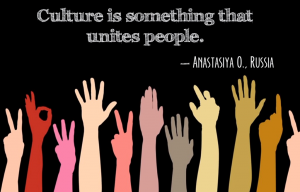 Culture is an important dimension of diversity for psychologists to examine. In general, culture has been challenging to define, with modern definitions viewing culture as a dynamic concept that changes both individuals and societies together over time. Further, culture in today’s society refers to more than just cultural and ethnic groups but also includes racial groups, religious groups, sexual minority groups, socioeconomic groups, nation-states, and corporations. While numerous definitions for culture are available, there are key defining components, such as shared meanings and shared experiences by individuals in a group that are passed down over time with each generation. That is, cultures have shared beliefs, values, practices, definitions, and other elements that are expressed through family socialization, formal schooling, shared language, social roles, and norms for feeling, thinking, and acting (Cohen, 2009).
“Culture is something that unites people.” by Exchanges Photos is licensed under CC0 1.0
Using the Ecological Model, culture can be examined at multiple levels to understand its impact. This means that culture can influence the norms and practices of individuals, families, organizations, local communities, and the broader society. For example, cultural influences can have an impact on how members function and interact with one another. Further, culture should be understood within a broader context of power relationships, and how power is used and distributed (Clauss-Elhers, 2019).
Race

Ethnicity
“Elderly Japanese Women” by Teo Romera is licensed under CC BY-SA 2.0
 Ethnicity refers to one’s social identity based on the culture of origin, ancestry, or affiliation with a cultural group (Pinderhughes, 1989). Ethnicity is not the same as nationality, which is a person’s status of belonging to a specific nation by birth or citizenship (e.g., an individual can be of Japanese ethnicity but British nationality because they were born in the United Kingdom). Ethnicity is defined by aspects of subjective culture such as customs, language, and social ties (Resnicow, Braithwaite, Ahluwalia, & Baranowski, 1999).
Gender
Age
Social Class
Sexual Orientation
Ability/Disability

Religion & Spirituality

Impact of Identities

Diversity in Practice
Critical Thought Questions
References
American Psychological Association. (2017). Multicultural guidelines: An ecological approach to context, identity, and intersectionality. APA.