

10.1: Consciousness
- Page ID
- 381607
This page is a draft and under active development. Please forward any questions, comments, and/or feedback to the ASCCC OERI (oeri@asccc.org).

\( \newcommand{\vecs}[1]{\overset { \scriptstyle \rightharpoonup} {\mathbf{#1}} } \)
\( \newcommand{\vecd}[1]{\overset{-\!-\!\rightharpoonup}{\vphantom{a}\smash {#1}}} \)
\( \newcommand{\dsum}{\displaystyle\sum\limits} \)
\( \newcommand{\dint}{\displaystyle\int\limits} \)
\( \newcommand{\dlim}{\displaystyle\lim\limits} \)
\( \newcommand{\id}{\mathrm{id}}\) \( \newcommand{\Span}{\mathrm{span}}\)
( \newcommand{\kernel}{\mathrm{null}\,}\) \( \newcommand{\range}{\mathrm{range}\,}\)
\( \newcommand{\RealPart}{\mathrm{Re}}\) \( \newcommand{\ImaginaryPart}{\mathrm{Im}}\)
\( \newcommand{\Argument}{\mathrm{Arg}}\) \( \newcommand{\norm}[1]{\| #1 \|}\)
\( \newcommand{\inner}[2]{\langle #1, #2 \rangle}\)
\( \newcommand{\Span}{\mathrm{span}}\)
\( \newcommand{\id}{\mathrm{id}}\)
\( \newcommand{\Span}{\mathrm{span}}\)
\( \newcommand{\kernel}{\mathrm{null}\,}\)
\( \newcommand{\range}{\mathrm{range}\,}\)
\( \newcommand{\RealPart}{\mathrm{Re}}\)
\( \newcommand{\ImaginaryPart}{\mathrm{Im}}\)
\( \newcommand{\Argument}{\mathrm{Arg}}\)
\( \newcommand{\norm}[1]{\| #1 \|}\)
\( \newcommand{\inner}[2]{\langle #1, #2 \rangle}\)
\( \newcommand{\Span}{\mathrm{span}}\) \( \newcommand{\AA}{\unicode[.8,0]{x212B}}\)
\( \newcommand{\vectorA}[1]{\vec{#1}} % arrow\)
\( \newcommand{\vectorAt}[1]{\vec{\text{#1}}} % arrow\)
\( \newcommand{\vectorB}[1]{\overset { \scriptstyle \rightharpoonup} {\mathbf{#1}} } \)
\( \newcommand{\vectorC}[1]{\textbf{#1}} \)
\( \newcommand{\vectorD}[1]{\overrightarrow{#1}} \)
\( \newcommand{\vectorDt}[1]{\overrightarrow{\text{#1}}} \)
\( \newcommand{\vectE}[1]{\overset{-\!-\!\rightharpoonup}{\vphantom{a}\smash{\mathbf {#1}}}} \)
\( \newcommand{\vecs}[1]{\overset { \scriptstyle \rightharpoonup} {\mathbf{#1}} } \)
\(\newcommand{\longvect}{\overrightarrow}\)
\( \newcommand{\vecd}[1]{\overset{-\!-\!\rightharpoonup}{\vphantom{a}\smash {#1}}} \)
\(\newcommand{\ket}[1]{\left| #1 \right>}\)
\(\newcommand{\bra}[1]{\left< #1 \right|}\)
\(\newcommand{\braket}[2]{\left< #1 \vphantom{#2} \right| \left. #2 \vphantom{#1} \right>}\)
\(\newcommand{\braopket}[3]{\left< #1 \vphantom{#2}\vphantom{#3} \right| #2 \vphantom{#1}\vphantom{#3} \left| #3 \vphantom{#1}\vphantom{#2} \right>}\)
\(\newcommand{\qmvec}[1]{\mathbf{\vec{#1}}}\)
\(\newcommand{\op}[1]{\hat{\mathbf{#1}}}\)
\(\newcommand{\expect}[1]{\langle #1 \rangle}\)
\(\newcommand{\dfn}[1]{\emph{\textbf{#1}}}\)
- Differentiate the main theories of consciousness.
- Describe the Default Mode Network including its associated brain structures and its role in varying levels of consciousness
Overview
What does it mean to be conscious? Clearly when someone has fainted, they are unconscious, and when they are sitting up and solving a math problem alongside you they are conscious. But consider this, when a child I was babysitting walked into my living room one night, but refused to answer me when I asked her if everything was alright, it was my first experience with sleepwalking. Would you say she was conscious? Alternately, is there a difference between the level or kind of consciousness you experience while taking an exam, versus when you have eaten some marijuana brownies, versus when you are meditating? There are theories about whether consciousness varies on levels or types. There has also been much research looking at the brain underpinnings of these different states. So theories of consciousness as well as the Default Mode Network (brain parts involved in resting wakefulness) will be described below.
Theories of Consciousness
Conscious states can be thought of as global dimensions of consciousness that can modulate how we think, feel and behave (Bayne and Hohwy 2016; Bayne et al. 2016). For example, in the state of ordinary waking awareness, a wide variety of inputs can enter consciousness, and a wide variety of cognitive and behavioral capacities can be exercised. In other conscious states, however, both the range of conscious content and the range of cognitive and behavioral capacities may be curtailed. Conditions that are often associated with changes in conscious state include post-comatose disorders of consciousness (Bruno et al. 2011; Casarotto et al. 2016), sleep and drug-induced sedation (Sarasso et al. 2015), and certain pathologies of consciousness, such as epileptic absence seizures (Gloor 1986; Blumenfeld 2005; Bayne 2011). For example, Minimally Conscious State patients can track certain features of their environment (such as the presence of motion or the semantic content of simple instructions), but they lack the capacity to engage in complex forms of cognition or behavior, and they seem unable to entertain complex thoughts or ideas (Giacino et al. 2002).
The Integrated Information Theory of Consciousness (IITC) is one theory suggesting that consciousness can be explained in terms of levels (Tononi & Koch, 2015). However, this assumes that conscious states can be ordered along a single continuum. Indeed, using transcranial magnetic stimulation (TMS – as you learned about in chapter 2) and computerized compression of the wave patterns that result, Casali et al (2013) figured out a way to objectively measure different states of consciousness including healthy subjects who are awake, dreaming, in NREM sleep, and those who are sedated, as well as in patients who had emerged from coma. But these are still not quite levels, and might indeed be thought of as qualitatively separate states of consciousness.
On the other hand, Bayne and Carter (2018) claim that consciousness ought to be construed in multidimensional terms, and that conscious states can differ from each other along multiple dimensions. For example, one of their central claims is that although the psychedelic state is distinct from the state of ordinary waking awareness, it is neither ‘higher’ nor ‘lower’ than the state of ordinary waking awareness.
The Global Workspace Theory of Consciousness (Dahaene et al., 2017) holds that changes in consciousness only involve ‘vigilance’ and ‘wakefulness’ where there is global availability of content. But this theory does not consider the multidimensional nature of consciousness.
Consider the state of consciousness elicited by psychedelic drugs. The psychedelic state involves a state that certainly differs from that associated with ordinary waking awareness, but there is no reason to think that individuals in the psychedelic state are more conscious (or, for that matter, less conscious) than individuals who are not in it. Why do psychedelics increase the vividness, complexity and possibly also the bandwidth of sensory experience? What explains the systematic effects that psychedelics have on the experience of unity across a wide range of domains (e.g. time, space and the self)? Addressing these questions have helped researchers to identify the various dimensions that structure consciousness. Additionally, as presented in the chapter 6 on drugs, since much is known about the neurochemical effects of psychedelics, using this knowledge in both animal models and human imaging might provide a window into understanding the neural basis of consciousness.
Default Mode Network
Raichle et al coined the term, Default Mode Network (DMN) in 2001 to describe how the brain is constantly active even when not doing anything actively (See Figure \(\PageIndex{1}\)). The regions in this network exhibit decreased activation when engaging in goal-oriented or attention-demanding tasks, and therefore facilitate a “default” functional state within the brain. (Raichle et al., 2001; Figure \(\PageIndex{1}\)).
The brain is constantly active even when it is not engaged in a task. In the restful yet awake state, the default mode network is primarily activated. It used to also be called the task negative network – meaning that it was deactivated when we are engaged in a particular task. The main parts in this network include the medial prefrontal cortex, posterior cingulate cortex/precuneus and angular gyrus
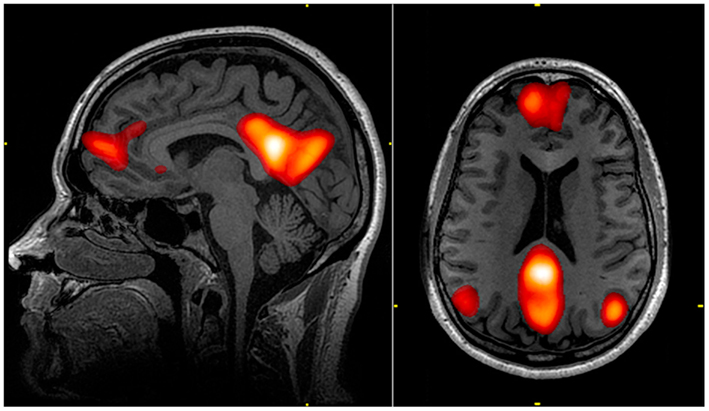
This network is active when one is in a state of wakeful rest, for example when one is daydreaming, relaxing, or meditating.
DMN activation is modulated in different types of consciousness changes. Table \(\PageIndex{1}\) summarizes studies showing these connections.
| Consciousness change | Effect on DMN | Research credit |
|---|---|---|
| Acupuncture | DMN connectivity reduced in pain response | Huang et al, 2012 |
| Meditation | Structural changes in areas of precuneus | Fox et al, 2014 |
| Resting wakefulness | Increase in DMN | Picchioni et al, 2013 |
| Sleep deprivation | Decrease in connectivity | McKenna & Eyler, 2012 |
| Use of psychedelics | reduced blood flow to precuneus and medial prefrontal cortex | Carhart-Ellis et al, 2012 |
| Deep brain stimulation | used to rebalance the restful brain structures | Kringelbach et al, 2011 |
| Psychotherapy | helps stabilize the DMN in PTSD sufferers | Sripada et al, 2012 |
| Attention training techniques | help increase connectivity in DMN | Kowalski et al, 2020 |
| Antidepressant use | improves abnormalities in DMN in PTSD sufferers | Akiki et al, 2017 |
| Physical activity and exercise | alters DMN | Shao et al, 2019; Muraskin et al, 2016; Voss et al, 2019 |
Summary
There has been a lot of research into what consciousness means philosophically and how that ties in with brain activity. Clearly, when one is asleep there is a difference in the awareness of stimuli, thought and function behaviorally. Biological psychologists have attempted to establish whether the differences in consciousness experienced while awake, asleep, under the influence of different drugs, while meditating, and in comatose states are qualitative or quantitative differences. Images of the brain in these different conditions have helped scientists come up with theories - and arguments - for each of these positions
References
Akiki, T. J., Averill, C. L., & Abdallah, C. G. (2017). A Network-Based Neurobiological Model of PTSD: Evidence From Structural and Functional Neuroimaging Studies. Current psychiatry reports, 19(11), 81. https://doi.org/10.1007/s11920-017-0840-4
Bayne T. (2011). The presence of consciousness in absence seizures. Behav Neurol, 24(1:47-53. doi: 10.3233/BEN-2011-0318
Bayne, T., & Hohwy, J. (2016). Modes of consciousness. In: Sinnott-Armstrong W. (ed.), Finding Consciousness: The Neuroscience, Ethics and Law of Severe Brain Damage. New York: Oxford University Press, 57–80.
Bayne, T., Hohwy, J., & Owen, A.M. (2016). Are there levels of consciousness? Trends Cogn Sci 20, 405–413.
Blumenfeld H. (2005). Consciousness and epilepsy: why are patients with absence seizures absent? Prog Brain Res. 150, 271-286. doi: 10.1016/S0079-6123(05)50020-7.
Bruno, M. A., Vanhaudenhuyse, A., Thibaut, A., Moonen, G., & Laureys, S. (2011). From unresponsive wakefulness to minimally conscious PLUS and functional locked-in syndromes: recent advances in our understanding of disorders of consciousness. J Neurol. 258(7),1373-1384. doi: 10.1007/s00415-011-6114-x.
Carhart-Harris, R. L., Erritzoe, D., Williams, T., Stone, J. M., Reed, L. J., Colasanti, A., Tyacke, R. J., Leech, R., Malizia, A. L., Murphy, K., Hobden, P., Evans, J., Feilding, A., Wise, R. G., & Nutt, D. J. (2012). Neural correlates of the psychedelic state as determined by fMRI studies with psilocybin. Proceedings of the National Academy of Sciences of the United States of America, 109(6), 2138–2143. https://doi.org/10.1073/pnas.1119598109
Casali, A.G., Gosseries, O., Rosanova, M., Boly, M., Sarasso, S., Casali, P., Casarotto, S., Bruno, M., Laureys, S., Tononi, G., & Massimini, M. (2013) A theoretically based index of consciousness independent of sensory processing and behavior. Sci Transl Med, 14(5),198ra105. doi: 10.1126/scitranslmed.3006294.
Casarotto, S., Comanducci, A., Rosanova, M., Sarasso, S., Fecchio, M., Napolitani, M., Pigorini, A., Casali, A., Trimarchi, P. D., Boly, M., Gosseries, O., Bodart, O., Curto, F., Landi, C., Mariotti, M., Devalle, G., Laureys, S., Tononi, G., & Massimini, M. (2016). Stratification of unresponsive patients by an independently validated index of brain complexity. Ann Neurol. 80(5), 718-729. doi: 10.1002/ana.24779.
Dehaene, S., Lau, H., & Kouider, S. (2017). What is consciousness, and could machines have it? Science, 358, 486-492. doi: 10.1126/science.aan8871.
Fox, K. C. R, Nijeboer, S., Dixon, M. L., Floman, J. L., Ellamil, M., Rumak, S. P., Sedlmeier, P., & Christoff, K. (2014). Is meditation associated with altered brain structure? A systematic review and meta-analysis of morphometric neuroimaging in meditation practitioners. Neuroscience & Biobehavioral Reviews, 43, 48-73. https://doi.org/10.1016/j.neubiorev.2014.03.016.
Giacino, J.T., Ashwal, S., Childs, N., Cranford, R., Jennett, B., Katz, D.I., Kelly, J.P., Rosenberg, J.H., Whyte, J., Zafonte, R.D., & Zasler, N.D. (2002). The minimally conscious state: definition and diagnostic criteria. Neurology,58(3):349-353. doi: 10.1212/wnl.58.3.349.
Gloor P. (1986). Consciousness as a neurological concept in epileptology: a critical review. Epilepsia. 27 Suppl 2:S14-26. doi: 10.1111/j.1528-1157.1986.tb05737.x.
Graner, J., Oakes, T. R., French, L. M. & Riedy, G. (2013). Functional MRI in the investigation of blast-related traumatic brain injury. Frontiers in Neurology, 4, 16, 1-18. https://doi.org/10.3389/fneur.2013.00016
Huang, W., Pach, D., Napadow, V., Park, K., Long, X., Neumann, J., Maeda, Y., Nierhaus, T., Liang, F., & Witt, C. M. (2012). Characterizing acupuncture stimuli using brain imaging with FMRI--a systematic review and meta-analysis of the literature. PloS one, 7(4), e32960. https://doi.org/10.1371/journal.pone.0032960
Kowalski, J., Wierzba, M., Wypych, M., Marchewka, A., & Dragan, M. (2020). Effects of attention training technique on brain function in high- and low-cognitive-attentional syndrome individuals: Regional dynamics before, during, and after a single session of ATT. Behaviour Research and Therapy, 132, 103693. https://doi.org/10.1016/j.brat.2020.103693.
Kringelbach, M., Green, A., & Aziz T. (2011). Balancing the Brain: Resting State Networks and Deep Brain Stimulation. Frontiers in Integrative Neuroscience, 5. doi: 10.3389/fnint.2011.00008
McKenna, B. S., & Eyler, L. T. (2012). Overlapping prefrontal systems involved in cognitive and emotional processing in euthymic bipolar disorder and following sleep deprivation: a review of functional neuroimaging studies. Clinical psychology review, 32(7), 650–663. https://doi.org/10.1016/j.cpr.2012.07.003
Muraskin, J., Dodhia, S., Lieberman, G., Garcia, J. O., Verstynen, T., Vettel, J. M., Sherwin, J., & Sajda, P. (2016). Brain dynamics of post-task resting state are influenced by expertise: Insights from baseball players. Human brain mapping, 37(12), 4454–4471. https://doi.org/10.1002/hbm.23321
Picchioni, D., Duyn, J. H., Horovitz, S. G. (2013). Sleep and the functional connectome. NeuroImage, 80, 387-396. https://doi.org/10.1016/j.neuroimage.2013.05.067.
Raichle, M. E., MacLeod, A. M., Snyder, A.Z., Powers, W. J., Gusnard, D. A., & Shulman, G. L. (2001). A default mode of brain function. Proceedings of the National Academy of Sciences 98 (2) 676-682. doi: 10.1073/pnas.98.2.676
Sarasso, S., Boly, M., Napolitani, M., Gosseries, O., Charland-Verville, V., Casarotto, S., Rosanova, M., Casali, A. G., Brichant, J. F., Boveroux, P., Rex, S., Tononi, G., Laureys, S., & Massimini, M. (2015). Consciousness and complexity during unresponsiveness induced by Propofol, Xenon, and Ketamine. Curr Biol. 25(23), 3099-3105. doi: 10.1016/j.cub.2015.10.014.
Shao, M., Lin, H., Yin, D., Li, Y., Wang, Y., Ma, J., Yin, J., & Jin, H. (2019). Learning to play badminton altered resting-state activity and functional connectivity of the cerebellar sub-regions in adults. PloS one, 14(10), e0223234. https://doi.org/10.1371/journal.pone.0223234
Sripada, R. K., King, A. P., Welsh, R. C., Garfinkel, S. N., Wang, X., Sripada, C. S., & Liberzon, I. (2012). Neural dysregulation in posttraumatic stress disorder: evidence for disrupted equilibrium between salience and default mode brain networks. Psychosomatic medicine, 74(9), 904–911. https://doi.org/10.1097/PSY.0b013e318273bf33
Voss, M. W., Soto, C., Yoo, S., Sodoma, M., Vivar, C., & van Praag, H. (2019). Exercise and hippocampal memory systems. Trends in Cognitive Sciences, 23(4), 318-333. https://doi.org/10.1016/j.tics.2019.01.006
Attributions
Adapted by Bakhtawar Bhadha from Tim Bayne, Olivia Carter, Dimensions of consciousness and the psychedelic state, Neuroscience of Consciousness, Volume 2018, Issue 1, 2018, niy008, https://doi.org/10.1093/nc/niy008 Licensed CC-BY NC
Adapted by Bakhtawar Bhadha from Tononi G, Koch C. 2015 Consciousness: here, there and everywhere? Phil. Trans. R. Soc. B 370: 20140167. http://dx.doi.org/10.1098/rstb.2014.0167 Licensed CC-BY
Functional MRI in the investigation of blast-related traumatic brain injury by Graner, Oakes, French and Riedy in the Public Domain.