

Social Sci LibreTexts

11.2: Audience Analysis

  • Page ID
    269410
  • \( \newcommand{\vecs}[1]{\overset { \scriptstyle \rightharpoonup} {\mathbf{#1}} } \)

    \( \newcommand{\vecd}[1]{\overset{-\!-\!\rightharpoonup}{\vphantom{a}\smash {#1}}} \)

    \( \newcommand{\dsum}{\displaystyle\sum\limits} \)

    \( \newcommand{\dint}{\displaystyle\int\limits} \)

    \( \newcommand{\dlim}{\displaystyle\lim\limits} \)

    \( \newcommand{\id}{\mathrm{id}}\) \( \newcommand{\Span}{\mathrm{span}}\)

    ( \newcommand{\kernel}{\mathrm{null}\,}\) \( \newcommand{\range}{\mathrm{range}\,}\)

    \( \newcommand{\RealPart}{\mathrm{Re}}\) \( \newcommand{\ImaginaryPart}{\mathrm{Im}}\)

    \( \newcommand{\Argument}{\mathrm{Arg}}\) \( \newcommand{\norm}[1]{\| #1 \|}\)

    \( \newcommand{\inner}[2]{\langle #1, #2 \rangle}\)

    \( \newcommand{\Span}{\mathrm{span}}\)

    \( \newcommand{\id}{\mathrm{id}}\)

    \( \newcommand{\Span}{\mathrm{span}}\)

    \( \newcommand{\kernel}{\mathrm{null}\,}\)

    \( \newcommand{\range}{\mathrm{range}\,}\)

    \( \newcommand{\RealPart}{\mathrm{Re}}\)

    \( \newcommand{\ImaginaryPart}{\mathrm{Im}}\)

    \( \newcommand{\Argument}{\mathrm{Arg}}\)

    \( \newcommand{\norm}[1]{\| #1 \|}\)

    \( \newcommand{\inner}[2]{\langle #1, #2 \rangle}\)

    \( \newcommand{\Span}{\mathrm{span}}\) \( \newcommand{\AA}{\unicode[.8,0]{x212B}}\)

    \( \newcommand{\vectorA}[1]{\vec{#1}}      % arrow\)

    \( \newcommand{\vectorAt}[1]{\vec{\text{#1}}}      % arrow\)

    \( \newcommand{\vectorB}[1]{\overset { \scriptstyle \rightharpoonup} {\mathbf{#1}} } \)

    \( \newcommand{\vectorC}[1]{\textbf{#1}} \)

    \( \newcommand{\vectorD}[1]{\overrightarrow{#1}} \)

    \( \newcommand{\vectorDt}[1]{\overrightarrow{\text{#1}}} \)

    \( \newcommand{\vectE}[1]{\overset{-\!-\!\rightharpoonup}{\vphantom{a}\smash{\mathbf {#1}}}} \)

    \( \newcommand{\vecs}[1]{\overset { \scriptstyle \rightharpoonup} {\mathbf{#1}} } \)

    \( \newcommand{\vecd}[1]{\overset{-\!-\!\rightharpoonup}{\vphantom{a}\smash {#1}}} \)

    \(\newcommand{\avec}{\mathbf a}\) \(\newcommand{\bvec}{\mathbf b}\) \(\newcommand{\cvec}{\mathbf c}\) \(\newcommand{\dvec}{\mathbf d}\) \(\newcommand{\dtil}{\widetilde{\mathbf d}}\) \(\newcommand{\evec}{\mathbf e}\) \(\newcommand{\fvec}{\mathbf f}\) \(\newcommand{\nvec}{\mathbf n}\) \(\newcommand{\pvec}{\mathbf p}\) \(\newcommand{\qvec}{\mathbf q}\) \(\newcommand{\svec}{\mathbf s}\) \(\newcommand{\tvec}{\mathbf t}\) \(\newcommand{\uvec}{\mathbf u}\) \(\newcommand{\vvec}{\mathbf v}\) \(\newcommand{\wvec}{\mathbf w}\) \(\newcommand{\xvec}{\mathbf x}\) \(\newcommand{\yvec}{\mathbf y}\) \(\newcommand{\zvec}{\mathbf z}\) \(\newcommand{\rvec}{\mathbf r}\) \(\newcommand{\mvec}{\mathbf m}\) \(\newcommand{\zerovec}{\mathbf 0}\) \(\newcommand{\onevec}{\mathbf 1}\) \(\newcommand{\real}{\mathbb R}\) \(\newcommand{\twovec}[2]{\left[\begin{array}{r}#1 \\ #2 \end{array}\right]}\) \(\newcommand{\ctwovec}[2]{\left[\begin{array}{c}#1 \\ #2 \end{array}\right]}\) \(\newcommand{\threevec}[3]{\left[\begin{array}{r}#1 \\ #2 \\ #3 \end{array}\right]}\) \(\newcommand{\cthreevec}[3]{\left[\begin{array}{c}#1 \\ #2 \\ #3 \end{array}\right]}\) \(\newcommand{\fourvec}[4]{\left[\begin{array}{r}#1 \\ #2 \\ #3 \\ #4 \end{array}\right]}\) \(\newcommand{\cfourvec}[4]{\left[\begin{array}{c}#1 \\ #2 \\ #3 \\ #4 \end{array}\right]}\) \(\newcommand{\fivevec}[5]{\left[\begin{array}{r}#1 \\ #2 \\ #3 \\ #4 \\ #5 \\ \end{array}\right]}\) \(\newcommand{\cfivevec}[5]{\left[\begin{array}{c}#1 \\ #2 \\ #3 \\ #4 \\ #5 \\ \end{array}\right]}\) \(\newcommand{\mattwo}[4]{\left[\begin{array}{rr}#1 \amp #2 \\ #3 \amp #4 \\ \end{array}\right]}\) \(\newcommand{\laspan}[1]{\text{Span}\{#1\}}\) \(\newcommand{\bcal}{\cal B}\) \(\newcommand{\ccal}{\cal C}\) \(\newcommand{\scal}{\cal S}\) \(\newcommand{\wcal}{\cal W}\) \(\newcommand{\ecal}{\cal E}\) \(\newcommand{\coords}[2]{\left\{#1\right\}_{#2}}\) \(\newcommand{\gray}[1]{\color{gray}{#1}}\) \(\newcommand{\lgray}[1]{\color{lightgray}{#1}}\) \(\newcommand{\rank}{\operatorname{rank}}\) \(\newcommand{\row}{\text{Row}}\) \(\newcommand{\col}{\text{Col}}\) \(\renewcommand{\row}{\text{Row}}\) \(\newcommand{\nul}{\text{Nul}}\) \(\newcommand{\var}{\text{Var}}\) \(\newcommand{\corr}{\text{corr}}\) \(\newcommand{\len}[1]{\left|#1\right|}\) \(\newcommand{\bbar}{\overline{\bvec}}\) \(\newcommand{\bhat}{\widehat{\bvec}}\) \(\newcommand{\bperp}{\bvec^\perp}\) \(\newcommand{\xhat}{\widehat{\xvec}}\) \(\newcommand{\vhat}{\widehat{\vvec}}\) \(\newcommand{\uhat}{\widehat{\uvec}}\) \(\newcommand{\what}{\widehat{\wvec}}\) \(\newcommand{\Sighat}{\widehat{\Sigma}}\) \(\newcommand{\lt}{<}\) \(\newcommand{\gt}{>}\) \(\newcommand{\amp}{&}\) \(\definecolor{fillinmathshade}{gray}{0.9}\)
    Learning Objectives
    • use the three stages of audience analysis to determine the dynamics of a given audience.
    • describe the core demographic characteristics of an audience.
    • make inferences to describe the key traits of an audience.
    • determine how to adapt an informative speech to an audience.
    • determine how to adapt a persuasive speech to an audience.
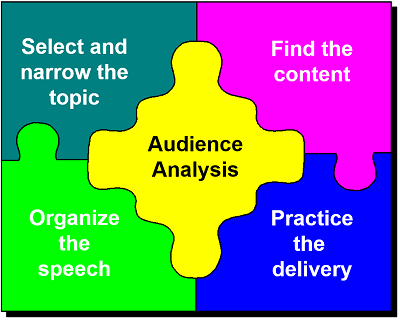
    A good way to think of developing a speech is to think of it like a puzzle. There are multiple pieces that all have to fit together, with the driving piece being the audience. The core of a good presentation is an understanding of the audience to whom the speech is targeted. We need to spend some time gaining an understanding of our audience which becomes the criteria to determine the best strategies and approaches to employ.

    image 1.png

    Figure \(\PageIndex{1}\): Speech Puzzle

    The first stage, gathering information, can be as simple as observing who is in the audience, or can be a more involved process of formalized data collection. For classroom speeches, simply look around the room and determine some basic data, such as:

    The first stage, gathering information, can be as simple as observing who is in the audience, or can be a more involved process of formalized data collection. For classroom speeches, simply look around the room and determine some basic data, such as:

    • Average Age
    • Gender Distribution
    • Education Level
    • Probable Income Level
    • Relationship Status
    • Parental Status

    image 2.jpg

    Figure \(\PageIndex{2}\): Audience

    image 3.jpg

    Figure \(\PageIndex{3}\): Audience

    For situations in which the speaker is invited to speak, ask the person extending the invitation about the audience: Who are they? Why are they gathered? What are their expectations? With this basic information, we can move to the next stage, making inferences.

    Making Inferences

    At this stage, we are trying to get a handle on the audiences' collective "personality." To do this, we make inferences. An inference is an conclusion based on evidence and reasoning. An inference is not a guess; a guess is more random while an inference is based on specific bits of information. For instance, if it is December and the wind is blowing, those of us living in colder climates, like Minnesota, will infer, "It's cold outside." That conclusion is based on combining experience with bits of evidence to draw a reasonable conclusion.

    We can do the same thing with audiences. Now that we have gathered some demographic data, we can move on and make inferences as to what the data tells us about the audience. The most any speaker can consider are the common denominators, those things we believe are true of the vast majority of our audience members.

    For example, one common denominator is they are all in attendance for the speech. Why are they there? Are they attending because they came of their own free will, such as attending a religious service. Or are they in attendance because it is mandated by their job? Or is it somewhere in between, such as a college classroom, in which students voluntarily sign up for the class yet are required to attend by the instructor and didn't necessarily choose the topic? Knowing the basis of why they are there gives the speaker a sense of what the audience is expecting and the attitudes they are likely holding.

    Adapting the Speech

    The final step, adapting the speech, is the key to using an audience analysis to enhance the chance of success. It really does not matter how well we complete steps 1 and 2, if we do not take the information and act upon it, the speech is much less likely to succeed.

    In adapting the speech, we are considering how to package the information for the audience; determining the best approach or strategy for accomplishing the speaker's goal. This does not mean the speaker must alter their core message. Instead, it means to take the core message and package it in a manner more interesting to the audience.

    For example, if doing a speech on sexually transmitted diseases (STDs) to two audiences, 10th graders and college freshmen, the same basic information can be communicated, but it would be packaged differently. For the 10th graders, more formal, medical terms would be used, less humor would be used, and since the speaker needs to consider parents, the speaker should assume the audience is not currently engaging in intercourse. For the college audience, however, more lay terms could be used, more humor could be used, and the speaker could safely assume the audience members, in general, are more sexually active. Notice, the basic information does not change, but the packaging changes.

    Everything in the speech should be considered as to its fit with the audience. What kind of attire is the audience expecting: formal, casual, or in-between? Is the audience expecting a very animated, active delivery with lots of movement and energy, or are they expecting a more subdued, more thoughtful delivery style? Is the language level to be formal and high level? Or is a more casual language level acceptable?

    Which sources should the speaker seek out? For an audience with a lot of specific knowledge on the speaker's topic, higher level, very specific, highly qualified sources will be needed. For an audience with less specific knowledge, more casual sources may suffice. If informing an audience of physicians on the latest discoveries in the treatment of lung cancer, very specific medical research sources are needed. However, if informing an audience of college students on the same topic, general interest sources, such as newspapers or magazines, will be sufficient.

    Everything in the speech must be considered in light of the audience. Some variables may arise as more important than others. For one audience, the quality of sources may be paramount to the success of the speech, yet for another audience, the quality of delivery may be most important. Through carefully considering the dynamics of the audience, a speaker can make self-reflexive choices to increase the chance of success.

    Audience Adaptation for Informative Speeches
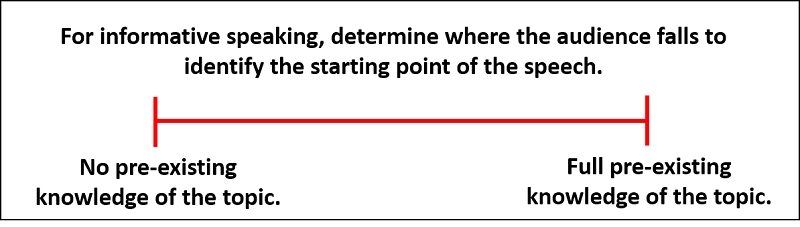
    image 5.png

    Figure \(\PageIndex{5}\): Informative Audience Interest

    When adapting to an audience for informative speaking, it is vital we have some idea of where the audiences' existing knowledge is on the topic. Remember, If we were to compare individual audience members, we would find a range, but we have to aim for average or middle ground.

    Once we have an idea of what middle ground is, we use that to determine where to focus the speech. We do not want to focus the speech below the audiences' existing knowledge level. If we do so, the audience may be bored or may even become offended, perceiving the speaker as being patronizing. Likewise, we cannot start the speech above the audiences' existing knowledge as they will not know what we are talking about and will not be able to follow the speech. They will not be able to make the leap from their existing knowledge to the starting point of the speech. The ideal place to start is at their existing level of knowledge, and then we move them forward.

    Audience Adaptation for Persuasive Speeches
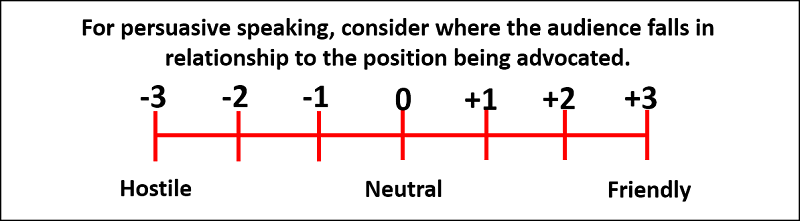
    image 6.png

    Figure \(\PageIndex{6}\): Persuasive Audience Interest

    When adapting to an audience for persuasive speaking, it is vital the speaker have an idea of the audiences' existing attitude or position on the topic, and how that compares with the speaker's. As with any audience, we know the attitudes will range, but again we are looking for the average attitudinal position.
    There are three general types of audiences for persuasion: hostile, neutral and friendly.

    1. A hostile audience is one that already disagrees with the speaker's position. With a hostile audience, it is vital to know why they disagree because those are the reasons we need to address. If we do not address the key issues, the audience will be left holding their hostile position. The speaker also needs to consider how to approach the issues to avoid offending the audience. The speaker needs to respect the audience's position and tactfully offer a contrary position.
    2. A neutral audience is usually a group who does not really know anything about the topic; they have yet to form an opinion on the topic. We have two jobs: "inform" the audience, and persuade them to accept our position. However, "informing" in this case will not be as objective as a pure informative speech would be. Rather, we introduce the audience to the topic in a manner consistent with the position we are advocating. Then we offer the audience reasons to accept the position being advocated.
    3. A friendly audience is one who largely agrees with the speaker's position, but not completely. For these audiences, we must identify, as specifically as possible, why the audience is not in complete agreement, and then focus on those points of difference to move the audience to the position being advocated. For example, most people believe that donating blood is a good idea, yet only a fraction of those eligible actually donate. They are friendly to the idea, but they are not engaging in the action. The speaker needs to determine why they are not taking that final step and focus the speech in those areas.

    Keep in mind that if the audience totally agrees with the speaker's position at the outset, there is little point in trying to "persuade" them as there is no place for them to move, nothing to change, since they already agree with the speaker's position. In this situation, we would give more of a motivational speech to remind the audience of their agreement with our position.


    This page titled 11.2: Audience Analysis is shared under a mixed 1.0 license and was authored, remixed, and/or curated by Keith Green, Ruth Fairchild, Bev Knudsen, & Darcy Lease-Gubrud (Minnesota State Colleges and Universities) .
