

3.1: Guest 1 – Meet Michael and Learn about the LGBTQA+ Community
- Page ID
- 79240

\( \newcommand{\vecs}[1]{\overset { \scriptstyle \rightharpoonup} {\mathbf{#1}} } \) \( \newcommand{\vecd}[1]{\overset{-\!-\!\rightharpoonup}{\vphantom{a}\smash {#1}}} \)\(\newcommand{\id}{\mathrm{id}}\) \( \newcommand{\Span}{\mathrm{span}}\) \( \newcommand{\kernel}{\mathrm{null}\,}\) \( \newcommand{\range}{\mathrm{range}\,}\) \( \newcommand{\RealPart}{\mathrm{Re}}\) \( \newcommand{\ImaginaryPart}{\mathrm{Im}}\) \( \newcommand{\Argument}{\mathrm{Arg}}\) \( \newcommand{\norm}[1]{\| #1 \|}\) \( \newcommand{\inner}[2]{\langle #1, #2 \rangle}\) \( \newcommand{\Span}{\mathrm{span}}\) \(\newcommand{\id}{\mathrm{id}}\) \( \newcommand{\Span}{\mathrm{span}}\) \( \newcommand{\kernel}{\mathrm{null}\,}\) \( \newcommand{\range}{\mathrm{range}\,}\) \( \newcommand{\RealPart}{\mathrm{Re}}\) \( \newcommand{\ImaginaryPart}{\mathrm{Im}}\) \( \newcommand{\Argument}{\mathrm{Arg}}\) \( \newcommand{\norm}[1]{\| #1 \|}\) \( \newcommand{\inner}[2]{\langle #1, #2 \rangle}\) \( \newcommand{\Span}{\mathrm{span}}\)\(\newcommand{\AA}{\unicode[.8,0]{x212B}}\)
Module 1 – LGBTQ+
Intercultural Communication Speaker Series – Meet Michael
Learn more about LGBTQ+ Topics
Language Use: Initialisms and Vocabulary

Initialism…
Initialisms

Literally, an umbrella!
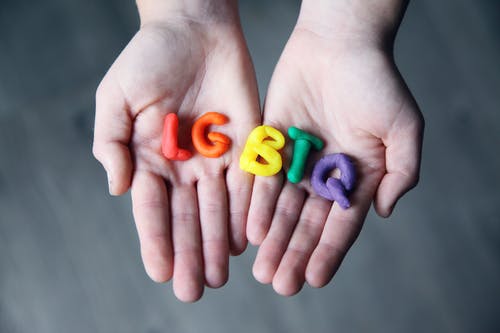
Have a conversation about what initialism others choose.
LBGTQ+
Language Choice: Presenting the “Genderbread Person”
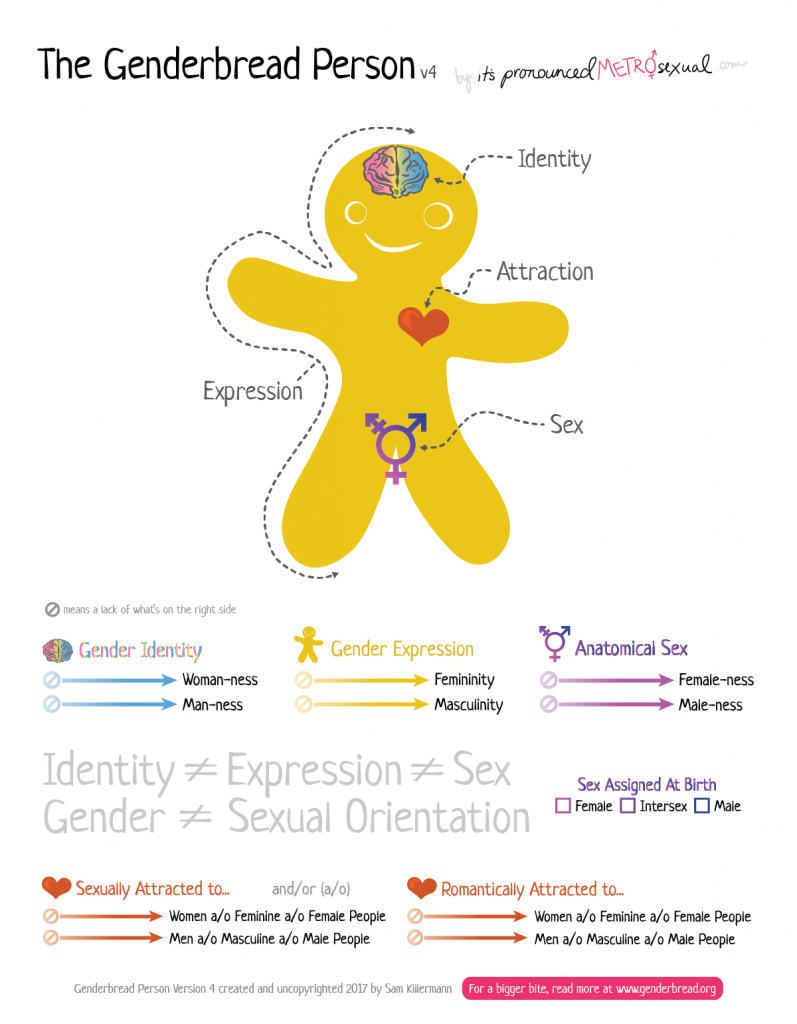
 Understanding the language in this unit, and the changes that have occurred since you had “the BIG sex talk” in middle or even elementary school are daunting. Back in the 1970’s we watched an animated show, one for the boys and one for the girls. A lot has changed since. The “Genderbread Person,” created by Sam Killermann, is an effort to bring about positive change as an “educational tool to clarify the distinctions among gender assigned at birth, experienced gender, and sexual orientation” (IACAPAP.org, 2018). Below is a copy of the Genderbread Person shared under Killermann’s uncopyright policy.
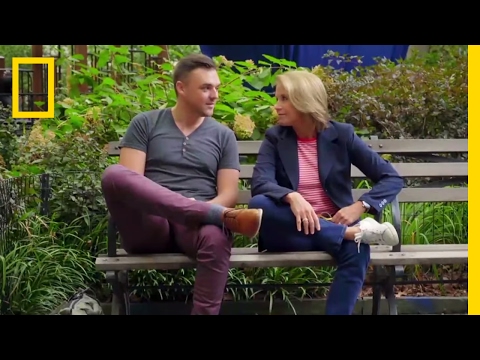
Katie Couric Interviews Sam Killermann
Module 2:
Sex, Sexual Orientation, Gender Expression, or Gender Identity? What’s the Difference?
Better Understanding the Difference between Sexual Orientation & Gender Identity
Definitions:

Dictionary Says…
The Relationship Between Biology & Sex

Biology & Sex – New Questions & Answers
Module Three: Skills for Inclusive Communication
Singular They and Pronoun Use

Ask, “What are your pronouns?” not, “What are your preferred pronouns?”
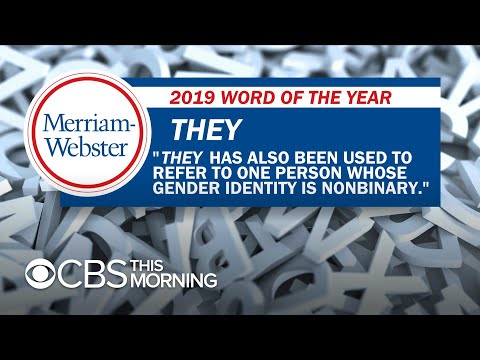
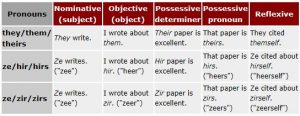
| Example | |
| they | Casey is a gender-fluid person. They are from Texas and enjoy tacos. |
| them | Every client got a care package delivered to them. |
| their | Each child played with their parent. |
| theirs | The cup of coffee is theirs. |
| themselves (or themself) | A private person usually keeps to themselves [or themself]. |
| Strategy | Example |
| Rewording the sentence | I delivered a care package to the client. |
| Using the plural | Private people usually keep to themselves. |
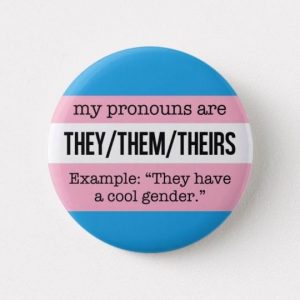
What are your pronouns?
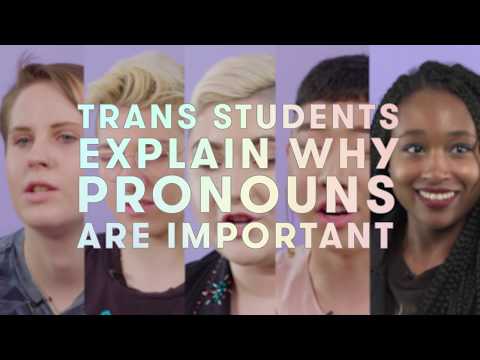
Pronouns Matter
Module 4:
LGBTQ+: Intersectionality, Dominant Culture, and Co-Culture
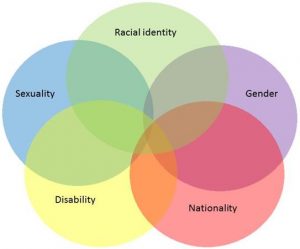
Oppression is linked…
The Balance of Intersectionality, Dominant Culture, and Co-Culture
Module 5: Improving Intercultural Communication Competence

What can you do to improve your skills, motivation, and knowledge?
Strategies to Use!

Equity = giving someone what they need to be successful
Training Materials
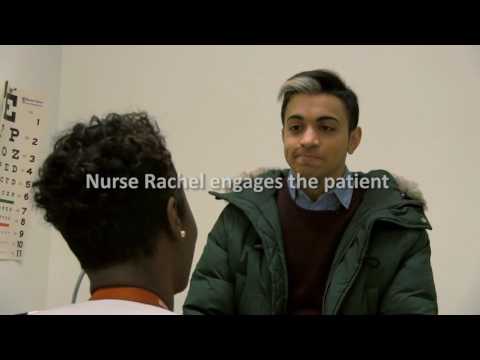
Training Videos with Medical Scenarios
Care to the Trans* and Gender Non-Conforming Identified Patient


Education Related Videos and Resources
Links to Education Related Topics
Module 6:
Finally, Fast Facts, Timelines, and Additional Resources

Dig more deeply, learn more.
Works Cited
(*under construction)
Adult health. (2019, August 21). Retrieved May 1, 2020, from www.mayoclinic.org/healthy-l...h/hlv-20049421
Open Textbook Library. (2016). Communication in the Real World: An Introduction to Communication Studies. Minneapolis, MN.
Legal & Trans Justice. (n.d.). Retrieved May 1, 2020, from https://www.outfront.org/legal-trans...ans-law-health
Liszewski, W., Peebles, J. K., Yeung, H., & Arron, S. (2018, December 20). Persons of Nonbinary Gender – Awareness, Visibility, and Health Disparities. Retrieved May 1, 2020, from www.ncbi.nlm.nih.gov/pmc/articles/PMC6748626/
McLean, S. (2018). Intercultural Communication. Boston: Flat World.
National Center for Transgender Equality. (n.d.). Retrieved May 23, 2020, from https://transequality.org/sites/defa...mary-Dec17.pdf
Originally published on 22 January, 2016. (2020, April 28). Do
Ask, Do Tell: Talking to your provider about being LGBT ” LGBT Health Education Center. Retrieved from http://www.lgbthealtheducation.org/publication/dadt/
Prepare to Care: A Planning Guide for Caregivers in the LGBT Community. (n.d.). Retrieved May 1, 2020, from https://www.aarp.org/content/dam/aar...-lgbt-aarp.pdf
Reid-Smith, T. (2020, January 24). Should I use LGBT, LGBT, LGBTQ, LGBTI, LGBTQIA or something else? Retrieved May 1, 2020, from https://www.gaystarnews.com/article/...omething-else/
Samovar, L. A., Porter, R. E., McDaniel, E. R., & Roy, C. S. (2017). Communication between cultures. Boston, MA: Cengage Learning.