

13.3: Coworker (Peer Relationships)
- Last updated
- Save as PDF
- Page ID
- 66625

- Jason S. Wrench, Narissra M. Punyanunt-Carter & Katherine S. Thweatt
- SUNY New Paltz & SUNY Oswego via OpenSUNY
Learning Outcomes
- List and explain Patricia Sias’s characteristics of coworker relationships and Jessica Methot’s three additional characteristics.
- Differentiate among Kathy Kram and Lynn Isabella’s three types of coworker relationships.
- Explain Patricia Sias and Daniel Cahill’s list of influencing factors on coworker relationships.
- Describe the three ways coworkers go about disengaging from workplace relationships articulated by Patricia Sias and Tarra Perry.
Characteristics of Coworker Relationships
According to organizational workplace relationship expert Patricia Sias, peer coworker relationships exist between individuals who exist at the same level within an organizational hierarchy and have no formal authority over each other.31 According to Sias, we engage in these coworker relationships because they provide us with mentoring, information, power, and support. Let’s look at all four of these.
Sias’s Reasons for Workplace Relationships
Mentoring
First, our coworker relationships are a great source for mentoring within any organizational environment. It’s always good to have a peer that you can run to when you have a question or need advice. Because this person has no direct authority over you, you can informally interact with this person without fear of reproach if these relationships are healthy. We’ll discuss what happens when you have nonhealthy relationships in the next section.
Sources of Information
Second, we use our peer coworker relationships as sources of information. One of our coauthors worked in a medical school for a while. Our coauthor quickly realized that there were some people he could talk to around the hospital who would gladly let him know everything that was going on around the place. One important caveat to all of this involves the quality of the information we are receiving. By information quality, Sias refers to the degree to which an individual perceives the information they are receiving as accurate, timely, and useful. Ever had that one friend who always has great news, that everyone else heard the previous week? Not all information sources provide you with quality information. As such, we need to establish a network of high-quality information sources if we are going to be successful within an organizational environment.
Issues of Power
Third, we engage in coworker relationships as an issue of power. Although two coworkers may exist in the same run within an organizational hierarchy, it’s important also to realize that there are informal sources of power as well. In the next chapter, we are going to explore the importance of power within interpersonal relationships in general. For now, we’ll say that power can help us influence what goes on within our immediate environments. However, power can also be used to control and intimidate people, which is a huge problem in many organizations.
Social Support
The fourth reason we engage in peer coworker relationships is social support. For our purposes, let’s define social support as the perception and actuality that an individual receives assistance and care from those people within their life. Let’s face it; there’s a reason corporate America has been referred to as a concrete jungle, a circus, or a theatre of the absurd. Even the best organization in the world can be trying at times. The best boss in the world will eventually get under your skin about something. We’re humans; we’re flawed. As such, no organization is perfect, so it’s always important to have those peer coworkers we can go to who are there for us. One of our coauthors has a coworker who they call whenever our coauthor needs to be “talked off the ledge.” Our coauthor likes higher education and loves being a professor, but occasionally something happens, and our coauthor needs to vent to about something that has occurred. For the most part, our coauthor doesn’t want their coworker to solve a problem; our coauthor just wants someone to listen. We all need to de-stress in the workplace, and having peer coworker relationships is one way we do this.
Other Characteristics
In addition to the four characteristics discussed by Sias, Jessica Methot argue that three other features are also important: trust, relational maintenance, and ability to focus.32
Trust
Methot defines trust as “the willingness to be vulnerable to another party with the expectation that the other party will behave with the best interest of the focal individual.”33 In essence, in the workplace, we eventually learn how to make ourselves vulnerable to our coworkers believing that our coworkers will do what’s in our best interests. Now, trust is an interesting and problematic concept because it’s both a function of workplace relationships and also an outcome. For coworker relationships to work or operate as they should, we need to be able to trust our coworkers. However, the more we get to know our coworkers and know they have our best interests at heart, then the more we will ultimately trust our coworkers. Trust develops over time and is not something that is not just a binary concept (trust or no trust). Instead, there are various degrees of trust in the workplace. At first, you may trust your coworkers just enough to tell them surface level things about yourself (e.g., where you went to college, your major, your hometown), but over time, as we’ve discussed before in this book, we start to self-disclose as deeper levels as our trust increases. Most coworker relationships will never be intimate relationships or even actual friendships, but we can learn to trust our coworkers within the confines of our jobs.
Relational Maintenance
Kathryn Dindia and Daniel J. Canary write that definitions of the term “relational maintenance” can be broken down into four basic types:
- . To keep a relationship in existence;
- To keep a relationship in a specified state or condition;
- To keep a relationship in a satisfactory condition; and
- To keep a relationship in repair.34
Methot argues that relational maintenance is a difficult task in any context. Still, coworker relationships can have a range of negative outcomes if organizational members have difficulty maintaining their relationships with each other. For this reason, Methot defines maintenance difficulty as “the degree of difficulty individuals experience in interpersonal relationships due to misunderstandings, incompatibility of goals, and the time and effort necessary to cope with disagreements.”35 Imagine you have two coworkers who tend to behave in an inappropriate fashion nonverbally. Maybe one coworker sits there and rolls his eyes at everything his coworker says, or perhaps she uses exaggerated facial expressions to mock her coworker when he’s talking. Having these types of coworkers will cause us (as a third party witnessing these problems) to spend more time trying to maintain relationships with both of them. On the flip side, the relationship between our two coworkers will take even more maintenance to get them to a point where they can just be collegial in the same room with each other. The more time we have to spend trying to decrease tension or resolve interpersonal conflicts in the workplace, the less time we will ultimately have on our actual jobs. Eventually, this can leave you feeling exhausted feeling and emotionally drained as though you just don’t have anything else to give. When this happens, we call this having inadequate resources to meet work demands. All of us will eventually hit a wall when it comes to our psychological and emotional resources. When we do hit that wall, our ability to perform job tasks will decrease. As such, it’s essential that we strive not only to maintain healthy relationships with our coworkers ourselves, but also to foster an environment that encourages our coworkers to maintain healthy relationships with each other. However, it’s important to note that some people will simply never play well in the sandbox with others. Some coworker relationships can become so toxic that minimizing contact and interaction can be the best solution to avoid draining your psychological and emotional resources.
Ability to Focus
Have you ever found your mind wandering while you are trying to work? One of the most important things when it comes to getting our work done is having the ability to focus. Within an organizational context, Methot defines “ability to focus” as “the ability to pay attention to value-producing activities without being concerned with extraneous issues such as off-task thoughts or distractions.”36 When individuals have healthy relationships with their coworkers, they are more easily able to focus their attention on the work at hand. On the other hand, if your coworkers always play politics, stab each other in the back, gossip, and engage in numerous other counterproductive workplace (or deviant workplace) behaviors, then it’s going to be a lot harder for you to focus on your job.
Types of Coworker Relationships
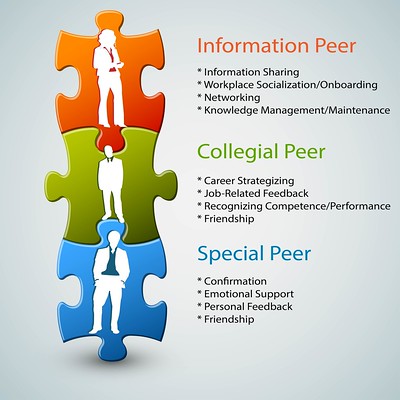
Now that we’ve looked at some of the characteristics of coworker relationships, let’s talk about the three different types of coworkers that research has categorized. Kathy Kram and Lynn Isabella found that there are essentially three different types of coworker relationships in the workplace: information peer, collegial peer, and special peer.37 Figure 13.3.1 illustrates the basic things we get from each of these different types of peer relationships.
Information Peers
Information peers are so-called because we rely on these individuals for information about job tasks and the organization itself. As you can see from Figure 13.3.1, we engage information peers in four basic types of activities we engage information peers for information sharing, workplace socialization and onboarding, networking, and knowledge management and maintenance.
Information Sharing
First, we share information with our information peers. Of course, this information is task-focused, so the information is designed to help us complete our job better.
Workplace Socialization and Onboarding
Second, information peers are vital during workplace socialization or onboarding. Workplace socialization can be defined as the process by which new organizational members learn the rules (e.g., explicit policies and explicit procedures), norms (e.g., when you go on break, how to act at work, who to eat with, who not to eat with), and culture (e.g., innovation, risk-taking, team orientation, competitiveness) of an organization. Organizations often have a very formal process for workplace socialization that is called onboarding. Onboarding is when an organization helps new members get acquainted with the organization, its members, its customers, and its products/services.
Networking
Third, information peers help us network within our organization or a larger field. Half of being successful in any organization involves getting to know the key players within the organization. Our information peers will already have existing relationships with these key players, so they can help make introductions. Furthermore, some of our peers may connect with others in the field (outside the organization), so they could help us meet other professionals as well.
Knowledge Management/Maintenance
Lastly, information peers help us manage and maintain knowledge. During the early parts of workplace socialization, our information peers will help us weed through all of the noise and focus on the knowledge that is important for us to do our jobs. As we become more involved in an organization, we can still use these information peers to help us acquire new knowledge or update existing knowledge. When we talk about knowledge, we generally talk about two different types: explicit and tacit. Explicit knowledge is information that is kept in some retrievable format. For example, you’ll need to find previously written reports or a list of customers’ names and addresses. These are examples of the types of information that may exist physically (or electronically) within the organization. Tacit knowledge, on the other hand, is the knowledge that’s difficult to capture permanently (e.g., write down, visualize, or permanently transfer from one person to another) because it’s garnered from personal experience and contexts. Informational peers who have been in an organization for a long time will have a lot of tacit knowledge. They may have an unwritten history of why policies and procedures are the way they are now, or they may know how to “read” certain clients because they’ve spent decades building relationships. For obvious reasons, it’s much easier to pass on explicit knowledge than implicit knowledge.
Collegial Peers
The second class of relationships we’ll have in the workplace are collegial peers or relationships that have moderate levels of trust and self-disclosure and are different from information peers because of the increased openness that is shared between two individuals. Collegial peers may not be your best friends, but they are people that you enjoy working with. Some of the hallmarks of collegial peers include career strategizing, job-related feedback, recognizing competence and performance, and friendship.
Career Strategizing
First, collegial peers help us with career strategizing. Career strategizing is the process of creating a plan of action for one’s career path and trajectory. First, notice that career strategizing is a process, so it’s marked by gradual changes that help you lead to your ultimate result. Career strategizing isn’t something that happens once. Often our intended career paths take twists and turns we never expected or predicted. However, our collegial peers are often great resources for helping us think through this process either within a specific organization or a larger field.
Job-Related Feedback
Second, collegial peers also provide us with job-related feedback. We often turn to those who are around us the most often to see how we are doing within an organization. Our collegial peers can provide us this necessary feedback to ensure we are doing our jobs to the utmost of our abilities and the expectations of the organization. Under this category, the focus is purely on how we are doing our jobs and how we can do our jobs better.
Recognizing Competence and Performance
Third, collegial peers are usually the first to recognize our competence in the workplace and recognize us for excellent performance. Generally speaking, our peers have more interactions with us on the day-to-day job than middle or upper management, so they are often in the best position to recognize our competence in the workplace. Our competence in the workplace can involve having valued attitudes (e.g., liking hard work, having a positive attitude, working in a team), cognitive abilities (e.g., information about a field, technical knowledge, industry-specific knowledge), and skills (e.g., writing, speaking, technical ability) necessary to complete critical work-related tasks. Not only do our peers recognize our attitudes, cognitive abilities, and skills, but they are also there to pat us on the backs and tell us we’ve done a great job when a task is complete.
Friendship
Lastly, collegial peers provide us a type of friendship in the workplace. They also offer us someone we can both like and trust in the workplace. Now, it’s important to distinguish this level of friendships from other types of friendships we have in our lives. Collegial peers are not going to be your “best friends,” but they will offer you friendships within the workplace that make work more bearable and even enjoyable. At the collegial level, you may not associate with these friends beyond workplace functions (e.g., sitting next to each other at meetings, having lunch together, finding projects to work on together). It’s also possible that a group of collegial peers will go to events outside the workplace as a group (e.g., going to happy hour, throwing a holiday party, attending a baseball game).
Special Peers
The final group of peers we work with are called special peers. Kram and Isabella note that a special peer relationship “involves revealing central ambivalences and personal dilemmas in work and family realms. Pretense and formal roles are replaced by greater self-disclosure and self-expression.”38 Special peer relationships are marked by confirmation, emotional support, personal feedback, and friendship.
Confirmation
First, special peers provide us with validation. When we are having one of our darkest days at work and are not sure we’re doing our jobs well, our special peers are there to let us know that we’re doing a good job. They approve of who we are and what we do. These are also the first people we go to when we do something well at work.
Emotional Support
Second, special peers provide us with emotional support in the workplace. Emotional support from special peers comes from their willingness to listen and offer helpful advice and encouragement. Kelly Zellars and Pamela Perrewé have noted there are four types of emotional social support we get from peers: positive, negative, non-job-related, and empathic communication.39 Positive emotional support is when you and a special peer talk about the positive sides to work. For example, you and a special peer could talk about the joys of working on a specific project. Negative emotional support, on the other hand, is when you and a special peer talk about the downsides to work. For example, maybe both of you talk about the problems working with a specific manager or coworker. The third form of emotional social support is non-job-related or talking about things that are happening in your personal lives outside of the workplace itself. These could be conversations about friends, family members, hobbies, etc. A good deal of the emotional social support we get from special peers has nothing to do with the workplace at all. The final type of emotional social support is empathic communication, or conversations about one’s emotions or emotional state in the workplace. If you’re having a bad day, you can go to your special peer, and they will reassure you about the feelings you are experiencing. Another example is talking to your special peer after having a bad interaction with a customer that ended with the customer yelling at you for no reason. After the interaction, you seek out your special peer, and they will validate your feelings and thoughts about the interaction.
Personal Feedback
Third, special peers will provide both reliable and candid feedback about you and your work performance. One of the nice things about building an intimate special peer relationship is that both of you will be honest with one another. There are times we need confirmation, but then there are times we need someone to be bluntly honest with us. We are more likely to feel criticized and hurt when blunt honesty comes from someone when we do not have a special peer relationship. Special peer relationships provide a safe space where we can openly listen to feedback even if we’re not thrilled to receive that feedback.
Friendship
Lastly, special peers also offer us a sense of deeper friendship in the workplace. You can almost think of special peers as your best friend within the workplace. Most people will only have one or two people they consider a special peer in the workplace. You may be friendly with a lot of your peers (e.g., collegial peers), but a special peer relationship is deeper and more meaningful.
A Further Look at Workplace Friendships
At some point, a peer coworker relationship may, or may not, evolve into a workplace friendship. According to Patricia Sias, there are two key hallmarks of a workplace friendship: voluntariness and personalistic focus. First, workplace friendships are voluntary. Someone can assign you a mentor or a mentee, but that person cannot make you form a friendship with that person. Most of the people you work with will not be your friends. You can have amazing working relationships with your coworkers, but you may only develop a small handful of workplace friendships. Second, workplace friendships have a personalistic focus. Instead of just viewing this individual as a coworker, we see this person as someone who is a whole individual who is a friend. According to research, workplace friendships are marked by higher levels of intimacy, frankness, and depth than those who are peer coworkers.40
Friendship Development in the Workplace
According to Patricia Sias and Daniel Cahill, workplace friendships are developed by a series of influencing factors: individual and personal factors, contextual factors, and communication changes. 41 First, some friendships develop because we are drawn to the other person. Maybe you’re drawn to a person in a meeting because she has a sense of humor that is similar to yours, or maybe you find that another coworker’s attitude towards the organization is exactly like yours. Whatever the reason we have, we are often drawn to people that are like us. For this reason, we are often drawn to people who resemble ourselves demographically (e.g., age, sex, race, religion).
A second reason we develop relationships in the workplace is because of a variety of different contextual factors. Maybe your office is right next to someone else’s office, so you develop a friendship because you’re next to each other all the time. Perhaps you develop friendships because you’re on the same committee or put on the same work project with another person. In large organizations, we often end up making friends with people simply because we get to meet them. Depending on the size of your organization, you may end up meeting and interact with a tiny percentage of people, so you’re not likely to become friends with everyone in the organization equally. Other organizations provide a culture where friendships are approved of and valued. In the realm of workplace friendship research, two important factors have been noticed concerning contextual factors controlled by the organization: opportunity and prevalence.42 Friendship opportunity refers to the degree to which an organization promotes and enables workers to develop friendships within the organization. Does your organization have regular social gatherings for employees? Does your organization promote informal interaction among employees, or does it clamp down on coworker communication? Not surprisingly, individuals who work in organizations that allow for and help friendships tend to be satisfied, more motivated, and generally more committed to the organization itself.
Friendship prevalence, on the other hand, is less of an organizational culture and more the degree to which an individual feels that they have developed or can develop workplace friendships. You may have an organization that attempts to create an environment where people can make friends, but if you don’t think you can trust your coworkers, you’re not very likely to make workplace friends. Although the opportunity is important when seeing how an individual responds to the organization, friendship prevalence is probably the more important factor of the two. If I’m a highly communicative apprehensive employee, I may not end up making any friends at work, so I may see my workplace place as just a job without any commitment at all. When an individual isn’t committed to the workplace, they will probably start looking for another job. 43
Lastly, as friendships develop, our communication patterns within those relationships change. For example, when we move from being just an acquaintance to being a friend with a coworker, we are more likely to increase the amount of communication about non-work and personal topics. Sias and Cahill note that change from friend to close friend is marked by decreased caution and increased intimacy. Furthermore, this transition in friendship is characterized by an increase in discussing work-related problems. The final transition from a close friend to “almost best” friend. According to Sias and Cahill, “Because of the increasing amount of trust developed between the coworkers, they felt freer to share opinions and feelings, particularly their feelings about work frustrations. Their discussion about both work and personal issues became increasingly more detailed and intimate.” 44
Relationship Disengagement
Thus far, we’ve talked about workplace friendships as positive factors in the workplace, but any friendship can sour. Some friendships sour because one person moves into a position of authority of the other, so there is no longer perceived equality within the relationship. Other friendships occur when there is a relationship violation of some kind (see Chapter 8). Some friendships devolve because of conflicting expectations of the relationship. Maybe one friend believes that giving him a heads up about insider information in the workplace is part of being a friend, and the other person sees it as a violation of trust given to her by her supervisors. When we have these conflicting ideas about what it means to “be a friend,” we can often see a schism that gets created. So, how does an individual get out of workplace friendships? Patricia Sias and Tarra Perry were the first researchers to discuss how colleagues disengage from relationships with their coworkers.45 Sias and Perry found three distinct tools that coworkers use: state-of-the-relationship talk, cost escalation, and depersonalization. Before explaining them, we should mention that people use all three and do not necessarily progress through them in any particular order.
State-of-the-Relationship
Talk The first strategy people use when disengaging from workplace friendships involves state-of-the-relationship talk. State-of-the-relationship talk is exactly what it sounds like; you officially have a discussion about the friendship ending. The goal of state-of-the-relationship talk is to engage the other person and inform them that ending the friendship is the best way to ensure that the two can continue a professional, functional relationship. Ideally, all workplace friendships could end in a situation where both parties agree that it’s in everyone’s best interest for the friendship to stop. Still, we all know this isn’t always the case, which is why the other two are often necessary.
Cost Escalation
The second strategy people use when ending a workplace friendship involves cost escalation. Cost escalation involves tactics that are designed to make the cost of maintaining the relationship higher than getting out of the relationship. For example, a coworker could start belittling a friend in public, making the friend the center of all jokes, or talking about the friend behind the friend’s back. All of these behaviors are designed to make the cost of the relationship too high for the other person.
Depersonalization
The final strategy involves depersonalization. Depersonalization can come in one of two basic forms. First, an individual can depersonalization a relationship by stopping all the interaction that is not task-focused. When you have to interact with the workplace friend, you keep the conversation purely business and do not allow for talk related to personal lives. The goal of this type of behavior is to alter the relationship from one of closeness to one of professional distance. The second way people can depersonalize a relationship is simply to avoid that person. If you know a workplace friend is going to be at a staff party, you purposefully don’t go. If you see the workplace friend coming down the hallway, you go in the opposite direction or duck inside a room before they can see you. Again, the purpose of this type of depersonalization is to put actual distance between you and the other person. According to Sias and Perry’s research, depersonalization tends to be the most commonly used tactic. 46
Key Takeaways
- According to Patricia Sias, people engage in workplace relationships for several reasons: mentoring, information, power, and support. Jessica Methot has further suggested that we engage in coworker relationships for trust, relational maintenance, and the ability to focus.
- Kathy Kram and Lynn Isabella have explained that there are three different types of workplace relationships: information peer, collegial peer, and special peer. Information peers are coworkers we rely on for information about job tasks and the organization itself. Collegial peers are coworkers with whom we have moderate levels of trust and self-disclosure and more openness that is shared between two individuals. Special peers, on the other hand, are coworkers marked by high levels of trust and self-disclosure, like a “best friend” in the workplace.
- Patricia Sias and Daniel Cahill created a list of influencing factors on coworker relationships. First, we are simply more drawn to some coworkers than others. As such, traditional notions of interpersonal attraction and homophily are at play. A second influencing factor involves contextual changes. Often there are specific contextual changes (e.g., moving offices, friendship opportunity, and friendship prevalence) that impact the degree to which people develop coworker friendships. Finally, communication changes as we progress through the four types of coworker friendships: acquaintance, friend, close friend, and almost best friend.
- Patricia Sias and Tarra Perry describe three different ways that coworkers can disengage from coworker relationships in the workplace. First, individuals can engage in state-of-the-relationship talk with a coworker, or explain to a coworker that a workplace friendship is ending. Second, individuals can make the cost of maintaining the relationship higher than getting out of the relationship, which is called cost escalation. The final disengagement strategy coworkers can utilize, depersonalization occurs when an individual stops all the interaction with a coworker that is not task-focused or simply to avoids the coworker.
Exercises
- Think about your workplace relationships with coworkers. Which of Patricia Sias’s four reasons and Jessica Methot’s three additional characteristics were at play in these coworker relationships?
- Kathy Kram and Lynn Isabella describe three different types of peers we have in the workplace: information peer, collegial peer, and special peer. Think about your workplace. Can you identify people who fall into all three categories? If not, why do you think you don’t have all three types of peers? If you do, how are these relationships distinctly different from one another?
- Think about an experience where you needed to end a workplace relationship with a coworker. Which of Patricia Sias and Tarra Perry’s disengagement strategies did you use? Do you think there are other disengagement strategies available beyond the ones described by Sias and Perry?