Describe Vygotsky’s sociocultural theory of cognitive development
Explain Bronfenbrenner’s bioecological model
Contextual Perspectives: A Broad Approach to Development
Contextual perspectives consider the relationship between individuals and their physical, cognitive, and social worlds. They also examine socio-cultural and environmental influences on development. We will focus on two major theorists who pioneered this perspective: Lev Vygotsky and Urie Bronfenbrenner. Lev Vygotsky was a Russian psychologist who is best known for his sociocultural theory. He believed that social interaction plays a critical role in children’s learning; through such social interactions, children go through a continuous process of scaffolded learning. Urie Bronfenbrenner developed the ecological systems theory to explain how everything in a child and the child’s environment affects how a child grows and develops. He labeled different aspects or levels of the environment that influence children’s development.
Vygotsky’s Sociocultural Theory: Changes in thought with guidance
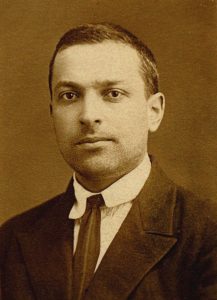
Figure 1. Lev Vygotsky, founder of the sociocultural theory, which emphasizes contextual factors in cognitive development.
Modern social learning theories stem from the work of Russian psychologist Lev Vygotsky, who produced his ideas as a reaction to existing conflicting approaches in psychology (Kozulin, 1990). Vygotsky’s ideas are most recognized for identifying the role of social interactions and culture in the development of higher-order thinking skills. His theory is especially valuable for the insights it provides about the dynamic “interdependence between individual and social processes in the construction of knowledge” (John-Steiner & Mahn, 1996, p. 192). Vygotsky’s views are often considered primarily as developmental theories, focusing on qualitative changes in behavior over time as attempts to explain unseen processes of development of thought, language, and higher-order thinking skills. Although Vygotsky’s intent was mainly to understand higher psychological processes in children, his ideas have many implications and practical applications for learners of all ages.
Three themes are often identified with Vygotsky’s ideas of sociocultural learning: (1) human development and learning originate in social, historical, and cultural interactions, (2) use of psychological tools, particularly language, mediate development of higher mental functions, and (3) learning occurs within the Zone of Proximal Development. While we discuss these ideas separately, they are closely interrelated, non-hierarchical, and connected.
Vygotsky’s sociocultural theory emphasizes the importance of culture and interaction in the development of cognitive abilities. Vygotsky contended that thinking has social origins, social interactions play a critical role especially in the development of higher-order thinking skills, and cognitive development cannot be fully understood without considering the social and historical context within which it is embedded. He explained, “Every function in the child’s cultural development appears twice: first, on the social level, and later, on the individual level; first between people (interpsychological) and then inside the child (intrapsychological)” (Vygotsky, 1978, p. 57). It is through working with others on a variety of tasks that a learner adopts socially shared experiences and associated effects and acquires useful strategies and knowledge (Scott & Palincsar, 2013).
Rogoff (1990) refers to this process as guided participation, where a learner actively acquires new culturally valuable skills and capabilities through a meaningful, collaborative activity with an assisting, more experienced other. It is critical to notice that these culturally mediated functions are viewed as being embedded in sociocultural activities rather than being self-contained. Development is a “transformation of participation in a sociocultural activity” not a transmission of discrete cultural knowledge or skills (Matusov, 2015, p. 315).
Scaffolding and the Zone of Proximal Development
Figure 2. According to Vygotsky, children can develop cognitively in their understanding of the world and learn what is important in society through play and cooperation with others.
Vygotsky differed with Piaget in that he believed that a person not only has a set of abilities, but also a set of potential abilities that can be realized if given the proper guidance from others. He believed that through guided participation known as scaffolding, with a teacher or capable peer, a child can learn cognitive skills within a certain range known as the zone of proximal development. While Piaget’s ideas of cognitive development assume that development through certain stages is biologically determined, originates in the individual, and precedes cognitive complexity, Vygotsky presents a different view in which learning drives development. The idea of learning driving development, rather than being determined by the developmental level of the learner, fundamentally changes our understanding of the learning process and has significant instructional and educational implications (Miller, 2011).
Have you ever taught a child to perform a task? Maybe it was brushing their teeth or preparing food. Chances are you spoke to them and described what you were doing while you demonstrated the skill and let them work along with you throughout the process. You gave them assistance when they seemed to need it, but once they knew what to do-you stood back and let them go. This is scaffolding. This approach to teaching has also been adopted by educators. Rather than assessing students on what they are doing, they should be understood in terms of what they are capable of doing with the proper guidance.
This difference in assumptions has significant implications for the design and development of learning experiences. If we believe as Piaget did that development precedes learning, then we will make sure that new concepts and problems are not introduced until learners have developed innate capabilities to understand them. On the other hand, if we believe as Vygotsky did that learning drives development and that development occurs as we learn a variety of concepts and principles, recognizing their applicability to new tasks and new situations, then our instructional design will look very different.
Watch It
Watch this video to learn more about Vygotsky’s theory of sociocultural development.
Another psychologist who recognized the importance of the environment on development was American psychologist, Urie Bronfenbrenner (1917-2005), who formulated the ecological systems theory to explain how the inherent qualities of a child and their environment interact to influence how they will grow and develop. The term “ecological” refers to a natural environment; human development is understood through this model as a long-lasting transformation in the way one perceives and deals with the environment. Bronfenbrenner’s ecological theory stresses the importance of studying children in the context of multiple environments because children typically find themselves enmeshed simultaneously in different ecosystems. Each of these systems inevitably interact with and influence each other in every aspect of the child’s life, from the most intimate level to the broadest. Furthermore, he eventually renamed his theory the bioecological model in order to recognize the importance of biological processes in development. However, he only recognized biology as producing a person’s potential, with this potential being realized or not via environmental and social forces.
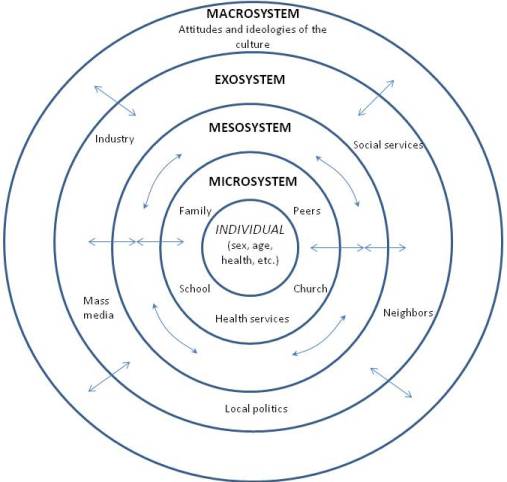
An individual is impacted by microsystems such as parents or siblings; those who have direct, significant contact with the person. The input of those people is modified by the cognitive and biological state of the individual as well. These influence the person’s actions, which in turn influence systems operating on them. The mesosystem includes larger organizational structures such as school, the family, or religion. These institutions impact the microsystems just described. For example, the religious teachings and traditions of a family may create a climate that makes the family feel stigmatized and this indirectly impacts the child’s view of their self and others. The philosophy of the school system, daily routine, assessment methods, and other characteristics can affect the child’s self-image, growth, sense of accomplishment, and schedule, thereby impacting the child physically, cognitively, and emotionally. These mesosystems both influence and are influenced by the larger contexts of the community, referred to as the exosystem. A community’s values, history, and economy can impact the organizational structures it houses. And the community is influenced by macrosystems, which are cultural elements such as global economic conditions, war, technological trends, values, philosophies, and a society’s responses to the global community. In sum, a child’s experiences are shaped by larger forces such as the family, school, religion, and culture. All of this occurs within the relevant historical context and timeframe, or chronosystem. The chronosystem is made up of the environmental events and transitions that occur throughout a child’s life, including any socio-historical events. This system consists of all the experiences that a person has had during their lifetime.
Figure 3. Brofenbrenner’s ecological theory emphasizes the influence of microsystems, mesosystems, exosystems, and the macrosystems on an individual. Not pictured is the chronosystem, or the historical context and timeframe which provides the context for all the other systems. The chronosystem includes environmental events, major life transitions, and historical events.
Watch It
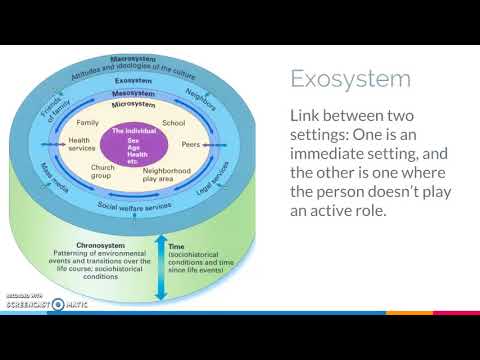
This short video from Professor Rachelle Tannenbaum of Anne Arundel Community College explains and gives examples of Brofenbrenner’s theory.
the perspective suggesting that multiple levels of the environment interact with biological potential to influence development
chronosystem
the environmental events and transitions that occur throughout a child’s life, including any socio-historical events
contextual perspective
a theory that considers the relationship between individuals and their physical, cognitive, and social worlds
ecological systems theory
Urie Bronfenbrenner’s theory stressing the importance of studying a child in the context of multiple environments, organized into five levels of external influence: microsystem, mesosystem, exosystem, macrosystem, and chronosystem
exosystem
the larger contexts of the community, including the values, history, and economy
macrosystem
cultural elements such as global economic conditions, war, technological trends, values, philosophies, and a society’s responses to the global community which impact a community
mesosystem
larger organizational structures such as school, the family, or religion
microsystem
immediate surrounds including those who have direct, significant contact with the person, such as parents or siblings
scaffolding
a process in which adults or capable peers model or demonstrate how to solve a problem, and then step back, offering support as needed
sociocultural theory
Vygotsky’s theory that emphasizes how cognitive development proceeds as a result of social interactions between members of a culture
zone of proximal development (ZPD)
the difference between what a learner can do without help, and what they can do with help
Modification, adaptation, and original content. Authored by: Sonja Ann Miller for Lumen Learning. Provided by: Lumen Learning. License: CC BY: Attribution