Social Sci LibreTexts

1: Introduction

  • Page ID
    204102
  • \( \newcommand{\vecs}[1]{\overset { \scriptstyle \rightharpoonup} {\mathbf{#1}} } \)

    \( \newcommand{\vecd}[1]{\overset{-\!-\!\rightharpoonup}{\vphantom{a}\smash {#1}}} \)

    \( \newcommand{\dsum}{\displaystyle\sum\limits} \)

    \( \newcommand{\dint}{\displaystyle\int\limits} \)

    \( \newcommand{\dlim}{\displaystyle\lim\limits} \)

    \( \newcommand{\id}{\mathrm{id}}\) \( \newcommand{\Span}{\mathrm{span}}\)

    ( \newcommand{\kernel}{\mathrm{null}\,}\) \( \newcommand{\range}{\mathrm{range}\,}\)

    \( \newcommand{\RealPart}{\mathrm{Re}}\) \( \newcommand{\ImaginaryPart}{\mathrm{Im}}\)

    \( \newcommand{\Argument}{\mathrm{Arg}}\) \( \newcommand{\norm}[1]{\| #1 \|}\)

    \( \newcommand{\inner}[2]{\langle #1, #2 \rangle}\)

    \( \newcommand{\Span}{\mathrm{span}}\)

    \( \newcommand{\id}{\mathrm{id}}\)

    \( \newcommand{\Span}{\mathrm{span}}\)

    \( \newcommand{\kernel}{\mathrm{null}\,}\)

    \( \newcommand{\range}{\mathrm{range}\,}\)

    \( \newcommand{\RealPart}{\mathrm{Re}}\)

    \( \newcommand{\ImaginaryPart}{\mathrm{Im}}\)

    \( \newcommand{\Argument}{\mathrm{Arg}}\)

    \( \newcommand{\norm}[1]{\| #1 \|}\)

    \( \newcommand{\inner}[2]{\langle #1, #2 \rangle}\)

    \( \newcommand{\Span}{\mathrm{span}}\) \( \newcommand{\AA}{\unicode[.8,0]{x212B}}\)

    \( \newcommand{\vectorA}[1]{\vec{#1}}      % arrow\)

    \( \newcommand{\vectorAt}[1]{\vec{\text{#1}}}      % arrow\)

    \( \newcommand{\vectorB}[1]{\overset { \scriptstyle \rightharpoonup} {\mathbf{#1}} } \)

    \( \newcommand{\vectorC}[1]{\textbf{#1}} \)

    \( \newcommand{\vectorD}[1]{\overrightarrow{#1}} \)

    \( \newcommand{\vectorDt}[1]{\overrightarrow{\text{#1}}} \)

    \( \newcommand{\vectE}[1]{\overset{-\!-\!\rightharpoonup}{\vphantom{a}\smash{\mathbf {#1}}}} \)

    \( \newcommand{\vecs}[1]{\overset { \scriptstyle \rightharpoonup} {\mathbf{#1}} } \)

    \( \newcommand{\vecd}[1]{\overset{-\!-\!\rightharpoonup}{\vphantom{a}\smash {#1}}} \)

    \(\newcommand{\avec}{\mathbf a}\) \(\newcommand{\bvec}{\mathbf b}\) \(\newcommand{\cvec}{\mathbf c}\) \(\newcommand{\dvec}{\mathbf d}\) \(\newcommand{\dtil}{\widetilde{\mathbf d}}\) \(\newcommand{\evec}{\mathbf e}\) \(\newcommand{\fvec}{\mathbf f}\) \(\newcommand{\nvec}{\mathbf n}\) \(\newcommand{\pvec}{\mathbf p}\) \(\newcommand{\qvec}{\mathbf q}\) \(\newcommand{\svec}{\mathbf s}\) \(\newcommand{\tvec}{\mathbf t}\) \(\newcommand{\uvec}{\mathbf u}\) \(\newcommand{\vvec}{\mathbf v}\) \(\newcommand{\wvec}{\mathbf w}\) \(\newcommand{\xvec}{\mathbf x}\) \(\newcommand{\yvec}{\mathbf y}\) \(\newcommand{\zvec}{\mathbf z}\) \(\newcommand{\rvec}{\mathbf r}\) \(\newcommand{\mvec}{\mathbf m}\) \(\newcommand{\zerovec}{\mathbf 0}\) \(\newcommand{\onevec}{\mathbf 1}\) \(\newcommand{\real}{\mathbb R}\) \(\newcommand{\twovec}[2]{\left[\begin{array}{r}#1 \\ #2 \end{array}\right]}\) \(\newcommand{\ctwovec}[2]{\left[\begin{array}{c}#1 \\ #2 \end{array}\right]}\) \(\newcommand{\threevec}[3]{\left[\begin{array}{r}#1 \\ #2 \\ #3 \end{array}\right]}\) \(\newcommand{\cthreevec}[3]{\left[\begin{array}{c}#1 \\ #2 \\ #3 \end{array}\right]}\) \(\newcommand{\fourvec}[4]{\left[\begin{array}{r}#1 \\ #2 \\ #3 \\ #4 \end{array}\right]}\) \(\newcommand{\cfourvec}[4]{\left[\begin{array}{c}#1 \\ #2 \\ #3 \\ #4 \end{array}\right]}\) \(\newcommand{\fivevec}[5]{\left[\begin{array}{r}#1 \\ #2 \\ #3 \\ #4 \\ #5 \\ \end{array}\right]}\) \(\newcommand{\cfivevec}[5]{\left[\begin{array}{c}#1 \\ #2 \\ #3 \\ #4 \\ #5 \\ \end{array}\right]}\) \(\newcommand{\mattwo}[4]{\left[\begin{array}{rr}#1 \amp #2 \\ #3 \amp #4 \\ \end{array}\right]}\) \(\newcommand{\laspan}[1]{\text{Span}\{#1\}}\) \(\newcommand{\bcal}{\cal B}\) \(\newcommand{\ccal}{\cal C}\) \(\newcommand{\scal}{\cal S}\) \(\newcommand{\wcal}{\cal W}\) \(\newcommand{\ecal}{\cal E}\) \(\newcommand{\coords}[2]{\left\{#1\right\}_{#2}}\) \(\newcommand{\gray}[1]{\color{gray}{#1}}\) \(\newcommand{\lgray}[1]{\color{lightgray}{#1}}\) \(\newcommand{\rank}{\operatorname{rank}}\) \(\newcommand{\row}{\text{Row}}\) \(\newcommand{\col}{\text{Col}}\) \(\renewcommand{\row}{\text{Row}}\) \(\newcommand{\nul}{\text{Nul}}\) \(\newcommand{\var}{\text{Var}}\) \(\newcommand{\corr}{\text{corr}}\) \(\newcommand{\len}[1]{\left|#1\right|}\) \(\newcommand{\bbar}{\overline{\bvec}}\) \(\newcommand{\bhat}{\widehat{\bvec}}\) \(\newcommand{\bperp}{\bvec^\perp}\) \(\newcommand{\xhat}{\widehat{\xvec}}\) \(\newcommand{\vhat}{\widehat{\vvec}}\) \(\newcommand{\uhat}{\widehat{\uvec}}\) \(\newcommand{\what}{\widehat{\wvec}}\) \(\newcommand{\Sighat}{\widehat{\Sigma}}\) \(\newcommand{\lt}{<}\) \(\newcommand{\gt}{>}\) \(\newcommand{\amp}{&}\) \(\definecolor{fillinmathshade}{gray}{0.9}\)

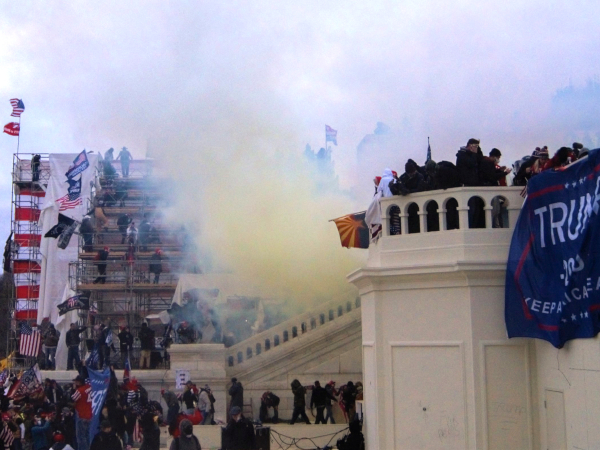
    On January 6, 2021, two weeks before Joe Biden was scheduled to become the 46th President of the United States, thousands of supporters of outgoing President Donald Trump amassed at the U.S. Capitol in Washington, D.C., overwhelmed the Capitol Police officers attempting to secure the building, and forced their way into the congressional chambers and offices. Egged on by the president himself at a rally earlier that day, the protesters were trying to prevent Congress from certifying Biden as the winner of the 2020 presidential election. Biden’s victory, they claimed, was illegitimate: the election had been “stolen” from Trump through massive voter fraud. Ultimately, the protesters succeeded only in postponing the certification, which was completed shortly after midnight the following morning.

    Photograph of supporters of President Donald Trump storming the U.S. Capitol on January 6, 2021
    Supporters of President Donald Trump storm the U.S. Capitol on January 6, 2021, to protest the results of the 2020 presidential election.

    No angry mob breached the Capitol in the aftermath of the 2016 presidential election four years prior when Trump defeated Hillary Clinton, but dozens of U.S. cities did experience mass protests. Some of these events escalated into violent riots, in which Clinton supporters vandalized businesses, set fire to cars and garbage cans, and attacked police officers. The protesters’ arguments in 2016 were different — Clinton had won more votes than Trump, Russians had “hacked” the election, Trump was morally unfit for the office — but their underlying message was the same: “This man has no right to be president, and the fact that he has been elected proves something is seriously wrong with the American political system.”

    Anyone who regularly reads, watches, or listens to the news in the United States has encountered sentiments like this. As Figure 1.1 below shows, at least a quarter (and usually more than half ) of Americans have been dissatisfied with the way things are going in their country since pollsters began asking the question — and they blame government for their dissatisfaction. Skim the headlines and you’ll find countless claims that something about American government — Congress, the Electoral College, the two-party system, the Constitution — is “broken,” desperately in need of repair or replacement. Not everyone agrees on which parts are broken or how they should be fixed, but you would be hard-pressed to find someone who firmly believed everything about government and politics in the United States was working perfectly.

    Line chart showing the percentage of Americans who are dissatisfied with the way things are going in the United States from 1979 to 2023, according to Gallup
    Figure 1.1: Percentage of Americans dissatisfied with "the way things are going in the United States," 1979-2023 (Source: Gallup)

    And yet, paradoxically, America trundles along in spite of this “brokenness.” For almost a quarter of a millennium, the United States has operated under the same basic political system, even as many other countries have repeatedly overhauled their own governments. Overall, Americans enjoy a degree of prosperity and security of which most of the rest of the world can only dream. In virtually any other country, an event like what occurred on January 6, 2021, would be taken as a sign of an imminent coup, yet most Americans who saw the siege on the news went about their daily lives as usual, confident that their country’s democratic institutions would still be intact when the dust settled.

    Why is it so easy for people to agree that America’s government is broken and yet so hard for them to agree on exactly how it is broken? And, if it is in fact broken, how has it managed to overcome so many obstacles for hundreds of years?


    This page titled 1: Introduction is shared under a CC BY-NC 4.0 license and was authored, remixed, and/or curated by Benjamin R. Kantack (Tekakwitha Press) via source content that was edited to the style and standards of the LibreTexts platform.

    • Was this article helpful?