

5.1: Introduction
- Page ID
- 408286

\( \newcommand{\vecs}[1]{\overset { \scriptstyle \rightharpoonup} {\mathbf{#1}} } \)
\( \newcommand{\vecd}[1]{\overset{-\!-\!\rightharpoonup}{\vphantom{a}\smash {#1}}} \)
\( \newcommand{\dsum}{\displaystyle\sum\limits} \)
\( \newcommand{\dint}{\displaystyle\int\limits} \)
\( \newcommand{\dlim}{\displaystyle\lim\limits} \)
\( \newcommand{\id}{\mathrm{id}}\) \( \newcommand{\Span}{\mathrm{span}}\)
( \newcommand{\kernel}{\mathrm{null}\,}\) \( \newcommand{\range}{\mathrm{range}\,}\)
\( \newcommand{\RealPart}{\mathrm{Re}}\) \( \newcommand{\ImaginaryPart}{\mathrm{Im}}\)
\( \newcommand{\Argument}{\mathrm{Arg}}\) \( \newcommand{\norm}[1]{\| #1 \|}\)
\( \newcommand{\inner}[2]{\langle #1, #2 \rangle}\)
\( \newcommand{\Span}{\mathrm{span}}\)
\( \newcommand{\id}{\mathrm{id}}\)
\( \newcommand{\Span}{\mathrm{span}}\)
\( \newcommand{\kernel}{\mathrm{null}\,}\)
\( \newcommand{\range}{\mathrm{range}\,}\)
\( \newcommand{\RealPart}{\mathrm{Re}}\)
\( \newcommand{\ImaginaryPart}{\mathrm{Im}}\)
\( \newcommand{\Argument}{\mathrm{Arg}}\)
\( \newcommand{\norm}[1]{\| #1 \|}\)
\( \newcommand{\inner}[2]{\langle #1, #2 \rangle}\)
\( \newcommand{\Span}{\mathrm{span}}\) \( \newcommand{\AA}{\unicode[.8,0]{x212B}}\)
\( \newcommand{\vectorA}[1]{\vec{#1}} % arrow\)
\( \newcommand{\vectorAt}[1]{\vec{\text{#1}}} % arrow\)
\( \newcommand{\vectorB}[1]{\overset { \scriptstyle \rightharpoonup} {\mathbf{#1}} } \)
\( \newcommand{\vectorC}[1]{\textbf{#1}} \)
\( \newcommand{\vectorD}[1]{\overrightarrow{#1}} \)
\( \newcommand{\vectorDt}[1]{\overrightarrow{\text{#1}}} \)
\( \newcommand{\vectE}[1]{\overset{-\!-\!\rightharpoonup}{\vphantom{a}\smash{\mathbf {#1}}}} \)
\( \newcommand{\vecs}[1]{\overset { \scriptstyle \rightharpoonup} {\mathbf{#1}} } \)
\(\newcommand{\longvect}{\overrightarrow}\)
\( \newcommand{\vecd}[1]{\overset{-\!-\!\rightharpoonup}{\vphantom{a}\smash {#1}}} \)
\(\newcommand{\ket}[1]{\left| #1 \right>}\)
\(\newcommand{\bra}[1]{\left< #1 \right|}\)
\(\newcommand{\braket}[2]{\left< #1 \vphantom{#2} \right| \left. #2 \vphantom{#1} \right>}\)
\(\newcommand{\braopket}[3]{\left< #1 \vphantom{#2}\vphantom{#3} \right| #2 \vphantom{#1}\vphantom{#3} \left| #3 \vphantom{#1}\vphantom{#2} \right>}\)
\(\newcommand{\qmvec}[1]{\mathbf{\vec{#1}}}\)
\(\newcommand{\op}[1]{\hat{\mathbf{#1}}}\)
\(\newcommand{\expect}[1]{\langle #1 \rangle}\)
\(\newcommand{\dfn}[1]{\emph{\textbf{#1}}}\)
Psychopharmacology, the scientific study of how drugs affect the brain and behavior, is a relatively new science. However, people have been taking drugs to change how they feel and think since early human history (e.g., consuming fermented fruit, early forms of beer, coca leaves as stimulants, and mind-altering mushrooms in rituals). The term psychopharmacology tells us that this field bridges brain, behavior, and pharmacology, encompassing a broad range of topics.
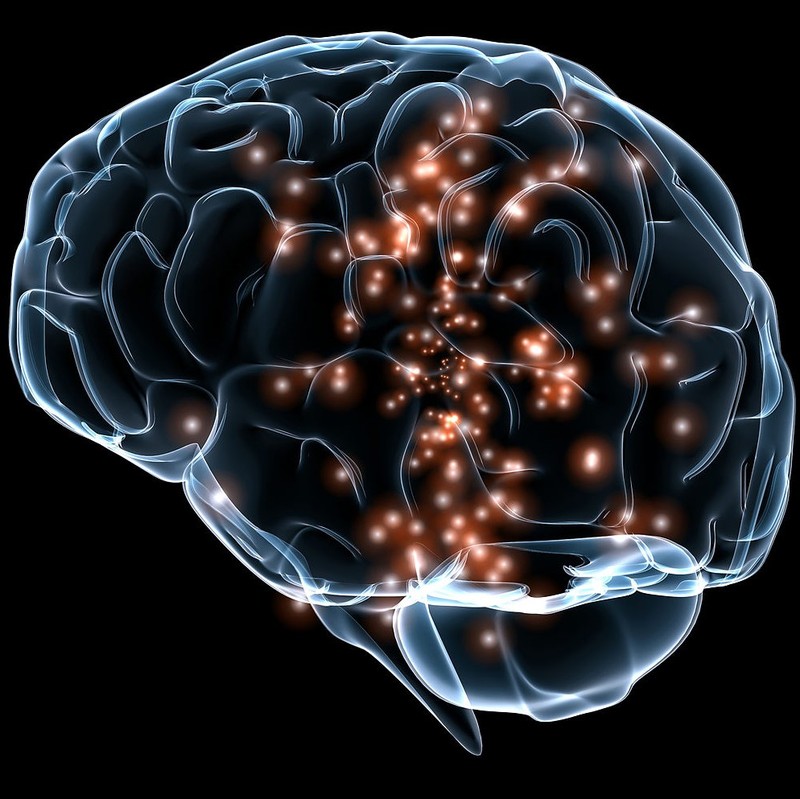
Virtually any drug that changes the way you feel does so by altering how neurons communicate with each other. Neurons communicate with each other by releasing a chemical (neurotransmitter) across a tiny space between two neurons (the synapse). When the neurotransmitter crosses the synapse, it binds to a postsynaptic receptor on the receiving neuron, and the message may then be transmitted onward. Neurotransmission is far more complicated than this—we reviewed neurotransmission in a previous chapter, and links at the end of this chapter can provide useful additional information—but the first step is understanding that virtually all psychoactive drugs modulate how neurons communicate with each other.
Several neurotransmitters play crucial roles in psychopharmacological treatments and drugs of abuse (examples in Table 1). The neurons that release these neurotransmitters, for the most part, are localized within specific circuits of the brain that mediate these behaviors. Psychoactive drugs can either increase activity at the synapse (these are called agonists) or reduce activity at the synapse (antagonists). Different drugs do this by various mechanisms, and examples of agonists and antagonists are presented in Table 2. Each example includes the drug’s trade name from the drug company and it generic name in parentheses.
| Neurotransmitter | Abbreviation | Behaviors of Diseases Related to These Neurotransmitter |
| Acetylcholine | ACh | Learning and memory; Alzheimer’s disease’ muscle movement in the peripheral nervous system |
| Dopamine | DA | Reward circuits; Motor circuits involved in Parkinson’s disease; Schizophrenia |
| Norepinephrine | NE | Arousal; Depression |
| Serotonin | 5HT | Depression; Aggression; Schizophrenia |
| Glutamate | GLU | Learning; Major excitatory neurotransmitter in the brain |
| GABA | GABA | Anxiety disorders; Epilepsy; Major inhibitory neurotransmitter in the brain |
| Endogenous Opioids | Endorphins, Enkephalins | Pain; Analgesia; Reward |
A link at the end of this chapter shows various steps involved in neurotransmission and some ways drugs can alter them.
Table 2 provides examples of drugs and their primary mechanism of action, but it is important to realize that drugs also affect other neurotransmitters. This contributes to a drug’s side effects. Current drugs lack precise targeting to specific brain regions or individual neurotransmitter systems. In many cases, individuals are sometimes prescribed one psychotropic drug but then may also have to take additional drugs to reduce the side effects caused by the initial drug. Some side effects can be so severe that individuals stop taking their medication.
| Drug | Mechanism | Use | Agonist/Antagonist |
| L-dopa | Increase Synthesis of DA | Parkinson’s disease | Agonist for DA |
| Adderall (mixed salts amphetamine) | Increase Synthesis of DA, NE | ADHD | Agonist for DA, NE |
| Ritalin (methylphenidate) | Blocks removal of DA, NE and lesser (5HT) from synapse | ADHD | Agonist for DA, NE mostly |
| Aricept (donepezil) | Blocks removal of ACh from synapse | Alzheimer’s disease | Agonist for ACh |
| Prozac (fluoxetine) | Blocks removal of 5HT from synapse | Depression, obsessive- compulsive disorder | Agonist 5HT |
| Seroquel (quetiapine) | Blocks DA and 5HT receptors | Schizophrenia, bipolar disorder | Antagonist for DA, 5HT |
| Revia (naltrexone) | Blocks opioid post-synaptic receptors | Alcoholism, opioid addiction | Antagonist (for opioids) |
Media Attributions
- original © Noba is licensed under a Public Domain license
A chemical substance produced by a neuron that is used for communication between neurons
The tiny space separating neurons
A drug that changes mood or the way someone feels
A drug that increases or enhances a neurotransmitter’s effect
A drug that blocks a neurotransmitter’s effect
A drug that changes mood or emotion, usually used when talking about drugs prescribed for various mental conditions (depression, anxiety, schizophrenia, etc.)