

2: Population and Health
- Page ID
- 382052

\( \newcommand{\vecs}[1]{\overset { \scriptstyle \rightharpoonup} {\mathbf{#1}} } \)
\( \newcommand{\vecd}[1]{\overset{-\!-\!\rightharpoonup}{\vphantom{a}\smash {#1}}} \)
\( \newcommand{\dsum}{\displaystyle\sum\limits} \)
\( \newcommand{\dint}{\displaystyle\int\limits} \)
\( \newcommand{\dlim}{\displaystyle\lim\limits} \)
\( \newcommand{\id}{\mathrm{id}}\) \( \newcommand{\Span}{\mathrm{span}}\)
( \newcommand{\kernel}{\mathrm{null}\,}\) \( \newcommand{\range}{\mathrm{range}\,}\)
\( \newcommand{\RealPart}{\mathrm{Re}}\) \( \newcommand{\ImaginaryPart}{\mathrm{Im}}\)
\( \newcommand{\Argument}{\mathrm{Arg}}\) \( \newcommand{\norm}[1]{\| #1 \|}\)
\( \newcommand{\inner}[2]{\langle #1, #2 \rangle}\)
\( \newcommand{\Span}{\mathrm{span}}\)
\( \newcommand{\id}{\mathrm{id}}\)
\( \newcommand{\Span}{\mathrm{span}}\)
\( \newcommand{\kernel}{\mathrm{null}\,}\)
\( \newcommand{\range}{\mathrm{range}\,}\)
\( \newcommand{\RealPart}{\mathrm{Re}}\)
\( \newcommand{\ImaginaryPart}{\mathrm{Im}}\)
\( \newcommand{\Argument}{\mathrm{Arg}}\)
\( \newcommand{\norm}[1]{\| #1 \|}\)
\( \newcommand{\inner}[2]{\langle #1, #2 \rangle}\)
\( \newcommand{\Span}{\mathrm{span}}\) \( \newcommand{\AA}{\unicode[.8,0]{x212B}}\)
\( \newcommand{\vectorA}[1]{\vec{#1}} % arrow\)
\( \newcommand{\vectorAt}[1]{\vec{\text{#1}}} % arrow\)
\( \newcommand{\vectorB}[1]{\overset { \scriptstyle \rightharpoonup} {\mathbf{#1}} } \)
\( \newcommand{\vectorC}[1]{\textbf{#1}} \)
\( \newcommand{\vectorD}[1]{\overrightarrow{#1}} \)
\( \newcommand{\vectorDt}[1]{\overrightarrow{\text{#1}}} \)
\( \newcommand{\vectE}[1]{\overset{-\!-\!\rightharpoonup}{\vphantom{a}\smash{\mathbf {#1}}}} \)
\( \newcommand{\vecs}[1]{\overset { \scriptstyle \rightharpoonup} {\mathbf{#1}} } \)
\(\newcommand{\longvect}{\overrightarrow}\)
\( \newcommand{\vecd}[1]{\overset{-\!-\!\rightharpoonup}{\vphantom{a}\smash {#1}}} \)
\(\newcommand{\ket}[1]{\left| #1 \right>}\)
\(\newcommand{\bra}[1]{\left< #1 \right|}\)
\(\newcommand{\braket}[2]{\left< #1 \vphantom{#2} \right| \left. #2 \vphantom{#1} \right>}\)
\(\newcommand{\braopket}[3]{\left< #1 \vphantom{#2}\vphantom{#3} \right| #2 \vphantom{#1}\vphantom{#3} \left| #3 \vphantom{#1}\vphantom{#2} \right>}\)
\(\newcommand{\qmvec}[1]{\mathbf{\vec{#1}}}\)
\(\newcommand{\op}[1]{\hat{\mathbf{#1}}}\)
\(\newcommand{\expect}[1]{\langle #1 \rangle}\)
\(\newcommand{\dfn}[1]{\emph{\textbf{#1}}}\)
- Understand: the spatial organization of the human population
- Explain: the dynamics of population as they are reflected in fertility, morbidity, and mortality
- Describe: the relationship between population and other spatial phenomena such as living standards, agriculture, and health
- Connect: development, migration and population as a fluid self- balancing system
- 2.1: Introduction
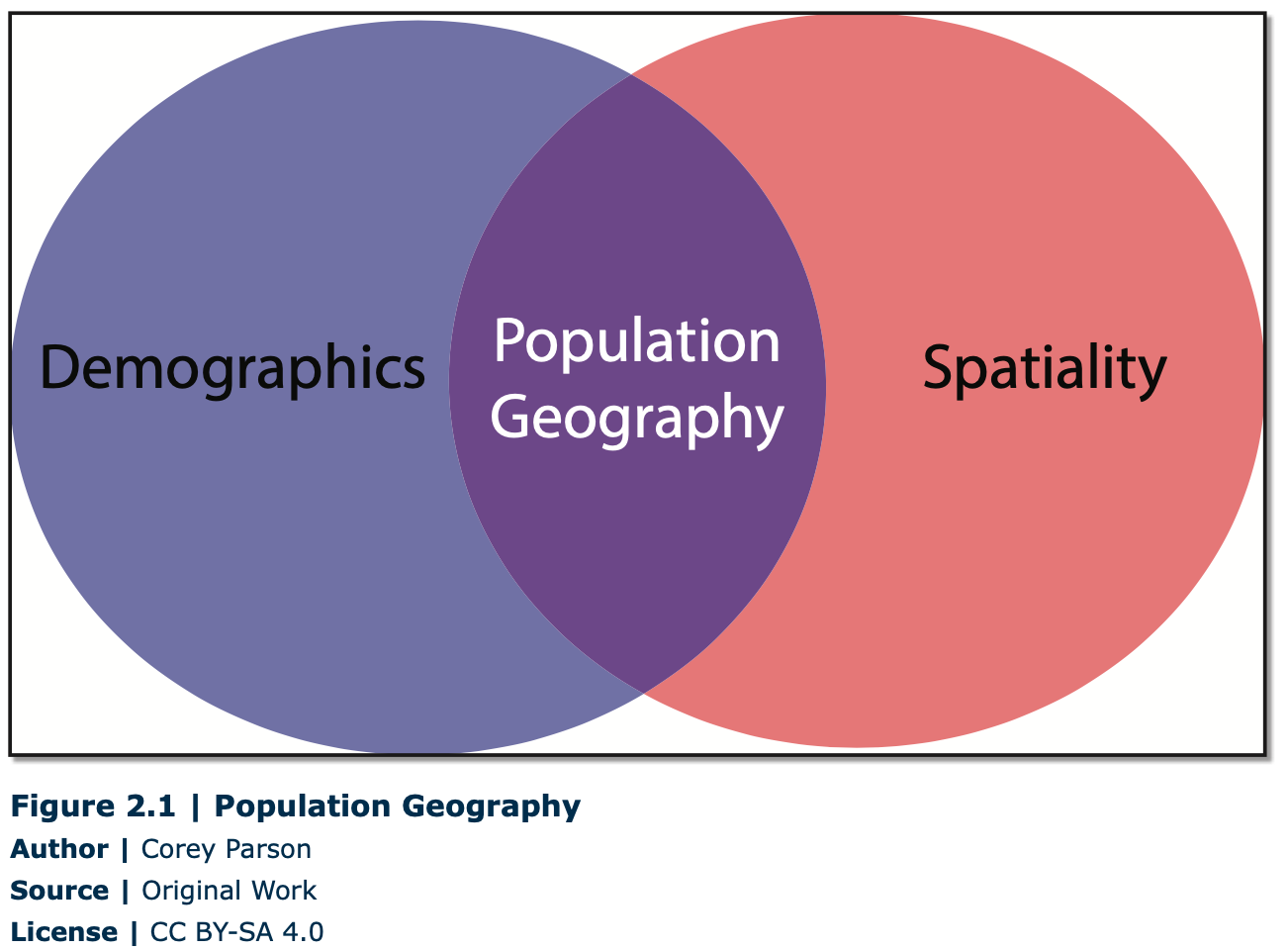
- This page discusses the global human population of 7.5 billion, analyzing population growth, natural increase, and migration patterns. It highlights disparities, such as Russia's declining population versus Bangladesh's growth, and factors like poverty and infant mortality that influence these trends. The chapter underscores the complexity of population changes due to diverse local influences, making it difficult to pinpoint a single explanatory factor.
- 2.2: Thinking about Population
- This page examines the evolution of population perspectives, from the Greek "ecumene" to Malthus's warnings on growth versus Boserup's optimistic views on human resourcefulness. It underscores the mismatch between global food abundance and local insecurity, while cautioning against the ecological fallacy in interpreting statistical data.
- 2.3: Population and Development
- This page examines the differing perspectives of Malthus and Boserup on population growth, revealing that while it can spur innovation, it may also result in negative effects like emigration and unrest when economic growth lags. It presents underpopulation cases, like Russia, and underscores that overpopulation is often perceived as a lack of resources. The text stresses the complex and context-sensitive nature of population dynamics and their consequences.
- 2.4: Population Is Dynamic
- This page covers global population trends, noting disparities in growth rates across regions. It explains demographic measures like birth and death rates and their limitations. Key concepts discussed include replacement level fertility, population pyramids, life expectancy, population momentum, and the dependency ratio, highlighting their significance for future resource allocation and societal structure.
- 2.5: The Demographic Transition
- This page discusses the Demographic Transition Model, which describes population changes during societal industrialization through four stages. Stage One has high birth and death rates, Stage Two sees declining death rates and rapid growth, Stage Three experiences falling birth rates leading to slower growth, and Stage Four stabilizes the population. The model illustrates the demographic shifts countries undergo during development.
- 2.6: Measuring The Impact Of Population
- This page explores methods for evaluating population pressure on land, including arithmetic, physiological, and agricultural densities, each focusing on different land use aspects. It emphasizes the concept of carrying capacity, which fluctuates over time due to environmental changes and technological progress, impacting the sustainable population a given land can support.
- 2.7: Future Population
- This page explains the importance of population pyramids in analyzing population trends and making future projections for resource allocation and economic planning. It notes the challenges posed by unexpected events, referred to as "Black Swan events," which can significantly impact demographic forecasts. Despite these uncertainties, the text underscores the necessity of making projections for effective planning.
- 2.8: Geography of Health
- This page explores the geography of health, detailing how health characteristics relate to geographical locations. It highlights demographic and epidemiological transitions, showing the shift from infectious to chronic diseases as regions develop. It notes narrowing health disparities and rising obesity and diabetes in developing countries.
- 2.9: Summary
- This page examines the trends in human population growth, indicating a slowdown in overall rates with significant regional differences. It notes that poorer regions experience rapid growth, while wealthier areas, despite low populations, have higher resource consumption. The page emphasizes the importance of understanding these disparities and their connection to poverty, paving the way for discussions on migration in the subsequent chapter.
- 2.10: Key Terms Defined
- This page provides an overview of essential demographic concepts for population studies, defining terms like agricultural and arithmetic density, carrying capacity, and key statistical rates such as birth and death rates. It covers demographic transition, dependency ratio, and population dynamics, including overpopulation, population momentum, and total fertility rate. Overall, the emphasis is on understanding the complexity of human populations and their growth patterns.
- 2.11: Works Consulted and Further Reading
- This page provides a compilation of references in health and population geography from various sources, including textbooks and websites. It covers key topics such as health geography and demographic theories, highlighting influential figures like Ester Boserup and Thomas Robert Malthus. Institutions such as the World Bank and CDC are also noted, emphasizing the interdisciplinary aspect.