Families are functional at some levels and simultaneously dysfunctional at others. No two families are exactly alike and very few families experience blissful ideal family experiences. Think about it, how could a family be ideal when its members are mortals?
It can't. Even in the history and myths of ancient civilizations, families had dysfunctions.
For example, Father Abraham's polygamous family had two sons, Ishmael (first-born) and Isaac (second-born). Ishmael and Isaac could not live together because their family broke up as a result of their mothers not getting along (their descendants still hold traditional enmity over these issues). Royal histories are filled with sibling rivalry, incestuous relationships, and violence.
The Roman lore of its founding history includes the fight between two adult brothers over what would eventually become Rome, wherein the twin boys were nearly drowned by their uncle (search Romulus and Remus to be surprised at who these twin's step-mother proved to be). Ancient Greek mythology is also full of family feuding and fighting and discord (search Prometheus, Hercules, Oedipus, and Narcissus). And these characters were assumed to be gods! Again, all modern families have functions and dysfunctions.
Family functions are the tasks and goals that support and sustain the family.
Dysfunctions are failures in the family to accomplish these tasks and goals. Functions are intended. Dysfunctions are typically unintended. For example, family members do not intend to establish poor communication patterns, invisible sexual boundaries (incest), or economic hardships. The basic family functions which are intended include: economic cooperation, control of sexuality, socializing children, identity and social status, and social and emotional need fulfillment.
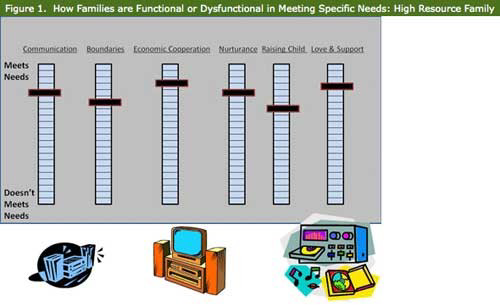
Figures \(\PageIndex{1}\) and \(\PageIndex{2}\) show diagrams of how family functions and dysfunctions can be compared to an equalizer on a stereo system. In Figure \(\PageIndex{1}\) this family meets the needs of communication, boundaries that are in place and maintained, economic cooperation, nurturance through relationships, raising the child/children, and offering love and support to other family members. Some families meet family members needs better than others.
These are often referred to as being high resource families. There are other families that meet some needs well and other needs poorly.
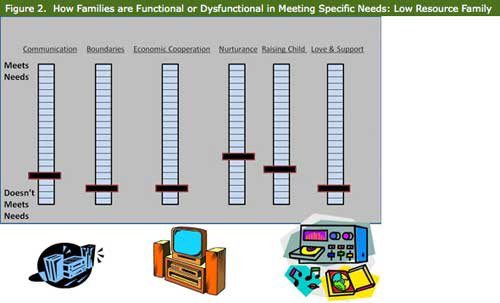
Figure \(\PageIndex{2}\) shows a family that meets most needs poorly. These are called low resource families. This family fails to meet the needs of communication, boundaries that are in place and maintained, economic cooperation, nurturance through relationships, raising the child/children, and offering love and support to other family members. This looks like a hopeless situation, but with voluntary efforts at seeking help or even involuntary efforts (state intervention), more resources could be attained and the family may improve its functionality.
Figure \(\PageIndex{1}\). How Families are Functional or Dysfunctional in Meeting Specific Needs: High Resource FamilyFigure \(\PageIndex{2}\). How Families are Functional or Dysfunctional in Meeting Specific Needs: Low Resource Family
Family dysfunctions can be handed down from generation to generation, with few family members aware that something is wrong in the family system. I know of a 62 year old man who shared with me in private that he was the first in a long line of family members who did NOT sexually abuse other family members. “I broke the chain of abuse,” he declared. His father would not acknowledge the abuse, much less talk to him about his having broken the chain.
Family Stressors
Having a baby, getting a new job, and buying a home are all normative stressors, or common and expected stressful events in life.
Many married couples experience a noticeable decline in marital satisfaction which accompanies the birth of their first child. Judith Wallerstein is quoted as having said, “Each couple must embrace the daunting roles of parents and absorb the impact of her majesty the baby's dramatic entrance while protecting the couples' own privacy” (see The Good Marriage By Wallerstein, J. S. & Blakeslee, S. 1995, Houghton Mifflin: NY).
Many researchers have established a decline in marital satisfaction after the birth of a child, especially the first child. The better the couple are as friends, the less the impact the first child has on their marriage. To transition to the role of parents, it was found that couples who work closely and in a mutually supportive manner make the best adjustments (retrieved 26 April, 2010 from http://www.apa.org/monitor/jan01/parenthood.aspx).
When we bought our first home, we purchased it through friends who were eager to sell and move. They lowered the price for us. Because we got along so well, things went easier for all of us. But, it was by far the most stressful experience of our married lives.
We spent 2 weeks arranging our finances, getting all the legal paper work in order, helping them by keeping appointments with inspectors and closing agents, and beginning to pack our belongings. We simultaneously put our mobile home on the market. The day of the closing, minute details threatened the paperwork so much so that we truly reached the point of believing it through. We eventually signed and succeeded in buying the house. The next day, our home sold and the process of appointments and inspections began from the seller's point of view-then came the move. Our friends moved out. We helped them clean. Then we moved in. We got all of our belongings into the house by about 11:30 at night. The first night in our house we slept on the floor, exhausted to the core of our souls. Buying this house was a huge boon to us. But, even though it was a normal thing for a US family to do, it was very stressful.
Middle families tend to be in their 30-50s, their children are teens or young adults, they are in mid-career, and financially established with a home and cars. Middle families launch children into college, military, and jobs while maintaining steady earnings. They typically have retirement investments and are paying off mortgages and other loans. As they age into their 50s they find that some of their married children return home for a short season because of marital or financial hardships. Parents begin to witness the death of their own parents and siblings and are made much more aware of their pending move into the ranks of the elderly. These families have fewer normative stressors than the younger families.
Elderly families have more freedoms from childrearing than the younger families have.
They are 60 plus and are often grandparents, have their homes paid off, and are looking forward to retirement. Their grandchildren graduate college and become parents in their own right. They have experienced the passing of their grandparents, parents, aunts and uncles, and siblings. They also have begun to face the sober realities of their biological health declines. These families have far fewer normative stressors than younger families.
Acute stressors are typically unexpected, sudden, and demand tremendous resources to cope with them. Bankruptcies, illnesses, crime victimization, loss, and natural hazards are just a few of the acute stressors that could impact a family. Wallerstein and Blakesly (1995) also reported that happily married couples had “confronted and mastered the inevitable crises of life, maintaining the strength of the bond in the face of adversity.”
Stuff happens and some of it is truly acute and stressful.
In the 1970s, two psychiatrists named Thomas Holmes and Richard Rahe developed a scale that measured life stressor that could have impacted an individual or his or her family over the last 3 years (see Holmes, T.H. and Rahe, R.H.: The social readjustments rating scales, Journal of Psychosomatic Research, 11:213-218, 1967, also see another approach from Brown, G.W. and Harris, T.O.: Social origins of depression: A study of psychiatric disorder in women. London: Tavistock, 1978). For families in the young family stage, getting married, having a baby, buying a home, or having a parent die ranked as the most stressful events. For middle and older families, having your spouse die, divorce or separating, moving, and being married were among the most stressful events. In this paradigm one of these events can be coped with fairly well if the family members can gather enough resources to meet the challenge. Two or more acute stressors can pile up into your normative stressors and overwhelm you to the point of illness. This happened to me recently. My father died of cancer, we nearly lost an investment that would have financially ruined us, our married son and his wife moved back home with us then had a baby (they both lost their jobs), I had a car wreck, and I was promoted to Assistant Department Chair. This is on top of all the normal life events we have as parents of three teenagers and employees. As Homes and Rahe predicted, I had surgery.
My life is not that bad compared to our friends. Our best friends from junior college suffered an accident in 1991 when one of their 18 month old twins ran underneath a truck and was instantly killed. This tragic loss impacted them, us, friends, and family. To this day, this has proven to be the most intense stressor they have faced. They survived the loss, but if you were to ask them, it still exists as a tender part of their feelings. How families respond to stresses make a huge difference in their quality of life. Researchers have established that stress can strengthen you or destroy you, depending on how you cope with stressors as individuals or families.
When a series of normal and less significant stressors accumulate it can have the same effect as a major acute stressor. If both happen together, stress can pile up. Stressor pile up occurs when stressful events accumulate in such a manner that resolution has not happened with existing stressors before new stressors are added. Stressor pile up can be detrimental if adequate resources are not obtained to meet the demands of the stressors (search Hill and McCubbin's ABCX Models).
This generation of families does not share the same conservative financial tendencies as did the generation of our grandparents. In the US, many desire to have what they desire now, even if debt has to be incurred to get it. Now-time gratification (also called present time) is the individual perspective that seeks immediate satisfaction of their needs, wants, and desires. Delayed gratification is the individual perspective that has patience, the ability to invest time and efforts now in hopes of a payoff down the road. Delayed gratification is very common among college students who are willing to put in 4-6 years for the promise of a life-long career of better earnings and life experiences.
Bankruptcy often occurs among those who are now-time oriented and fail to wisely manage their resources. A bankruptcy is a federally authorized procedure that allows families (businesses too) to be relieved from liability from its debts and to arrange partial repayments through court ordered relief strategies. The American Bankruptcy Institute keeps track of bankruptcies in the US and report hundreds of thousands of bankruptcies each year (http://www.abiworld.org/AM//Template.cfm?Section=Home). The majority of those are non-business consumer bankruptcies. Chapter 7 (quickest and easiest for business and individuals) and Chapter 13 ( has a built-in repayment plan) are the two most common forms in the US. Bankruptcy does not allow persons to walk away without repercussion.
The 2005 Bankruptcy Abuse Prevention and Consumer Protection Act mandates partial repayments and an 8 year waiting period before refilling (see "Hearing before the Senate Judiciary Committee on Bankruptcy Reform", 109th Cong. February 10, 2005. Retrieved 27 April, 2010). Consumer misspending and mismanagement of funds contribute to a great deal of bankruptcies, but medical bills are often reported as being the cause for half of all bankruptcies in the US (see http://www.theatlantic.com/business/...nkruptcy/4683/).
Medical expenses cost billions to US consumers and can easily bankrupt under-insured and non-insured people. One of these medical concerns includes problematic childbirths.
Over 4 million babies are born in the US each year and only 1 percent were born away from a hospital in 2006 (retrieved 27 April, 2010 from www.hhs.gov/news/healthbeat/2...20100329a.html). In 2005 it is estimated that $32 billion was spent on childbirth expenses in the US ( retrieved 27 April 2010 from Big Money: Cost of 10 Most Expensive health conditions Near $500 billion www.ahrq.gov/news/nn/nn012308.htm).