The two legal drugs that have serious consequences for their users are alcohol and tobacco. While recreational cannabis use is legal in some states, it remains illegal in other states and at the federal level, thus it is included in the illegal drugs section below.
Alcohol
The amount of alcohol consumed annually by US drinkers is staggering. According to the National Institute on Alcohol Abuse and Alcoholism (NIAAA 2024), in 2022, the alcohol consumption rate of 2.5 gallons per capita equated to a person (aged 14 or older) consuming approximately an average of 533 standard drinks in a year. However, alcohol consumption declined to a new low in 2025, according to self-reporting in a Gallup poll. The poll revealed that 54% of Americans used alcoholic beverages (in contrast to being a total abstainer), down from a high of 71% in the mid-to-late 1970s and from 67% in 2022, and that drinkers are consuming less alcohol per week than in recent decades (Saad 2025). Nevertheless, alcohol consumption has health implications. In fact, the same Gallup poll found that a majority of Americans now feel that drinking even in moderation is bad for health, a reversal of prior decades in which most felt that it made no difference for health (Saad 2025). Moreover, moderate alcohol use differs from binge use and heavy use.
The Substance Abuse and Mental Health Services Administration (SAMHSA) of the federal government administers a national survey which provides comprehensive data on drug use among adults aged 12 and over. They ask survey respondents whether they had used specific drugs in the past month from when the survey was completed. In 2024, there were over 134 million current alcohol drinkers, and among those over 43% were binge drinkers and over one in ten (10.8%) were heavy drinkers. Over five million youth (13.3%) aged 12 to 20 – those not old enough to drink legally – used alcohol in the past month, including 1.7 million under the age of 18 (6.6%); however, they are less likely to be heavy drinkers than those aged 18-25 (SAMHSA 2025).
Moderate alcohol use is far less damaging than more excessive use, though many people drink more than moderately. Binge drinking is defined as having at least four (for women) or five (for men) drinks on the same occasion at least once in the past month (30 days). Heavy drinking is defined as binge drinking on five or more days in the past month. As the Harvard School of Public Health (2012) explains, “If all drinkers limited themselves to a single drink a day, we probably wouldn’t need as many cardiologists, liver specialists, mental health professionals, and substance abuse counselors. But not everyone who likes to drink alcohol stops at just one. While most people drink in moderation, some don’t.” Though, the 'some' that don't amount to nearly 60 million people aged 12 and older in the US.
Chart 11.1: Alcohol Use and Misuse among People Aged 12 or Older, 2024

This figure displays the number of people aged 12 and older who used alcohol, binge drank, and engaged in heavy drinking in the past month from when the survey was administered.
Source: SAMHSA 2025
As noted earlier, alcohol has a long history in the US and an even longer history in much of the rest of the world. When we think about the tens of millions of Americans who drink at least occasionally, the ads for beer and wine and hard liquor that appear regularly in the popular media, and the thousands of bars and related venues across the country, it is certainly no exaggeration to say that we have a drinking culture.
Once upon a time, the federal government and state governments tried to eliminate this culture. We are speaking, of course, about Prohibition. The passage of the Eighteenth Amendment to the US Constitution in January 1919 banned the manufacture, sale, and transportation of alcohol, and the ban took effect a year later. The ban was eventually deemed a failure, and the passage of the Twenty-First Amendment in 1933 repealed the ban. The manufacture, sale, and transportation of alcohol became legal once again.
Alcohol manufacturing and sales are a major industry worldwide today. Several alcohol companies rank among the largest corporations in the world as well as in the US (Jernigan 2009). US alcohol sales amount to billions annually (Smith 2011). The amount of money the public spends on alcohol is has been estimated at 12.5% of what it spends on food (US Department of Agriculture 2011). As authors at the American Medical Association explain:
"The alcohol industry produces a legal, widely consumed drug, is dominated by relatively few producers, and utilizes a powerful combination of advertising dollars, savvy marketing, political campaign contributions, and sophisticated lobbying tactics to create and maintain an environment favorable to its economic and political interests. ... As a chemical that affects our bodies, alcohol is a powerful drug resulting in more premature deaths and illnesses than all illicit drugs combined. Yet the industry has shaped public opinion and forced government to treat it not as a drug but as a cultural artifact, a valued legal commodity, almost a food, even a necessity of life" (Yoast & Williams 2004: 1).
As just one example of how the alcohol industry promotes its 'powerful drug,' the headline of a news article declared that the "alcohol companies go online to lure young drinkers" (Gardner 2010). According to the report, alcohol companies are increasingly using social media to persuade young people to buy and drink their products. Not surprisingly, many of these young targets turn out to be under the legal drinking age of 21 because they are easily able to gain access to alcohol sites. This problem led a public health professor to observe, "Close to 5,000 people under the age of 21 die of alcohol overuse each year. Virtual worlds show all of the appeal and none of the consequences of alcohol use and undercut efforts to reduce the incidence of underage drinking. At this point, alcohol companies appear limited only by their imaginations and pocketbooks" (Gardner, 2010).

The alcohol industry is a major part of the US and worldwide economies and has been successful in promoting its continued use.
© Thinkstock
Tobacco, Nicotine, and Vape
Nicotine, the major drug in tobacco, is another legal but dangerous drug. Over 11% of US adults (28.8 million adults) smoked cigarettes as of 2022. Over 13% of adult men and over 10% of adult women reported using cigarettes either 'every day' or 'some days' and had smoked at least 100 cigarettes during their lifetime. White and Black people (12.9% and 11.7%, respectively) are more likely to smoke cigarettes than Asian and Latino people (5.4% and 7.7%, respectively). People with a 4-year college degree are far less likely to smoke than those without one (5.3% versus 13.7% or higher) (CDC 2024b). However, thanks to more knowledge about tobacco’s health effects, public education campaigns about these effects, heavy taxes on cigarettes, and changing attitudes about tobacco, these numbers represent a significant decline from generations ago.
Additionally, the SAMHSA (2025) survey found that 27.7 million people (9.6%) aged 12 or older used an e-cigarette or similar device to vape nicotine in the past month. Nearly a quarter of people aged 18-25 vape, as represented in the figure below. Another survey, the 2024 National Youth Tobacco Survey, found that over 10% of US high school students and over 5% of middle school students report using at least one tobacco product, including e-cigarettes (American Lung Association 2025).
Chart 10.2: Nicotine Vaping among People Aged 12 or Older, 2024

Vaping nicotine is far more popular among the youngest adults (aged 18-25) than among other adults (aged 26 or older).
Source: SAMHSA 2025
If you have ever watched any number of pre-1970s movies or television shows like “Mad Men” that portray life back then, you know that the US used to have a tobacco culture the way it now has an alcohol culture. Many people smoked cigarettes, and a large number smoked cigars or pipes. This particular drug culture began to abate in the 1970s after much evidence mounted about the deaths and other serious health effects of tobacco use and especially about the dangers of secondhand smoke. Whereas college students a generation ago often sat in smoke-filled classrooms and Americans generally sat in smoke-filled restaurants and other venues, today most Americans can count on being in enclosed public spaces in which smoking is banned.
This is for good reason: Tobacco is a slow poison. It is unlikely that the Food and Drug Administration would approve this product, if a company had just manufactured cigarettes for the first time and it were not already used by millions. Fortunately for tobacco companies, nicotine does not distort perception the way that alcohol and many other psychoactive drugs do. Someone smoking or otherwise using tobacco can safely drive a car, operate machinery, and so forth. We don't hear about someone “under the influence” of tobacco. This, however, makes it dangerous.
Illicit Drugs (Combined)
The SAMHSA (2025) survey also gathers data from its thousands of respondents about illicit (illegal) drug use in the past year, which includes "any use of marijuana or cannabis products (including smoking, vaping, and other modes of use), cocaine (including crack), heroin, hallucinogens, inhalants, and methamphetamine, as well as misuse of prescription stimulants, tranquilizers or sedatives (e.g., benzodiazepines), or pain relievers" (SAMHSA 2025: 8). Over a quarter of the population aged 12 or older, 73.6 million people, used illicit drugs in the past year, as displayed below.
Chart 11.3: Illicit Drug Use among People Aged 12 or Older, 2024

This graphic displays the proportion of the population aged 12 and older who used illicit drugs in the past year, along with the number of users for each drug category. Cannabis is by far the most commonly used illicit drug today.
Source: SAMHSA 2025
These percentages may underestimate the problem of illegal drug use in at least two respects. First, the SAMHSA survey does not include people whose illegal drug use is especially high: Those experiencing houselessness, 'runaway' teens, and those incarcerated in prison, jail, or detention centers. Second, the survey includes people whose illegal drug use is relatively low, namely, 12-year-olds and young adolescents plus people in middle- or older-age. Thus, age matters: Young adults 18-25 years old consistently have the highest rates of drug use.
Below we explore more data on illicit drugs including cannabis, cocaine, heroin, opioids, and prescription drugs.
Cannabis
The most commonly used illicit drug by far is cannabis, with 64.2 million people using it in the past year (note that the categories are not mutually exclusive, meaning that the same individuals may be using cannabis as well as other drugs such as hallucinogens or opioids). Over one-third of young adults (12.2 million adults aged 18-25) used marijuana in the past year, with about 1 in 10 teens (2.7 million adolescents aged 12-17) using it in the past year. Additionally, more than one in seven people used cannabis in the past month alone, amounting to 44.3 million people, or over 15% of the population aged 12 or older. The majority of young people (aged 12 to 25) vaped the drug, whereas those aged 26 or older were more likely to use it a different way. Overall, smoking remains the most common mode of use, followed by eating (or drinking), then vaping, then other methods.
Hallucinogens
In the SAMHSA (2025) study, hallucinogens include drugs that cause hallucinations to various degrees including psilocybin mushrooms, LSD, MDMA (Molly or its predecessor Ecstasy), PCP, ketamine, peyote, and mescaline, among others. Hallucinogens are the second most common illicit drug, with 10.4 million people aged 12 and older (3.6%) using in the past year. Young adults (aged 18-25) are far more likely to use these drugs than other age groups, at a rate of 6.8% (2.4 million young adults).
Charts 11.4 and 11.5: Marijuana and Hallucinogen Use among People Aged 12 or older, 2021-2024


Young adults have the highest rates of use for most drug categories, with a far higher rate of cannabis and hallucinogen use than other age groups.
Source: SAMHSA 2025
Prescription Drugs and Opioids
Using prescription drugs for nonmedical purposes or recreation is considered a form of misuse, which is illegal. The SAMHSA survey includes "misuse of psychotherapeutic drugs currently or recently available by prescription in the United States, including prescription stimulants, tranquilizers or sedatives (e.g., benzodiazepines), and pain relievers" (over-the-counter drug misuse was excluded) (2025: 12). Most prescription drug misusers have their own prescriptions or obtain their drugs from friends, acquaintances, or relatives who have their own prescriptions. Whatever the source, some of these prescriptions are obtained legitimately – for actual medical conditions, but then are misused. Many experts fault physicians for overprescribing painkillers and other prescription drugs.
Chart 11.6: Prescription Pain Reliever Misuse Sources

This graphic shows that the great majority of prescription pain relievers that are misused are obtained directly from a healthcare provider (mostly through prescriptions) or from a friend or relative.
Source: SAMHSA 2025
Because prescription drugs are beneficial for so many people, our nation faces a special difficulty in dealing with the misuse of these drugs. As the head of the National Institute on Drug Abuse explained, "The challenges we face are much more complex because we need to address the needs of patients in pain, while protecting those at risk for substance use disorders." Thus according to a news report, "These drugs must be somehow legal and illegal, encouraged yet discouraged, tightly regulated yet easily available" (Zuger 2011).
In 2024, 13.8 million people aged 12 and older had misused prescription psychotherapeutic drugs in the past year. Opioids are the most commonly misused of these, with 7.6 million people misusing opioids, followed by prescription tranquilizers or sedatives at 4.6 million, and prescription stimulants at 3.9 million. Within the opioid category, Hydrocodone (e.g., Vicodin®) is the most common prescription misused, followed by Oxycodone (e.g., OxyContin®). (Note that in the survey, opioid misuse excludes illegally made fentanyl.) Luckily, prescription opioid misuse has declined in recent years, from 3.0% (8.5 million people) in 2021 to 2.6% (7.6 million people) in 2024; however, there are still millions of people who misuse opioids as part of the opioid crisis.

Prescription opioids drove the opioid crisis. Many believe that the pharmaceutical industry and prescribing physicians should be held responsible for the great damage that (over)prescribing opioids has caused.
© Thinkstock
Opioids more broadly include the prescriptions named above as well as similar drugs such as heroin, codeine, and morphine. Thus, there are more people that engage in opioid misuse when the measurement includes these drugs; however, the figure is only slightly higher as 95% of opioid misuse is through prescription opioids: 2.7% (7.8 million people aged 12 and older) misused opioids in the past year.
Opioid use produces a feeling of euphoria. For instance, after heroin is injected, "the user feels a flash, a rush, which has been described as an intense, voluptuous, orgasm-like sensation. Following this is the feeling of well-being, tranquility, ease, and calm, the sensation that everything in the user’s life is just fine. Tensions, worries, problems, the rough edges of life – all seem simply to melt away" (Goode 2008: 308-309). As described here, users typically take heroin into their body by injecting it into a vein. This mode of administration is undoubtedly a major reason for the public’s negative image of heroin users, describe in the prior page. Despite public concern, heroin use is quite rare. One-fifth of 1% of the population aged 12 or older (0.2%) used heroin in the past year, or 556,000 people. Heroin is one of few drugs that is less common among young adults than older adults, with 0.1% of adults aged 18-25 using and 0.2% of adults aged 26 or older using in the past year (SAMHSA 2025).
Fentanyl, a synthetic opioid, has become a leading concern regarding drug use. It has been largely responsible for the rise in overdose deaths since 2013, as we will see below. The drug is strong and users may not understand the high risk or that the drug they're taking even has fentanyl present:
"Fentanyl is 50 to 100 times stronger than morphine. Therefore, the risks for overdose or other adverse effects are substantially increased when people use fentanyl, especially among people whose bodies are not accustomed to the effects of opioids. IMF [Illegally Manufactured Fentanyl] is sometimes present in products that are sold as heroin or in counterfeit prescription drugs that are made to look like commonly misused prescription opioids. Some people who use IMF are not aware they are doing so" (SAMHSA 2025: 18-19).
The prevalence of fentanyl misuse is quite small statistically speaking, with 0.3% of adults aged 12 and older (816,000 people) misusing it in the past year and 0.2% (668,000 people) using IMF in the past year; however, because this drug is so dangerous, this figure is a top concern regarding harmful drug use. Moreover, as the SAMHSA report explains: "Because people who used IMF may have been unaware that they used it, caution must be taken in interpreting estimates of IMF use; these estimates are almost certainly an underestimate of true IMF use" (2025: 19).
The Applying Social Research box below discusses the roots of adolescent prescription drug misuse in the social institutions of family and education. The importance of these factors reinforces the sociological view that the origins of drug use often lie beyond the individual and in the social environment.
Applying Social Research
Prescription Drug Abuse by Adolescents
Despite the significance of prescription drug misuse, social science research on its causes is relatively sparse. In one of the first studies to examine the social origins of adolescent prescription drug abuse, sociologist Jason A. Ford (2009) analyzed data on adolescents in the national survey conducted by the Substance Abuse and Mental Health Services Administration (SAMHSA) that is discussed elsewhere in this chapter. Drawing on the large body of work that attributes drug use in part to weak social bonds, Ford reasoned that prescription drug abuse should be higher among adolescents who have weaker bonds to their parents and also weaker bonds to their schools.
For his measure of parental bonds, Ford used several questions that asked adolescents about their relationship with their parents, including whether parents feel proud of them and praise them for doing a good job, and whether their parents help them with their homework and limit their time out with friends on a school night. For his measure of school bonds, he used several questions that asked adolescents such things as whether they liked going to school and whether they found their schooling meaningful and important. His measure of prescription drug abuse relied on the adolescents’ self-reports of whether they had used any prescription drug for nonmedical purposes in the past year.
Controlling for gender, race, and other factors, Ford found support for his hypotheses: Prescription drug misuse was higher among adolescents with weaker bonds to their parents and also weaker bonds to their schools.
These results have important implications for efforts to reduce prescription drug misuse by adolescents: We must engage in efforts to strengthen families and to improve our schools.
Source: Ford 2009
Unlike other drugs, women are more likely than men to misuse prescription drugs (Ford 2009). The reasons for this counterintuitive finding are unclear, but scholars speculate that because girls and women obtain more prescription drugs than do boys and men, their greater nonmedical use of prescription drugs reflects the fact that they have more access to these drugs in the first place. Because boys and men and socialized into hegemonic masculinity, which devalues and stigmatizes the seeking of medical care, girls and women are more likely to be seen by doctors who may prescribe these drugs.
Cocaine
Like opioids, cocaine produces a high that is considered pleasurable by its users. According to sociologist Erich Goode (2008: 288), "Cocaine’s principal effects are exhilaration, elation, and euphoria – voluptuous, joyous feelings accompanied by a sense of grandiosity." As a stimulant, cocaine can increase energy, alertness, and a sense of self-confidence. It is not physiologically addictive, but it is considered psychologically addictive: The high it produces is so pleasurable that some users find they need to keep using it. A more potent form, crack cocaine, produces an immediate, intense high and is a relatively inexpensive drug. These features made crack a very popular drug when it was first introduced into US cities in the 1980s (Faupel et al. 2010).
Cocaine use, including crack, has declined since the 1980s, and today only 1.5% of the population aged 12 and older used the drug in the past year, and 2.3% for young adults aged 18-25 (SAMHSA 2025). Cocaine use thus is somewhat rare in percentage terms; however, that 1.5% translates to 4.3 million people, which is significant. Cocaine use may not be as harmful as other drugs, but it does have consequences. We discuss examples of consequences of drug use and harmful drug use next.
Consequences of Drug Use
Of all consequences of drug use and harmful drug use, perhaps the most severe is death: Smoking tobacco is the top preventable cause of death in the US, with 490,000 deaths annually. Secondhand smoke results in 19,000 deaths annually, for well over 500,000 people dying each year due to tobacco smoking (American Lung Association 2025). Excessive alcohol consumption (either over time or on one occasion) is also a leading preventable cause of death in the US, with 178,000 deaths annually (CDC 2024a). Drug overdoses amount to over 105,000 deaths annually, a figure that increased substantially since the early-mid 2010s due to synthetic opioids (Garnett & Miniño 2024). However, there are other consequences of drug use and harmful drug use, which we will also explore.
Legal Drugs
The rate of harmful alcohol use means that alcohol has serious personal and social consequences. One set of consequences involves individual and population health. The figure cited above – that harmful alcohol use is responsible for about 178,000 deaths annually – amounts to 488 deaths per day, or 20 per hour, as represented in the CDC graphic below. Excessive alcohol use has been estimated to have shortened the lives of those who died by an average of 24 years (CDC 2024a).
Infographic 11.1: Excessive Alcohol Use Deaths

The Centers for Disease Control and Prevention (CDC) shares graphics to educate the public about the harms of drug use. This one states that there are 488 deaths each day from excessive alcohol use, which is about 20 deaths every hour.
Source: CDC 2024a
This occurs primarily through the physiological damage it causes. About two-thirds of alcohol-related deaths arise from chronic conditions related to alcohol use, with the other third from binge drinking (CDC 2024). Heavy alcohol use can destroy the liver, increase blood pressure, weaken the heart and immune system, lead to neurological problems, raise the risk of incurring several kinds of cancer, and result in other concerns such as sexual dysfunction. Binge drinking can cause serious immediate health problems because it may lead to someone overdosing on alcohol. Harmful alcohol use was involved in over 7% of all emergency department visits in 2020 and involved in one in six drug overdoses in 2020-2021. The National Institute on Alcohol Abuse and Alcoholism (NIAAA) explains:
"Between 2015 and 2019, the leading causes of alcohol-attributable deaths due to chronic conditions in the United States were liver diseases (e.g., alcohol-associated liver disease and unspecified liver cirrhosis), cardiovascular diseases, cancers of various types (e.g., organs of the upper respiratory and digestive tracts, liver, colon, and breast), and alcohol use disorder" (NIAAA 2025).
Death from excessive alcohol use is gendered, just as alcohol use is, with over two-thirds of those dying being men and the other third being women (we do not have data on nonbinary people) (NIAAA 2025).
In addition to these health problems, alcohol use is responsible for more than 13,000 traffic fatalities annually, nearly one-third of all driving fatalities (NIAAA 2025). It also plays an important role in violent crime (Felson, Teasdale, & Burchfield 2008). Alcohol abuse can also lead to problems for families, including domestic violence and divorce, and the stress that results from having to deal with a family member's alcohol use disorder on a daily basis. The Children and Our Future box below discusses the impact of parental alcoholism on children.
Children and Our Future
Children of Alcoholics
As with so many social problems, one of the saddest consequences of alcohol abuse involves children. About one-fifth of children have lived with an alcoholic parent or other adult. Whether because alcoholism is partly inherited or because children tend to use their parents as role models, children of alcoholics are four times more likely than children of nonalcoholics to become alcoholics themselves by the time they reach adulthood.
Because living with an alcoholic parent is often both chaotic and unpredictable, it is no surprise that children of alcoholics often experience a great deal of stress and other difficulties that may also account for their greater tendency to become alcoholics. Compared to other children, they are more likely to be neglected and/or abused by their parents, and they are also more likely to miss school, have lower grades, and engage in disruptive behavior. In addition, they are at great risk for eating disorders and substance abuse other than alcohol abuse. The stress they experience can also harm their neurological development and immune system and put them at greater risk for different kinds of illness and disease. Children of alcoholics are also at greater risk for several kinds of psychological and emotional problems. These include (1) guilt, because they may blame themselves for their parent’s drinking; (2) anxiety, because they worry about their parent’s health and may see their parents arguing and fighting; (3) embarrassment that leads them not to invite friends over to visit nor to ask another adult for help; (4) lack of trust in other people, because they have learned not to trust their alcoholic parent; and (5) anger, confusion, and depression.
One special problem that children of alcoholics face is that they are “forced into adulthood.” They often find themselves having to care for younger siblings and even for their alcoholic parent. By taking on such a heavy responsibility, they in effect become adults at too tender an age. This responsibility weighs on them and helps account for the psychological and emotional difficulties they often experience.
Mental health professionals strongly advise that children of alcoholics receive counseling and other kinds of support to help them deal with their family experiences. Group support programs for teenaged children may be very helpful. Perhaps the best known such program is Alateen, which also services teenagers who want help dealing with an alcoholic friend. Teenagers at Alateen meetings share their experiences, learn how to deal with the special difficulties that stem from having a relative or friend with an alcohol problem, and provide emotional support for each other. One important message they learn from Alateen is that they are in no way responsible for the alcoholism of their parent, other relative, or friend.
Alateen has helped many young people, as this testimonial from “Lizzy” attests: “Alateen has helped me a lot over the years…From the day I went to my first meeting, the door to my happiness was flung open. With the help of the Alateen Group Sponsors and my fellow teens, my life has become what I always wanted it to be. My goal for success in the program was fulfilled. I have been given a second chance at life and I have Alateen to thank for that.”
Young children and teenagers are resilient, but children of alcoholics have to be especially resilient. Programs like Alateen help give them a second chance.
Sources: Alateen 2011; American Academy of Child and Adolescent Psychiatry 2006; James 2008
Harmful alcohol use is also costly for society. In 2010 (the last year reliable data were available as of this writing), alcohol misuse cost the US $249 billion (NIAAA 2024b). Another estimate found that it costs the US more than $185 billion each year in medical expenses, lost earnings because of alcohol-related illness or premature death, lost earnings by victims of violent crime, and alcohol-caused traffic accidents (Harvard School of Public Health 2012).
Finally, binge drinking by college students has serious consequences (Center for Science in the Public Interest 2008; National Center on Addiction and Substance Abuse 2007), such as:
- Binge drinkers are more likely than other students to miss class, get poor grades, be injured, have unprotected sex, and to drive after drinking.
- Six hundred thousand college students suffer alcohol-related injuries (from motor vehicle crashes and other accidents) each year, and 1,700 die from these injuries.
- Thirty thousand college students need medical attention annually to treat alcohol overdosing.
- Seven hundred thousand students are assaulted annually by a student who has been drinking, and three hundred students die from these assaults.
- Students who attend colleges with high rates of binge drinking are more likely to experience sleep disruption, property damage, and physical and sexual assaults than those who attend colleges with low rates of binge drinking.
As we saw earlier, smoking tobacco kills nearly three times as many people every year as those killed by harmful alcohol use. Tobacco smoking is ranked in the top of preventable deaths and illnesses. A striking research finding is that about half of all cigarette smokers will one day die from a premature death caused by a smoking-related illness (King et al. 2011). Again, nicotine is a slow poison.
Tobacco kills in several ways. Smoking causes the great majority of all lung cancers, and it greatly increases the risk of emphysema and other lung disease, coronary heart disease, and stroke. In addition to lung cancer, tobacco use also causes several other cancers, including bladder cancer, cervical cancer, esophageal cancer, stomach cancer, and throat cancer. Women who smoke are at greater risk for lower bone density and hip fracture when they get older.
Cigarette smoking is also costly, as with harmful alcohol use. In 2018, it cost the nation over $600 billion, including nearly $372 billion in lost productivity and over $240 billion in healthcare costs (CDC 2024b). Additionally, secondhand smoke costs the nation around $7 billion per year, due to premature death. Medicaid spending alone amounts to over $68.3 billion in healthcare costs for smoking-related diseases annually – over one-fifth of its total spending (American Lung Association 2025). An older estimate found that Americans spend about $90 billion annually on tobacco products (CDC 2011).
Most vaping involves nicotine, and thus has similar consequences as those described above. One unique concern is the rate of vaping among the youngest adults (25 or younger). According to the CDC (2025):
- Nicotine poses unique dangers to youth because their brains are still developing.
- Nicotine can harm brain development which continues until about age 25.
- Youth can start showing signs of nicotine addiction quickly, sometimes before the start of regular or daily use.
- Using nicotine during adolescence can harm the parts of the brain that control attention, learning, mood, and impulse control.
- Adolescents who use nicotine may be at increased risk for future addiction to other drugs.
- Youth who vape may also be more likely to smoke cigarettes in the future.
However, other vaping involves different dangers: The aerosols found in e-cigarettes and other vaping devices can contain harmful substances such as chemicals known to cause cancer, chemicals that harm the gut, heavy metals (such as lead, tin, or nickel), small particles that infiltrate the lungs, and volatile compounds (CDC 2025).
Illicit Drugs
Cannabis use can cause several adverse outcomes (National Institute on Drug Abuse 2010). It may distort perception, impair coordination, and cause short-term memory loss, and people who are high from cannabis may be unable to safely drive a motor vehicle or operate machinery. In addition, regular cannabis smokers are at risk for respiratory problems. Chronic cannabis use is also associated with absence from school and the workplace and with social relationship problems, although it is difficult to determine whether cannabis is causing these effects or whether the association exists because someone with personal problems begins using cannabis regularly.
Health researchers are also concerned about the impacts of cannabis legalization on adolescent use. Increasing amounts of research reveal correlations between adolescent cannabis use and short and potentially long-term impairments on cognition, worse academic and vocational outcomes, and increased prevalence of psychotic, mood, and addictive disorders (Hammond et al. 2020). Though cannabis use rates among adolescents are higher in states that have legalized the substance, those rates were higher even before legalization (Ammerman et al. 2015; Choo et al. 2014; Wall et al. 2011). Legalization itself did not cause higher usage rates.
Other negative impacts of cannabis use have risen in states where cannabis is legalized. Motor vehicle accidents and deaths where cannabis was involved have increased. Young children and pets accidentally overdose more often. Finally, emergency rooms see more patients and hospitalize them more often due to potent cannabis causing psychosis, depression, and anxiety (Committee on Substance Abuse 2015, as cited in Hammond et al. 2020).
Despite these concerns, cannabis appears to be the most benign illicit drug in terms of health and social consequences, and it is also more benign than either alcohol or tobacco (Drug Policy Alliance 2011; Faupel et al. 2010). As noted earlier, these latter two drugs kill far more Americans annually. In contrast, cannabis does not kill many, and its use has not been associated with cancers in the same way. A review of the evidence on cannabis summarized research findings as follows: “Studies of long-term marijuana smokers do not produce gross or major clinical, psychiatric, psychological, or social difference between users and nonusers, or between heavier and lighter users” (Goode 2008: 247).
In summary, while not entirely safe, cannabis appears to be safer than either alcohol or tobacco. Even so, it remains an illegal drug federally and within several states. This fact underscores the issue that the legality of drugs has no logical basis. If the personal and social harm caused by a drug determined whether it is legal or not, then it would be logical for cannabis to be legal and for alcohol or tobacco to be illegal.
The public’s image and concern about heroin is partly deserved in some ways and partly undeserved in other ways. Like other opioids, heroin is extremely physiologically addictive, although not as addictive as nicotine. But also like other opiates, heroin does not damage body organs. The emaciated look we often associate with heroin users stems not from the drug itself but from the lifestyles that heroin users tend to live. However, an overdose of heroin can certainly kill, just as overdoses of other drugs can kill. One reason heroin overdoses occur is that heroin users cannot know for sure the purity of the heroin they buy illegally and thus may inject an unsafe dose to get high. We discuss overdoses further below.
Applying Social Research
Experiences of Heroin Users in Rural New Mexico
We see differences in the harm caused by harmful drug use because of the lack of treatment centers in rural areas. The lack of treatment centers harms white people who live in these areas as well as people of color.
Anthropologist Angela Garcia (pictured below) spent several years researching heroin use among members of a Hispano (of Spanish decent) and Indigenous community in rural northern New Mexico.
Garcia's findings (2010) point to the loss of a connection to land and livelihood and the experience of settler colonialism as social determinants of harmful heroin use. Settler colonialism is a system that normalizes the continuous settler occupation of Indigenous lands and exploitation of Indigenous resources. It is Eurocentric in nature, assuming that European white ideas and values are superior (Cox 2017).
Garcia’s research found that dispossession of ancestral lands ruptured the link to cultural heritage and caused impoverishment. Together, the disconnection and poverty formed a source of never-ending emotional pain for users of heroin.
The sparsely populated rural setting also meant that drug treatment was less available.
By examining the history of dispossession and oppression that impacted this community, Garcia shows how the social determinants of harmful drug use can illuminate the root social causes of the problem.
If you would like to learn more, please watch Angela Garcia on “Postcolonial theory and psychological anthropology”. In the video, Garcia also discusses her relationship with those she studied, including the pain of returning to her home.

Anthropologist Angela Garcia studies heroin use among members of a Latinx community in rural New Mexico. How might geographic location and ties to land play a role in drug misuse, incarceration, and treatment?
“Photo of Dr. Angela Garcia” © Stanford University is all rights reserved and included with permission
Finally, as a stimulant, cocaine speeds up the central nervous system. Because it does so much more intensely than most other stimulants, its use poses special dangers for the cardiovascular system (National Institute on Drug Abuse 2011). In particular, it can disrupt the heart’s normal rhythm and cause ventricular fibrillations, and it can speed up the heart and raise blood pressure. An overdose of cocaine can thus be deadly, and long-term use produces an increased risk of stroke, seizure, and heart disease. Because cocaine also constricts blood vessels in the brain, long-term use raises the risk of attention deficit, memory loss, and other cognitive problems. Long-term abuse has also caused panic attacks, paranoia, and even psychosis.
Substance Use Disorders
Another consequence of harmful drug use is the development of substance use disorders (SUDs), which refers to the medical diagnosis regarding harmful drug use. SAMSHA (2025: 21) describes SUDs as "characterized by impairment caused by the recurrent use of alcohol or other drugs (or both), including health problems; disability; and failure to meet major responsibilities at work, school, or home." Thus, the definition of SUDs points to consequences for health, disability, and life responsibilities.
In 2024, 48.4 million people (16.8% of the population aged 12 or older) could be characterized as having a SUD in the past year. Drug use disorder (a broad category involving a long list of drugs) and alcohol use disorder were the top SUDs, with 28.2 million and 27.9 million people having them, respectively. The next largest category is marijuana use disorder, at 20.6 million people.
Chart 11.7: Substance Use Disorder among People Aged 12 or Older, 2024
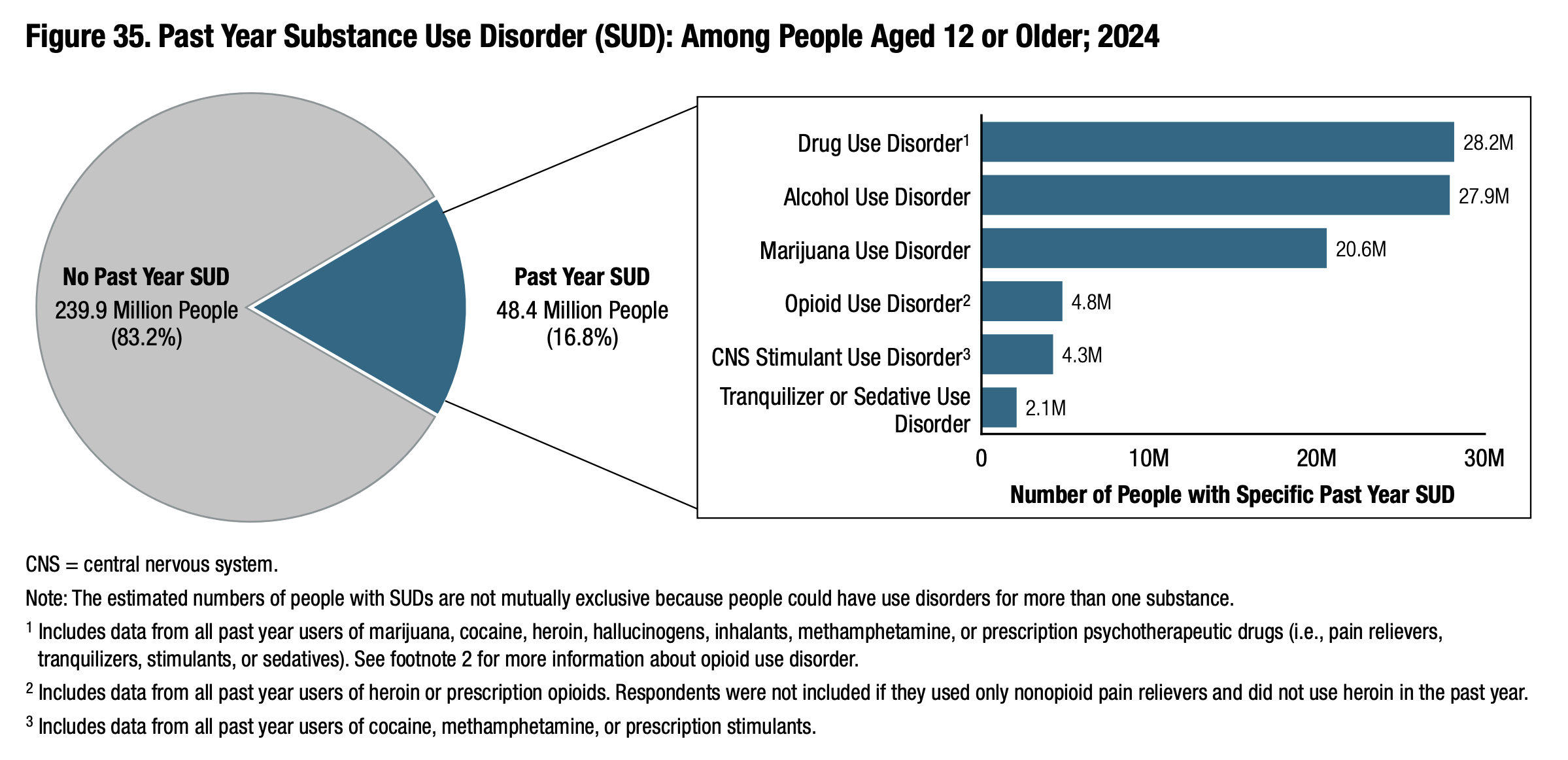
This chart displays the prevalence of Substance Use Disorders (SUDs), broken down by type of disorder. Drug use disorder (a broad category) and alcohol use disorder are the most common, with marijuana use disorder being third.
Source: SAMHSA 2025
Young adults have the highest rates of SUDs: Over a quarter of those aged 18-25 (9.1 million people), had an SUD in the past year. Among those aged 26 or older, 16.4% had an SUD in the past year (37.3 million adults), and among adolescents aged 12-17, 7.8% did (2.0 million teens). Among those adolescents, about two-fifths (792,000 teens) also had a major depressive episode in the past year. For all adults with an SUD (46.3 million adults aged 18 or older), slightly less than half (21.2 million adults) also had a mental illness in the past year. Additionally, among those who had any SUD in the past year, over one in five (21.3%) had a 'severe' disorder, defined as meeting meet six or more criteria among the eleven criteria for SUDs (SAMHSA 2025).
SUDs have consequences themselves. As Daley (2014) explains, research has documented that the impact on family members of those with an SUD include emotional burdens and relationship strain (e.g., frustration, anger, anxiety, fear, relationship tension), economic concerns (e.g., reduced income due to job loss, money spent on drugs), and family instability (e.g., separation/divorce, violence, removal of children by child protective services). Additionally, using drugs during a pregnancy can lead to fetal and child development problems (e.g., birth 'defects,' cognitive delays, oppositional disorders, psychiatric problems).
In addition to family-related consequences, SUDs impact society at large regarding population health, economic instability, and increased incarceration. For instance, SUDS "contribute to medical or psychiatric conditions, disability, and death as a result of accidents or diseases caused or worsened by substance use, or higher rates of suicidality, all of which affect society." Other social-level concerns are increased housing instability, crime, unemployment, and HIV transmission through shared needles (Daley 2014).
Drug Overdoses
We mentioned that the most serious consequence of harmful drug use is death, and those include drug overdoses. As stated above over 105,000 people in the US died in 2023 from drug overdoses. The rate of drug overdose deaths (deaths per 100,000 people) nearly quadrupled between 2003 and 2022, from 8.9 to 32.6. In 2023, it decreased slightly to 31.3 (Garnett & Miniño 2024). A large proportion of those deaths were due to synthetic opioids, as seen in the chart below. An increase was also seen with stimulants, such as cocaine and 'psychostimulants with abuse potential' (methamphetamine, amphetamine, and methylphenidate).
Chart 11.8: Drug Overdose Deaths Involving Opioids, 2003-2023

As this chart clearly displays, synthetic opioids became a major concern as the rates of drug overdose deaths involving opioids soared after 2013. This helps visualize the depth of the opioid crisis.
Source: Garnett & Miniño, National Center for Health Statistics, CDC 2024
There is variation in overdose deaths by social location. For instance, men have higher overdose death rates than women, as seen in the left chart below. There are also racial differences, with a wide gap between racial groups with higher and lower rates of overdose deaths, as seen in the right chart below.
Charts 11.9 and 11.10: Drug Overdose Death Rates by Sex and Race


The left side chart shows that drug overdose rates increased substantially from 2003 to 2022, with the largest increase in the second half of that period. It also shows a steeper increase for men, who have higher overdose rates that women. The right side chart shows that drug overdose rates are highest among American Indian and Alaska Native people, and that Asian people have far lower rates than others.
Source: Garnett & Miniño, National Center for Health Statistics, CDC 2024
Drug overdose death rates also vary by age, with young-to-middle adults having the highest rates (aged 25-64, with ages 35-44 having the highest). Teens and very young adults (aged 15-24) and older adults (aged 65 or older) have far lower overdose death rates.
––––
To reiterate what we discussed before, not all drug use may be considered harmful. Many drugs used in moderation, such as alcohol or cannabis, do not carry the same risks and consequences as other drugs, such as fentanyl or tobacco, or as used excessively, such as with heavy drinking. However, there are health concerns to consider even for moderate use of less harmful drugs. Thus, there consequences of drug use itself. Harmful drug use, however, carries more significant consequences including deteriorating health, distress to family members, economic costs to society, and other concerns such as housing insecurity and mass incarceration. We will further explore this last concern – mass incarceration – on the next page. The US took a punitive approach to drug use, harmful drug use, and substance use disorders (for some drugs at least, not tobacco nor alcohol), which led to a dramatic rise in the incarcerated population over the latter decades of the twentieth century through the first 15 or so years of the twenty-first century. This approach has consequences for individuals, their families, and society at large.


