Conflict, war, and terrorism are interrelated but each distinct. They are also vast and diverse, making them challenging to succinctly describe. Below we provide general definitions of conflict, war, and terrorism. We also describe different types of each. We refrain from offering many examples here, as we will focus on examples of each on the Patterns page.
Conflict
Conflict may occur between two or more groups as a result of competing ideologies or cultural values, differences in religious or ethnic identities, disputes over land or resources, and more. Conflict may be within or between nations, and may lead to war or not. Some patterns of conflict demonstrate how the actions of dominant groups inspired by ideology and prejudice have caused great harm, particularly to marginalized social groups. In this chapter we describe a few of patterns of interaction between social groups in conflict. Note how each includes a degree of physical and/or psychological violence. We will briefly define these types of conflict here, then provide examples of each on the Patterns page.
Segregation is one pattern of interaction that arises when social groups are in conflict. Segregation, as we've discussed in prior chapters, refers to the social and sometimes legal separation of social groups on the basis of race, ethnicity, religion, gender, or other social group membership. We have covered racial residential segregation, in which neighborhoods are separated by race, occupational gender segregation, in which jobs are separated by gender, and both de jure and de facto educational segregation, in which schools are separated by race and income – either by law or by fact. We will discuss racial segregation more broadly in this chapter, including de jure segregation. Segregation is a form of social control intended to maintain social hierarchies, with the dominant group enforcing the segregation.
Another pattern of conflict behavior is expulsion. Expulsion refers to when one group expels another group out of their home or homeland and into a different space. Expulsion includes a dominant group designating a specific area of the country in which another group is allowed to live, mandating that the group leave the country entirely, or forcing the group into concentration or internment camps. Expulsion is also a form of social control intended to disempower the group being expelled, displacing them from their homeland or secluding them from others.
Our final example is genocide. When describing Indian boarding schools in the chapter on Education, we introduced the concept of genocide: The systematic and widespread extermination of a cultural, ethnic, political, racial, or religious group. Genocide may involve the actual extermination of individuals in a specific group – widespread killings – or it may involve the eradication of a group's culture and identity. It is clear that with genocide, the dominant group seeks to eliminate another group entirely.
The US has, arguably, engaged in all of these patterns of interaction; with no doubt about the first two. We will review examples of US participation in these forms of conflict on the Patterns page.
War
War involves organized armed violence between social groups to achieve some objective. It has been defined as “sustained armed conflict” that causes “large-scale loss of life or extreme material destruction” (Worrell 2011: 1). Though when a war technically begins is often difficult to pinpoint, in the US, the Constitution grants Congress the sole power to declare that the nation is engaged in war.
Wars occur both between nations and within nations, when two or more factions engage in armed conflict. War between nations is called international war or interstate war, while war within nations is called civil war or intrastate war. The US has engaged in both. For instance, as aptly named, the US had the Civil War between the Union and the Confederacy in the 1860s. We have engaged in many more interstate wars, such as the World Wars in the early-mid 1900s and the wars in Iraq and Afghanistan more recently. We will list these and other wars that the US has participated in on the Patterns page, along with their casualties.
There are other types of war. Total war refers to those with no limits on weaponry or territorial scope, such as WWI which mobilized all of society’s resources. Just war refers to those which are strongly supported by the public (they view it as morally correct or 'just'), such as WWII which many Americans viewed as just. Proxy war refers to those in which nations fight indirectly by taking sides in other wars, such as the Vietnam War which was a fight against the spread of communism (a thus a fight against Soviet ideologies). Today, there is cyber war, attacks on a nation’s computer or online systems with hacking and malware, such as Russia’s cyber attacks on the Ukraine and U.S.
Terrorism
Terrorism refers to the use or threat of violence against civilians or governments to achieve some objective. As the term suggests, it is intended to incite terror. Some terrorist attacks are conducted by organized networks of people, such as with 9/11 in 2001, and others are conducted by individuals, such as with the Oklahoma City bombing in 1995 (discussed below).
Although dozens of definitions of terrorism exist, most take into account what are widely regarded as three defining features of terrorism: The use of violence, the goal of making people afraid, and the desire for political, social, economic, and/or cultural change. A popular definition by political scientist Ted Robert Gurr (1989: 201) captures these features: Terrorism is “The use of unexpected violence to intimidate or coerce people in the pursuit of political or social objectives.”
When we think about this definition, 9/11 certainly comes to mind, but there are, in fact, several kinds of terrorism – based on the identity of the actors and targets – to which this definition applies. One typology of terrorism, again by Gurr (1989), is well-cited: Vigilante terrorism, insurgent terrorism, transnational (or international) terrorism, and state terrorism. However, though vigilante terrorism is domestic terrorism, the latter may be broader.
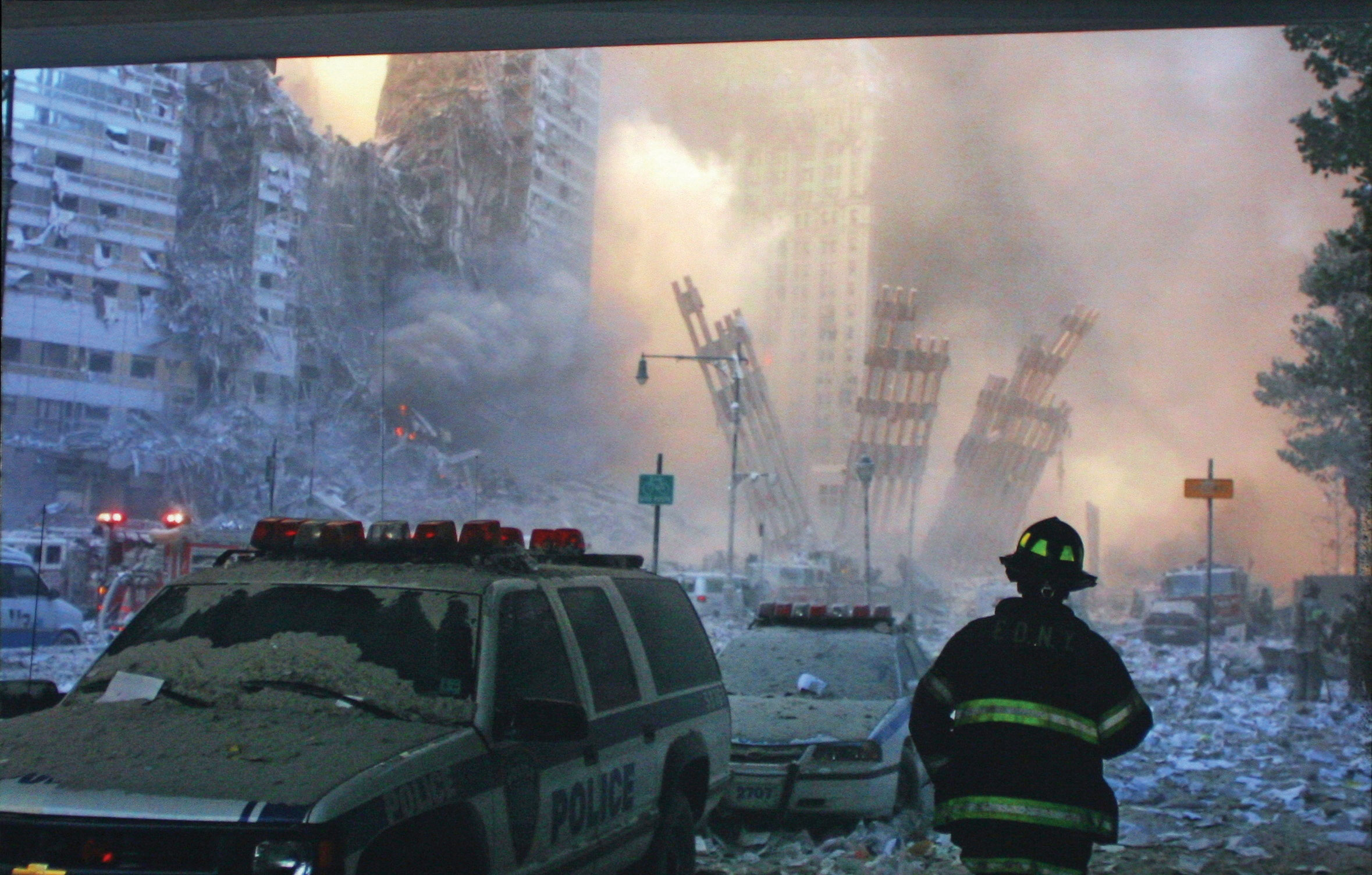
As the attacks on 9/11 remind us, terrorism involves the use of indiscriminate violence to instill fear in a population and thereby win certain political, economic, or social objectives.
Image courtesy of Bill Biggart, http://www.flickr.com/photos/nostri-imago/4951407339
Vigilante terrorism is committed by private citizens against other private citizens. Sometimes the motivation is racial, ethnic, religious, or other hatred, and sometimes the motivation is to resist social change. The violence of racist groups like the Ku Klux Klan was vigilante terrorism, as was the violence used by white Europeans against Native Americans from the 1600s through the 1800s. What we now call “hate crime” is a contemporary example of vigilante terrorism. Vigilante terrorism is a form of domestic terrorism, which refers to when private citizens engage in acts of violence against other citizens of their own nation. However, domestic terrorism also includes when private citizens commit violence against state actors in order to influence policy or operations of the government, which overlaps with the next type of terrorism.
Insurgent terrorism is committed by private citizens against their own government or against businesses and institutions seen as representing the 'establishment.' US history is filled with insurgent terrorism, starting with some of the actions the colonists waged against British forces before and during the American Revolution, when “the meanest and most squalid sort of violence was put to the service of revolutionary ideals and objectives” (Brown 1989: 25). An example here is tarring and feathering: Hot tar and then feathers were smeared over the unclothed bodies of Tories. Some of the labor violence committed after the Civil War also falls under the category of insurgent terrorism, as does some of the violence committed by left-wing groups during the 1960s and 1970s. A significant example of right-wing insurgent terrorism is the 1995 bombing of the federal building in Oklahoma City by Timothy McVeigh and Terry Nichols that killed 168 people.
Transnational terrorism is committed by the citizens of one nation against targets in another nation. This is the type that has most concerned Americans at least since 9/11, yet 9/11 was not the first time that Americans had been killed by international terrorism. A decade earlier, a truck bombing at the World Trade Center killed six people and injured more than 1,000 others. In 1988, 189 Americans were among the 259 passengers and crew who died when a plane bound for New York exploded over Lockerbie, Scotland. Agents from Libya were widely thought to have planted that bomb. Despite these American deaths, transnational terrorism has actually been much more common in several other nations: London, Madrid, and various cities in the Middle East have often been the targets of international terrorists.
State terrorism involves violence by a government that is meant to frighten its own citizens and thereby stifle their dissent. State terrorism may involve mass murder, assassinations, and torture. Whatever its form, state terrorism has killed and injured more people than all the other kinds of terrorism combined (Gareau 2010). Genocide, defined above, is the most deadly type of state terrorism, but state terrorism also occurs on a smaller scale. As just one example, the violent response of Southern white law enforcement officers to the civil rights protests of the 1960s amounted to state terrorism, as officers murdered or beat hundreds of activists during this period. Although state terrorism is usually linked to authoritarian regimes, many observers say that the US government also engaged in state terrorism and genocide during the nineteenth century, when US troops killed thousands of Native Americans (Brown 2009).
The Snapshot table below summarizes the types of conflict, war, and terrorism that we have discussed above.
Types of Conflict, War, and Terrorism Snapshot
| Conflict |
|
| Segregation |
The social, sometimes legal, separation of groups |
| Expulsion |
The expelling of a social group out of one space into another |
| Genocide |
The systematic and widespread extermination of a group |
| War |
|
| Interstate or international war |
Sustained armed conflict between nations |
| Intrastate or civil war |
Sustained armed conflict within a nation |
| Terrorism |
|
| Transnational terrorism |
Violence committed by citizens of one nation against targets in another nation |
| Domestic terrorism |
Violence committed by citizens within one nation against targets in that nation |
| Vigilante terrorism |
Violence committed domestically by citizens in the name of retribution or the social order |
| Insurgent terrorism |
Violence committed by citizens against their government or 'establishment' organizations |
| State terrorism |
Violence committed by a government against its own citizens |
On the following pages we outline various explanations for conflict, war, and terrorism, offering special focus on sociological framings including the classical theoretical perspectives. We also discuss more examples of conflict, war, and terrorism and their consequences. We then shift attention to a related special topic: Militarism and the US military budget, which connects to a concept introduced in the Theoretical Perspectives page: The military industrial complex. Finally, we review potential strategies to reduce conflict, war, and terrorism and their consequences.


