

Social Sci LibreTexts

Understanding Social Problems

  • Page ID
    255618
    • Anonymous
    • LibreTexts

    \( \newcommand{\vecs}[1]{\overset { \scriptstyle \rightharpoonup} {\mathbf{#1}} } \)

    \( \newcommand{\vecd}[1]{\overset{-\!-\!\rightharpoonup}{\vphantom{a}\smash {#1}}} \)

    \( \newcommand{\dsum}{\displaystyle\sum\limits} \)

    \( \newcommand{\dint}{\displaystyle\int\limits} \)

    \( \newcommand{\dlim}{\displaystyle\lim\limits} \)

    \( \newcommand{\id}{\mathrm{id}}\) \( \newcommand{\Span}{\mathrm{span}}\)

    ( \newcommand{\kernel}{\mathrm{null}\,}\) \( \newcommand{\range}{\mathrm{range}\,}\)

    \( \newcommand{\RealPart}{\mathrm{Re}}\) \( \newcommand{\ImaginaryPart}{\mathrm{Im}}\)

    \( \newcommand{\Argument}{\mathrm{Arg}}\) \( \newcommand{\norm}[1]{\| #1 \|}\)

    \( \newcommand{\inner}[2]{\langle #1, #2 \rangle}\)

    \( \newcommand{\Span}{\mathrm{span}}\)

    \( \newcommand{\id}{\mathrm{id}}\)

    \( \newcommand{\Span}{\mathrm{span}}\)

    \( \newcommand{\kernel}{\mathrm{null}\,}\)

    \( \newcommand{\range}{\mathrm{range}\,}\)

    \( \newcommand{\RealPart}{\mathrm{Re}}\)

    \( \newcommand{\ImaginaryPart}{\mathrm{Im}}\)

    \( \newcommand{\Argument}{\mathrm{Arg}}\)

    \( \newcommand{\norm}[1]{\| #1 \|}\)

    \( \newcommand{\inner}[2]{\langle #1, #2 \rangle}\)

    \( \newcommand{\Span}{\mathrm{span}}\) \( \newcommand{\AA}{\unicode[.8,0]{x212B}}\)

    \( \newcommand{\vectorA}[1]{\vec{#1}}      % arrow\)

    \( \newcommand{\vectorAt}[1]{\vec{\text{#1}}}      % arrow\)

    \( \newcommand{\vectorB}[1]{\overset { \scriptstyle \rightharpoonup} {\mathbf{#1}} } \)

    \( \newcommand{\vectorC}[1]{\textbf{#1}} \)

    \( \newcommand{\vectorD}[1]{\overrightarrow{#1}} \)

    \( \newcommand{\vectorDt}[1]{\overrightarrow{\text{#1}}} \)

    \( \newcommand{\vectE}[1]{\overset{-\!-\!\rightharpoonup}{\vphantom{a}\smash{\mathbf {#1}}}} \)

    \( \newcommand{\vecs}[1]{\overset { \scriptstyle \rightharpoonup} {\mathbf{#1}} } \)

    \(\newcommand{\longvect}{\overrightarrow}\)

    \( \newcommand{\vecd}[1]{\overset{-\!-\!\rightharpoonup}{\vphantom{a}\smash {#1}}} \)

    \(\newcommand{\avec}{\mathbf a}\) \(\newcommand{\bvec}{\mathbf b}\) \(\newcommand{\cvec}{\mathbf c}\) \(\newcommand{\dvec}{\mathbf d}\) \(\newcommand{\dtil}{\widetilde{\mathbf d}}\) \(\newcommand{\evec}{\mathbf e}\) \(\newcommand{\fvec}{\mathbf f}\) \(\newcommand{\nvec}{\mathbf n}\) \(\newcommand{\pvec}{\mathbf p}\) \(\newcommand{\qvec}{\mathbf q}\) \(\newcommand{\svec}{\mathbf s}\) \(\newcommand{\tvec}{\mathbf t}\) \(\newcommand{\uvec}{\mathbf u}\) \(\newcommand{\vvec}{\mathbf v}\) \(\newcommand{\wvec}{\mathbf w}\) \(\newcommand{\xvec}{\mathbf x}\) \(\newcommand{\yvec}{\mathbf y}\) \(\newcommand{\zvec}{\mathbf z}\) \(\newcommand{\rvec}{\mathbf r}\) \(\newcommand{\mvec}{\mathbf m}\) \(\newcommand{\zerovec}{\mathbf 0}\) \(\newcommand{\onevec}{\mathbf 1}\) \(\newcommand{\real}{\mathbb R}\) \(\newcommand{\twovec}[2]{\left[\begin{array}{r}#1 \\ #2 \end{array}\right]}\) \(\newcommand{\ctwovec}[2]{\left[\begin{array}{c}#1 \\ #2 \end{array}\right]}\) \(\newcommand{\threevec}[3]{\left[\begin{array}{r}#1 \\ #2 \\ #3 \end{array}\right]}\) \(\newcommand{\cthreevec}[3]{\left[\begin{array}{c}#1 \\ #2 \\ #3 \end{array}\right]}\) \(\newcommand{\fourvec}[4]{\left[\begin{array}{r}#1 \\ #2 \\ #3 \\ #4 \end{array}\right]}\) \(\newcommand{\cfourvec}[4]{\left[\begin{array}{c}#1 \\ #2 \\ #3 \\ #4 \end{array}\right]}\) \(\newcommand{\fivevec}[5]{\left[\begin{array}{r}#1 \\ #2 \\ #3 \\ #4 \\ #5 \\ \end{array}\right]}\) \(\newcommand{\cfivevec}[5]{\left[\begin{array}{c}#1 \\ #2 \\ #3 \\ #4 \\ #5 \\ \end{array}\right]}\) \(\newcommand{\mattwo}[4]{\left[\begin{array}{rr}#1 \amp #2 \\ #3 \amp #4 \\ \end{array}\right]}\) \(\newcommand{\laspan}[1]{\text{Span}\{#1\}}\) \(\newcommand{\bcal}{\cal B}\) \(\newcommand{\ccal}{\cal C}\) \(\newcommand{\scal}{\cal S}\) \(\newcommand{\wcal}{\cal W}\) \(\newcommand{\ecal}{\cal E}\) \(\newcommand{\coords}[2]{\left\{#1\right\}_{#2}}\) \(\newcommand{\gray}[1]{\color{gray}{#1}}\) \(\newcommand{\lgray}[1]{\color{lightgray}{#1}}\) \(\newcommand{\rank}{\operatorname{rank}}\) \(\newcommand{\row}{\text{Row}}\) \(\newcommand{\col}{\text{Col}}\) \(\renewcommand{\row}{\text{Row}}\) \(\newcommand{\nul}{\text{Nul}}\) \(\newcommand{\var}{\text{Var}}\) \(\newcommand{\corr}{\text{corr}}\) \(\newcommand{\len}[1]{\left|#1\right|}\) \(\newcommand{\bbar}{\overline{\bvec}}\) \(\newcommand{\bhat}{\widehat{\bvec}}\) \(\newcommand{\bperp}{\bvec^\perp}\) \(\newcommand{\xhat}{\widehat{\xvec}}\) \(\newcommand{\vhat}{\widehat{\vvec}}\) \(\newcommand{\uhat}{\widehat{\uvec}}\) \(\newcommand{\what}{\widehat{\wvec}}\) \(\newcommand{\Sighat}{\widehat{\Sigma}}\) \(\newcommand{\lt}{<}\) \(\newcommand{\gt}{>}\) \(\newcommand{\amp}{&}\) \(\definecolor{fillinmathshade}{gray}{0.9}\)

    A social problem is a social condition or behavior that a segment of society views as harmful and in need of a solution. It involves any social condition that has negative consequences for large numbers of people (recall personal troubles versus public issues), and that is generally recognized as needing to be addressed. A social condition is an observable social phenomenon.

    For instance, within a specific society we might observe that women and men are treated differently. We might see this in how men are paid more than women for the same work, how men are portrayed more positivity in media than women, how men are allowed to vote when women are prohibited, or how men are allowed to leave home unaccompanied when women are required to have a chaperone. This is gender inequality. The social condition is that the inequality exists, and is observable – we can witness it first hand and measure it in research. The majority of people in some societies have come to understand gender inequality as harmful and in need of a solution. Thus, it is a social problem. Other societies, however, may not view that inequality as harmful and in need of remedy. Thus, it remains a social condition. This highlights how social problems may be approached from different lenses.


    Approaches to Social Problems

    You might have heard someone claim, "Well, that's subjective. I disagree." What this person mean is that there is no one truth to the matter – no one reality nor one correct interpretation of it. In other words, they mean that there is no objective truth on the matter. Rather, this person is stating that our understanding of the matter is up to personal interpretation. It varies from individual to individual or group to group. It is subjective. These general terms can be applied to how we understand social problems.

    Objective and Subjective Approaches

    The objectivist approach to social problems focuses on measurable characteristics, or the objective reality of the problem. In other words, for any condition or behavior to be considered a social problem, it must have negative consequences for large numbers of people.

    How do we know if a social problem has negative consequences? Reasonable people can and do disagree on whether such consequences exist and, if so, on their extent and seriousness. However, a body of evidence – work by academic researchers, government agencies, and other sources – may point to extensive consequences. The reasons for these consequences may be debated, and as we shall see in certain chapters in this book, sometimes the very existence of these consequences is disputed.

    A current example is climate change: Although the overwhelming majority of climate scientists say that climate change (changes in the earth’s climate due to the buildup of greenhouse gases in the atmosphere) is real and serious, some Americans say that they do not think it is happening (Leiserowitz et al. 2011).

    1.1.0.jpg

    Sometimes disputes occur over whether a particular condition or behavior has negative consequences and is thus a social problem. A current example is climate change: Although almost all climate scientists think climate change is real, the product of human activity, and a serious threat, some Americans continue to believe that climate change is not happening, not human-caused, nor a social problem. We return to this problem in the Environment chapter.

    Wikimedia Commons – public domain

    Sociologists generally delight in statistics, those numbers that measure rates, patterns, and trends. You might think that a social problem exists when things get measurably worse in ways we can see with statistics, such as when unemployment rises, food prices increase, deaths from AIDS skyrocket, or gender-related hate crimes explode. Changes in the numbers, the objective measures, provide only part of the story. Sometimes these changes go unnoticed in the wider society and don’t result in action. Other times one community takes action, but another community with similar statistics does not.

    Disputes and variation like these point to the subjectivist approach to social problems, which focuses on the feeling that something is a problem. It holds that there must be a perception by enough people in society that a social condition or behavior is wrong or harmful and needs to be addressed for it to be considered a social problem.

    This view lies at the heart of the social constructionist approach to social problems (Rubington & Weinberg 2010). In this view, many types of negative social conditions and behaviors exist. Many of these are considered sufficiently negative to acquire the status of a social problem; however, some do not receive this consideration and thus do not become a social problem, and some become considered a social problem only if individuals, groups, policymakers, or other parties call attention to the condition or behavior.

    Constructionist Approach

    The constructionist approach focuses on the process of why and how a social condition becomes a social problem. In order to understand this perspective, we must describe social constructs. Social constructs are shared understandings that are jointly accepted by large numbers of people in a society or large group. This concept asserts that while material objects and biological processes exist, it is the meaning that we give to them that creates our shared social reality. The video below provides more examples of this concept.

    This video, Social Construction, explores what it means to jointly create our social reality. What else do you see that is socially constructed? [Transcript]

    Social Construction ” by Elizabeth Pearce, Kimberly Puttman, and Colin Stapp, Open Oregon Educational Resources, is licensed under CC BY 4.0

    Austrian-born American sociologist Peter Berger and American-Austrian sociologist Thomas Luckmann introduced the term social construction in 1966. They wrote a book called The Social Construction of Reality. In it, they argued that society is created by humans and human interaction. These interactions are often habits. They use the term habitualization to describe how “any action that is repeated frequently becomes cast into a pattern, which can then be … performed again in the future in the same manner and with the same economical effort” (Berger and Luckmann 1966). Not only do we construct our own society, but we also accept it as it is because others have created it before us. Society is, in fact, habit.

    For example, a school building exists as a school and not as a generic building because you and others agree that it is a school. If your school is older than you are, it was created by the agreement of others before you. By employing the convention of naming a building as a 'school,' the school, while socially constructed, is made real and assigned specific expectations as to how it will be used.

    For another example, we can look to symbols, such as gestures and language. Sociologists who study how we interact recognize that language, including body language, reflect our values. If you have learned a foreign language, you know that every word does not translate easily. The same is true for gestures. What does the gesture in the figure below mean? While Americans might recognize a thumbs-up as meaning 'got it' or 'great,' in Germany it would mean 'one,' and in Japan, it would mean 'five.' Thus, our construction of reality is influenced by our symbolic interactions.

    A person is giving a thumbs up.

    What do you think the person in the photo, gesturing “Thumbs up,” is trying to say? Depending on his country, he may be saying great, one, or five. Even our hand gestures are socially constructed.

    Photo” by Aziz Acharki is licensed under the Unsplash License

    Another way of looking at the social construction of reality is through an idea developed by white American sociologists Dorothy Thomas and William Thomas. The Thomas theorem states, “If [people] define situations as real, they are real in their consequences” (Thomas and Thomas 1928). Let's look at an example of how the social construction of our current understanding of rape led to the public viewing it as a real social problem.

    The history of attention given to rape and sexual assault in the United States before and after the 1970s provides an example. These acts of sexual violence have no doubt occurred throughout history and certainly were common in the US before the 1970s. Although perpetrators (most often men) were sometimes arrested and prosecuted for rape and sexual assault, sexual violence (most often against women) was otherwise ignored by policymakers and received little attention in textbooks or the news. Many people thought that rape and sexual assault were just something that happened (Allison & Wrightsman 1993). Thus, although sexual violence existed, it was not considered a social problem. When the contemporary women's movement began in the late 1970s (which we will return to in the Social Movements chapter), it soon focused on rape and sexual assault as serious crimes and as manifestations of gender inequality. Thanks to this focus, rape and sexual assault eventually entered the public consciousness, views of these crimes began to change, and policymakers began to give them more attention. In short, sexual violence against women became a social problem.

    c95f087bea89ab449fd8d5e32526b92f.jpg

    Before the 1970s, rape and sexual assault were common, but they were generally ignored and not considered a social problem. When the contemporary women’s movement arose during the 1970s, it focused on sexual violence against women and turned this social condition or behavior into a social problem.

    Image courtesy of Women’s eNews, http://www.flickr.com/photos/wenews/5167303294/

    A key belief of the social constructionist view is that perception matters at least as much as reality, and sometimes more so. In line with this belief, social constructionism emphasizes that individuals, interest groups, policymakers, and other parties often compete to influence popular perceptions of many types of conditions and behaviors. They try to influence news media coverage and popular views of the nature and extent of any negative consequences that may be occurring, the reasons underlying the condition or behavior in question, and possible solutions to the problem.

    Social constructionism’s emphasis on perception has a provocative implication: Just as a condition or behavior may not be considered a social problem even if there is strong evidence for it, so may a condition or behavior be considered a social problem even if there is little or no basis for this perception. The issue of women in college provides a historical example of this latter possibility. In the late 1800s, leading physicians and medical researchers in the US wrote journal articles, textbooks, and newspaper columns in which they warned women not to go to college. The reason? They claimed that the stress of college would disrupt women’s menstrual cycles, and they also feared that women would not do well in exams during 'that time of the month' (Ehrenreich & English, 2005). We now know better, of course, but the sexist beliefs of these individuals turned the idea of women going to college into a social problem, mobilized a portion of the public to fight against women's admittance to colleges, and helped implement or reinforce restrictions on women's access to college.

    yustinus-tjiuwanda-BCBGahg0MH0-unsplash.jpg

    Sometimes a condition or behavior becomes a social problem even if there is little or no basis for this perception. A historical example involves women in college. During the late 1800s, medical authorities warned women not to go to college because they claimed that the stress of college would disrupt women’s menstrual cycles and they thought that women would not do well on exams while they were menstruating.

    © Thinkstock

    In a related dynamic, various parties can distort certain aspects of a social problem that do exist: Politicians can give speeches, the news can use scary headlines and heavy coverage to capture interest, and businesses can use advertising and influence news coverage. News coverage of violent crime provides many examples of this dynamic (Robinson, 2011; Surette, 2011). The news media overdramatize violent crime, which is far less common than property crime like burglary and larceny, by featuring so many stories about it. This misleading coverage contributes to public fear of crime. Media stories about violent crime also tend to be more common when the accused offender is Black and the victim is white. Thus, there is racial bias in news coverage of violent crime, which is thought to heighten the public’s prejudice toward Black Americans.

    Sociologists argue that social problems are socially constructed. In order to explain why some social conditions or behaviors become relevant to particular communities, sociologists propose a process, or sequence of steps, that a condition undergoes before it becomes a social problem. Sociologist Joel Best proposes a useful six-step process.


    The Social Problems Process

    In order to explain why social problems arise, sociologists look for patterns across many social problems. As early as 1940, Richard Fuller and Richard Myers proposed a model for social problem creation, action, and resolution. They called the model a natural history of a social problem. Fuller and Myers asked us to be excellent observers, looking at the social world the way a biologist would study nature. A biologist would observe, gather evidence, and explain patterns she sees. Sociologists who study social problems also observe and organize details into steps or models. They use those models to explain social phenomena or predict what might happen next.

    More recently, sociologist Joel Best (2020) proposed a detailed framework for the social problems process (see the figure below). In it, Best includes steps for identifying and examining what a social problem is. He considers modern technology by describing how social media can rally people to a cause or promote government programs. He also expands our understanding of how the government takes action with social problems and helps us think about what happens next. This model is helpful because it allows us to explore what is common in social problems, and perhaps more importantly, what is effective in trying to solve them. The following sections walk through the model step by step.

    image15.png

    Best’s model of claimsmaking contains the six steps of the Social Problems Process. How might you explain social problems based on this model?

    “Best’s Model of Claimsmaking” by Kimberly Puttman, based on Joel Best’s model of social problems, CC BY 4.0

    Step One: Claimsmaking

    In this step, people and groups identify an issue and try to convince others to take it seriously. In this step, the problem is called a claim, or “an argument that a particular troubling condition needs to be addressed” (Best 2020:15). In this stage, people disagree about whether a problem exists. They disagree on who should take action.

    In Best’s classic example, civil rights activists claimed that racial segregation in public spaces, employment, housing, voting and other aspects of social life was unacceptable. Predominantly Black activists held sit-ins, boycotts, marches, and demonstrations to assert their claim. The people conducting these actions are claimsmakers, the “people who seek to convince others that there is a troubling condition about which something needs to be done” (Best 2020:15).

    Step Two: Media Coverage

    In the second step, claimsmakers work to find other people and groups who agree with them on the causes, impacts, and desired outcomes of the particular issue at hand.

    Civil rights activists (pictured below) used newspapers, radio, and television to build an audience sympathetic to the needed civil rights changes. Dr. King and other speakers used their gifts for impassioned speaking to encourage media coverage and gain wide agreement about how and why civil rights laws should change.

    Media coverage also includes social media, sometimes with heavy reliance on social media platforms, as with the #MeToo movement highlighting the social problem of sexual harassment and assault.

    Step Three: Public Reaction
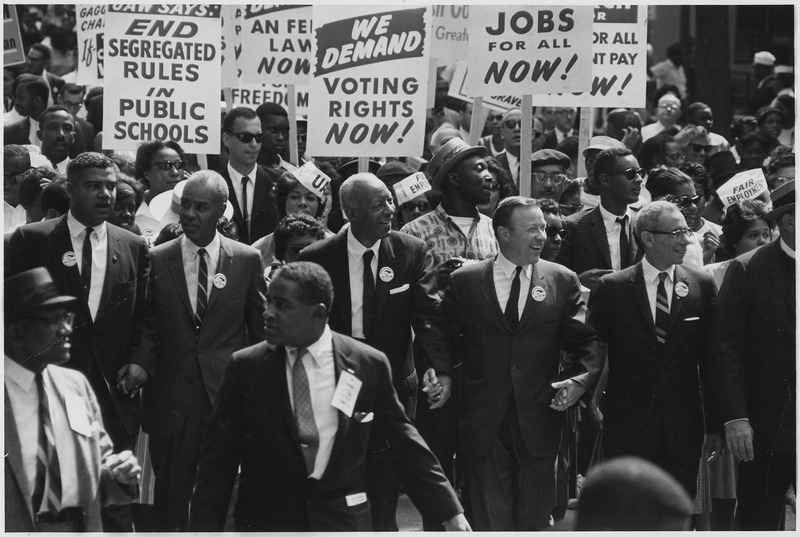
    In this step, individuals, groups, and organizations begin to align to a particular explanation of the problem and request a change in policy or law.

    Often, at this step, it is the power of social movements that creates the changes in policy or law. For example, the marches for civil rights led to Congress passing the Civil Rights Act of 1964 and the Voting Rights Act of 1965.

    Civil rights leaders marching from the Washington Monument to the Lincoln Memorial.

    This photo captures the Civil Rights March on Washington, D.C., in which Black and white leaders protested together.

    Civil Rights March on Washington, D.C.” by Rowland Scherman, Wikimedia Commons is in the Public Domain

    Step Four: Policy Making

    In the policy making step, governments create new laws. These laws force institutions to create new policies to address social problems.

    Response to the social problem requires institutions with power to take action to make change. With the example of civil rights, race-based segregation and some forms of discrimination became illegal at the federal level.

    Step Five: Social Problems Work

    Once a new policy is put into place, people must act to implement the change. Thus, policy implementation is the 'work.'

    For the civil rights movement, this work included integrating schools, which we will discuss in a later chapter. It also included registering Black people to vote. It included ending legal de jure segregation of public spaces, even though de facto segregation still exists today, as we will see.

    Step Six: Policy Outcomes

    In this step, claimsmakers examine the outcomes of the policies and actions taken to respond to the social problem. Often, the outcome of this step is making the claim stronger and requesting more action.

    The civil rights movement became a training ground for other protests. People who learned to organize, march, and lead non-violent resistance in the civil rights movement used these skills to advocate for women’s rights, end the war in Vietnam, and expand LGBTQ+ rights.

    Although the steps of the social problems process appear to be linear, moving from 1 to 2 to 3, and so on, Best (2020) notes that there are feedback loops in which one step can impact another and another. In other words, this process is not meant to be understood as perfectly linear but as nonlinear and always in flux.

    We continue the cycle of social problem creation and resolution, moving toward a new – and potentially transformative – normal.

    ––

    On the next page, we focus on social change as it relates to social problems, including the power of individual agency – which you have – as well as collective action and social movements. We also define interdependence, which highlights how we all rely on each other to create a social world where we can all thrive, in which we all have social justice.


    This page titled Understanding Social Problems is shared under a CC BY-NC-SA 3.0 license and was authored, remixed, and/or curated by Anonymous via source content that was edited to the style and standards of the LibreTexts platform.