The criminal justice system is part of the social institution of the state, along with government and the military, and is comprised of officers, the court system, the prison system, and more. In a democracy like the United States, the criminal justice system must balance its major tasks of public safety and crime reduction with the protection of individual freedoms such as freedom from the abuse of power by law enforcement agents and other government officials. Having a criminal justice system that protects individual rights and liberties is a key feature that distinguishes a democracy from a dictatorship.
How well does the US criminal justice system work in both respects? How well does it reduce crime and make the public safe, and how well does it observe individual rights and liberties, not treating people differently based on their social class, race, gender, and other areas of social location? Are there problems related to our criminal justice system?
This page offers a discussion on some of these concerns, including regarding policing practices, the court system, the prison system, and the immigration system. We connect this discussion to the concept of social control, efforts to control the population. Social control is about behaviors or sanctions that attempt to get people to conform to social norms, expectations, and laws. We all engage in informal social control with behaviors that attempt to get people to abide by social norms such as scowling at someone who littered, telling girls that they're "so ladylike sitting quietly in that pretty dress," ending a friendship with someone who did something we think is immoral, or shaking our head at someone who's dressed outside the norm – these are positive and negative sanctions that get people to conform.
The institution of the state engages in formal social control with fines, incarceration, deportation, or other punishments for violations of social norms and laws. In particular, the police and court, prison, and immigration systems are mechanisms of social control. On this page we will question whether formal social control at the hands of the state is applied differently to various social groups. We will also discuss consequences of this form of social control for targeted groups, incarcerated individuals and their families, and immigrants.
The Police
The police are our first line of defense against crime and criminals and for that reason are often called “the thin blue line.” Police officers realize that their lives may be in danger at any time, and they also often interact with suspects and other citizens whose hostility toward the police is quite evident. For these reasons, officers typically develop a 'working personality' that, in response to the danger and hostility police face, tends to be authoritarian and suspicious (Skolnick 1994). Indeed, it is not too far-fetched to say that police-citizen relations are characterized by mutual hostility and suspicion (Dempsey & Forst 2012).
A few aspects of police behavior are especially relevant for social problems. The first is police corruption. No one knows for sure how much police corruption occurs, but low-level corruption (e.g., accepting small bribes and stealing things from stores while on patrol) is thought to be fairly common, while high-level corruption (e.g., accepting large bribes and confiscating and then selling illegal drugs) is thought to be far from rare. In one study involving trained researchers who rode around in police cars, more than one-fifth of the officers being observed committed some corruption (Reiss 1980). Several notorious police scandals have called attention to rampant corruption amid some police forces. One scandal several decades ago involved New York City officer Frank Serpico, whose story was later documented in a best-selling book (Maas 1973) and in a tension-filled film starring Al Pacino. After Serpico reported high-level corruption to his superiors, other officers plotted to have him murdered and almost succeeded. A more recent scandal involved the so-called Rampart Division in Los Angeles and involved dozens of officers who beat and shot suspects, stole drugs and money, and lied at the trials of the people they arrested (Glover & Lait 2000).
The next concern is police bias, in which police hold and act on racial biases and other biases against people in marginalized groups. For instance, researchers Pierson and colleagues (2020) found racial disparities in traffic stops in which Black drivers were less likely to be stopped by police after sunset. The "veil of darkness" protects Black drivers as police are less able to discern their race at night. The team of researchers also found that police were more likely to search Black and Latinx drivers for contraband, suggesting that the bar for searching these drivers was set lower than for white drivers.

Police have been found to be less likely to pull over Black drivers after sunset, when the driver's race is not visible.
Source: Untitled by Anonymous is licensed under CC BY-NC 4.0
Related to police bias is the concern of police brutality, which has caught the attention of the public in recent years. Police brutality involves unjustified or excessive use of force by police. Police are permitted and even expected to use physical force when necessary to subdue suspects. Given the context of police work noted above (feelings of danger and suspicion) and the strong emotions at work in any encounter between police and suspects, it is inevitable that some police will go beyond the bounds of appropriate force and commit brutality. However, brutality occurs when there is no reasonable justification for excessive force, such as when a suspect has been pinned down on the ground and immobilized.
Police brutality has resulted in the loss of life and in other injuries. In the US, the police kill between 900-1,100 people annually (Fagan & Campbell 2020; NAACP 2025), with the great majority of these killings involving a fatal shooting at the hands of the police. Black people are overrepresented in police killings in the US. According to Mapping Police Violence, in 2025, Black people are 2.8 times more likely to be killed by police. Black people are also more likely to be killed by police when unarmed themselves (Mapping Police Violence 2024). Fagan and Campbell (2020) explain:
"We find that, across several circumstances of police killings and their objective reasonableness, Black suspects are more than twice as likely to be killed by police than are persons of other racial or ethnic groups; even when there are no other obvious circumstances during the encounter that would make the use of deadly force reasonable."
In addition to individual-level racial bias, research indicates that state-level structural racism (e.g., racial residential segregation, racial disparities in incarceration rates, and economic indicators) is associated with racial disparities in police killings of unarmed individuals (Mesic et al. 2018). George Floyd, Breonna Taylor, Trayvon Martin, Aura Rosser, and Patrick Lyoya are few of many Black Americans who have been killed by police in recent years. You may visit Al Jazeera's Know Their Name project by Alia Chughtai to learn more about some of these individuals and other Black individuals killed by police.
This student-created ancillary offers an overview of the police as a form of social control through a critical perspective. Please view the full presentation here.

The Police and Social Control by Mira Byers, Analy Lopez, Kaleb Kidder, and Kimberly Castaneda is licensed under CC BY-NC 4.0
The Court System
In the US legal system, suspects and defendants enjoy certain rights and protections guaranteed by the Constitution and Bill of Rights and provided in various Supreme Court rulings since these documents were written some 220 years ago. Although these rights and protections do exist and again help distinguish our democratic government from authoritarian regimes, in reality criminal courts often fail to achieve the high standards by which they should be judged. Justice Denied (Downie 1972) and Injustice for All (Strick 1978) are the titles of two popular critiques of the courts written several decades ago, and these titles continue to apply to the criminal court system today.
A basic problem is the lack of adequate counsel for the poor. Wealthy defendants can afford the best attorneys and get what they pay for – excellent legal defense. An oft-cited example here is O. J. Simpson, the former football star and television and film celebrity who was arrested and tried during the mid-1990s for allegedly killing his ex-wife and one of her friends (Barkan 1996). Simpson hired a “dream team” of nationally famous attorneys and other experts, including private investigators, to defend him at an eventual cost of some $10 million. A jury acquitted him, but a poor defendant in similar circumstances may likely have been found guilty and perhaps even received a death sentence.
Many criminal defendants are poor. Although they enjoy the right to free legal counsel, in practice they often receive ineffective counsel or virtually no counsel at all. The poor are defended by public defenders or by court-appointed private counsel, and either type of attorney simply has far too many cases in any time period to handle adequately. Many poor defendants see their attorneys for the first time just moments before a hearing before the judge. Because of their heavy caseloads, the defense attorneys do not have the time to consider the complexities of any one case, and most defendants end up pleading guilty.

Public defenders often have a high caseload, which results in the inability to be as effective in representing their defendants as they would be if they had a more manageable caseload.
Source: Untitled by Anonymous is licensed under CC BY-NC 4.0
A 2006 report by a New York state judicial commission reflected these problems. The report concluded that “local governments were falling well short of constitutional requirements in providing legal representation to the poor,” according to a news story (Hakim 2006). Some New York attorneys, the report found, had an average yearly caseload of 1,000 misdemeanors and 175 felonies. The report also found that many poor defendants in 1,300 towns and villages throughout the state received no legal representation at all. The judge who headed the commission called the situation “a serious crisis.”
Another problem is plea bargaining, in which a defendant agrees to plead guilty, usually in return for a reduced sentence. Under our system of justice, criminal defendants are entitled to a trial by jury if they want one. In reality, however, most defendants plead guilty, and criminal trials are very rare: Fewer than 3% of felony cases go to trial. Prosecutors favor plea bargains because they help ensure convictions while saving the time and expense of jury trials, while defendants favor plea bargains because they help ensure a lower sentence than they might receive if they exercised their right to have a jury trial and then were found guilty. However, this practice in effect means that defendants are punished if they do exercise their right to have a trial. Critics of this aspect say that defendants are being coerced into pleading guilty even when they have a good chance of winning a not guilty verdict if their case went to trial (Oppel 2011).
An additional concern is the death penalty. Moral questions about the state's killing of convicted offenders aside, the death penalty is racially discriminatory. While some studies find that Black people are more likely than white people who commit similar homicides to receive the death penalty, the clearest evidence for racial discrimination involves the race of the victim: Homicides with white victims are more likely than those with Black victims to result in a death sentence (Paternoster & Brame 2008). This difference, whether intended or not, suggests that the criminal justice system values white lives more than Black lives. In fact, evidence about this discrimination and the ineffectiveness of this type of punishment leads most criminologists to oppose the death penalty. In 1989, the American Society of Criminology adopted this official policy position on capital punishment:
“Be it resolved that because social science research has demonstrated the death penalty to be racist in application and social science research has found no consistent evidence of crime deterrence through execution, The American Society of Criminology publicly condemns this form of punishment, and urges its members to use their professional skills in legislatures and courts to seek a speedy abolition of this form of punishment.”
The Prison System
The US has housed more than 1.5 million people in state and federal prisons and more than 750,000 in local jails. This peak of approximately 2.3 million people behind bars is about double the figure in 1990, exponentially bigger than in 1975, and yielded an incarceration rate of the highest of Western democracies both in terms of raw numbers and per capita (which considers overall population size). Today, the US remains among the highest in both raw and per capita figures, though it is no longer the highest for per capita.

The US held the highest rate of incarceration worldwide in terms of both the total prison population and the prison population per capita, and continues to be among the highest today – far higher than its neighbors of Canada and Mexico.
Source: The Sentencing Project 2024
This high rate is troubling, and so is the racial composition of prisoners in the US. Nearly 7 in 10 prisoners are people of color, primarily Black or Latinx, a rate far higher than they comprise the general population, meaning that incarceration rates are strongly disproportionate. In 2022, the incarceration rate per 100,000 people was 1,196 for Black individuals, 603 for Latinx, and 229 for white (The Sentencing Project 2024).
Additionally, the corrections system costs the nation more than $80 billion annually. Together with the police ($62.2 billion) and judicial and legal system ($29 billion), the entire system costs $182 billion annually, excluding private prison profits, discussed below (Prison Policy Initiative 2017). What does this huge expenditure accomplish? It would be reassuring to know that the high US incarceration rate keeps the nation safe and even helps reduce the crime rate; however, many criminologists think that the surge in imprisonment during the 1980s, 1990s, and 2000s did not help reduce the crime rate or at least in a cost-efficient manner (Durlauf & Nagin 2011). Greater crime declines would be produced, many criminologists say, if equivalent funds were instead spent on crime prevention instead of on crime punishment, namely incarceration (Welsh & Farrington 2007).
Criminologists also worry that prison may be a breeding ground for crime because rehabilitation programs such as vocational training and drug and alcohol counseling are lacking and because prison conditions are substandard. They note that more than 700,000 inmates are released from prison every year and come back into their communities ill equipped to resume a normal life. There they face a lack of job opportunities (employers may discriminate against applicants convicted of a crime, or those deemed 'criminal') and a lack of friendships with law-abiding individuals, as our earlier discussion of labeling theory and differential association indicated. Partly for these reasons, imprisonment ironically may increase the likelihood of future offending (Durlauf & Nagin 2011).
Living conditions behind bars merit further discussion. Although some minimum-security federal prisons may have clean, adequate facilities, state prisons and local jails are often squalid places. As one critique summarized the situation, “Behind the walls, prisoners are likely to find cramped living conditions, poor ventilation, poor plumbing, substandard heating and cooling, unsanitary conditions, limited private possessions, restricted visitation rights, constant noise, and a complete lack of privacy” (Kappeler & Potter 2005: 293). These conditions increase the odds that inmates will leave prison or jail as more of a threat to public safety than when they were first incarcerated. Treating inmates humanely would be an important step toward successful reentry into mainstream society.
Organization Profile
Making a Difference in the Lives of Ex-Cons
The text notes that more than 600,000 inmates are released from prison every year. Many of them are burdened with drug, alcohol, and other problems and face bleak prospects for employment, friendships, and stable lives, in general. Since 1967, The Fortune Society has been making a difference in the lives of ex-convicts in and near New York City.
The Fortune Society’s website (http://www.fortunesociety.org) describes the group’s mission: “The Fortune Society is a nonprofit social service and advocacy, founded in 1967, whose mission is to support successful reentry from prison and promote alternatives to incarceration, thus strengthening the fabric of our communities.” About 70 percent of its more than 190 employees are ex-prisoners and/or have histories of substance abuse or homelessness. It is fair to say that The Fortune Society was working on prisoner reentry long before scholars discovered the problem in the late 1990s and early 2000s.
The group’s president, JoAnne Page, described its halfway house where inmates stay for up to two months after their release from prisons: “This is what we do. We bring people home safely. There’s a point when the crime happened. The sentence was served, and the rehabilitation must begin. We look at a human being as much more than the worst they ever did.” Recalling that many of her relatives died in the Holocaust, Page added, “What my family experience did was to make me want to be somebody who fights institutions that damage people and who makes the world a little safer. Prisons are savage institutions.”
In addition to its halfway house, the Fortune Society provides many other services for inmates, ex-inmates, and offenders who are put on probation in lieu of incarceration. It regularly offers drug and alcohol counseling, family services, adult education and career development programs, and classes in anger management, parenting skills, and health care. One of its most novel programs is Miss Betty’s Practical Cooking and Nutrition Class, an eight-week course for ex-inmates who are young fathers. While a first reaction might be to scoff at such a class, a Fortune counselor pointed to its benefits after conceding her own immediate reaction. “When I found out about the cooking classes, I thought, ‘So they’re going to learn to cook, so what?’ What’s that going to do? But it’s building self-esteem. For most of these guys, they’re in a city, they’ve grown up on Kool-Aid and a bag of chips. This is building structure. They’re at the point where they have really accomplished something…They’re learning manners. You really can change patterns.”
One ex-convict that Fortune helped was 22-year-old Candice Ellison, who spent more than two years in prison for assault. After not finding a job despite applying to several dozen jobs over a six-month span, she turned in desperation to The Fortune Society for help. Fortune bought her interview clothes and advised her on how to talk about her prison record with potential employers. Commending the help she received, she noted, “Some of my high school friends say it’s not that hard to get a job, but for people like me with a criminal background, it’s like 20 times harder.”
The Fortune Society has received national recognition for its efforts. Two federal agencies, the Department of Justice and the Department of Housing and Urban Development, have featured The Fortune Society as a model program for helping ex-inmates. The Urban Institute featured this model in a video it developed about prisoner reentry programs. And in 2005, the American Society of Criminology presented the Society its President’s Award for “Distinguished Contributions to the Cause of Justice.” These and other examples of the national recognition won by The Fortune Society indicate that for more than four decades it has indeed been making a difference.
Sources: Bellafante 2005; Greenhouse 2011; Richardson 2004
The Immigration System
The state engages in social control of immigrants at two levels: Individual state governments and the federal government. In recent decades, many states enacted strict laws for immigrants, including the denial of schooling and various social services to undocumented immigrant families. Arizona, Georgia, and Alabama enacted some of the most restrictive legislation in the early 2010s.
Arizona’s 2010 law made failing to carry immigration documents a crime and required the police to question and detain anyone they suspected of being an unauthorized immigrant. Previously, these restrictions had been the sole province of the federal government. Critics argued that this new law would lead to racial and ethnic profiling, as only people who looked Mexican would be stopped by police for suspicion of being illegal (Archibold 2010). They also noted that the new law caused an economic loss of $250 million during the first year after its enactment from a loss in conference and convention business in Arizona (Brown 2011).
Georgia’s 2011 law allowed police to demand immigration documents from criminal suspects and to hold suspects for deportation by federal officials who do not provide documentation. The law also made it more difficult to hire workers without proper documentation, increased the penalties for businesses that hire these workers, and provided penalties for people who house or transport undocumented immigrants. Georgia’s Chamber of Commerce worried about the law’s economic impact, and in particular was concerned that the law would reduce tourism. Reports estimated that if the law forced all undocumented workers to leave Georgia, the state’s agricultural industry would lose up to $1 billion annually, since unauthorized workers form the bulk of the Georgia’s farm labor force (Berman 2011).
Alabama’s 2011 law also allowed police to detain people suspected of being unauthorized immigrants. In addition, it required schools to record the immigration status of all students and also required people seeking a driver’s license to prove that they were US citizens. The law led to very long lines to renew driver’s licenses, and because many migrant workers left the state, crops went unharvested on the state’s farms. Business leaders feared the law would harm the state’s economy, a fear that was heightened when a German executive at Mercedes-Benz was detained by police (Ott 2012). Several months after the Alabama law took effect, a study by a University of Alabama economist concluded that it had forced at least 40,000 and perhaps as many as 80,000 undocumented workers to leave the state (Lee 2012). The exit of so many workers caused an estimated annual loss to Alabama’s GDP of at least $2 billion, a loss in state and state revenue from income and sales taxes of at least $57 million, and a loss in local sales tax revenue of at least $20 million.
The federal government is the entity responsible for detaining and deporting unauthorized immigrants. More than 600,000 people were detained by the government in August 2025 (Goldberg 2025), and according to ICE, their detentions cost $152 per day per person (Bustillo & Hurt 2025), which amounts to tens of millions of dollars. Most detainees are in custody for technical violations of immigrant laws, such as overstaying a visa, rather than for serious criminal behavior. As such, detained immigrants typically do not pose a public danger.
Critics decry the conditions under which undocumented immigrants are detained (Semple 2011). They say that detainees are denied basic due process rights, such as the right to have a court-appointed attorney, more than four-fifths have no legal representation at all, and those who do receive legal assistance often receive incompetent assistance. Recently, New York Times reporter Emma Goldberg (2025) brought attention to the severity of this issue: Reports of suicide attempts in ICE detention facilities are persistent as detainees do not receive adequate mental health care.
Additionally, the federal government has issued eight million deportation orders since 1895, with seven million of those (nearly 88%) occurring since 1991. According to the Mapping Deportations (2025) project, nearly 99% of all deportation orders since 1991 have been for people from countries that are majority of color, with the great majority targeting people from Central America and Mexico.
Social Control
With the concerns discussed above in mind, we now return to the concept of social control. We have seen that people of color, particularly who are Black, are disproportionately likely to experience police brutality including being killed by the police, that they are more likely to get the death penalty after homicide (especially if the victim was white), and are overrepresented in the prison population. Additionally, Black and Latino people have been arrested and imprisoned for drug offenses far out of proportion to their actual use of illegal drugs, an issue we return to in a later chapter when we discuss the War on Drugs.
This racial disparity has contributed to what professor Michelle Alexander (2010) terms the new Jim Crow, in which criminalization operates in similar ways to Jim Crow, resulting in discrimination and disenfranchisement of Black people after incarceration. Alexander argues that criminalizing Black people is the newest form of racialized social control, in which Black people are hyper-targeted by the state and its criminal justice system. Racialized social control in the US began with slavery, then transitioned into Jim Crow segregation, then finally into criminalization today.
People who are convicted of crimes in some states experience the loss of voting rights, the inability to gain certain forms of employment, exclusion from serving on juries, and other forms of discrimination – which reflects the disenfranchisement and discrimination Black people experienced in the Jim Crow era. Additionally, the fees of incarceration keep people trapped in the criminal justice system. For instance, phone calls to family members are costly, court fees may pile up, and bail can be in the thousands.
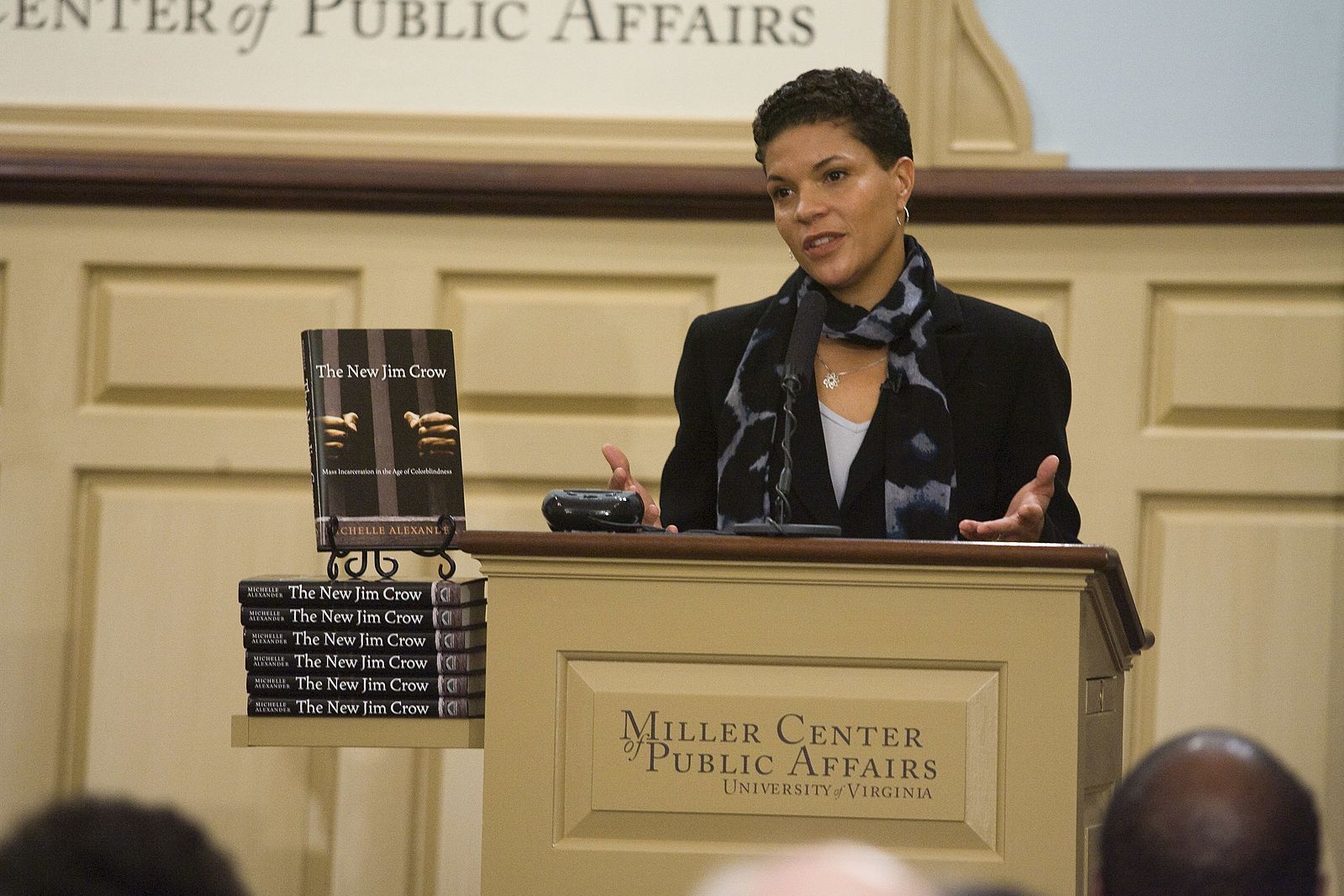
Michelle Alexander discusses The New Jim Crow: Mass Incarceration in the Age of Colorblindness at the Miller Center Forum.
Source: Michelle Alexander speaks at the Miller Center Forum, December 3, 2011 by Miller Center is licensed under CC BY 2.0
This connection between the criminal justice system, slavery, and contemporary racialized social control is part of the prison industrial complex, which ties mass incarceration to capitalism, slavery, and social control. The other connection – between mass incarceration and capitalism – concerns (1) the rise of the private prison industry in which prisons are owned and operated by private corporations rather than by a state government or the federal government, and (2) the use of coerced or forced prison labor to create goods, or the industries that profit off of individuals who are incarcerated or on probation. Thus, formal social control results in corporate profits.
Beyond raising questions regarding the morality of profiting off of humans behind bars, the privatization of prisons has been found to increase incarceration rates. Researchers Galinato and Rohla found that "a rise in private prison beds per capita increases the number of incarcerated individuals per capita and average sentence length" (2020). In other words, private prisons lead to higher levels of incarceration, further fueling mass incarceration and the prison industrial complex.
The issues of prison calls and bail mentioned above highlights how corporations and other businesses profit off of the costly fees incarcerated people and their families incur. Jeremy Cherson and David Gaspar (2025) of the Bail Project explain:
"Today, families are often asked to come up with thousands of dollars for bail with little notice. That’s in a country where over a third of adults would not be able to cover an unexpected expense over $400. Bail bond agents profit from this imbalance and lobby hard to protect it. This helps preserve a system where most of the people in local jails haven’t been convicted of a crime."
Further, pretrial detention for low-income individuals who cannot post bail has consequences, as one day in jail has been found to cause lasting harms, including the mental and physical health toll of jail conditions, as severe as increasing their risk of death. Pretrial detention also disrupts individuals' ability to work and support their families, and is a stigmatizing event. In a briefing for the Prison Policy Initiative, Nam-Sonenstein (2024) writes:
"The criminal legal system views pretrial detention as a necessary sacrifice that prioritizes crime prevention and court attendance over personal liberty. However, detention is demonstrably ineffective on both fronts: when compared to releasing people pretrial, jail counterintuitively worsens these outcomes on day one while making the system decidedly more unjust for those behind bars."
Returning to our discussion on immigration, the prison industrial complex and social control can also be seen in how the state handles immigration, as with the examples discussed above and how some immigrant detention facilities are privatized, meaning that, again, corporations are profiting off of detainees. Despite the realities that immigrants commit less crime than US-born people and that they contribute much to the economy, in 2025, the federal government has unleashed a massive campaign against immigrants, conducting raids in spaces where Latino people work or frequent, demonizing Black immigrants (e.g., Haitians living in Ohio), deporting undocumented immigrants by airplane, and more.
It is clear that the institution of the state, including police and the court, prison, and immigration systems, continues to engage in racialized social control. Black and Brown people are targeted by the state, evidenced in data that show their overrepresentation in arrests, convictions, incarcerations, and detentions. Racialized social control serves to reinforce and justify existing social hierarchies, which is social injustice.