In its most basic form, communication occurs when one individual (the sender) emits a signal that conveys information, which is detected by another individual. We have discussed several aspects of primate sociality in this chapter, all of which require the communication of information between individuals. But, how does a female chimpanzee communicate her sexual availability? How does a vervet monkey communicate the approach of a leopard or that a python is nearby? How does a dominant (or subordinate) macaque signal its place in the dominance hierarchy? How do solitary, nocturnal primates, like the slow loris, communicate information about themselves to conspecifics?
Forms of Communication
Primate communication comes in four forms: vocal, visual, olfactory, and tactile. Species vary in their reliance on each. Because it is difficult to see others in the dark, and because nocturnal primates avoid predators by remaining quiet, species like the slow loris and the aye-aye rely heavily on scent-marking to communicate with conspecifics. Diurnal species tend to rely more heavily on visual and vocal forms of communication.
Vocal Communication
Primates use sound to claim and maintain a territory, make contact with other group members, or to communicate danger or threats, among other things. Loud calls are designed to travel great distances and are used in territorial defense by many primate species including indris, orangutans, gibbons, howler monkeys, and siamangs. In dense forest, where visual communication can be difficult, loud calls can be useful in signaling to conspecifics that a group or individual occupies a specific area. Howler monkeys are named for their loud calls, or “roars,” which can be heard one kilometer or more away (Schön Ybarra 1986). Howler group roars may act to maintain distance between neighboring groups or keep extra-group males from entering the home range (Schön Ybarra 1986; Sekulic 1982).
Other vocalizations are intended to communicate with individuals in one’s own group. These include vocalizations given as part of threat displays or dominance interactions, as well as contact calls that provide information about location to other group members. Baboons have a rich repertoire of vocalizations for communicating with other group members (Fischer et al. 2008; Ransom 1981). Adult males give specific vocalizations during threat displays and physical confrontations. Subordinates “screech” when retreating from a dominant individual, signaling submission. Since baboons rely on membership in their group for finding food and detecting predators, a baboon separated from his group will vocalize in an attempt to regain contact. Young baboons emit their own contact calls when separated from their mothers.
Alarm-calling behavior is widespread in primates. Often, alarm calls serve to notify conspecifics of potential danger, as is the case with vervet monkeys. Research by Dorothy Cheney, Robert Seyfarth, and others has shown that: (1) vervets classify predators based on hunting style; (2) alarm calls convey information to other vervets about that hunting style; and (3) other vervets respond in ways appropriate for evading that type of predator (Seyfarth et al. 1980a). When a vervet gives a “leopard” alarm call [directed at mammalian carnivores like leopards and dogs], monkeys on the ground climb the nearest tree, while monkeys already in trees stay there or climb higher. Since most mammalian carnivores hunt on the ground, getting into, and staying in, a tall tree is the best option for escape. When the distinct “snake” alarm call is given, vervets stand on their hind legs and look down at the ground. Since snakes, like pythons are not pursuit predators, locating them so as to avoid them is the best strategy. Lastly, when an “eagle” alarm call is given, vervets look up or run into bushes, both of which are useful responses for avoiding hawks and eagles, which attack from above. Vervets clearly understand the meaning of each type of alarm call, as they respond appropriately even when they do not see the actual predator (Seyfarth et al.1980b). Such semantic communication, which involves the systematic use of signals to refer to objects in the environment, was once believed to be unique to humans. It may be a precursor to the symbolic capacities of human language.
Definition: sematic communication
The systematic use of signals to refer to objects in the environment.
Research on other African monkeys indicates that some species use alarm calls to signal to the predator that it has been detected. Diana monkeys, Campbell’s guenons, and sooty mangabeys of the Taï forest give alarm calls to leopards but not chimpanzees (Zuberbühler et al. 1997). Because leopards are stealth predators, they rely on the element of surprise to sneak up on their prey. Alarm calling at leopards appears to tell the leopard that it has been seen and therefore its chance of success will be low. Leopards are more likely to stop hunting after an alarm call has been emitted. Unlike leopards, chimpanzees are pursuit predators and may even use alarm calls to locate potential prey. With such a predator, prey are better off remaining as silent as possible so as not to alert the predator to their location (Boesch and Boesch 1989; Zuberbühler et al. 1999).
Visual Communication
Visual signals are an important component of nonhuman primate behavior, alone or in combination with other forms of communication. Some visual signals are common to all nonhuman primates. For example, piloerection, or raising one’s hair or fur, is used in aggressive interactions to make an individual appear larger than it actually is. The females of many Old World primate species, including macaques, baboons, and chimpanzees, signal sexual receptivity through changes in the size, shape, and, often, color of their hindquarters, called a sexual swelling (Figure 6.4.1a). The sexual swelling reaches its maximum size at ovulation. When females are not receptive, either because they are pregnant or are nursing, they do not display a sexual swelling (Figure 6.4.1b). Thus, its presence or absence signals a female’s reproductive state. In some species, females use other visual cues to indicate sexual receptivity. Common marmoset females solicit mating through tongue-flicking displays directed at males, while female patas monkeys engage in a more elaborate visual display. When soliciting mating, the female crouches in front of the male and looks back at him while blowing air into her cheeks; she also may drool and curl her tail (Chism et al. 1984).
Definition: piloerection
Raising one’s hair or fur in an effort to look bigger.
Definition: sexual swelling
Area of the hindquarters that change in size, shape and often color over the course of a female’s reproductive cycle, reaching maximum size at ovulation. Occurs in many Old World primate species.
Figure \(\PageIndex{1}\): a) This female hamadryas baboon displays a sexual swelling; b) A female hamadryas baboon with infant (foreground); note the lack of a sexual swelling (a male is behind her).
Figure \(\PageIndex{2}\): a) A male mandrill yawning; b) A male gelada baboon lip flip.
Monkeys and apes also use a diversity of facial expressions in visual communication. Showing your teeth in a “smile” sends a signal of friendship in humans. Displaying teeth in this way is a sign of anxiety or fear in Old World monkeys. That male mandrill you see “yawning” at your local zoo is actually displaying his teeth to signal tension or threaten a rival (Figure 6.4.2a). Male gelada baboons use “lip flips,” in which the gums and teeth are exposed by flipping the upper lip up over the nostrils (Figure 6.4.2b), and “raised eyelids,” in which the pale eyelids are exposed by pulling the scalp back as threatening gestures (Aich et al. 1990). Submissive males respond by fleeing or presenting their hindquarters. In the Smithsonian Channel video[1], male gelada baboons use the lip flip in competition with other males.
Figure \(\PageIndex{3}\): A male mandrill.
Primates also communicate through color. In some species, facial coloration provides information about individual health or status to conspecifics. Mandrills are a good example of this. Female mandrill faces are brighter during ovulation, which may function to communicate reproductive state to males (Setchell et al. 2006). Redness of male mandrill faces is correlated with androgen levels. Thus, facial coloration can, on the one hand, communicate information about competitiveness to other males and information about reproductive fitness to females (Figure 6.4.3; Setchell et al. 2008). On the other hand, the variation in facial coloration among New World monkeys, ranging from very simple (Figure 6.4.4a) to highly complex color patterns (Figure 6.4.4b), appears to be linked to species recognition, or the ability to distinguish conspecifics from other species. Species with more complex facial color patterns tend to be those that are sympatric with a larger number of other primate species. In such circumstances, distinct facial coloration and patterning may help individuals recognize conspecifics and reduce the chances of mating with another species (Santana et al. 2012).
Definition: species recognition
Recognition of conspecifics.
Figure \(\PageIndex{4}\): a) An ukari displaying bold but simple facial coloration; b) A white-bellied spider monkey displaying a complex facial color pattern.
Olfactory Communication
Figure \(\PageIndex{5}\): A male ring-tailed lemur uses spur marking to deposit scent on a young tree at Berenty Reserve in Madagascar.
All primates use scent to communicate. Females secrete chemicals from their anogenital region (the area of the anus and genitals) that provide males with information about their reproductive state. In some species, like macaques and chimpanzees, this olfactory signal is enhanced by a sexual swelling (a visual signal; see Figure 6.4.1a and discussion above). Olfactory communication is particularly important for New World monkeys, lemurs, and lorises. Male and female squirrel monkeys engage in “urine washing,” in which an individual urinates on its hands and feet and then uses them to spread urine all over its body. The function of urine washing may include marking trails for other group members to follow, self-cleaning or controlling body temperature, dominance displays, enhanced grasping ability while climbing, or communicating reproductive state (Boinski 1992). During aggressive interactions with other males, male ring-tailed lemurs rub their tails with scent from glands on their wrists and chests. They then waive their tails toward their opponent, who responds with his own “stinky tail” display, physical aggression, or by fleeing (Jolly 1966). Both sexes use their anogenital scent glands to mark substrates (like saplings, fallen trees, or tree trunks) in their group’s territory (Jolly 1966). Males also leave visual and scent marks during “spur marking,” in which they impregnate a substrate with scent from their wrist gland after using a thorny “spur” near the gland to cut into it (Figure 6.4.5). Because substrate marking behavior occurs where the ranges of two groups overlap, and increases during the mating season, the primary function is believed to reinforce territorial boundaries (Mertl-Millhollen 1988).
Definition: anogenital
Relating to the anus and genitals.
Tactile Communication
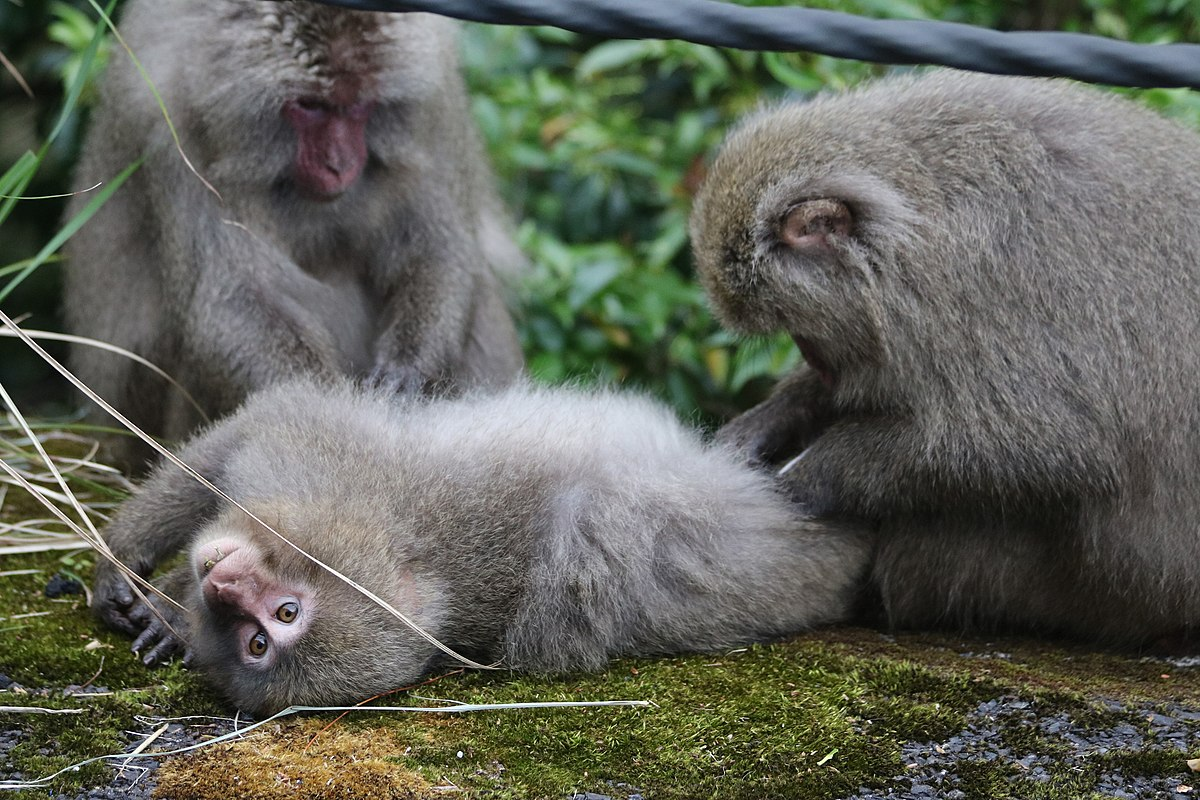
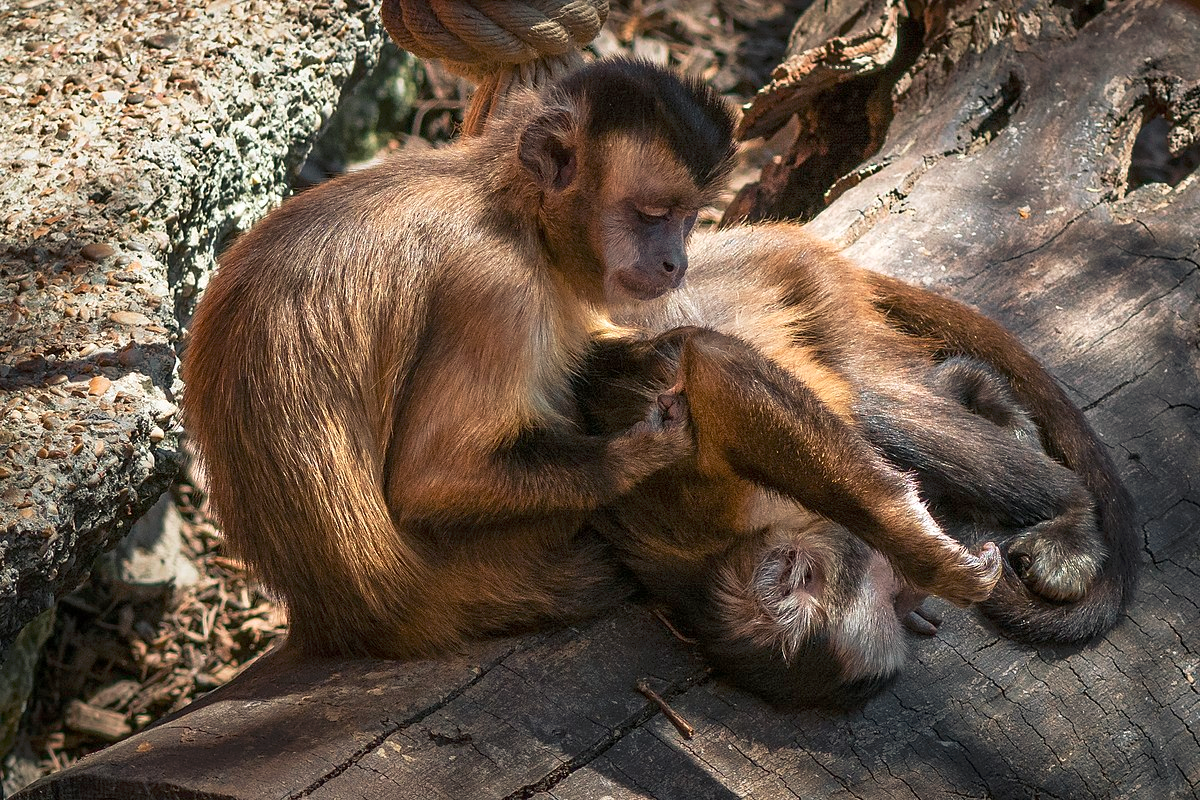
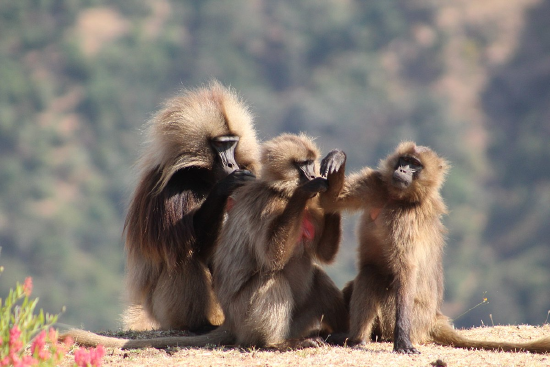
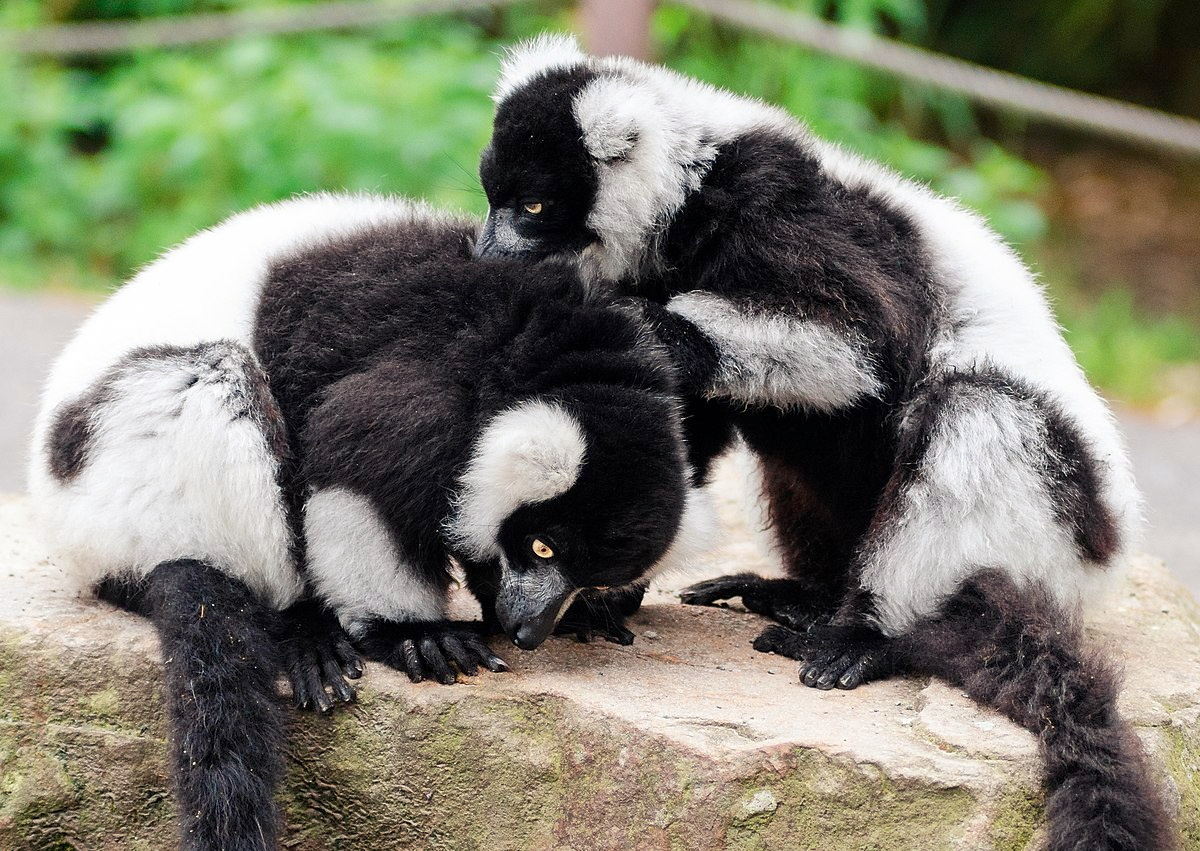
Tactile communication, or touch, is very important in all primate species. Physical contact is used to comfort and reassure, is part of courtship and mating, and is used to establish dominance and alliances. Grooming is an important and clearly enjoyable form of tactile communication for all primates (Figure 6.4.6a–d). Not only does grooming serve to clean the skin and fur, removing parasites and debris, but it is an important affiliative (non-aggressive) behavior that helps reinforce social bonds, repair relationships, and cement alliances. Among chimpanzees, subordinates groom dominants in an effort to receive benefits such as protection, acceptance, and reciprocal grooming. When yellow baboon females engage in more grooming activity (as both givers and receivers), their offspring have an increased chance of surviving to one year (Silk et al. 2003). Although the mechanism behind this relationship is unknown, close associations with group members may provide females and their young offspring with protection from harassment or access to valuable resources that enhance infant survival. Social integration, as exemplified by grooming, is of significant adaptive value to primates.
Definition: affiliative
A description of non-aggressive social interactions and associations between individuals.
Figure \(\PageIndex{6}\): a) A group of Japanese macaques grooming each other; b) Tufted capuchins grooming; c) A group of gelada baboons grooming; d) Black-and-white ruffed lemurs groom each other.
REFERENCES
Aich, H., R. Moos-Heilen, and E. Zimmermann. 1990. “Vocalizations of Adult Gelada Baboons (Theropithecus gelada): Acoustic Structure and Behavioural Context.” Folia Primatologica 55 (3–4): 109–132.
Boesch, Christophe, and Hedwige Boesch. 1989. “Hunting Behavior of Wild Chimpanzees in the Taï National Park.” American Journal of Physical Anthropology 78 (4): 547–573.
Boinski, S. 1992. “Olfactory Communication among Costa Rican Squirrel Monkeys: A Field Study.” Folia Primatologica 59 (3): 127–136.
Chism, J. B., T. E. Rowell, and D. Olson. 1984. “Life History Patterns of Female Patas Monkeys.” In Female Primates: Studies of Women Primatologists, edited by Meredith Small, 175–190. New York: A.R. Liss.
Fischer, Julia, Kurt Hammerschmidt, Dorothy L. Cheney, and Robert M. Seyfarth. 2008. “Acoustic Features of Female Chacma Baboon Barks.” Ethology 107 (1): 33–54.
Jolly, Alison. 1966. Lemur Behavior: A Madagascar Field Study. Chicago: University of Chicago Press.
Mertl-Millhollen, Anne S. 1988. “Olfactory Demarcation of Territorial but Not Home Range Boundaries by Lemur catta.” Folia Primatologica 50 (3–4): 175–187.
Ransom, Timothy W. 1981. Beach Troop of the Gombe. East Brunswick, New Jersey: Bucknell University Press.
Santana, Sharlene E., Jessica Lynch Alfaro, and Michael E. Alfaro. 2012. “Adaptive Evolution of Facial Colour Patterns in Neotropical Primates.” Proceedings of the Royal Society B: Biological Sciences 279 (1,736): 2,204–2,211.
Schön Ybarra, M. A. 1986. “Loud Calls of Adult Male Red Howling Monkeys (Alouatta seniculus).” Folia Primatologica 47 (4): 204–216.
Sekulic, Ranka. 1982. “The Function of Howling in Red Howler Monkeys (Alouatta seniculus).” Behaviour 81 (1): 38–54.
Setchell, Joanna M., Tessa Smith, E. Jean Wickings, and Leslie A. Knapp. 2008. “Social Correlates of Testosterone and Ornamentation in Male Mandrills.” Hormones and Behavior 54 (3): 365–372.
Setchell, Joanna M., E. Jean Wickings, and Leslie A. Knapp. 2006. “Signal Content of Red Facial Coloration in Female Mandrills (Mandrillus sphinx).” Proceedings of the Royal Society B: Biological Sciences273 (1599): 2395–2400.
Seyfarth, R. M., D. L. Cheney, and P. Marler. 1980a. “Monkey Responses to Three Different Alarm Calls: Evidence of Predator Classification and Semantic Communication.” Science 210 (4,471): 801–803.
Seyfarth, Robert M., Dorothy L. Cheney, and Peter Marler. 1980b. “Vervet Monkey Alarm Calls: Semantic Communication in a Free-Ranging Primate.” Animal Behaviour 28 (4): 1,070–1,094.
Silk, Joan B., Susan C. Alberts, and Jeanne Altmann. 2003. “Social Bonds of Female Baboons Enhance Infant Survival.” Science 302 (5,648): 1,231–1,234.
Zuberbühler, Klaus, David Jenny, and Redouan Bshary. 1999. “The Predator Deterrence Function of Primate Alarm Calls.” Ethology 105 (6): 477–490.
Zuberbühler, Klaus, Ronald Noë, and Robert M. Seyfarth. 1997. “Diana Monkey Long-Distance Calls: Messages for Conspecifics and Predators.” Animal Behaviour 53 (3): 589–604.


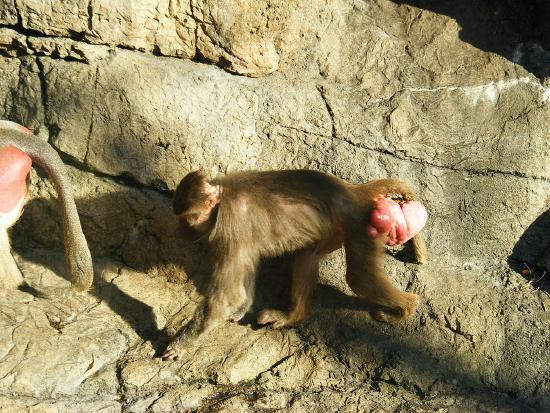
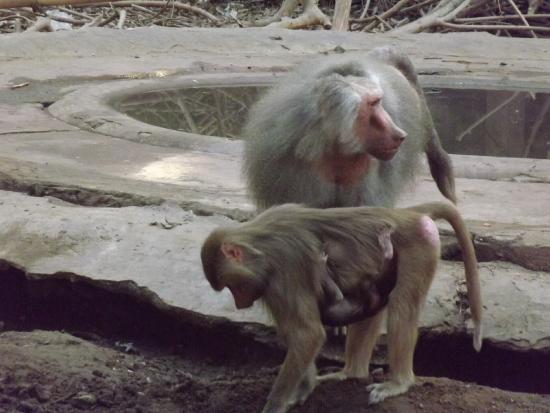
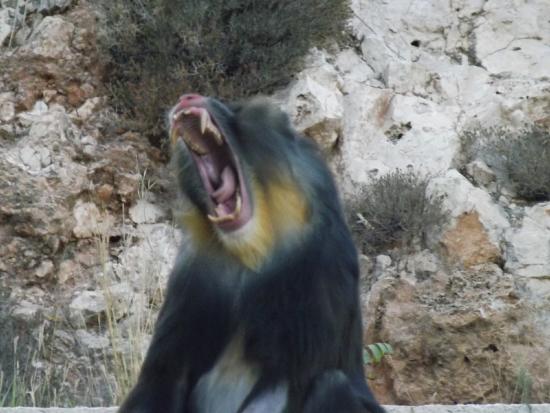
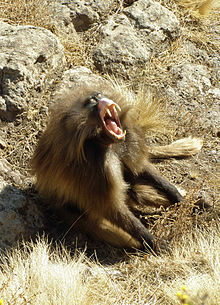
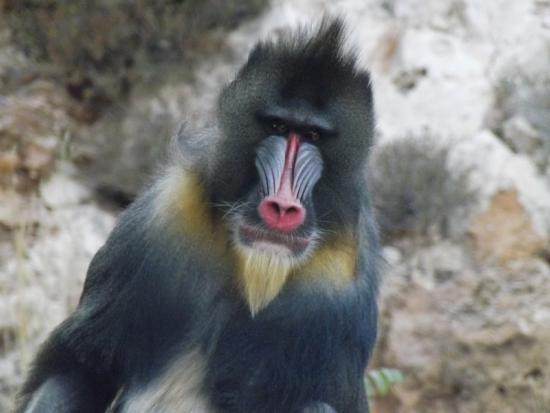 Figure \(\PageIndex{3}\): A male mandrill.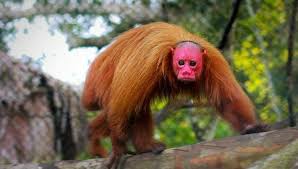
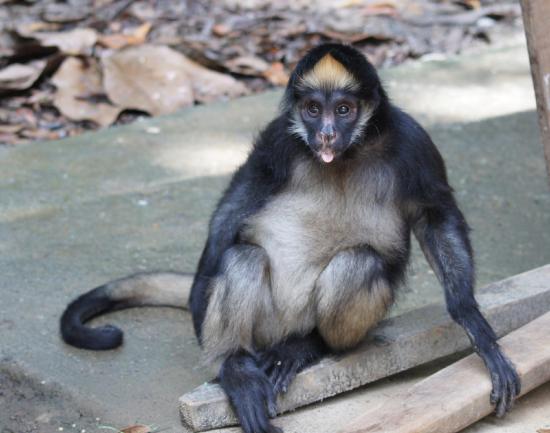
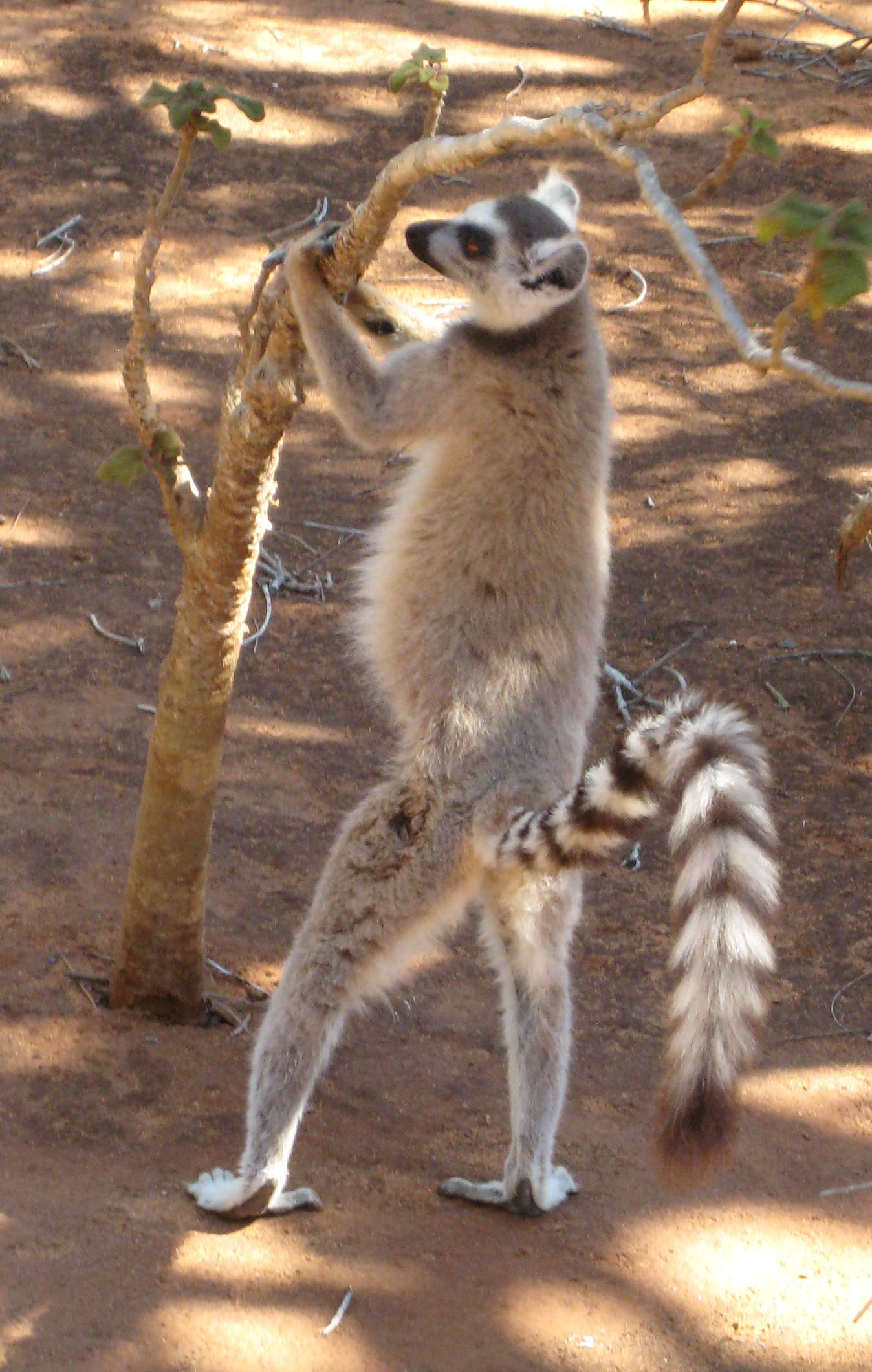 Figure \(\PageIndex{5}\): A male ring-tailed lemur uses spur marking to deposit scent on a young tree at Berenty Reserve in Madagascar.