Systematic and long-term research studies provide some of the most foundational and necessary information for the conservation of endangered primates (Kappeler and Watts 2012). Research provides critical data on essential and preferred feeding resources, life history parameters and reproduction rates, territoriality, the carrying capacity of habitats, and solitary or group social dynamics. Within the last few decades, researchers have also begun to stress the acute need for studies investigating how various primates are responding to human disturbances; how climate change is affecting the behavior, range, and habitat of these species; and the significance of primate biodiversity hotspots (Brown and Yoder 2015; Chapman and Peres 2001; Estrada et al. 2018). Understanding these aspects will provide crucial information for practitioners to make the most effective and species-specific conservation decisions.
Long-term studies on primate species provide some of the most conclusive information on changes occurring to populations in the face of anthropogenic disturbances and climate change. They also provide a suite of direct and indirect conservation contributions to endangered species, and the continual monitoring of populations can deter deleterious anthropogenic actions, allowing for population growth and forest regeneration. For example, the Northern Muriqui Project of Caratinga in Minas Gerais, Brazil, has documented growth of both the muriqui population and the regeneration of the forest via secondary succession (Strier 2010). The project has also invested in future research and conservation by training more than 65 Brazilian students, as well as providing stable jobs for local people, stimulating the local community, and alleviating reliance on forest products for income and survival (Strier 2010; Strier and Boubli 2006; Strier and Mendes 2012). Several other long-term primate studies all over the world have seen similar positive impacts and conservation successes including work in Beza Mahafaly Special Reserve, Berenty Reserve, and Ranomafana National Park, Madagascar; Lomas Barbudal and Santa Rosa National Park, Costa Rica; Khau Yai National Park, Thailand; Amboseli National Park, Kenya; Gombe Stream National Park, Tanzania; Kibale National Park, Uganda, among many others (Kappeler and Watts 2012).
The implementation of novel research techniques can also aid in the conservation of primates and their ecosystems. The use of high-resolution camera traps have become widespread and invaluable in their ability to aid primatologists and conservationists in surveying rare populations, establishing population counts, and assessing behavior (Pebsworth and LaFleur 2014). Camera traps also have the potential to aid in ethical considerations, photographing illegal activities such as poaching. Research is also imperative for making important decisions regarding translocations and reintroductions of animals. Without knowledge of the species’ social ecology, demography, and unique learned behaviors—also known as primate traditions or cultures—successful translocations and reintroductions from captive populations would not be possible. Researchers and conservationists must recognize these dynamics when making the difficult decision to reintroduce or move populations and factor in how these dynamics may shift or affect the resident population after management. The most notable case of effective translocation and reintroduction is that of the golden lion tamarin (Leontopithecus rosalia). Over 30 zoos contributed 146 captive-born individuals to be reintroduced into Brazil, providing essential information on nutrition and health that aided in reintroduction strategies. Additionally, in 1994, isolated individuals in forest fragments were successfully translocated into protected regions in order to increase gene flow, which through the exchange of genes, introduces more genetic variation into the next generation (Kierulff et al. 2012).
Nongovernmental Organizations (NGOs) and Community-Based Conservation Work
Conservation NGOs have a long-standing history of working to save endangered species from going extinct. These organizations often target primates for their work because of their ability to act as umbrella species, supporting the conservation of many species found within their ecosystems. Over the past 30 years, conservation NGOs have begun to move away from a preservation-based mindset that focused on excluding humans from using protected areas. The 1990s ushered in a shift toward community-based conservation (CBC), which instead aimed to work with local people living near targeted natural environments to reduce human-wildlife conflict and establish sustainable practices (Horwich and Lyon 2007). CBC has shown success in terms of reducing hunting and deforestation in many regions including the Manas Biosphere Reserve in Assam, India, as well as in the cloud forests of Peru from the work of the Yellow Tailed Woolly Monkey Project (Horwich et al. 2012; Shanee et al. 2007). Although CBC has seen conservation successes, many warn that it should not be a panacea for all conservation goals but, rather, one mechanism among many when attempting to conserve endangered species (Reibelt and Nowack 2015; Scales 2014).
Reforestation is widely becoming one of the most practical ways in which NGOs aid in primate conservation. Organizations often collaborate with communities to establish nurseries to grow saplings, which can then be transplanted strategically to reforest certain parts of primate habitats or create habitat corridors between forest fragments. Madagascar Biodiversity Partnership, an NGO with four field sites throughout Madagascar, has planted over 1,850,000 trees from 2010 to June of 2018 (Edward E. Louis Jr., personal communication, 05/24/2018). These efforts have been shown to be successful, as lemurs have been observed in reforested regions where they had previously not been seen.
What Can Readers of This Book Do?
It may be difficult to imagine how an individual living thousands of miles away can aid in the conservation of primates and their habitats, but in fact there are several small steps that people all over the world can take to make a difference. Many local zoos contribute to in situ conservation work as well as maintain species survival plans in order to increase diversity among zoo populations. We recommend readers visit their local zoos to learn about what actions zoos take to aid in the conservation of primates and how they can get involved in these activities.
One tangible action that can be done is to reduce the purchasing of products that contain non-sustainable ingredients. The demand for cheap oil has increased in recent years for commercial products such as peanut butter, chocolate, soaps, and shampoos, among many others. As such, palm oil plantations have expanded into wildlife habitat throughout Southeast Asia, especially in Borneo and Sumatra, the last remaining habitats of orangutans (Pongo spp.) and many other species of primates. This, coupled with other local pressures such as hunting and peat fires, resulted in the IUCN upgrading the Borneo orangutan’s (Pongo pygmaeus) conservation status to Critically Endangered in 2016. They were also included in the 25 most endangered primates list for the first time (Husson et al. 2016). Although data suggest that orangutans will nest within agroindustrial environments, they will only do so with natural forest patches nearby (Ancrenaz et al. 2014). Reducing individual consumption of palm oil or choosing sustainable oil products can help reduce the overall demand; it can drive producers to commit to more environmentally friendly practices. This can hopefully slow the conversion of naturally forested landscapes into agroindustrial environments.
With the proliferation of social media, the desirability to photograph animals in close proximity has greatly increased (Pearce and Moscardo 2015). We recommend that readers who visit native primate environments resist engaging with primates in an attempt to take “selfies” with animals. Repeated encounters with travelers and tourists can overhabituate primates and put them in danger of contracting (and transmitting) diseases (Geffroy et al. 2015). Paying for photos with primates can also exacerbate the illegal pet trade because local people will be incentivized to harvest primate infants from wild populations, adversely affecting primate densities and social group dynamics. While it may be popular to try to take the most engaging “selfie” with a wild animal, it is best to just admire these animals from afar (Figure 18.3.1).
Figure \(\PageIndex{1}\): Students on a field course observe and record data on primates in the canopy at El Zota field station in Costa Rica. Field courses are a great way to learn how to safely observe animals in the wild while gaining hands-on experience collecting behavioral, ecological, and conservation data.
Lastly, readers can aid in primate conservation by resisting sharing YouTube (or other) videos depicting primates in nonnative habitats. Often times videos of primates engaging with humans spark the popularity of these animals as pets. The desire for these animals can lead to an influx in illegal pet harvesting and trading, the mistreatment of wild animals in domestic settings, and the belief that these animals are not endangered since others own them as pets (Nekaris et al. 2013). After a video depicting a pygmy slow loris (Nycticebus pygmaeus) being “tickled” went viral in 2009, and another depicting a slow loris eating rice went viral in 2012, international confiscations of slow lorises increased (Nekaris et al. 2013). Awareness, coupled with the resistance to share these “cute” videos, can help reduce the market for primates to be captured for the illegal pet trade.
For those interested in gaining hands-on experience with primates, we recommend visiting Primate Info Net, where a list of field school opportunities and professional, educational, and volunteer positions are posted regularly. These listings can be found at: http://pin.primate.wisc.edu/jobs/list/avail
FUTURE PERSPECTIVES
As anthropogenic and natural disturbances continue to intensify in range and scale, the future status of the world’s primates is increasingly dire. However, researchers, conservationists, and the general public are attempting to understand how primates respond to these disturbances, what actions can be done to mitigate further disturbances, how to establish sustainable relationships between humans and primates, and what small actions can be done in their own lives to aid these processes.
Regardless of our cultural or political views, we think it is valid to ask ourselves as researchers, conservationists, and students: What is the value of Earth’s biological diversity, and what are our obligations to nonhuman primates, our closest living ancestors? Although scientists and conservationists often argue that there is inherent value in maintaining the world’s biodiversity, we propose that primates have a special significance that goes beyond their intrinsic contribution to biodiversity. The concept that species and systems can provide a suite of benefits to humans is known as ecosystem services (Cardinale et al. 2012; Kremen 2005). These services are often classified into four categories: provisioning (e.g., food), regulating (e.g., water quality regulating), cultural (e.g., recreation and aesthetic), and supporting services (e.g., nutrient cycling) (Harrison et al. 2014; Mace et al. 2011; Millennium Ecosystem Assessment 2005). Following this approach, we propose that understanding the value of primates and their habitats in terms of their ecological, bioanthropological, cultural/historical, and economic contributions can aid in the long-term conservation of these endangered species. Recognizing the connections and continuities between ourselves and other primates is the first critical step toward caring about their future and making it part of our own.


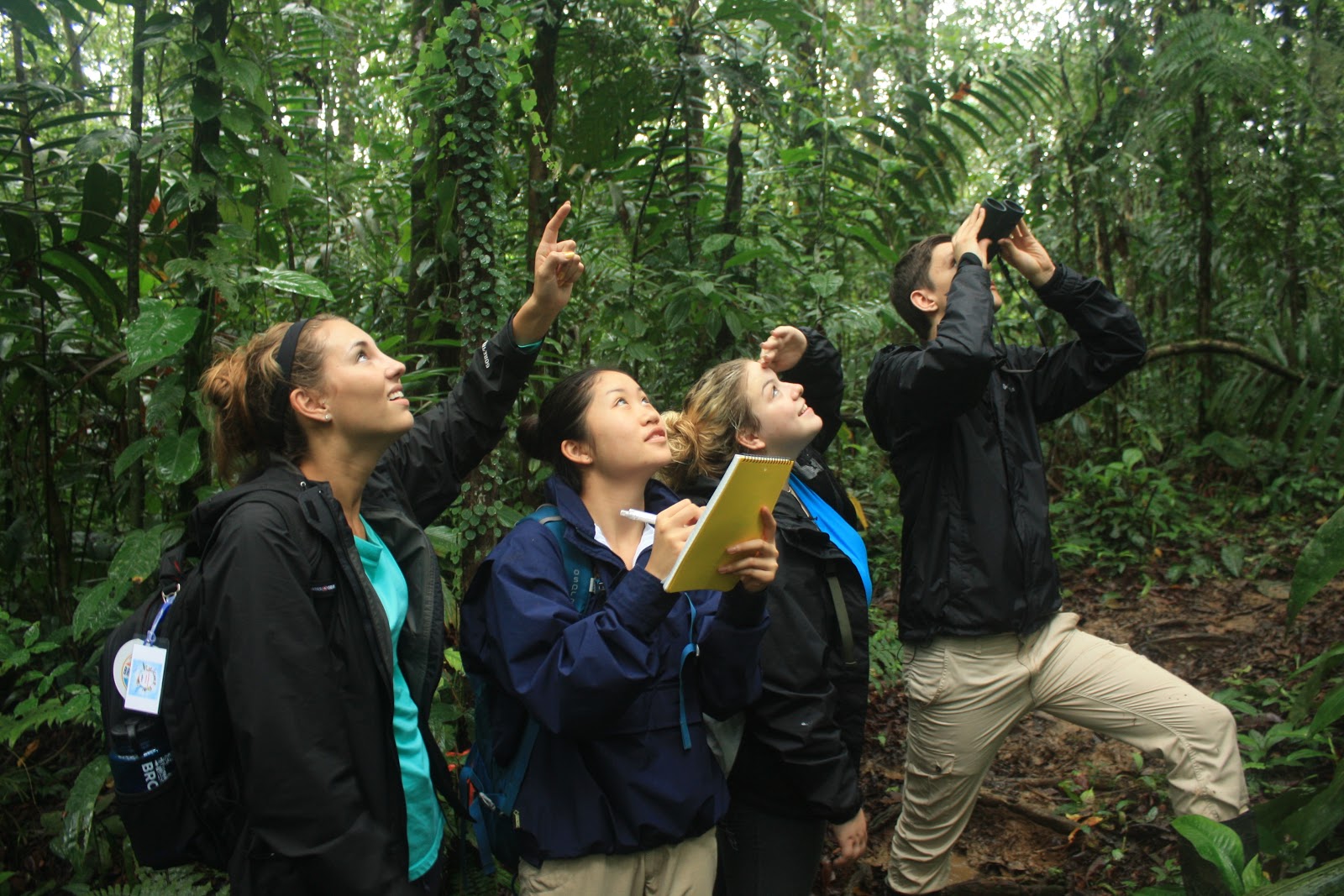 Figure \(\PageIndex{1}\): Students on a field course observe and record data on primates in the canopy at El Zota field station in Costa Rica. Field courses are a great way to learn how to safely observe animals in the wild while gaining hands-on experience collecting behavioral, ecological, and conservation data.