

Social Sci LibreTexts

2: Biological Anthropology

  • Page ID
    286991
  • \( \newcommand{\vecs}[1]{\overset { \scriptstyle \rightharpoonup} {\mathbf{#1}} } \)

    \( \newcommand{\vecd}[1]{\overset{-\!-\!\rightharpoonup}{\vphantom{a}\smash {#1}}} \)

    \( \newcommand{\dsum}{\displaystyle\sum\limits} \)

    \( \newcommand{\dint}{\displaystyle\int\limits} \)

    \( \newcommand{\dlim}{\displaystyle\lim\limits} \)

    \( \newcommand{\id}{\mathrm{id}}\) \( \newcommand{\Span}{\mathrm{span}}\)

    ( \newcommand{\kernel}{\mathrm{null}\,}\) \( \newcommand{\range}{\mathrm{range}\,}\)

    \( \newcommand{\RealPart}{\mathrm{Re}}\) \( \newcommand{\ImaginaryPart}{\mathrm{Im}}\)

    \( \newcommand{\Argument}{\mathrm{Arg}}\) \( \newcommand{\norm}[1]{\| #1 \|}\)

    \( \newcommand{\inner}[2]{\langle #1, #2 \rangle}\)

    \( \newcommand{\Span}{\mathrm{span}}\)

    \( \newcommand{\id}{\mathrm{id}}\)

    \( \newcommand{\Span}{\mathrm{span}}\)

    \( \newcommand{\kernel}{\mathrm{null}\,}\)

    \( \newcommand{\range}{\mathrm{range}\,}\)

    \( \newcommand{\RealPart}{\mathrm{Re}}\)

    \( \newcommand{\ImaginaryPart}{\mathrm{Im}}\)

    \( \newcommand{\Argument}{\mathrm{Arg}}\)

    \( \newcommand{\norm}[1]{\| #1 \|}\)

    \( \newcommand{\inner}[2]{\langle #1, #2 \rangle}\)

    \( \newcommand{\Span}{\mathrm{span}}\) \( \newcommand{\AA}{\unicode[.8,0]{x212B}}\)

    \( \newcommand{\vectorA}[1]{\vec{#1}}      % arrow\)

    \( \newcommand{\vectorAt}[1]{\vec{\text{#1}}}      % arrow\)

    \( \newcommand{\vectorB}[1]{\overset { \scriptstyle \rightharpoonup} {\mathbf{#1}} } \)

    \( \newcommand{\vectorC}[1]{\textbf{#1}} \)

    \( \newcommand{\vectorD}[1]{\overrightarrow{#1}} \)

    \( \newcommand{\vectorDt}[1]{\overrightarrow{\text{#1}}} \)

    \( \newcommand{\vectE}[1]{\overset{-\!-\!\rightharpoonup}{\vphantom{a}\smash{\mathbf {#1}}}} \)

    \( \newcommand{\vecs}[1]{\overset { \scriptstyle \rightharpoonup} {\mathbf{#1}} } \)

    \(\newcommand{\longvect}{\overrightarrow}\)

    \( \newcommand{\vecd}[1]{\overset{-\!-\!\rightharpoonup}{\vphantom{a}\smash {#1}}} \)

    \(\newcommand{\avec}{\mathbf a}\) \(\newcommand{\bvec}{\mathbf b}\) \(\newcommand{\cvec}{\mathbf c}\) \(\newcommand{\dvec}{\mathbf d}\) \(\newcommand{\dtil}{\widetilde{\mathbf d}}\) \(\newcommand{\evec}{\mathbf e}\) \(\newcommand{\fvec}{\mathbf f}\) \(\newcommand{\nvec}{\mathbf n}\) \(\newcommand{\pvec}{\mathbf p}\) \(\newcommand{\qvec}{\mathbf q}\) \(\newcommand{\svec}{\mathbf s}\) \(\newcommand{\tvec}{\mathbf t}\) \(\newcommand{\uvec}{\mathbf u}\) \(\newcommand{\vvec}{\mathbf v}\) \(\newcommand{\wvec}{\mathbf w}\) \(\newcommand{\xvec}{\mathbf x}\) \(\newcommand{\yvec}{\mathbf y}\) \(\newcommand{\zvec}{\mathbf z}\) \(\newcommand{\rvec}{\mathbf r}\) \(\newcommand{\mvec}{\mathbf m}\) \(\newcommand{\zerovec}{\mathbf 0}\) \(\newcommand{\onevec}{\mathbf 1}\) \(\newcommand{\real}{\mathbb R}\) \(\newcommand{\twovec}[2]{\left[\begin{array}{r}#1 \\ #2 \end{array}\right]}\) \(\newcommand{\ctwovec}[2]{\left[\begin{array}{c}#1 \\ #2 \end{array}\right]}\) \(\newcommand{\threevec}[3]{\left[\begin{array}{r}#1 \\ #2 \\ #3 \end{array}\right]}\) \(\newcommand{\cthreevec}[3]{\left[\begin{array}{c}#1 \\ #2 \\ #3 \end{array}\right]}\) \(\newcommand{\fourvec}[4]{\left[\begin{array}{r}#1 \\ #2 \\ #3 \\ #4 \end{array}\right]}\) \(\newcommand{\cfourvec}[4]{\left[\begin{array}{c}#1 \\ #2 \\ #3 \\ #4 \end{array}\right]}\) \(\newcommand{\fivevec}[5]{\left[\begin{array}{r}#1 \\ #2 \\ #3 \\ #4 \\ #5 \\ \end{array}\right]}\) \(\newcommand{\cfivevec}[5]{\left[\begin{array}{c}#1 \\ #2 \\ #3 \\ #4 \\ #5 \\ \end{array}\right]}\) \(\newcommand{\mattwo}[4]{\left[\begin{array}{rr}#1 \amp #2 \\ #3 \amp #4 \\ \end{array}\right]}\) \(\newcommand{\laspan}[1]{\text{Span}\{#1\}}\) \(\newcommand{\bcal}{\cal B}\) \(\newcommand{\ccal}{\cal C}\) \(\newcommand{\scal}{\cal S}\) \(\newcommand{\wcal}{\cal W}\) \(\newcommand{\ecal}{\cal E}\) \(\newcommand{\coords}[2]{\left\{#1\right\}_{#2}}\) \(\newcommand{\gray}[1]{\color{gray}{#1}}\) \(\newcommand{\lgray}[1]{\color{lightgray}{#1}}\) \(\newcommand{\rank}{\operatorname{rank}}\) \(\newcommand{\row}{\text{Row}}\) \(\newcommand{\col}{\text{Col}}\) \(\renewcommand{\row}{\text{Row}}\) \(\newcommand{\nul}{\text{Nul}}\) \(\newcommand{\var}{\text{Var}}\) \(\newcommand{\corr}{\text{corr}}\) \(\newcommand{\len}[1]{\left|#1\right|}\) \(\newcommand{\bbar}{\overline{\bvec}}\) \(\newcommand{\bhat}{\widehat{\bvec}}\) \(\newcommand{\bperp}{\bvec^\perp}\) \(\newcommand{\xhat}{\widehat{\xvec}}\) \(\newcommand{\vhat}{\widehat{\vvec}}\) \(\newcommand{\uhat}{\widehat{\uvec}}\) \(\newcommand{\what}{\widehat{\wvec}}\) \(\newcommand{\Sighat}{\widehat{\Sigma}}\) \(\newcommand{\lt}{<}\) \(\newcommand{\gt}{>}\) \(\newcommand{\amp}{&}\) \(\definecolor{fillinmathshade}{gray}{0.9}\)
    Biological anthropology uses a scientific and evolutionary approach to answer many of the same questions that all anthropologists are concerned with: What does it mean to be human? Where do we come from? Who are we today? Biological anthropologists are concerned with exploring how humans vary biologically, how humans adapt to their changing environments, and how humans have evolved over time and continue to evolve today. Some biological anthropologists also study what humans and nonhuman primates have in common and how we differ.

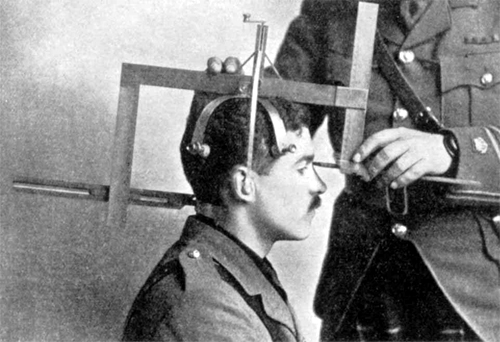
    You may have also heard biological anthropology referred to as physical anthropology—a discipline that dates to as far back as the eighteenth century, when it focused mostly on physical variation among humans. These researchers dedicated themselves to measuring bodies and skulls (anthropometry and craniometry) in great detail (figure below). Many also acted under the misguided racist belief that human biological races existed and could be used comparatively. Anthropologists today agree that there are no biological human races and that all humans alive today are members of the same species and subspecies: Homo sapiens sapiens. Differences we can see between peoples’ bodies are due to a wide variety of factors, including environment, diet, activities, and genetic makeup.

    The subdiscipline has thankfully changed a great deal since these early years. Biological anthropologists no longer identify human differences in order to assign people to groups, like races. The focus is instead on understanding how and why human and primate variation developed through evolutionary processes. The name for the subdiscipline has transitioned in recent years (from physical anthropology to biological anthropology) to reflect these changes. Many believe the term biological anthropology better reflects the subdiscipline’s focus today, which includes genetic and molecular research.

    A standing person in uniform is using a large metal tool to measure a seated man’s head.
    An anthropometric device used to measure a subject’s head, circa 1913. Credit: Head-Measurer of Tremearne (side view) by A.J.N. Tremearne, Man 15 (1914): 87–88 is in the public domain.

    The Scope of Biological Anthropology

    There are at least six subfields within biological anthropology: primatology, paleoanthropology, molecular anthropology, bioarchaeology, forensic anthropology, and human biology. Each subfield focuses on a different dimension of what it means to be human from a biological perspective. In this course, we will only scratch the surface of primatology, paleoanthropology, and (evolutionary) human biology.

    A “biological anthropology” umbrella hovers over subfield names accompanied by symbols.
    Biological anthropology includes primatology, paleoanthropology, bioarchaeology, molecular anthropology, forensic anthropology, and human biology. Credit: Subfields of biological anthropology (Figure 1.16) original to Explorations: An Open Invitation to Biological Anthropology by Mary Nelson is under a CC BY-NC 4.0 License.

    Primatology

    Primatologists study the anatomy, behavior, ecology, and genetics of living and extinct nonhuman primates, including apes, monkeys, tarsiers, lemurs, and lorises. Primatology research gives us insights into how evolution has shaped our species, since nonhuman primates are our closest living biological relatives. Through such studies, we have learned that all primates share a suite of traits.

    The head and hand of a gorilla rest on an angled tree trunk.
    A mountain gorillas feeds on insects. Their fingers and fingernails are very similar to that of humans. Credit: Mountain gorilla finger detail.KMRA by Kurt Ackermann (username KMRA) is under a CC BY 2.5 License.

    Paleoanthropology

    Paleoanthropologists study human ancestors from the distant past to learn how, why, and where they evolved. Because these ancestors lived before there were written records, paleoanthropologists have to rely on various types of physical evidence to come to their conclusions. This evidence includes fossilized remains (particularly fossilized bones), DNA, artifacts such as stone tools, and the contexts in which these items are found. In recent years, paleoanthropologists have made some monumental discoveries about hominin evolution. These findings helped us learn that human evolution did not occur in a simple, straight line but, rather, branched out in many directions. Most branches were evolutionary “dead ends.” Humans are now the only living hominins left on planet Earth.

    A gray-haired man looks eye-to-eye with a fossil cast.
    Donald Johanson and an Australopithecus fossil skull. Credit: Donald Johanson 2009 by Julesasu has been designated to the public domain (CC0).

    Molecular Anthropology

    Molecular anthropologists use molecular techniques (primarily genetics) to compare ancient and modern populations as well as to study living populations of humans or nonhuman primates. By examining DNA sequences, molecular anthropologists can estimate how closely related two populations are, as well as identify population events, like a population decline, that explain the observed genetic patterns. This information helps scientists trace patterns of migration and identify how people have adapted to different environments over time.

    Bioarchaeology

    Bioarchaeologists study human skeletal remains along with the surrounding soils and other materials. They use the research methods of skeletal biology, mortuary studies, osteology, and archaeology to answer questions about the lifeways of past populations. Through studying the bones and burials of past peoples, bioarchaeologists search for answers to how people lived and died, including their health, nutrition, diseases, and/or injuries. Most bioarchaeologists study not just individuals but entire populations to reveal biological and cultural patterns.

    Forensic Anthropology

    Forensic anthropologists use many of the same techniques as bioarchaeologists to develop a biological profile for unidentified individuals, including estimating sex, age at death, height, ancestry, or other unique identifying features such as skeletal trauma or diseases. They may also go to a crime or accident scene to assist in the search and recovery of human remains, aiding law enforcement teams (figure below). The popular television show Bones told the fictional story of a forensic anthropologist, Dr. Temperance Brennan, who brilliantly interpreted clues from victims’ bones to help solve crimes. While the show includes forensic anthropology techniques and responsibilities, it also includes many inaccuracies. For example, forensic anthropologists do not collect trace evidence like hair or fibers, run DNA tests, carry weapons, or solve criminal cases. Forensic anthropology is considered an applied area of biological anthropology, because it involves a practical application of anthropological theories, methods, and findings to solve real-world problems. While some forensic anthropologists are academics that work for colleges and universities, others are employed by public safety and law agencies.

    Woman placing flowers near a stone memorial.
    A remembrance of the victims of El Mozote Massacre in El Salvador. Forensic anthropologists played an important role in identifying the victims of this massacre during the Salvadoran Civil War. Credit: Untitled by Presidencia El Salvador has been designated to the public domain (CC0).

    Human Biology

    Many biological anthropologists do work that falls under the label of “human biology.” This type of research explores how the human body is affected by different physical environments, cultural influences, and nutrition. These include studies of human variation or the physiological differences among humans around the world. Some of these anthropologists study human adaptations to extreme environments, which includes physiological responses and genetic advantages to help them survive. Others are interested in how nutrition and disease affect human growth and development. Biological anthropologists engage in a wide range of research that spans the breadth of human biological diversity.

    The six subfields of biological anthropology all help us to understand what it means to be biologically human. From molecular analyses of our cells to studies of our changing skeleton, to research on our nonhuman primate cousins, biological anthropology assists in answering the central question of anthropology: What does it mean to be human? Despite their different foci, all biological anthropologists share a commitment to using a scientific approach to study how we became the complex, adaptable species we are today.

    • 2.1: Evolution
      Evolution by natural selection explains how species (including humans and other primates) change over time through inherited variations and environmental pressures, supported by extensive evidence from fossils, anatomy, and molecular biology. Understanding evolution is essential in biological anthropology for explaining human origins and our relationship to other species.
    • 2.2: Our Primate Relatives
      Primates, the order that includes humans, monkeys, and apes, share distinctive traits that evolved through various environmental adaptations over 65 million years. By studying our primate relatives through morphology, fossils, and behavior, biological anthropologists gain insights into human evolution and discover that many traits once considered uniquely human—such as tool use, culture, and cooperation—are actually shared across the primate order.
    • 2.3: Biological Humans
      Hominins evolved from bipedal ancestors over 7 million years ago, with the genus Homo emerging around 2 million years ago. The evolutionary origins of Modern Homo sapiens is much more complex than older linear or even straightforward 'branching' evolutionary models suggested. A "braided stream" of genetic exchange better explains modern humans.
    • 2.4: Today's Human Variation
      Human biological variation is minimal (humans share 99.9% DNA) and results from evolutionary adaptations to environmental challenges like UV radiation, climate, and disease rather than distinct racial categories. Historical racial classifications lack biological validity; traits like skin color and body shape vary continuously across populations as adaptive responses, making race a social construct rather than biological reality.


    2: Biological Anthropology is shared under a CC BY-NC 4.0 license and was authored, remixed, and/or curated by LibreTexts.

    • Was this article helpful?