

8.4: Influence of New Technologies
- Last updated
- Save as PDF
- Page ID
- 155664

- Anonymous
- LibreTexts
Learning Objectives
- Describe the difference between satellite television and cable television.
- Identify two of the major satellite companies in today’s market.
- Identify ways in which the Internet has affected content delivery and viewing patterns.
The experience of watching television is rapidly changing with the progression of technology. No longer restricted to a limited number of channels on network television, or even to a television schedule, viewers are now able to watch exactly what they want to watch, when they want to watch it. Non-television delivery systems such as the Internet, which enables viewers to download traditional television shows onto a computer, laptop, iPod, or smartphone, are changing the way people watch television. Meanwhile, cable and satellite providers are enabling viewers to purchase television shows to watch at their convenience through the use of video-on-demand services, changing the concept of prime-time viewing. Digital video recording (DVR) systems such as TiVo, which enable users to record particular shows onto the system’s computer memory, are having a similar effect.
Although television audiences are becoming increasingly fragmented, they are also growing because of the convenience and availability of new technology. In 2009, Nielsen’s Three Screen Report, which encompassed television, cell phone, and computer usage, reported that the average viewer watched more than 151 hours of television per month, up 3.6 percent from the previous year.Alana Semuels, “Television Viewing at All-Time High,” Los Angeles Times, February 24, 2009, http://articles.latimes.com/2009/feb/24/business/fi-tvwatching24. Viewers might not all be sitting together in the family room watching prime-time shows on network television between 7 and 11 p.m., but they are watching.
The War Between Satellite and Cable Television
The origins of satellite television can be traced to the space race of the 1950s, when the United States and the Soviet Union were competing to put the first satellite into space. Soviet scientists accomplished the goal first with the launch of Sputnik in 1957, galvanizing Americans (who were fearful of falling behind in space technology during the Cold War era) into intensifying their efforts and resulting in the creation of the National Aeronautics and Space Administration (NASA) in 1958. AT&T launched Telstar, the first active communications satellite, on July 10, 1962, and the first transatlantic television signal—a black-and-white image of a U.S. flag waving in front of the Andover Earth Station in western Maine—transmitted that same day. However, the television industry did not utilize satellites for broadcasting purposes until the late 1970s when PBS introduced Public Television Satellite Service. Satellite communication technology caught on and was used by broadcasters as a distribution method between 1978 and 1984 by pioneering cable channels such as HBO, TBS (Turner Broadcasting System), and CBN (Christian Broadcasting Network, later the Family Channel).
The trouble with early satellite television systems was that once people purchased a satellite system, they had free access to every basic and premium cable service that was broadcasting via satellite signals. The FCC had an “open skies” policy, under which users had as much right to receive signals as broadcasters had the right to transmit them. Initially, the satellite receiver systems were prohibitively expensive for most families, costing more than $10,000. However, as the price of a satellite dish dropped toward the $3,000 mark in the mid-1980s, consumers began to view satellite television as a cheaper, higher-quality alternative to cable. Following the initial purchase of a dish system, the actual programming—consisting of more than 100 cable channels—was free. Cable broadcasters lobbied the government for legal assistance and, under the 1984 Cable Act, were allowed to encrypt their satellite feeds so that only people who purchased a decoder from a satellite provider could receive the channel.
Following the passing of the Cable Act, the satellite industry took a dramatic hit. Sales of the popular direct-to-home (DTH) systems (precursors to the smaller, more powerful direct broadcast satellite systems introduced in the 1990s) that had offered free cable programming slumped from 735,000 units in 1985 to 225,000 units a year later, and around 60 percent of satellite retailers went out of business. The satellite industry’s sudden drop in popularity was exacerbated by large-scale anti-dish advertising campaigns by cable operators, depicting satellite dishes as unsightly. Although sales picked up in the late 1980s with the introduction of integrated receiving and decoding units and the arrival of program packages, which saved consumers the time and effort of signing up for individual programming services, the growth of the satellite industry was stunted by piracy—the theft of satellite signals. Of the 1.9 million units manufactured between 1986 and 1990, fewer than 500,000 were receiving signals legally.Harry W. Thibedeau, “DTH Satellite TV: Timelines to the Future,” Satellite Broadcasting & Communications Association, 2000, satelliteretailers.com/dish_installation.html. The problem was ultimately solved by the actions of the Satellite Broadcasting and Communications Association (SBCA), an association created in 1986 by the merger of two trade organizations—the Society of Private and Commercial Earth Stations (SPACE) and the Direct Broadcast Satellite Association (DBSA). SPACE was composed of manufacturers, distributors, and retailers of direct-to-home systems, and DBSA represented companies interested in direct broadcast satellite systems. The SBCA set up an antipiracy task force, aggressively pursuing illegal hackers with the FBI’s help.
Once the piracy problem was under control, the satellite industry could move forward. In 1994, four major cable companies launched a first-generation direct broadcast satellite (DBS) system called PrimeStar. The system, a small-dish satellite-delivered program service specifically intended for home reception, was the first successful attempt to enter the market in the United States. Within a year, PrimeStar was beaming 67 channels into 70,000 homes for a monthly fee of $25 to $35 (in addition to a hardware installation fee of $100 to $200). By 1996, competing companies DirecTV and the EchoStar Dish Network had entered the industry, and Dish Network’s cheaper prices were forcing its competitors to drop their fees. DirecTV acquired PrimeStar’s assets in 1999 for around $1.82 billion, absorbing its rival’s 2.3 million subscribers.Sandeep Junnarker, “DirecTV to Buy Rival PrimeStar’s Assets,” CNET, January 22, 1999, http://news.cnet.com/DirecTV-to-buy-rival-Primestars-assets/2100-1033_3-220509.html.

The Current Satellite Market: DirecTV versus Dish Network
As of 2010, the two biggest players in the satellite television industry are DirecTV and Dish Network. Assisted by the passing of the Satellite Television Home Viewers Act in 1999, which enabled satellite providers to carry local television stations (putting them on equal footing with cable television), both companies have grown rapidly over the past decade. In the first quarter of 2010, DirecTV boasted 18.6 million subscribers, placing it ahead of its rival, Dish Network, which reported a total of 14.3 million subscribers.Franklin Paul, “Dish Network Subscriber Gain, Profit Beat Street,” Reuters, May 10, 2010, http://www.reuters.com/article/idUSTRE6492MW20100510. Dish courts customers who have been hit by the economic downturn, aggressively cutting its prices and emphasizing its low rates. Conversely, DirecTV targets affluent consumers, emphasizing quality and choice in its advertising campaigns and investing in advanced services and products such as multiroom viewing (enabling a subscriber to watch a show in one room, pause it, and continue watching the same show in another room) to differentiate itself from rival satellite and cable companies.
Since the 1999 legislation put satellite television in direct competition with cable, the major satellite companies have increasingly pitted themselves against cable broadcasters, offering consumers numerous incentives to switch providers. One of these incentives is the addition of premium networks for satellite subscribers in the same vein as premium cable channel HBO. In 2005, DirecTV expanded its 101 Network channel to include original shows, becoming the first satellite station to air first episodes of a broadcast television series with NBC daytime soap opera Passions in 2007. The station aired first-run episodes of football drama series Friday Night Lights in 2008 and set its sights on the male over-35 demographic by obtaining syndication rights to popular HBO series Oz and Deadwood a year later. Commenting on the satellite company’s programming plans, executive vice president for entertainment for DirecTV Eric Shanks said, “We’d like to become a pre-cable window for these premium channels.”Bill Carter, “DirecTV Raises Its Sights for a Channel,” New York Times, January 23, 2009, http://www.nytimes.com/2009/01/24/business/media/24direct.html. In other words, the company hopes to purchase HBO shows such as Sex and the City before HBO sells the series to basic-cable channels like TBS.
In another overt bid to lure cable customers over to satellite television, both DirecTV and Dish Network offer a number of comprehensive movies and sports packages, benefiting from their additional channel capacity (satellite television providers typically offer around 350 channels, compared with 180 channels on cable) and their ability to receive international channels often unavailable on cable. In the mid-2000s, the satellite companies also began encroaching on cable television’s domination of bundled packages, by offering all-in-one phone, Internet, and television services. Despite being ideally suited to offering such packages with their single telecommunications pipe into the house, cable companies such as Comcast, Cox, and Time Warner had developed a reputation for offering poor service at extortionate prices. In the first three quarters of 2004, the eight largest cable providers (with the exception of bankrupt Adelphia) lost 552,000 basic-cable subscribers. Between 2000 and 2004, cable’s share of the television market fell from 66 percent to 62 percent, while the number of U.S. households with satellite television increased from 12 percent to 19 percent.Ken Belson, “Cable’s Rivals Lure Customers With Packages,” New York Times, November 22, 2004, http://www.nytimes.com/2004/11/22/technology/22satellite.html. Despite reports that cash-strapped consumers are switching off pay-TV services to save money during strained economic times, satellite industry revenues have risen steadily over the past decade.
The Impact of DVRs and the Internet: Changing Content Delivery
Over the past two decades, the viewing public has become increasingly fragmented as a result of growing competition between cable and satellite channels and traditional network television stations. Now, television audiences are being presented with even more options. Digital video recorders (DVRs) like TiVo allow viewers to select and record shows they can watch at a later time. For example, viewers can set their DVRs to record all new (or old) episodes of the show Deadliest Catch and then watch the recorded episodes whenever they have free time.
DVRs can be used by advertisers to track which shows are being viewed. DVRs are even capable of targeting viewers with specific ads when they decide to watch their recorded program. In 2008, consumer groups battled with cable companies and lawmakers to protect the privacy of viewers who did not wish to be tracked this way, causing Nielsen to make tracking optional.
Non-television delivery systems such as the Internet allow viewers to download their favorite shows at any time, on several different media. The Internet has typically been bad news for traditional forms of media; newspapers, magazines, the music industry, video rental companies, and bookstores have all suffered from the introduction of the Internet. However, unlike other media, television has so far survived the Internet’s effects. Television remains the dominant source of entertainment for most Americans, who are using new media in conjunction with traditional television viewing, watching vast quantities of television in addition to streaming numerous YouTube videos and catching up on missed episodes via the networks’ web pages. In the third quarter of 2008, the average American watched 142 hours of television per month, an increase of five hours per month from the same quarter the previous year. Internet use averaged 27 hours per month, an increase of an hour and a half between 2007 and 2008.Randall Stross, “Why Television Still Shines in a World of Screens,” New York Times, February 7, 2009, http://www.nytimes.com/2009/02/08/business/media/08digi.html.
New Viewing Outlets: YouTube and Hulu
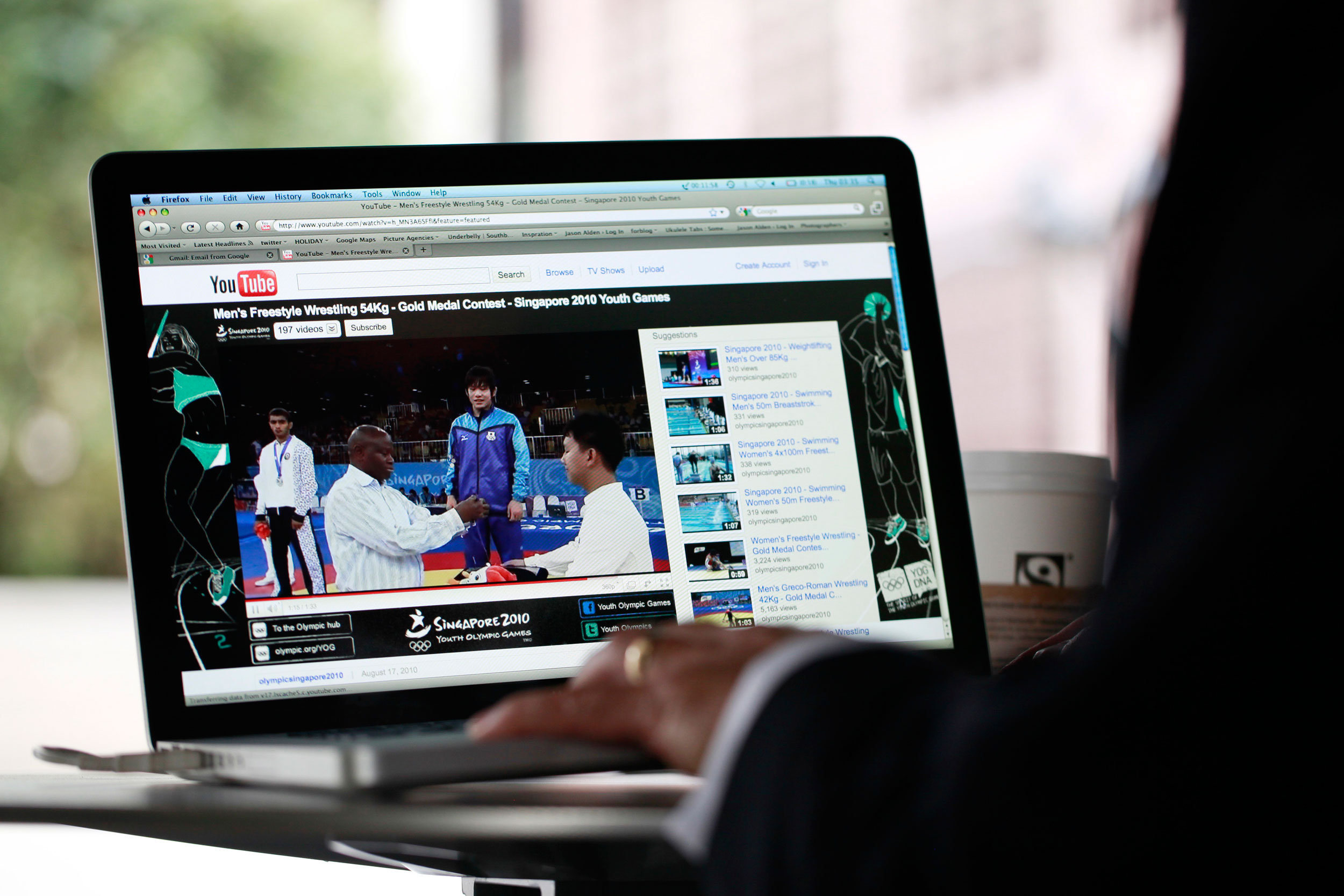
Of the many recent Internet phenomenons, few have made as big an impact as video-sharing website YouTube. Created by three PayPal engineers in 2005, the site enables users to upload personal videos, television clips, music videos, and snippets of movies that can be watched by other users worldwide. Although it initially drew unfavorable comparisons with the original music-sharing site Napster (see Chapter 6), which was buried under an avalanche of copyright infringement lawsuits, YouTube managed to survive the controversy by forming agreements with media corporations, such as NBC Universal Television, to legally broadcast video clips from shows such as The Office. In 2006, the company, which showed more than 100 million video clips per day, was purchased by Google for $1.65 billion.Associated Press, “Google Buys YouTube for $1.65 Billion,” MSNBC, October 10, 2006, http://www.msnbc.msn.com/id/15196982/ns/business-us_business/. Correctly predicting that the site was the “next step in the evolution of the Internet,” Google CEO Eric Schmidt has watched YouTube’s popularity explode since the takeover. As of 2010, YouTube shows more than 2 billion clips per day and allows people to upload 24 hours of video every single minute.YouTube, “YouTube Fact Sheet,” www.youtube.com/t/fact_sheet. To secure its place as the go-to entertainment website, YouTube is expanding its boundaries by developing a movie rental service and showing live music concerts and sporting events in real time. In January 2010, Google signed a deal with the Indian Premier League, making 60 league cricket matches available on YouTube’s IPL channel and attracting 50 million viewers worldwide.Heather Timmons, “Google Sees a New Role for YouTube: An Outlet for Live Sports,” New York Times, May 2, 2010, http://www.nytimes.com/2010/05/03/business/media/03cricket.html.
While YouTube remains focused on user-generated material, viewers looking for commercial videos of movies and television shows are increasingly turning to Hulu. Established in 2007 following a deal between NBC Universal, News Corporation, and a number of leading Internet companies (including Yahoo!, AOL, MSN, and MySpace), the site gives users access to an entire library of video clips without charge and syndicates its material to partner distribution sites. The videos include full episodes of current hit shows such as House, Saturday Night Live, and The Simpsons, as well as older hits from the studios’ television libraries. Supported through advertising, the venture, which is only available to viewers in the United States, became the premier video broadcast site on the web within 2 years. In July 2009, the site received more than 38 million viewers and delivered more videos than any site except YouTube.Chuck Salter, “Can Hulu Save Traditional TV?” Fast Company, November 1, 2009, http://www.fastcompany.com/magazine/140/the-unlikely-mogul.html. Throughout the entire year, Hulu generated an estimated $120 million in revenue and increased its advertiser base to 250 sponsors.Chuck Salter, “Can Hulu Save Traditional TV?” Fast Company, November 1, 2009, http://www.fastcompany.com/magazine/140/the-unlikely-mogul.html. Its advertising model appeals to viewers, who need only to watch two minutes of promotion in 22 minutes of programming, compared with 8 minutes on television. Limiting sponsorship to one advertiser per show has helped make recall rates twice as high as those for the same advertisements on television, benefiting the sponsors as well as the viewers.
Some critics and television executives claim that the Hulu model has been too successful for its own good, threatening the financial underpinnings of cable television by reducing DVD sales and avoiding carriage fees—in 2009, Fox pulled most of the episodes of It’s Always Sunny in Philadelphia from Hulu’s site. Per the networks’ request, Hulu also shut off access to its programming from Boxee, a fledgling service that enabled viewers to stream online video to their television sets. “We have to find ways to advance the business rather than cannibalize it,” stated the distribution chief at TNT, a network that refused to stream episodes of shows such as The Closer on Hulu’s site.Frank Rose, “Hulu, a Victim of Its Own Success?” Wired, May 12, 2009, http://www.wired.com/epicenter/2009/05/hulu-victim-success/. However, many television executives realize that if they do not cannibalize their own material, others will. When a viral video of Saturday Night Live short “Lazy Sunday” hit the web in 2005, generating millions of hits on YouTube, NBC did not earn a dime. Broadcast networks—the Big Four and the CW—have also begun streaming shows for free in an effort to stop viewers from watching episodes on other websites.
Hulu executives are considering introducing paid content on the site in an effort to subsidize advertising revenue, a blow to consumers that would likely be softened by perks such as early access to content, ad-free shows, and more comprehensive archives.
Video-on-Demand
Originally introduced in the early 1990s, the concept of video on demand (VOD)—a pay-per-view system that allows viewers to order or download a film via television or the Internet and watch it at their convenience—was not immediately successful because of the prohibitive cost of ordering a movie compared to buying or renting it from a store. Another early complaint about the service was that studios withheld movies until long after they were available on DVD, by which time most people who wanted to view the film had already seen it. Both of these disadvantages have since been remedied, with movies now released at the same time on VOD as they are on DVD at competitive rental prices. Currently, most cable and satellite television providers offer some form of on-demand service, either VOD, which provides movies 24 hours a day and enables viewers all the functionality of a DVD player (such as the ability to pause, rewind, or fast forward films), or NVOD (near video on demand), which broadcasts multiple copies of a film or program over short time intervals but does not allow viewers to control the video.
As an alternative to cable or satellite VOD, viewers can also readily obtain movies and television shows over the Internet, via free services such as YouTube and Hulu or through paid subscriptions to sites that stream movies to a computer. Online DVD rental service Netflix started giving subscribers instant access to its catalog of older television programs and films in 2007, while Internet giant Amazon.com set up a rival service resembling the pay-per-view model in 2008. Viewers can also stream free episodes of their favorite shows via cable and broadcast networks’ websites. With the increasing popularity of smartphones—cell phones that contain built-in applications and Internet access—viewers are using VOD as a way of watching television while they are out of the house. Having discovered that consumers are willing to watch entire television episodes or even films on their smartphones, industry executives are looking for ways to capitalize on smartphone technology. In 2010, News Corporation’s Fox Mobile Group was planning to launch Bitbop, a service that will stream television episodes to smartphones for $9.99 a month. Discussing the project, Bitbop architect Joe Bilman said that “the marriage of on-demand content and mobility has the power to light a fire in the smartphone space.”Brian Stelter, “Audiences, and Hollywood, Flock to Smartphones,” New York Times, May 2, 2010, http://www.nytimes.com/2010/05/03/business/media/03mobile.html. The shift from traditional television viewing to online viewing is making a small but noticeable dent in the $84 billion cable and satellite industry. Between the beginning of 2008 and the end of 2009, an estimated 800,000 U.S. households cut the cable cord in favor of web viewing.Erick Schonfeld, “Estimate: 800,000 U.S. Households Abandoned Their TVs for the Web,” TechCrunch, April 13, 2010, http://techcrunch.com/2010/04/13/800000-households-abandoned-tvs-web/.
Interactive Television
Moving a step beyond VOD, cable and satellite television providers are combining aspects of traditional television viewing with online content to create an entirely new way of watching shows—interactive television (iTV). Using an additional set-top box and their remote control, viewers can utilize several different features that go beyond simply watching a television show. For example, interactive television enables users to take part in quiz shows, vote for a favorite contestant on a game show, view highlights or look up statistics during sports matches, create a music playlist or photo slideshow, and view local information such as weather and traffic through a ticker under a current television program. Software such as Microsoft’s UltimateTV, released in 2001, even brought interactivity to individual television shows. For example, a viewer watching CBS crime series CSI can click on the interactive icon in the corner of the screen and obtain instant information about forensic analysis techniques, along with an episode guide, character biographies, and a map of the show’s Las Vegas setting.
Interactive television is beginning to take on the social format of the web, linking viewers with online communities who use communication tools such as Twitter and Skype IM to discuss what they just saw on television in real time. When popular musical comedy show Glee hit the screens in 2009, marketing experts at Fox pushed for a strong online presence, airing the pilot episode well in advance of the actual season debut and generating buzz on social networking sites such as Twitter and Facebook. Once the show gained widespread popularity, Fox launched an interactive hypertrailer on its website, allowing viewers to click on and “like” the show’s cast members on Facebook. The Glee cast also participates in weekly “tweet-peats,” which feature live Twitter feeds that scroll across the bottom of the screen during reruns of the show, providing behind-the-scenes details and answering fan questions. The CW network uses a similar technique with its “TV to Talk About” campaign, a tagline that changes from ad to ad to include iterations such as “TV to text about,” “blog about,” or “tweet about.” Its website offers forums where viewers can discuss episodes and interact with video extras, photos, and background clips about various shows. Online television forum Television Without Pity provides viewers with an alternative place for discussion that is not affiliated with any one network.

Despite the shift toward interactive television, one barrier that manufacturers seem to be unwilling to cross is the addition of Internet to people’s television sets. Although Internet-enabled televisions began trickling into the market in 2008 and 2009, many industry executives remained skeptical of their potential. In February 2009, Sony spokesman Greg Belloni said, “Sony’s stance is that consumers don’t want an Internet-like experience with their TVs, and we’re really not focused on bringing anything other than Internet video or widgets to our sets right now.”Matt Richtel, “What Convergence? TV’s Hesitant March to the Net,” New York Times, February 15, 2009, http://www.nytimes.com/2009/02/16/technology/internet/16chip.html. Although some analysts predict that up to 20 percent of televisions will be Internet-enabled by 2012, consulting firm Deloitte anticipates the continued concurrent use of television sets with laptops, MP3 players, and other browser-enabled devices.Deloitte, “Deloitte Analyses Top Trends for the Media Industry for 2010,” news release, www.deloitte.com/view/en_GB/uk/industries/tmt/press-release/37df818581646210VgnVCM100000ba42f00aRCRD.htm.
Key Takeaways
- The first satellite television signal was broadcast in 1962; however, the television industry did not begin utilizing satellites for broadcasting purposes until the late 1970s. Early problems with satellite television included the high cost of a satellite dish and the theft of satellite signals following the passing of the Cable Act in 1984. Once piracy was under control, satellite television companies began to emerge and become profitable. The two biggest current satellite television providers are DirecTV, which targets its services toward affluent consumers, and Dish Network, which targets lower-earning consumers. Since the 1999 legislation enabled satellite companies to broadcast local channels, satellite television has become a viable threat to cable. Satellite companies attempt to lure cable customers by offering premium channels, sports and movie packages, and competitive prices.
- Unlike some other forms of media, television is so far surviving the impact of the Internet. However, the World Wide Web is changing content delivery methods and the way people conceive television and program scheduling. New viewing outlets such as YouTube and Hulu enable viewers to watch online video clips, entire episodes of television shows, and movies free of charge (although Hulu may soon offer paid content to offset the losses in network advertising revenue). Video-on-demand services, now available through most cable and satellite providers, allow viewers to order movies or television programs at their convenience, rather than having to adhere to a fixed programming schedule. VOD is also available through Internet sites such as Amazon.com and Netflix, allowing people to stream shows and video clips to their smartphones and watch television while on the go. Thanks to the influence of the Internet, television is becoming more interactive, with providers combining aspects of traditional viewing and online content. This is manifested in two ways: new features that provide viewers with hundreds of additional options while they watch their favorite shows (for example, the ability to look up a news story or get a weather update), and social television, which encourages viewers to combine television viewing with social networking (for example, by blogging or joining an online chat forum about the show).
Exercise \(\PageIndex{1}\)
Please respond to the following short-answer writing prompts. Each response should be a minimum of one paragraph.
- What is the difference between satellite and cable television? In today’s market, who is winning the battle for consumers?
- Aside from DirecTV and Dish Network, what other satellite options do consumers have? How do these options differ from DirecTV and Dish Network?
- How have the Internet and DVRs affected your television-viewing habits?
End-of-Chapter Assessment
Review Questions
- Questions for Section 9.1
- What were some of the technological developments that paved the way for the evolution of television, and what role did they play?
- What factors contributed to the dominance of electronic television over mechanical television?
- Why was color technology slow to gain popularity following its development?
- What were some of the important landmarks in the history of television after 1960?
- Questions for Section 9.2
- What cultural factors influenced television programming between 1950 and 2010?
- How did television influence culture between 1950 and 2010? How are television and culture interrelated?
- Questions for Section 9.3
- How can corporate sponsors influence television programming?
- What factors have influenced the decline of the major networks since 1970? How have the networks adapted to changes in the industry?
- How does cable television differ from network television? How has the growth of cable been influenced by industry legislation?
- Questions for Section 9.4
- What are the main differences between satellite television and cable television? What factors influenced the growing popularity of satellite television in the 1980s and 1990s?
- Who are the two main competitors in the satellite television industry? How do they differ?
- How is the Internet changing content delivery methods and viewing patterns?
Critical Thinking Questions
- Do television programs just reflect cultural and social change, or do they influence it?
- Television audiences are becoming increasingly fragmented as a result of competition from cable and satellite companies and non-television delivery systems such as the Internet. What are the potential social implications of this trend?
- How can broadcast networks compete against satellite and cable operators?
- Critics frequently blame television for increasing levels of violence and aggression in children. Do broadcasters have a social responsibility to their viewers, and if so, how can they fulfill it?
- Supporters of public television argue that it serves a valuable role in the community, whereas opponents believe it is outdated. Is public television still relevant in today’s society, or should funding be cut completely?
Career Connection
Whether online viewing outlets continue to grow in popularity or viewers return to more traditional methods of watching television, broadcasters are likely to remain dependent on advertising sponsors to fund their programming. Advertising sales executives work for a specific network and sell television time to agencies and companies, working within budgets to ensure that clients make effective use of their advertising time.
Read through the U.S. Bureau of Labor Statistics overview of a career in advertising sales. You can find it at: www.bls.gov/oco/ocos297.htm.
Then, read BNET’s analysis of the television advertising industry at http://industry.bnet.com/media/10008136/truth-in-network-tv-advertising-and-what-to-do-about-it/. Once you have looked at both sites, use the information to answer these questions:
- According to the Bureau of Labor Statistics website, the employment rate for advertising sales agents is expected to increase by 7 percent between 2010 and 2018, about average for all professions. What reasons does the site give for this increase? How will the growth be offset?
- What predictions does the BNET article make about future trends in the Big Four networks’ advertising sales? How might this affect career prospects?
- Based on the analysis in the BNET article and the information on the Bureau of Labor Statistics website, how is the advertising sales industry likely to change and develop?
- As the Bureau of Labor Statistics website points out, creativity is an invaluable trait for advertising sales executives. Using the information on both sites, think of a list of creative ways to attract new clients to the ailing broadcast networks.