Social Sci LibreTexts

11.1: Electronic Games and Entertainment

  • Page ID
    155675
    • Anonymous
    • LibreTexts

    \( \newcommand{\vecs}[1]{\overset { \scriptstyle \rightharpoonup} {\mathbf{#1}} } \)

    \( \newcommand{\vecd}[1]{\overset{-\!-\!\rightharpoonup}{\vphantom{a}\smash {#1}}} \)

    \( \newcommand{\dsum}{\displaystyle\sum\limits} \)

    \( \newcommand{\dint}{\displaystyle\int\limits} \)

    \( \newcommand{\dlim}{\displaystyle\lim\limits} \)

    \( \newcommand{\id}{\mathrm{id}}\) \( \newcommand{\Span}{\mathrm{span}}\)

    ( \newcommand{\kernel}{\mathrm{null}\,}\) \( \newcommand{\range}{\mathrm{range}\,}\)

    \( \newcommand{\RealPart}{\mathrm{Re}}\) \( \newcommand{\ImaginaryPart}{\mathrm{Im}}\)

    \( \newcommand{\Argument}{\mathrm{Arg}}\) \( \newcommand{\norm}[1]{\| #1 \|}\)

    \( \newcommand{\inner}[2]{\langle #1, #2 \rangle}\)

    \( \newcommand{\Span}{\mathrm{span}}\)

    \( \newcommand{\id}{\mathrm{id}}\)

    \( \newcommand{\Span}{\mathrm{span}}\)

    \( \newcommand{\kernel}{\mathrm{null}\,}\)

    \( \newcommand{\range}{\mathrm{range}\,}\)

    \( \newcommand{\RealPart}{\mathrm{Re}}\)

    \( \newcommand{\ImaginaryPart}{\mathrm{Im}}\)

    \( \newcommand{\Argument}{\mathrm{Arg}}\)

    \( \newcommand{\norm}[1]{\| #1 \|}\)

    \( \newcommand{\inner}[2]{\langle #1, #2 \rangle}\)

    \( \newcommand{\Span}{\mathrm{span}}\) \( \newcommand{\AA}{\unicode[.8,0]{x212B}}\)

    \( \newcommand{\vectorA}[1]{\vec{#1}}      % arrow\)

    \( \newcommand{\vectorAt}[1]{\vec{\text{#1}}}      % arrow\)

    \( \newcommand{\vectorB}[1]{\overset { \scriptstyle \rightharpoonup} {\mathbf{#1}} } \)

    \( \newcommand{\vectorC}[1]{\textbf{#1}} \)

    \( \newcommand{\vectorD}[1]{\overrightarrow{#1}} \)

    \( \newcommand{\vectorDt}[1]{\overrightarrow{\text{#1}}} \)

    \( \newcommand{\vectE}[1]{\overset{-\!-\!\rightharpoonup}{\vphantom{a}\smash{\mathbf {#1}}}} \)

    \( \newcommand{\vecs}[1]{\overset { \scriptstyle \rightharpoonup} {\mathbf{#1}} } \)

    \( \newcommand{\vecd}[1]{\overset{-\!-\!\rightharpoonup}{\vphantom{a}\smash {#1}}} \)

    \(\newcommand{\avec}{\mathbf a}\) \(\newcommand{\bvec}{\mathbf b}\) \(\newcommand{\cvec}{\mathbf c}\) \(\newcommand{\dvec}{\mathbf d}\) \(\newcommand{\dtil}{\widetilde{\mathbf d}}\) \(\newcommand{\evec}{\mathbf e}\) \(\newcommand{\fvec}{\mathbf f}\) \(\newcommand{\nvec}{\mathbf n}\) \(\newcommand{\pvec}{\mathbf p}\) \(\newcommand{\qvec}{\mathbf q}\) \(\newcommand{\svec}{\mathbf s}\) \(\newcommand{\tvec}{\mathbf t}\) \(\newcommand{\uvec}{\mathbf u}\) \(\newcommand{\vvec}{\mathbf v}\) \(\newcommand{\wvec}{\mathbf w}\) \(\newcommand{\xvec}{\mathbf x}\) \(\newcommand{\yvec}{\mathbf y}\) \(\newcommand{\zvec}{\mathbf z}\) \(\newcommand{\rvec}{\mathbf r}\) \(\newcommand{\mvec}{\mathbf m}\) \(\newcommand{\zerovec}{\mathbf 0}\) \(\newcommand{\onevec}{\mathbf 1}\) \(\newcommand{\real}{\mathbb R}\) \(\newcommand{\twovec}[2]{\left[\begin{array}{r}#1 \\ #2 \end{array}\right]}\) \(\newcommand{\ctwovec}[2]{\left[\begin{array}{c}#1 \\ #2 \end{array}\right]}\) \(\newcommand{\threevec}[3]{\left[\begin{array}{r}#1 \\ #2 \\ #3 \end{array}\right]}\) \(\newcommand{\cthreevec}[3]{\left[\begin{array}{c}#1 \\ #2 \\ #3 \end{array}\right]}\) \(\newcommand{\fourvec}[4]{\left[\begin{array}{r}#1 \\ #2 \\ #3 \\ #4 \end{array}\right]}\) \(\newcommand{\cfourvec}[4]{\left[\begin{array}{c}#1 \\ #2 \\ #3 \\ #4 \end{array}\right]}\) \(\newcommand{\fivevec}[5]{\left[\begin{array}{r}#1 \\ #2 \\ #3 \\ #4 \\ #5 \\ \end{array}\right]}\) \(\newcommand{\cfivevec}[5]{\left[\begin{array}{c}#1 \\ #2 \\ #3 \\ #4 \\ #5 \\ \end{array}\right]}\) \(\newcommand{\mattwo}[4]{\left[\begin{array}{rr}#1 \amp #2 \\ #3 \amp #4 \\ \end{array}\right]}\) \(\newcommand{\laspan}[1]{\text{Span}\{#1\}}\) \(\newcommand{\bcal}{\cal B}\) \(\newcommand{\ccal}{\cal C}\) \(\newcommand{\scal}{\cal S}\) \(\newcommand{\wcal}{\cal W}\) \(\newcommand{\ecal}{\cal E}\) \(\newcommand{\coords}[2]{\left\{#1\right\}_{#2}}\) \(\newcommand{\gray}[1]{\color{gray}{#1}}\) \(\newcommand{\lgray}[1]{\color{lightgray}{#1}}\) \(\newcommand{\rank}{\operatorname{rank}}\) \(\newcommand{\row}{\text{Row}}\) \(\newcommand{\col}{\text{Col}}\) \(\renewcommand{\row}{\text{Row}}\) \(\newcommand{\nul}{\text{Nul}}\) \(\newcommand{\var}{\text{Var}}\) \(\newcommand{\corr}{\text{corr}}\) \(\newcommand{\len}[1]{\left|#1\right|}\) \(\newcommand{\bbar}{\overline{\bvec}}\) \(\newcommand{\bhat}{\widehat{\bvec}}\) \(\newcommand{\bperp}{\bvec^\perp}\) \(\newcommand{\xhat}{\widehat{\xvec}}\) \(\newcommand{\vhat}{\widehat{\vvec}}\) \(\newcommand{\uhat}{\widehat{\uvec}}\) \(\newcommand{\what}{\widehat{\wvec}}\) \(\newcommand{\Sighat}{\widehat{\Sigma}}\) \(\newcommand{\lt}{<}\) \(\newcommand{\gt}{>}\) \(\newcommand{\amp}{&}\) \(\definecolor{fillinmathshade}{gray}{0.9}\)

    Want to Get Away?

    07e672264adfa6705caeae2ae15a367e.jpg
    Figure 10.1

    Video games have come a long way from using a simple joystick to guide Pac-Man on his mission to find food and avoid ghosts. This is illustrated by a 2007 Southwest Airlines commercial in which two friends are playing a baseball video game on a Nintendo Wii–like console. The batting friend tells the other to throw his pitch—and he does, excitedly firing his controller into the middle of the plasma television, which then falls off the wall. Both friends stare in shock at the shattered flat screen as the narrator asks, “Want to get away?” More recent ads and viral videos feature similar mishaps with virtual reality headsets, showing that immersive technology brings its own physical comedy.

    Such a scene is unlikely to have taken place in the early days of video games when Atari reigned supreme and the action of playing solely centered on hand-eye coordination. The learning curve was relatively nonexistent; players maneuvered a joystick to shoot lines of aliens in the sky, or they turned the wheel on a paddle to play a virtual game of table tennis.

    But as video games became increasingly popular, they also became increasingly complex. Consoles upgraded and evolved on a regular basis, and the games kept up. Players called each other with loopholes and tips on how to get Mario and Luigi onto the next level, and now they share tips through livestreams, video platforms like YouTube, and gaming communities on Discord or TikTok. Games like The Legend of Zelda and Final Fantasy created alternate worlds and intricate story lines, providing multiple-hour epic adventures.

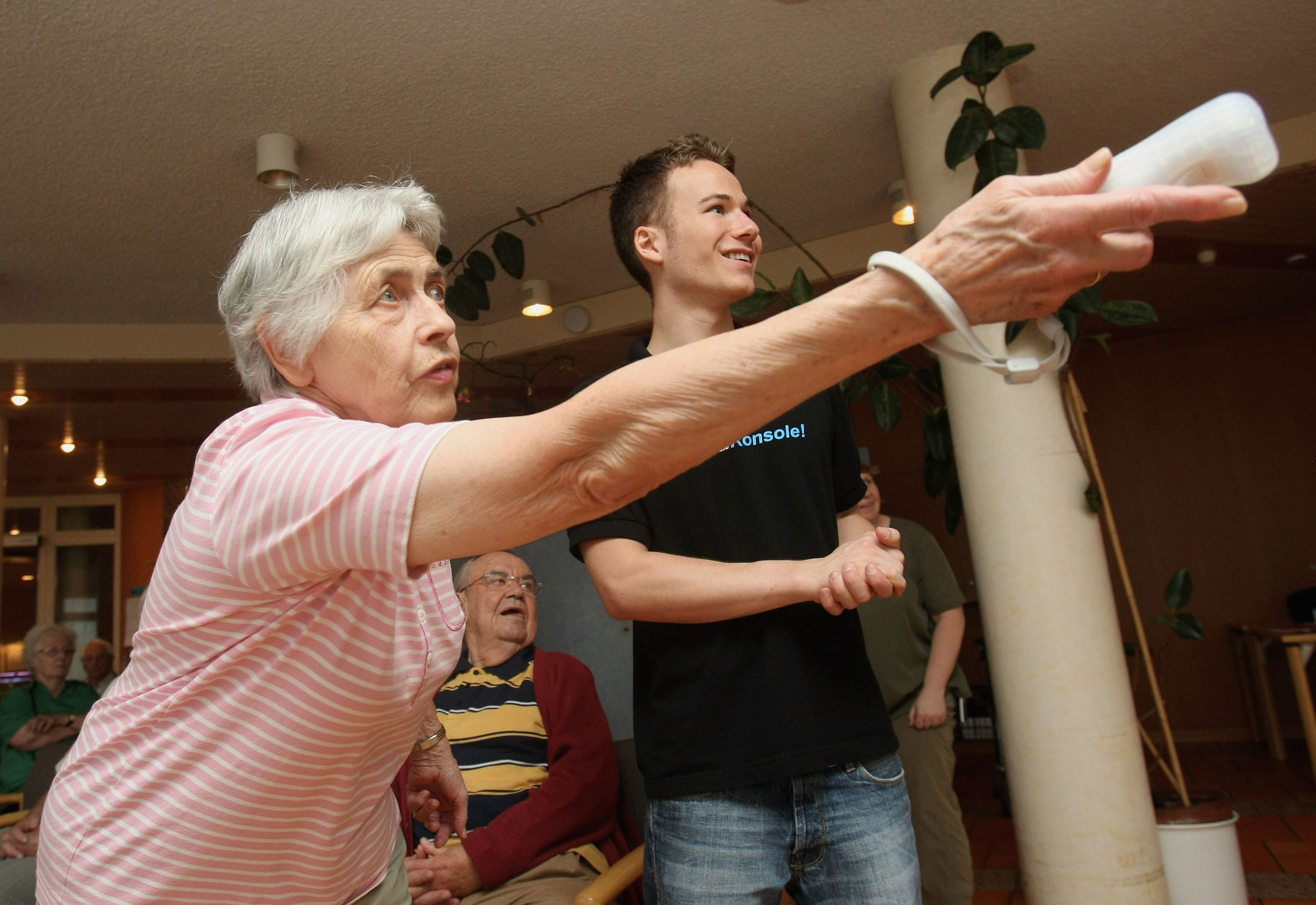
    Long criticized for taking kids out of the backyard and into a sedentary spot in front of the television, many video games have circled back to their simpler origins and, in doing so, have made players more active. Casual gamers who could quickly figure out how to put together puzzle pieces in Tetris can now just as easily figure out how to “swing” a tennis racket with a Wiimote. Video games are no longer a convenient scapegoat for America’s obesity problems; Wii Fit offers everything from yoga to boxing, and Dance Dance Revolution estimates calories burned while players dance. Today, many players use VR fitness games such as Beat Saber or Supernatural, which combine music, movement, and immersive visuals to keep workouts engaging.

    The logistics of video games continue to change, and as they do, gaming has begun to intersect with every other part of culture. Players can learn how to “perform” songs through rhythm games, from classic titles like Guitar Hero and Rock Band to newer mobile and VR experiences that simulate instruments or dance choreography. Product placement akin to what is seen in movies and on television is equally prevalent in video games such as the popular Forza Motorsport or FIFA series. As the Internet allows for players across the world to participate simultaneously, video games have the potential to one day look like competitive reality shows. Arguably, video games even hold a place in the art world, with the increasing complexity of animation and story lines.

    And now, with endless possibilities for the future, video games are attracting new and different demographics. Avid players who grew up with video games may be among the first to adopt emerging technologies such as virtual reality headsets and augmented reality glasses, which promise new kinds of immersive play. But casual players, perhaps of an older demographic, will be drawn to the simplicity of a game like Wii Bowling. Video games have become more accessible than ever. Mobile app stores for iOS and Android offer thousands of games—many free or inexpensive—literally putting video games in one’s pocket and making them playable anytime, anywhere. Who needs a cumbersome Scrabble board when it’s available on a touch screen anytime, anywhere?

    Video games have become ubiquitous in modern culture. Understanding them as a medium allows a fuller understanding of their implications in the realms of entertainment, information, and communication. Studying their history reveals new perspectives on the ways video games have affected mainstream culture.


    This page titled 11.1: Electronic Games and Entertainment is shared under a CC BY-NC-SA 3.0 license and was authored, remixed, and/or curated by Anonymous via source content that was edited to the style and standards of the LibreTexts platform.