In this section, we will address six important functions that our nonverbal communication serves in interactions: we use it to convey meaning and provide information, regulate interactions, express our identities, indicate relational standing, communicate emotions, and express status and power.
We Use Nonverbal Communication To Convey Meaning and Provide Information
We use nonverbal communication to complement, substitute for, modify, or contradict verbal messages.
Complement
We can use nonverbal communication to complement the accompanying verbal message. Obvious examples include a head-nod or a head-shake to complement the verbal messages of “yes” or “no.” If a friend tells us that they recently received a promotion and a pay raise, we can show our enthusiasm in a number of verbal and nonverbal ways. We can exclaim, “Wow, that’s great! I’m so happy for you!” while at the same time using our nonverbal communication to complement what we are saying by smiling and hugging them.
Substitute
We can also use nonverbal communication to substitute for a verbal message. If someone asks you a question, instead of a verbal reply “yes”, you may choose to simply nod your head without the accompanying verbal message. When we replace verbal communication with nonverbal communication, we use nonverbal behaviors that are easily recognized by others such as a wave, head-nod, or head-shake.
Modify
While nonverbal communication can complement verbal communication, we also use it to modify the meaning of verbal communication by emphasizing certain parts of the verbal message. For instance, you may be upset with a family member and state, “I’m very angry with you.” To accent this statement nonverbally you might say it, “I’m VERY angry with you,” placing your emphasis on the word “very” to demonstrate the magnitude of your anger. In this example, it is your tone of voice (called paralanguage) that serves as the nonverbal communication accenting the message
Contradict
Finally, our nonverbal messages can contradict our verbal message. Imagine that you are greeting a friend in passing and say, “How are you?” They might say, “Fine” but have a sad tone to their voice. In this example, their nonverbal behaviors go against their verbal response and sends a mixed message to you. Research suggests that when verbal and nonverbal messages contradict one another, receivers often place greater value on the nonverbal communication as the more accurate message (Argyle, Alkema & Gilmour).
We Use Nonverbal Communication To Regulate Interactions
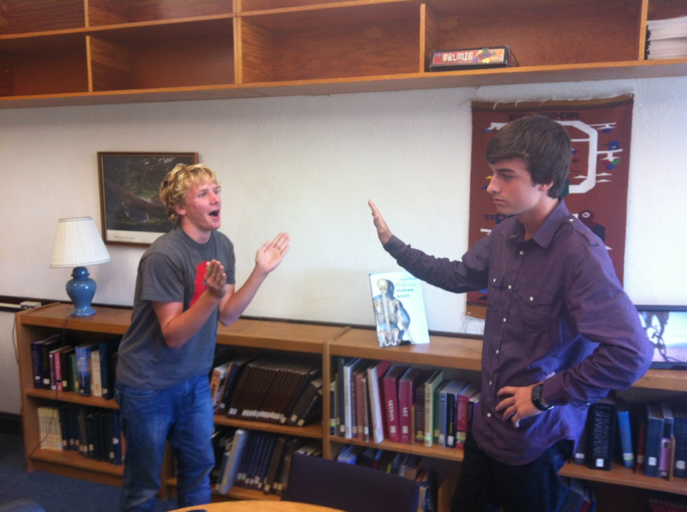
We can use our nonverbal communication to regulate interactions. For example, if we are talking to someone and we want to show them we are interested in what they are saying and that they should continue, we can make eye contact, lean forward, and/or nod our heads. However, if we are trying to get the other person to stop talking so that we can exit from the interaction, we might look at our phones or angle our bodies away from theirs. Based on the above body language, what message do you think the person on the left is trying convey to the person on the right?
Generally, it is pretty easy for us to enter, maintain, and exit our interactions with others nonverbally. Rarely, if ever, would we approach a person and say, “I’m going to start a conversation with you now. Okay, let’s begin.” Instead, we might make eye contact, move closer to the person, or face the person directly, which are all nonverbal behaviors that indicate our desire to interact. Likewise, we do not generally end conversations by stating, “I’m done talking to you now” unless there is a breakdown in the communication process. We are generally proficient enacting nonverbal communication such as looking at our watch, looking in the direction we wish to go, or being silent to indicate an impending end in the conversation. However, there are times where someone may not pick up on the nonverbal cues and we have to explicitly state something verbally instead.
We Use Nonverbal Communication To Express Our Identities
Nonverbal communication expresses who we are. Our identities are conveyed nonverbally through the way we set up our living and working spaces, the clothes we wear, the way we carry ourselves, and the way we talk. Our physical bodies even give others impressions about who we are. We have control over some aspects of our nonverbal communication in terms of how we communicate our identities. For example, the way we carry and present ourselves through posture, eye contact, and tone of voice can be altered to present ourselves as warm or distant depending on the context. Aside from our physical body, artifacts, which are the objects and possessions that surround us, also communicate our identities. Examples of artifacts include our clothes, jewelry, and space decorations.
We Use Nonverbal Communication To Indicate Relational Standing
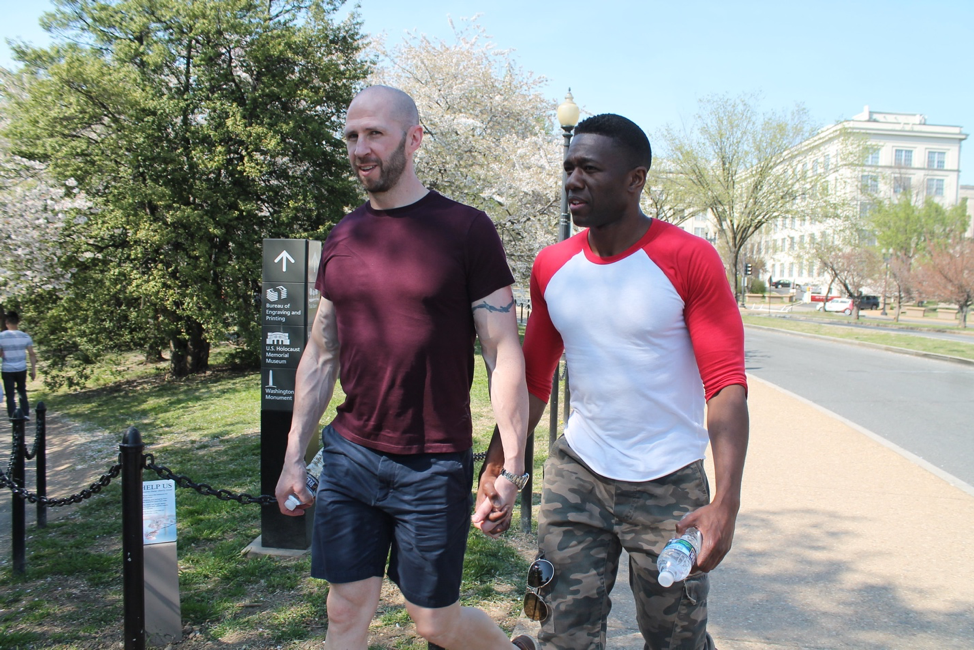
Nonverbal communication can indicate relationship standing. Holding hands, sitting close to another person, or wearing weddings rings can be used to express that you are in an intimate relationship.
Take a few moments today to observe the nonverbal communication of people you see in public areas. What can you determine about their relational standing from their nonverbal communication? For example, romantic partners tend to stand close to one another and touch one another frequently. On the other hand, acquaintances generally maintain greater distances and touch less than romantic partners. Those who hold higher social status often use more space when they interact with others. We make many inferences about relational standing based on the nonverbal communication of those with whom we interact and observe. Imagine seeing a couple talking to each other across a small table. They both have faces that look upset, red eyes from crying, closed body positions, leaning into each other, and are whispering emphatically. Upon seeing this, would you think they were having a “breakup conversation”? It is important to note, however, that nonverbals don’t always mean what we think they mean. Later on, we will cover the ambiguity of nonverbal communication.
We Use Nonverbal Communication To Communicate Emotions
Facial expressions are one way that we express emotion. What emotions do you think this person is trying to convey?
While we can certainly tell people how we feel, we more frequently use nonverbal communication to express our emotions. Conversely, we tend to interpret emotions by examining nonverbal communication. For example, it is probably easy to tell by their nonverbal communication that a friend may be feeling sad. Not only may they be less talkative but their shoulders may be slumped and they may not smile. One study suggests that it is important to use and interpret nonverbal communication for emotional expression as it leads to relational attachment and satisfaction (Schachner, Shaver, & Mikulincer). For example, if you acknowledge that your friend is sad, ask what is wrong, and try to help them this can heighten or increase intimacy. However, if a friend is visibly upset and you choose to ignore them, they may perceive that you don’t care about their feelings and become dissatisfied with the relationship.
We Use Nonverbal Communication To Express Social Status And Power
Nonverbal communication can be used to express social status in a variety of ways. (Verderber, MacGeorge, & Verderber, 2016). Nonverbal communication can be used to express social status in a variety of ways, such as by dressing or speaking a particular way. For example, think of how a high-level manager may convey status to employees. They may choose to wear a formal suit or speak with an authoritative tone. Likewise, employees may also use their nonverbals to show respect to their managers, as by making eye contact and listening to what they have to say. are also associated with power, while others are associated with powerlessness or vulnerability. For example, standing up tall and taking up a lot of space shows dominance, while hunched shoulders, folding your body inward to take up as little space as possible, and touching your neck indicate the opposite. Recent research has even demonstrated that forming expansive “power poses” with our bodies can actually increase emotional feelings of power, which may be helpful to us prior to job interviews and other anxiety-provoking situations (Cuddy, Schultz and Fosse, 2017).