

7.5: Designing your project using theory and paradigm
- Page ID
- 135122

\( \newcommand{\vecs}[1]{\overset { \scriptstyle \rightharpoonup} {\mathbf{#1}} } \)
\( \newcommand{\vecd}[1]{\overset{-\!-\!\rightharpoonup}{\vphantom{a}\smash {#1}}} \)
\( \newcommand{\dsum}{\displaystyle\sum\limits} \)
\( \newcommand{\dint}{\displaystyle\int\limits} \)
\( \newcommand{\dlim}{\displaystyle\lim\limits} \)
\( \newcommand{\id}{\mathrm{id}}\) \( \newcommand{\Span}{\mathrm{span}}\)
( \newcommand{\kernel}{\mathrm{null}\,}\) \( \newcommand{\range}{\mathrm{range}\,}\)
\( \newcommand{\RealPart}{\mathrm{Re}}\) \( \newcommand{\ImaginaryPart}{\mathrm{Im}}\)
\( \newcommand{\Argument}{\mathrm{Arg}}\) \( \newcommand{\norm}[1]{\| #1 \|}\)
\( \newcommand{\inner}[2]{\langle #1, #2 \rangle}\)
\( \newcommand{\Span}{\mathrm{span}}\)
\( \newcommand{\id}{\mathrm{id}}\)
\( \newcommand{\Span}{\mathrm{span}}\)
\( \newcommand{\kernel}{\mathrm{null}\,}\)
\( \newcommand{\range}{\mathrm{range}\,}\)
\( \newcommand{\RealPart}{\mathrm{Re}}\)
\( \newcommand{\ImaginaryPart}{\mathrm{Im}}\)
\( \newcommand{\Argument}{\mathrm{Arg}}\)
\( \newcommand{\norm}[1]{\| #1 \|}\)
\( \newcommand{\inner}[2]{\langle #1, #2 \rangle}\)
\( \newcommand{\Span}{\mathrm{span}}\) \( \newcommand{\AA}{\unicode[.8,0]{x212B}}\)
\( \newcommand{\vectorA}[1]{\vec{#1}} % arrow\)
\( \newcommand{\vectorAt}[1]{\vec{\text{#1}}} % arrow\)
\( \newcommand{\vectorB}[1]{\overset { \scriptstyle \rightharpoonup} {\mathbf{#1}} } \)
\( \newcommand{\vectorC}[1]{\textbf{#1}} \)
\( \newcommand{\vectorD}[1]{\overrightarrow{#1}} \)
\( \newcommand{\vectorDt}[1]{\overrightarrow{\text{#1}}} \)
\( \newcommand{\vectE}[1]{\overset{-\!-\!\rightharpoonup}{\vphantom{a}\smash{\mathbf {#1}}}} \)
\( \newcommand{\vecs}[1]{\overset { \scriptstyle \rightharpoonup} {\mathbf{#1}} } \)
\(\newcommand{\longvect}{\overrightarrow}\)
\( \newcommand{\vecd}[1]{\overset{-\!-\!\rightharpoonup}{\vphantom{a}\smash {#1}}} \)
\(\newcommand{\avec}{\mathbf a}\) \(\newcommand{\bvec}{\mathbf b}\) \(\newcommand{\cvec}{\mathbf c}\) \(\newcommand{\dvec}{\mathbf d}\) \(\newcommand{\dtil}{\widetilde{\mathbf d}}\) \(\newcommand{\evec}{\mathbf e}\) \(\newcommand{\fvec}{\mathbf f}\) \(\newcommand{\nvec}{\mathbf n}\) \(\newcommand{\pvec}{\mathbf p}\) \(\newcommand{\qvec}{\mathbf q}\) \(\newcommand{\svec}{\mathbf s}\) \(\newcommand{\tvec}{\mathbf t}\) \(\newcommand{\uvec}{\mathbf u}\) \(\newcommand{\vvec}{\mathbf v}\) \(\newcommand{\wvec}{\mathbf w}\) \(\newcommand{\xvec}{\mathbf x}\) \(\newcommand{\yvec}{\mathbf y}\) \(\newcommand{\zvec}{\mathbf z}\) \(\newcommand{\rvec}{\mathbf r}\) \(\newcommand{\mvec}{\mathbf m}\) \(\newcommand{\zerovec}{\mathbf 0}\) \(\newcommand{\onevec}{\mathbf 1}\) \(\newcommand{\real}{\mathbb R}\) \(\newcommand{\twovec}[2]{\left[\begin{array}{r}#1 \\ #2 \end{array}\right]}\) \(\newcommand{\ctwovec}[2]{\left[\begin{array}{c}#1 \\ #2 \end{array}\right]}\) \(\newcommand{\threevec}[3]{\left[\begin{array}{r}#1 \\ #2 \\ #3 \end{array}\right]}\) \(\newcommand{\cthreevec}[3]{\left[\begin{array}{c}#1 \\ #2 \\ #3 \end{array}\right]}\) \(\newcommand{\fourvec}[4]{\left[\begin{array}{r}#1 \\ #2 \\ #3 \\ #4 \end{array}\right]}\) \(\newcommand{\cfourvec}[4]{\left[\begin{array}{c}#1 \\ #2 \\ #3 \\ #4 \end{array}\right]}\) \(\newcommand{\fivevec}[5]{\left[\begin{array}{r}#1 \\ #2 \\ #3 \\ #4 \\ #5 \\ \end{array}\right]}\) \(\newcommand{\cfivevec}[5]{\left[\begin{array}{c}#1 \\ #2 \\ #3 \\ #4 \\ #5 \\ \end{array}\right]}\) \(\newcommand{\mattwo}[4]{\left[\begin{array}{rr}#1 \amp #2 \\ #3 \amp #4 \\ \end{array}\right]}\) \(\newcommand{\laspan}[1]{\text{Span}\{#1\}}\) \(\newcommand{\bcal}{\cal B}\) \(\newcommand{\ccal}{\cal C}\) \(\newcommand{\scal}{\cal S}\) \(\newcommand{\wcal}{\cal W}\) \(\newcommand{\ecal}{\cal E}\) \(\newcommand{\coords}[2]{\left\{#1\right\}_{#2}}\) \(\newcommand{\gray}[1]{\color{gray}{#1}}\) \(\newcommand{\lgray}[1]{\color{lightgray}{#1}}\) \(\newcommand{\rank}{\operatorname{rank}}\) \(\newcommand{\row}{\text{Row}}\) \(\newcommand{\col}{\text{Col}}\) \(\renewcommand{\row}{\text{Row}}\) \(\newcommand{\nul}{\text{Nul}}\) \(\newcommand{\var}{\text{Var}}\) \(\newcommand{\corr}{\text{corr}}\) \(\newcommand{\len}[1]{\left|#1\right|}\) \(\newcommand{\bbar}{\overline{\bvec}}\) \(\newcommand{\bhat}{\widehat{\bvec}}\) \(\newcommand{\bperp}{\bvec^\perp}\) \(\newcommand{\xhat}{\widehat{\xvec}}\) \(\newcommand{\vhat}{\widehat{\vvec}}\) \(\newcommand{\uhat}{\widehat{\uvec}}\) \(\newcommand{\what}{\widehat{\wvec}}\) \(\newcommand{\Sighat}{\widehat{\Sigma}}\) \(\newcommand{\lt}{<}\) \(\newcommand{\gt}{>}\) \(\newcommand{\amp}{&}\) \(\definecolor{fillinmathshade}{gray}{0.9}\)Learning Objectives
Learners will be able to…
- Apply the assumptions of each paradigm to your project
- Summarize what aspects of your project stem from positivist, interpretivist, or critical assumptions
In the previous sections, we reviewed the major paradigms and theories in social work research. In this section, we will provide an example of how to apply theory and paradigm in research. This process is depicted in Figure 7.2 below with some quick summary questions for each stage. Some questions in the figure below have example answers like designs (i.e., experimental, survey) and data analysis approaches (i.e., discourse analysis). These examples are arbitrary. There are a lot of options that are not listed. So, don’t feel like you have to memorize them or use them in your study.
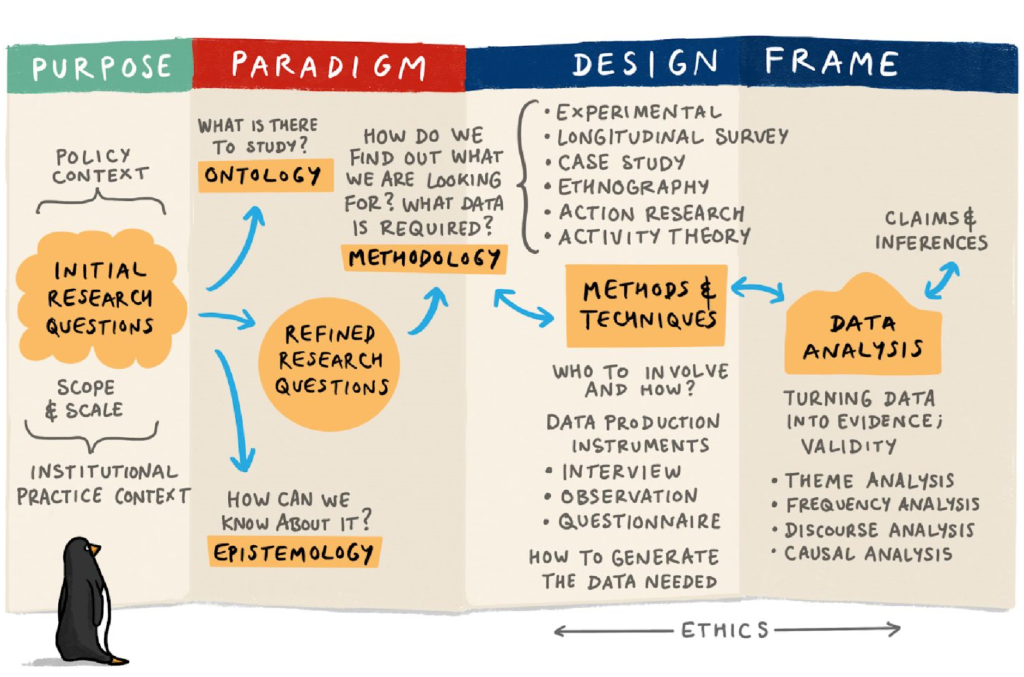
Figure 7.2 The research design process
This diagram (taken from an archived Open University (UK) course entitled E89-Educational Inquiry) shows one way to visualize the research design process. While research is far from linear, in general, this is how research projects progress sequentially. Researchers begin with a working question, and through engaging with the literature, develop and refine those questions into research questions (a process we will finalize in Chapter 9). But in order to get to the part where you gather your sample, measure your participants, and analyze your data, you need to start with paradigm. Based on your work in section 7.3, you should have a sense of which paradigm or paradigms are best suited to answering your question. The approach taken will often reflect the nature of the research question; the kind of data it is possible to collect; and work previously done in the area under consideration. When evaluating paradigm and theory, it is important to look at what other authors have done previously and the framework used by studies that are similar to the one you are thinking of conducting.
Once you situate your project in a research paradigm, it becomes possible to start making concrete choices about methods. Depending on the project, this will involve choices about things like:
- What is my final research question?
- What are the key variables and concepts under investigation, and how will I measure them?
- How do I find a representative sample of people who experience the topic I’m studying?
- What design is most appropriate for my research question?
- How will I collect and analyze data?
- How do I determine whether my results describe real patterns in the world or are the result of bias or error?
The data collection phase can begin once these decisions are made. It can be very tempting to start collecting data as soon as possible in the research process as this gives a sense of progress. However, it is usually worth getting things exactly right before collecting data as an error found in your approach further down the line can be harder to correct or recalibrate around.
Designing a study using paradigm and theory: An example
Paradigm and theory have the potential to turn some people off since there is a lot of abstract terminology and thinking about real-world social work practice contexts. In this section, I’ll use an example from my own research, and I hope it will illustrate a few things. First, it will show that paradigms are really just philosophical statements about things you already understand and think about normally. It will also show that no project neatly sits in one paradigm and that a social work researcher should use whichever paradigm or combination of paradigms suit their question the best. Finally, I hope it is one example of how to be a pragmatist and strategically use the strengths of different theories and paradigms to answering a research question. We will pick up the discussion of mixed methods in the next chapter.
Thinking as an expert: Positivism
In my undergraduate research methods class, I used an open textbook much like this one and wanted to study whether it improved student learning. You can read a copy of the article we wrote on based on our study. We’ll learn more about the specifics of experiments and evaluation research in Chapter 13, but you know enough to understand what evaluating an intervention might look like. My first thought was to conduct an experiment, which placed me firmly within the positivist or “expert” paradigm.
Experiments focus on isolating the relationship between cause and effect. For my study, this meant studying an open textbook (the cause, or intervention) and final grades (the effect, or outcome). Notice that my position as “expert” lets me assume many things in this process. First, it assumes that I can distill the many dimensions of student learning into one number—the final grade. Second, as the “expert,” I’ve determined what the intervention is: indeed, I created the book I was studying, and applied a theory from experts in the field that explains how and why it should impact student learning.
Theory is part of applying all paradigms, but I’ll discuss its impact within positivism first. Theories grounded in positivism help explain why one thing causes another. More specifically, these theories isolate a causal relationship between two (or more) concepts while holding constant the effects of other variables that might confound the relationship between the key variables. That is why experimental design is so common in positivist research. The researcher isolates the environment from anything that might impact or bias the cause and effect relationship they want to investigate.
But in order for one thing to lead to change in something else, there must be some logical, rational reason why it would do so. In open education, there are a few hypotheses (though no full-fledged theories) on why students might perform better using open textbooks. The most common is the access hypothesis, which states that students who cannot afford expensive textbooks or wouldn’t buy them anyway can access open textbooks because they are free, which will improve their grades. It’s important to note that I held this theory prior to starting the experiment, as in positivist research you spell out your hypotheses in advance and design an experiment to support or refute that hypothesis.
Notice that the hypothesis here applies not only to the people in my experiment, but to any student in higher education. Positivism seeks generalizable truth, or what is true for everyone. The results of my study should provide evidence that anyone who uses an open textbook would achieve similar outcomes. Of course, there were a number of limitations as it was difficult to tightly control the study. I could not randomly assign students or prevent them from sharing resources with one another, for example. So, while this study had many positivist elements, it was far from a perfect positivist study because I was forced to adapt to the pragmatic limitations of my research context (e.g., I cannot randomly assign students to classes) that made it difficult to establish an objective, generalizable truth.
Thinking like an empathizer: Interpretivism
One of the things that did not sit right with me about the study was the reliance on final grades to signify everything that was going on with students. I added another quantitative measure that measured research knowledge, but this was still too simplistic. I wanted to understand how students used the book and what they thought about it. I could create survey questions that ask about these things, but to get at the subjective truths here, I thought it best to use focus groups in which students would talk to one another with a researcher moderating the discussion and guiding it using predetermined questions. You will learn more about focus groups in Chapter 18.
Researchers spoke with small groups of students during the last class of the semester. They prompted people to talk about aspects of the textbook they liked and didn’t like, compare it to textbooks from other classes, describe how they used it, and so forth. It was this focus on understanding and subjective experience that brought us into the interpretivist paradigm. Alongside other researchers, I created the focus group questions but encouraged researchers who moderated the focus groups to allow the conversation to flow organically.
We originally started out with the assumption, for which there is support in the literature, that students would be angry with the high-cost textbook that we used prior to the free one, and this cost shock might play a role in students’ negative attitudes about research. But unlike the hypotheses in positivism, these are merely a place to start and are open to revision throughout the research process. This is because the researchers are not the experts, the participants are! Just like your clients are the experts on their lives, so were the students in my study. Our job as researchers was to create a group in which they would reveal their informed thoughts about the issue, coming to consensus around a few key themes.

When we initially analyzed the focus groups, we uncovered themes that seemed to fit the data. But the overall picture was murky. How were themes related to each other? And how could we distill these themes and relationships into something meaningful? We went back to the data again. We could do this because there isn’t one truth, as in positivism, but multiple truths and multiple ways of interpreting the data. When we looked again, we focused on some of the effects of having a textbook customized to the course. It was that customization process that helped make the language more approachable, engaging, and relevant to social work practice.
Ultimately, our data revealed differences in how students perceived a free textbook versus a free textbook that is customized to the class. When we went to interpret this finding, the remix hypothesis of open textbook was helpful in understanding that relationship. It states that the more faculty incorporate editing and creating into the course, the better student learning will be. Our study helped flesh out that theory by discussing the customization process and how students made sense of a customized resource.
In this way, theoretical analysis operates differently in interpretivist research. While positivist research tests existing theories, interpretivist research creates theories based on the stories of research participants. However, it is difficult to say if this theory was totally emergent in the dataset or if my prior knowledge of the remix hypothesis influenced my thinking about the data. Interpretivist researchers are encouraged to put a box around their prior experiences and beliefs, acknowledging them, but trying to approach the data with fresh eyes. Interpretivists know that this is never perfectly possible, though, as we are always influenced by our previous experiences when interpreting data and conducting scientific research projects.
Thinking like an activist: Critical
Although adding focus groups helped ease my concern about reducing student learning down to just final grades by providing a more rich set of conversations to analyze. However, my role as researcher and “expert” was still an important part of the analysis. As someone who has been out of school for a while, and indeed has taught this course for years, I have lost touch with what it is like to be a student taking research methods for the first time. How could I accurately interpret or understand what students were saying? Perhaps I would overlook things that reflected poorly on my teaching or my book. I brought other faculty researchers on board to help me analyze the data, but this still didn’t feel like enough.
By luck, an undergraduate student approached me about wanting to work together on a research project. I asked her if she would like to collaborate on evaluating the textbook with me. Over the next year, she assisted me with conceptualizing the project, creating research questions, as well as conducting and analyzing the focus groups. Not only would she provide an “insider” perspective on coding the data, steeped in her lived experience as a student, but she would serve as a check on my power through the process.
Including people from the group you are measuring as part of your research team is a common component of critical research. Ultimately, critical theorists would find my study to be inadequate in many ways. I still developed the research question, created the intervention, and wrote up the results for publication, which privileges my voice and role as “expert.” Instead, critical theorists would emphasize the role of students (community members) in identifying research questions, choosing the best intervention to used, and so forth. But collaborating with students as part of a research team did address some of the power imbalances in the research process.
Critical research projects also aim to have an impact on the people and systems involved in research. No students or researchers had profound personal realizations as a result of my study, nor did it lessen the impact of oppressive structures in society. I can claim some small victory that my department switched to using my textbook after the study was complete (changing a system), though this was likely the result of factors other than the study (my advocacy for open textbooks).
Social work research is almost always designed to create change for people or systems. To that end, every social work project is at least somewhat critical. However, the additional steps of conducting research with people rather than on people reveal a depth to the critical paradigm. By bringing students on board the research team, study had student perspectives represented in conceptualization, data collection, and analysis. That said, there was much to critique about this study from a critical perspective. I retained a lot of the power in the research process, and students did not have the ability to determine the research question or purpose of the project. For example, students might likely have said that textbook costs and the quality of their research methods textbook were less important than student debt, racism, or other potential issues experienced by students in my class. Instead of a ground-up research process based in community engagement, my research included some important participation by students on project created and led by faculty.
Conceptualization is an iterative process
I hope this conversation was useful in applying paradigms to a research project. While my example discusses education research, the same would apply for social work research about social welfare programs, clinical interventions, or other topics. Paradigm and theory are covered at the beginning of the conceptualization of your project because these assumptions will structure the rest of your project. Each of the research steps that occur after this chapter (e.g., forming a question, choosing a design) rely upon philosophical and theoretical assumptions. As you continue conceptualizing your project over the next few weeks, you may find yourself shifting between paradigms. That is normal, as conceptualization is not a linear process. As you move through the next steps of conceptualizing and designing a project, you’ll find philosophies and theories that best match how you want to study your topic.
Viewing theoretical and empirical arguments through this lens is one of the true gifts of the social work approach to research. The multi-paradigmatic perspective is a hallmark of social work research and one that helps us contribute something unique on research teams and in practice.
Key Takeaways
- Multi-paradigmatic research is a distinguishing hallmark of social work research. Understanding the limitations and strengths of each paradigm will help you justify your research approach and strategically choose elements from one or more paradigms to answer your question.
- Paradigmatic assumptions help you understand the “blind spots” in your research project and how to adjust and address these areas. Keep in mind, it is not necessary to address all of your blind spots, as all projects have limitations.
Exercises
- Sketch out which paradigm applies best to your project. Second, building on your answer to the exercise in section 7.3, identify how the theory you chose and the paradigm in which you find yourself are consistent or are in conflict with one another. For example, if you are using systems theory in a positivist framework, you might talk about how they both rely on a deterministic approach to human behavior with a focus on the status-quo and social order.