

1.4: Power
- Page ID
- 245724

\( \newcommand{\vecs}[1]{\overset { \scriptstyle \rightharpoonup} {\mathbf{#1}} } \)
\( \newcommand{\vecd}[1]{\overset{-\!-\!\rightharpoonup}{\vphantom{a}\smash {#1}}} \)
\( \newcommand{\dsum}{\displaystyle\sum\limits} \)
\( \newcommand{\dint}{\displaystyle\int\limits} \)
\( \newcommand{\dlim}{\displaystyle\lim\limits} \)
\( \newcommand{\id}{\mathrm{id}}\) \( \newcommand{\Span}{\mathrm{span}}\)
( \newcommand{\kernel}{\mathrm{null}\,}\) \( \newcommand{\range}{\mathrm{range}\,}\)
\( \newcommand{\RealPart}{\mathrm{Re}}\) \( \newcommand{\ImaginaryPart}{\mathrm{Im}}\)
\( \newcommand{\Argument}{\mathrm{Arg}}\) \( \newcommand{\norm}[1]{\| #1 \|}\)
\( \newcommand{\inner}[2]{\langle #1, #2 \rangle}\)
\( \newcommand{\Span}{\mathrm{span}}\)
\( \newcommand{\id}{\mathrm{id}}\)
\( \newcommand{\Span}{\mathrm{span}}\)
\( \newcommand{\kernel}{\mathrm{null}\,}\)
\( \newcommand{\range}{\mathrm{range}\,}\)
\( \newcommand{\RealPart}{\mathrm{Re}}\)
\( \newcommand{\ImaginaryPart}{\mathrm{Im}}\)
\( \newcommand{\Argument}{\mathrm{Arg}}\)
\( \newcommand{\norm}[1]{\| #1 \|}\)
\( \newcommand{\inner}[2]{\langle #1, #2 \rangle}\)
\( \newcommand{\Span}{\mathrm{span}}\) \( \newcommand{\AA}{\unicode[.8,0]{x212B}}\)
\( \newcommand{\vectorA}[1]{\vec{#1}} % arrow\)
\( \newcommand{\vectorAt}[1]{\vec{\text{#1}}} % arrow\)
\( \newcommand{\vectorB}[1]{\overset { \scriptstyle \rightharpoonup} {\mathbf{#1}} } \)
\( \newcommand{\vectorC}[1]{\textbf{#1}} \)
\( \newcommand{\vectorD}[1]{\overrightarrow{#1}} \)
\( \newcommand{\vectorDt}[1]{\overrightarrow{\text{#1}}} \)
\( \newcommand{\vectE}[1]{\overset{-\!-\!\rightharpoonup}{\vphantom{a}\smash{\mathbf {#1}}}} \)
\( \newcommand{\vecs}[1]{\overset { \scriptstyle \rightharpoonup} {\mathbf{#1}} } \)
\(\newcommand{\longvect}{\overrightarrow}\)
\( \newcommand{\vecd}[1]{\overset{-\!-\!\rightharpoonup}{\vphantom{a}\smash {#1}}} \)
\(\newcommand{\avec}{\mathbf a}\) \(\newcommand{\bvec}{\mathbf b}\) \(\newcommand{\cvec}{\mathbf c}\) \(\newcommand{\dvec}{\mathbf d}\) \(\newcommand{\dtil}{\widetilde{\mathbf d}}\) \(\newcommand{\evec}{\mathbf e}\) \(\newcommand{\fvec}{\mathbf f}\) \(\newcommand{\nvec}{\mathbf n}\) \(\newcommand{\pvec}{\mathbf p}\) \(\newcommand{\qvec}{\mathbf q}\) \(\newcommand{\svec}{\mathbf s}\) \(\newcommand{\tvec}{\mathbf t}\) \(\newcommand{\uvec}{\mathbf u}\) \(\newcommand{\vvec}{\mathbf v}\) \(\newcommand{\wvec}{\mathbf w}\) \(\newcommand{\xvec}{\mathbf x}\) \(\newcommand{\yvec}{\mathbf y}\) \(\newcommand{\zvec}{\mathbf z}\) \(\newcommand{\rvec}{\mathbf r}\) \(\newcommand{\mvec}{\mathbf m}\) \(\newcommand{\zerovec}{\mathbf 0}\) \(\newcommand{\onevec}{\mathbf 1}\) \(\newcommand{\real}{\mathbb R}\) \(\newcommand{\twovec}[2]{\left[\begin{array}{r}#1 \\ #2 \end{array}\right]}\) \(\newcommand{\ctwovec}[2]{\left[\begin{array}{c}#1 \\ #2 \end{array}\right]}\) \(\newcommand{\threevec}[3]{\left[\begin{array}{r}#1 \\ #2 \\ #3 \end{array}\right]}\) \(\newcommand{\cthreevec}[3]{\left[\begin{array}{c}#1 \\ #2 \\ #3 \end{array}\right]}\) \(\newcommand{\fourvec}[4]{\left[\begin{array}{r}#1 \\ #2 \\ #3 \\ #4 \end{array}\right]}\) \(\newcommand{\cfourvec}[4]{\left[\begin{array}{c}#1 \\ #2 \\ #3 \\ #4 \end{array}\right]}\) \(\newcommand{\fivevec}[5]{\left[\begin{array}{r}#1 \\ #2 \\ #3 \\ #4 \\ #5 \\ \end{array}\right]}\) \(\newcommand{\cfivevec}[5]{\left[\begin{array}{c}#1 \\ #2 \\ #3 \\ #4 \\ #5 \\ \end{array}\right]}\) \(\newcommand{\mattwo}[4]{\left[\begin{array}{rr}#1 \amp #2 \\ #3 \amp #4 \\ \end{array}\right]}\) \(\newcommand{\laspan}[1]{\text{Span}\{#1\}}\) \(\newcommand{\bcal}{\cal B}\) \(\newcommand{\ccal}{\cal C}\) \(\newcommand{\scal}{\cal S}\) \(\newcommand{\wcal}{\cal W}\) \(\newcommand{\ecal}{\cal E}\) \(\newcommand{\coords}[2]{\left\{#1\right\}_{#2}}\) \(\newcommand{\gray}[1]{\color{gray}{#1}}\) \(\newcommand{\lgray}[1]{\color{lightgray}{#1}}\) \(\newcommand{\rank}{\operatorname{rank}}\) \(\newcommand{\row}{\text{Row}}\) \(\newcommand{\col}{\text{Col}}\) \(\renewcommand{\row}{\text{Row}}\) \(\newcommand{\nul}{\text{Nul}}\) \(\newcommand{\var}{\text{Var}}\) \(\newcommand{\corr}{\text{corr}}\) \(\newcommand{\len}[1]{\left|#1\right|}\) \(\newcommand{\bbar}{\overline{\bvec}}\) \(\newcommand{\bhat}{\widehat{\bvec}}\) \(\newcommand{\bperp}{\bvec^\perp}\) \(\newcommand{\xhat}{\widehat{\xvec}}\) \(\newcommand{\vhat}{\widehat{\vvec}}\) \(\newcommand{\uhat}{\widehat{\uvec}}\) \(\newcommand{\what}{\widehat{\wvec}}\) \(\newcommand{\Sighat}{\widehat{\Sigma}}\) \(\newcommand{\lt}{<}\) \(\newcommand{\gt}{>}\) \(\newcommand{\amp}{&}\) \(\definecolor{fillinmathshade}{gray}{0.9}\)Power in Organizing
One of the most important concepts in community organizing is power. That is because so many of our problems are caused by imbalances of power, and the goal of community organizing is to challenge those imbalances.

Figure \(\PageIndex{1}\): Demonstrates how organized thought and action by a community hold enormous transformative power. (CC by 4.0; Xen Lapshin)
Many people have a negative view of power, and they see it as domination. If you see power that way, then you aren't likely to try to build power. But the main way that communities get their needs met is by building power intentionally and deliberately through organizing.
According to Martin Luther King Jr, power is “the ability to achieve purpose.” According to King’s definition, power is neither good nor bad. It is our ability to achieve purpose, and it is these purposes that can be judged as better or worse for our communities.
Forms of Power
According to many community organizers, there are three main forms of power: power over, power for, and power with. Understanding the differences between these forms of power can help us in our work to challenge unjust forms of power, use our power to help people, and build community power for deep social transformation.
These three forms of power are:
- Power over: (bosses, parents, police)
- Power is most commonly understood as a form of authority, control, or domination. Power over others can be exercised in many ways. The most obvious is brute domination, where a person or institution controls or constrains what another is able to do. But power can also be exercised by influencing what others think they can do or even imagine as possible. It extends beyond physical or verbal domination to affect the ways in which people view themselves, their rights, and capabilities.
- Power with: (friends, unions, grassroots organizations)
- This describes collective action or agency and includes both the psychological and political power that comes from being united. ‘Power with’ is often used to describe how those faced with overt or covert domination can act to address their situation: from joining together with others, through building shared understandings, to planning and taking collective action.
- Power for: (advocates, social workers, teachers)
- When you use your ability to achieve purpose to do something helpful to someone else, you are exercising power for.
Reading Response Question
Please reflect on this reading by writing a short response to this question. Your answer can include personal experience, and the writing does not need to be formal or polished. You are welcome to write as little as a sentence and as much as a paragraph. Think of it like journaling.
- Give an example of a time when you have experienced each form of power (power over, power with, and power for) and share what you think about that form of power.
Quotes on Power
Below are some quotes from successful organizers to help you reflect on the nature of power. They are from the civil rights organizer Martin Luther King Jr.; the formerly enslaved organizer against slavery, Frederick Douglass; and the contemporary organizer Alicia Garza. Garza was made famous for coming up with the slogan "Black Lives Matter."
Martin Luther King Jr.
Martin Luther King Jr. (1929 –1968) was an American Baptist minister, civil rights activist, and political philosopher who was a leader of the civil rights movement from 1955 until his assassination in 1968. He advanced civil rights for people of color in the United States through the use of nonviolent resistance and civil disobedience against Jim Crow laws and other forms of legalized discrimination.
A Black church leader, King participated in and led marches for the right to vote, desegregation, labor rights, and other civil rights. He oversaw the 1955 Montgomery bus boycott and became the first president of the Southern Christian Leadership Conference (SCLC). King was one of the leaders of the 1963 March on Washington, where he delivered his "I Have a Dream" speech on the steps of the Lincoln Memorial, and helped organize two of the three Selma to Montgomery marches during the 1965 Selma voting rights movement. The civil rights movement achieved pivotal legislative gains in the Civil Rights Act of 1964, the Voting Rights Act of 1965, and the Fair Housing Act of 1968.
In 1968, King was planning a national occupation of Washington, D.C., to be called the Poor People's Campaign, when he was assassinated on April 4 in Memphis, Tennessee.

This quote is from his Book Where Do We Go From Here: Chaos to Community (1968).
"Power, properly understood, is the ability to achieve purpose. It is the strength required to bring about social, political, or economic changes. In this sense power is not only desirable but necessary in order to implement the demands of love and justice. One of the greatest problems of history is that the concepts of love and power are usually contrasted as polar opposites. Love is identified with a resignation of power and power with a denial of love. What is needed is a realization that power without love is reckless and abusive and that love without power is sentimental and anemic. Power at its best is love implementing the demands of justice. Justice at its best is power correcting everything that stands against love."
Frederick Douglass
Frederick Douglass (1818- 1895) was an American social reformer, abolitionist, orator, writer, and statesman. He was the most important leader of the movement for African-American civil rights in the 19th century.
After escaping from slavery in Maryland in 1838, Douglass became a national leader of the abolitionist movement in Massachusetts and New York and gained fame for his oratory and incisive antislavery writings. Accordingly, he was described by abolitionists in his time as a living counterexample to claims by supporters of slavery that enslaved people lacked the intellectual capacity to function as independent American citizens. Northerners at the time found it hard to believe that such a great orator had once been enslaved. It was in response to this disbelief that Douglass wrote his first autobiography. Douglass wrote three autobiographies describing his experiences as an enslaved person. Douglass also actively supported women's suffrage, and he held several public offices.
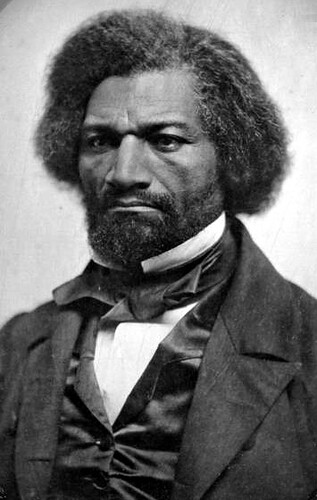
This is one of the most famous quotes from Douglass' speech in Canandaigua, New York, August 3 1857, which has been preserved in The Frederick Douglass Papers archive:
"Let me give you a word of the philosophy of reform. The whole history of the progress of human liberty shows that all concessions yet made to her august claims, have been born of earnest struggle. The conflict has been exciting, agitating, all-absorbing, and for the time being, putting all other tumults to silence. It must do this or it does nothing. If there is no struggle there is no progress. Those who profess to favor freedom and yet depreciate agitation, are men who want crops without plowing up the ground, they want rain without thunder and lightning. They want the ocean without the awful roar of its many waters.
This struggle may be a moral one, or it may be a physical one, and it may be both moral and physical, but it must be a struggle. Power concedes nothing without a demand. It never did and it never will. Find out just what any people will quietly submit to and you have found out the exact measure of injustice and wrong which will be imposed upon them, and these will continue till they are resisted with either words or blows, or with both. The limits of tyrants are prescribed by the endurance of those whom they oppress. In the light of these ideas, Negroes will be hunted at the North, and held and flogged at the South so long as they submit to those devilish outrages, and make no resistance, either moral or physical. Men may not get all they pay for in this world; but they must certainly pay for all they get. If we ever get free from the oppressions and wrongs heaped upon us, we must pay for their removal. We must do this by labor, by suffering, by sacrifice, and if needs be, by our lives and the lives of others."
Alicia Garza
Alicia Garza (1981- ) is an American civil rights activist and writer known for co-founding the Black Lives Matter movement. She is a recognized advocate for social and racial justice, with a particular focus on issues affecting marginalized communities, including Black women, LGBTQ+ people, and immigrants. Garza is also a writer and public speaker. She has written extensively on issues related to race, gender, and social justice, and her work has appeared in numerous publications. Her editorial writing has been published by Time, Mic, Marie Claire, Elle, Essence, The Guardian, The Nation, The Feminist Wire, Rolling Stone, HuffPost, and Truthout.
Garza has worked with organizations such as the National Domestic Workers Alliance and the Black Futures Lab, which focuses on building political power for Black communities. She has also engaged in community organizing efforts and initiatives aimed at creating systemic change and challenging inequality.

This quote is from Garza's book The Purpose of Power (2020).
"Today I am obsessed with power- Black power to be specific. I believe that Black communities have the potential to unlock a new democracy, a new civil society, and a new economy in the United States. I believe that Black communities have the power not just to save the country but to lead the country. I used to be a cynic. As I was developing my worldview, developing my ideas, working in communities, I used to believe that there was no saving America, and I had no desire to lead America.
Over the last decade, that cynicism has transformed into a profound hope. It is not the kind of hope that merely believes that there is something better out there somewhere like the great land of Oz. It is a hope that is clear-eyed, a hope that propels me. It is the hope that organizers carry, and hope that understands that what we are up against is mighty and that what we are up against will not go away quietly into the night just because we will it so. No, it is a hope that knows that we have no other choice but to fight, to try to unlock the potential of real change.
I know there is hope because I have helped to unlock a potential that I did not really think was possible, even as I pushed for it the potential for other Black people to see that we are worthy beyond measure and to allow that hope, that merciless hope, to push us forward. I have seen what can happen when we crack the code that allows others to believe that they are exactly who we need in order to bring about change in this country. We can transform power so that it is no longer producing misery around the world."
Reading Response Questions
Please reflect on this reading by writing a short response to these questions. Your answer can include personal experience, and the writing does not need to be formal or polished. You are welcome to write as little as a sentence and as much as a paragraph. Think of it like journaling.
- Read each of the quotes on power and write a paragraph on your thoughts about each quote.
References
Luther Kind Jr, Martin. Where do We Go From Here: Chaos to Community. Beacon Press, 1967.
Douglass, Frederick. From the speech on West India Emancipation, Canadaigua, New York. 1857.
Garza, Alicia. The Purpose of Power: How We Come Together When We Fall Apart. One World, 2020.