

2.1: Dialogical Performance
- Page ID
- 271462
\( \newcommand{\vecs}[1]{\overset { \scriptstyle \rightharpoonup} {\mathbf{#1}} } \)
\( \newcommand{\vecd}[1]{\overset{-\!-\!\rightharpoonup}{\vphantom{a}\smash {#1}}} \)
\( \newcommand{\dsum}{\displaystyle\sum\limits} \)
\( \newcommand{\dint}{\displaystyle\int\limits} \)
\( \newcommand{\dlim}{\displaystyle\lim\limits} \)
\( \newcommand{\id}{\mathrm{id}}\) \( \newcommand{\Span}{\mathrm{span}}\)
( \newcommand{\kernel}{\mathrm{null}\,}\) \( \newcommand{\range}{\mathrm{range}\,}\)
\( \newcommand{\RealPart}{\mathrm{Re}}\) \( \newcommand{\ImaginaryPart}{\mathrm{Im}}\)
\( \newcommand{\Argument}{\mathrm{Arg}}\) \( \newcommand{\norm}[1]{\| #1 \|}\)
\( \newcommand{\inner}[2]{\langle #1, #2 \rangle}\)
\( \newcommand{\Span}{\mathrm{span}}\)
\( \newcommand{\id}{\mathrm{id}}\)
\( \newcommand{\Span}{\mathrm{span}}\)
\( \newcommand{\kernel}{\mathrm{null}\,}\)
\( \newcommand{\range}{\mathrm{range}\,}\)
\( \newcommand{\RealPart}{\mathrm{Re}}\)
\( \newcommand{\ImaginaryPart}{\mathrm{Im}}\)
\( \newcommand{\Argument}{\mathrm{Arg}}\)
\( \newcommand{\norm}[1]{\| #1 \|}\)
\( \newcommand{\inner}[2]{\langle #1, #2 \rangle}\)
\( \newcommand{\Span}{\mathrm{span}}\) \( \newcommand{\AA}{\unicode[.8,0]{x212B}}\)
\( \newcommand{\vectorA}[1]{\vec{#1}} % arrow\)
\( \newcommand{\vectorAt}[1]{\vec{\text{#1}}} % arrow\)
\( \newcommand{\vectorB}[1]{\overset { \scriptstyle \rightharpoonup} {\mathbf{#1}} } \)
\( \newcommand{\vectorC}[1]{\textbf{#1}} \)
\( \newcommand{\vectorD}[1]{\overrightarrow{#1}} \)
\( \newcommand{\vectorDt}[1]{\overrightarrow{\text{#1}}} \)
\( \newcommand{\vectE}[1]{\overset{-\!-\!\rightharpoonup}{\vphantom{a}\smash{\mathbf {#1}}}} \)
\( \newcommand{\vecs}[1]{\overset { \scriptstyle \rightharpoonup} {\mathbf{#1}} } \)
\(\newcommand{\longvect}{\overrightarrow}\)
\( \newcommand{\vecd}[1]{\overset{-\!-\!\rightharpoonup}{\vphantom{a}\smash {#1}}} \)
\(\newcommand{\avec}{\mathbf a}\) \(\newcommand{\bvec}{\mathbf b}\) \(\newcommand{\cvec}{\mathbf c}\) \(\newcommand{\dvec}{\mathbf d}\) \(\newcommand{\dtil}{\widetilde{\mathbf d}}\) \(\newcommand{\evec}{\mathbf e}\) \(\newcommand{\fvec}{\mathbf f}\) \(\newcommand{\nvec}{\mathbf n}\) \(\newcommand{\pvec}{\mathbf p}\) \(\newcommand{\qvec}{\mathbf q}\) \(\newcommand{\svec}{\mathbf s}\) \(\newcommand{\tvec}{\mathbf t}\) \(\newcommand{\uvec}{\mathbf u}\) \(\newcommand{\vvec}{\mathbf v}\) \(\newcommand{\wvec}{\mathbf w}\) \(\newcommand{\xvec}{\mathbf x}\) \(\newcommand{\yvec}{\mathbf y}\) \(\newcommand{\zvec}{\mathbf z}\) \(\newcommand{\rvec}{\mathbf r}\) \(\newcommand{\mvec}{\mathbf m}\) \(\newcommand{\zerovec}{\mathbf 0}\) \(\newcommand{\onevec}{\mathbf 1}\) \(\newcommand{\real}{\mathbb R}\) \(\newcommand{\twovec}[2]{\left[\begin{array}{r}#1 \\ #2 \end{array}\right]}\) \(\newcommand{\ctwovec}[2]{\left[\begin{array}{c}#1 \\ #2 \end{array}\right]}\) \(\newcommand{\threevec}[3]{\left[\begin{array}{r}#1 \\ #2 \\ #3 \end{array}\right]}\) \(\newcommand{\cthreevec}[3]{\left[\begin{array}{c}#1 \\ #2 \\ #3 \end{array}\right]}\) \(\newcommand{\fourvec}[4]{\left[\begin{array}{r}#1 \\ #2 \\ #3 \\ #4 \end{array}\right]}\) \(\newcommand{\cfourvec}[4]{\left[\begin{array}{c}#1 \\ #2 \\ #3 \\ #4 \end{array}\right]}\) \(\newcommand{\fivevec}[5]{\left[\begin{array}{r}#1 \\ #2 \\ #3 \\ #4 \\ #5 \\ \end{array}\right]}\) \(\newcommand{\cfivevec}[5]{\left[\begin{array}{c}#1 \\ #2 \\ #3 \\ #4 \\ #5 \\ \end{array}\right]}\) \(\newcommand{\mattwo}[4]{\left[\begin{array}{rr}#1 \amp #2 \\ #3 \amp #4 \\ \end{array}\right]}\) \(\newcommand{\laspan}[1]{\text{Span}\{#1\}}\) \(\newcommand{\bcal}{\cal B}\) \(\newcommand{\ccal}{\cal C}\) \(\newcommand{\scal}{\cal S}\) \(\newcommand{\wcal}{\cal W}\) \(\newcommand{\ecal}{\cal E}\) \(\newcommand{\coords}[2]{\left\{#1\right\}_{#2}}\) \(\newcommand{\gray}[1]{\color{gray}{#1}}\) \(\newcommand{\lgray}[1]{\color{lightgray}{#1}}\) \(\newcommand{\rank}{\operatorname{rank}}\) \(\newcommand{\row}{\text{Row}}\) \(\newcommand{\col}{\text{Col}}\) \(\renewcommand{\row}{\text{Row}}\) \(\newcommand{\nul}{\text{Nul}}\) \(\newcommand{\var}{\text{Var}}\) \(\newcommand{\corr}{\text{corr}}\) \(\newcommand{\len}[1]{\left|#1\right|}\) \(\newcommand{\bbar}{\overline{\bvec}}\) \(\newcommand{\bhat}{\widehat{\bvec}}\) \(\newcommand{\bperp}{\bvec^\perp}\) \(\newcommand{\xhat}{\widehat{\xvec}}\) \(\newcommand{\vhat}{\widehat{\vvec}}\) \(\newcommand{\uhat}{\widehat{\uvec}}\) \(\newcommand{\what}{\widehat{\wvec}}\) \(\newcommand{\Sighat}{\widehat{\Sigma}}\) \(\newcommand{\lt}{<}\) \(\newcommand{\gt}{>}\) \(\newcommand{\amp}{&}\) \(\definecolor{fillinmathshade}{gray}{0.9}\)Overview
This chapter introduces the ethical challenges performers face when engaging with cultures different from their own. It emphasizes the importance of creating performances that foster respectful dialogue rather than misrepresentation or appropriation. Using Dwight Conquergood’s (1985) framework, the chapter outlines four common ethical pitfalls and presents dialogical performance as a guiding approach for navigating cross-cultural storytelling with care, responsibility, and openness.
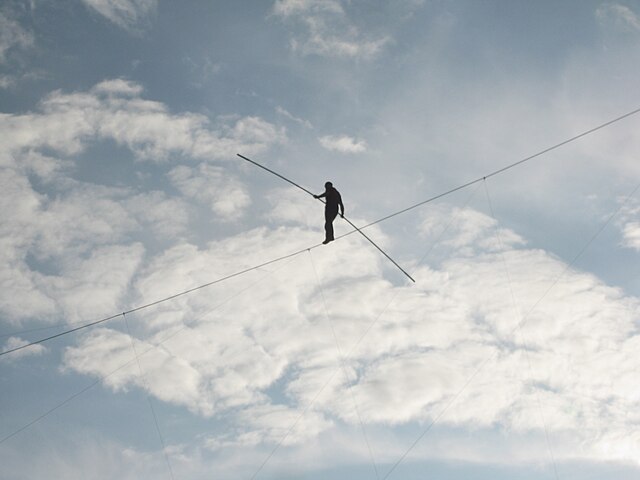 Figure \(\PageIndex{1}\): It is difficult to find balance while practicing dialogical performance. (CC BY 2.0; kevint3141 - Wonderland Walker 2)
 - Recognize the ethical responsibilities involved in performing stories from cultures other than your own, including the risks of misrepresentation, appropriation, and objectification.
- Explore Dwight Conquergood's framework of ethical performance, including the concept of Dialogical Performance and the four common pitfalls: The Custodian’s Rip-Off, The Enthusiast’s Infatuation, The Curator’s Exhibitionism, and The Skeptic’s Cop-Out.
Ethics of Performance
As discussed in the previous chapter, various cultures all over the world have engaged in oral interpretation performances throughout history. As you begin creating your own performances, especially those that draw from cultures different from your own, it’s essential to consider the ethical responsibilities that come with that creative process. Even with the best intentions, performers can unintentionally misrepresent, objectify, or appropriate elements of another culture. Understandably, this can lead to hesitation or fear. These feelings are rooted in compassion and a desire to do no harm.
However, while this apprehension is valid, it can also be limiting. Avoiding cross-cultural performance altogether may feel like the safest option, but doing so can shut down opportunities for meaningful connection, shared understanding, and artistic growth. Rather than retreating from the challenge, performers must instead commit to learning how to engage ethically by using performance as a space for dialogue rather than dominance. Through thoughtful, responsible practices, artists can create performances that not only respect cultural boundaries but also foster mutual understanding and collaboration.
To navigate these complexities, we turn to Dwight Conquergood’s (1985) influential framework from Performing as a Moral Act: Ethical Dimensions of the Ethnography of Performance. In his work, Conquergood argues for a model of Dialogical Performance, a mode of performance that brings together diverse voices, worldviews, and belief systems in an open, ongoing exchange. He writes, “This performative stance struggles to bring together different voices, world views, value systems, and beliefs so that they can have a conversation with one another… It is the kind of performance that resists conclusions, it is intensely committed to keeping the dialogue between performer and text open and ongoing” (p. 9).
To help performers recognize and avoid ethical missteps, Conquergood outlines four common pitfalls people may encounter while performing cultures that are not their own: The Custodian’s Rip-Off, The Enthusiast’s Infatuation, The Curator’s Exhibitionism, and The Skeptic’s Cop-Out. Each represents a different way that ethical intentions can go awry, often despite a performer’s best efforts. In the sections that follow, we will examine what they look like in practice, why they’re problematic, and how performers can move toward more ethical, dialogical approaches.
After you critically engage with these concepts, you will be better equipped to create performances that honor the complexity of others’ experiences while fostering deeper, more respectful intercultural dialogue.
Activity 1: Reflective Writing Prompt — Navigating Ethical Hesitation
Objective: To reflect on personal feelings around performing material from other cultures.
Instructions:
In a one-page journal entry, respond to the following prompts:
-
If you were to include a story, character, or element from a different culture in your creative work, what fears or ethical concerns come up for you?
-
How might you move from fear to curiosity, and from hesitation to ethical engagement?