

5.3: Introduction to Family and Family Relationships
- Last updated
- Save as PDF
- Page ID
- 271079
This page is a draft and is under active development.

\( \newcommand{\vecs}[1]{\overset { \scriptstyle \rightharpoonup} {\mathbf{#1}} } \)
\( \newcommand{\vecd}[1]{\overset{-\!-\!\rightharpoonup}{\vphantom{a}\smash {#1}}} \)
\( \newcommand{\dsum}{\displaystyle\sum\limits} \)
\( \newcommand{\dint}{\displaystyle\int\limits} \)
\( \newcommand{\dlim}{\displaystyle\lim\limits} \)
\( \newcommand{\id}{\mathrm{id}}\) \( \newcommand{\Span}{\mathrm{span}}\)
( \newcommand{\kernel}{\mathrm{null}\,}\) \( \newcommand{\range}{\mathrm{range}\,}\)
\( \newcommand{\RealPart}{\mathrm{Re}}\) \( \newcommand{\ImaginaryPart}{\mathrm{Im}}\)
\( \newcommand{\Argument}{\mathrm{Arg}}\) \( \newcommand{\norm}[1]{\| #1 \|}\)
\( \newcommand{\inner}[2]{\langle #1, #2 \rangle}\)
\( \newcommand{\Span}{\mathrm{span}}\)
\( \newcommand{\id}{\mathrm{id}}\)
\( \newcommand{\Span}{\mathrm{span}}\)
\( \newcommand{\kernel}{\mathrm{null}\,}\)
\( \newcommand{\range}{\mathrm{range}\,}\)
\( \newcommand{\RealPart}{\mathrm{Re}}\)
\( \newcommand{\ImaginaryPart}{\mathrm{Im}}\)
\( \newcommand{\Argument}{\mathrm{Arg}}\)
\( \newcommand{\norm}[1]{\| #1 \|}\)
\( \newcommand{\inner}[2]{\langle #1, #2 \rangle}\)
\( \newcommand{\Span}{\mathrm{span}}\) \( \newcommand{\AA}{\unicode[.8,0]{x212B}}\)
\( \newcommand{\vectorA}[1]{\vec{#1}} % arrow\)
\( \newcommand{\vectorAt}[1]{\vec{\text{#1}}} % arrow\)
\( \newcommand{\vectorB}[1]{\overset { \scriptstyle \rightharpoonup} {\mathbf{#1}} } \)
\( \newcommand{\vectorC}[1]{\textbf{#1}} \)
\( \newcommand{\vectorD}[1]{\overrightarrow{#1}} \)
\( \newcommand{\vectorDt}[1]{\overrightarrow{\text{#1}}} \)
\( \newcommand{\vectE}[1]{\overset{-\!-\!\rightharpoonup}{\vphantom{a}\smash{\mathbf {#1}}}} \)
\( \newcommand{\vecs}[1]{\overset { \scriptstyle \rightharpoonup} {\mathbf{#1}} } \)
\(\newcommand{\longvect}{\overrightarrow}\)
\( \newcommand{\vecd}[1]{\overset{-\!-\!\rightharpoonup}{\vphantom{a}\smash {#1}}} \)
\(\newcommand{\avec}{\mathbf a}\) \(\newcommand{\bvec}{\mathbf b}\) \(\newcommand{\cvec}{\mathbf c}\) \(\newcommand{\dvec}{\mathbf d}\) \(\newcommand{\dtil}{\widetilde{\mathbf d}}\) \(\newcommand{\evec}{\mathbf e}\) \(\newcommand{\fvec}{\mathbf f}\) \(\newcommand{\nvec}{\mathbf n}\) \(\newcommand{\pvec}{\mathbf p}\) \(\newcommand{\qvec}{\mathbf q}\) \(\newcommand{\svec}{\mathbf s}\) \(\newcommand{\tvec}{\mathbf t}\) \(\newcommand{\uvec}{\mathbf u}\) \(\newcommand{\vvec}{\mathbf v}\) \(\newcommand{\wvec}{\mathbf w}\) \(\newcommand{\xvec}{\mathbf x}\) \(\newcommand{\yvec}{\mathbf y}\) \(\newcommand{\zvec}{\mathbf z}\) \(\newcommand{\rvec}{\mathbf r}\) \(\newcommand{\mvec}{\mathbf m}\) \(\newcommand{\zerovec}{\mathbf 0}\) \(\newcommand{\onevec}{\mathbf 1}\) \(\newcommand{\real}{\mathbb R}\) \(\newcommand{\twovec}[2]{\left[\begin{array}{r}#1 \\ #2 \end{array}\right]}\) \(\newcommand{\ctwovec}[2]{\left[\begin{array}{c}#1 \\ #2 \end{array}\right]}\) \(\newcommand{\threevec}[3]{\left[\begin{array}{r}#1 \\ #2 \\ #3 \end{array}\right]}\) \(\newcommand{\cthreevec}[3]{\left[\begin{array}{c}#1 \\ #2 \\ #3 \end{array}\right]}\) \(\newcommand{\fourvec}[4]{\left[\begin{array}{r}#1 \\ #2 \\ #3 \\ #4 \end{array}\right]}\) \(\newcommand{\cfourvec}[4]{\left[\begin{array}{c}#1 \\ #2 \\ #3 \\ #4 \end{array}\right]}\) \(\newcommand{\fivevec}[5]{\left[\begin{array}{r}#1 \\ #2 \\ #3 \\ #4 \\ #5 \\ \end{array}\right]}\) \(\newcommand{\cfivevec}[5]{\left[\begin{array}{c}#1 \\ #2 \\ #3 \\ #4 \\ #5 \\ \end{array}\right]}\) \(\newcommand{\mattwo}[4]{\left[\begin{array}{rr}#1 \amp #2 \\ #3 \amp #4 \\ \end{array}\right]}\) \(\newcommand{\laspan}[1]{\text{Span}\{#1\}}\) \(\newcommand{\bcal}{\cal B}\) \(\newcommand{\ccal}{\cal C}\) \(\newcommand{\scal}{\cal S}\) \(\newcommand{\wcal}{\cal W}\) \(\newcommand{\ecal}{\cal E}\) \(\newcommand{\coords}[2]{\left\{#1\right\}_{#2}}\) \(\newcommand{\gray}[1]{\color{gray}{#1}}\) \(\newcommand{\lgray}[1]{\color{lightgray}{#1}}\) \(\newcommand{\rank}{\operatorname{rank}}\) \(\newcommand{\row}{\text{Row}}\) \(\newcommand{\col}{\text{Col}}\) \(\renewcommand{\row}{\text{Row}}\) \(\newcommand{\nul}{\text{Nul}}\) \(\newcommand{\var}{\text{Var}}\) \(\newcommand{\corr}{\text{corr}}\) \(\newcommand{\len}[1]{\left|#1\right|}\) \(\newcommand{\bbar}{\overline{\bvec}}\) \(\newcommand{\bhat}{\widehat{\bvec}}\) \(\newcommand{\bperp}{\bvec^\perp}\) \(\newcommand{\xhat}{\widehat{\xvec}}\) \(\newcommand{\vhat}{\widehat{\vvec}}\) \(\newcommand{\uhat}{\widehat{\uvec}}\) \(\newcommand{\what}{\widehat{\wvec}}\) \(\newcommand{\Sighat}{\widehat{\Sigma}}\) \(\newcommand{\lt}{<}\) \(\newcommand{\gt}{>}\) \(\newcommand{\amp}{&}\) \(\definecolor{fillinmathshade}{gray}{0.9}\)Learning Objectives
By the end of this section, you will be able to:
- Identify the major contexts for social and emotional development in infancy and toddlerhood
- Describe cultural and familial variations in the major contexts for social and emotional development
Family and Community as Context
The word “family” might bring to mind a specific type of family, perhaps one that mirrors your own family of origin, your chosen family, or the type of family you have or want to have one day. However, families can be very wide ranging and diverse, and both new and growing families also face new challenges when an infant enters the picture. In this section, you’ll explore family structures, home environments, and the variety of contexts in which families interact.
Family Structure
A family is a group of at least two people who work together as a unit, share financial resources, and are related either by blood or by legal contract such as for adoption or marriage. Families come in many constellations and can include groups or pairs of related adults without children. Families with children can include parents who are single, married, a common-law or long-term couple, separated, divorced, or widowed. Family members can also include stepparents, adoptive parents, and foster parents, along with other caregivers such as grandparents, uncles, aunts, older cousins, and siblings.
One family type is the nuclear family, in which children live with two parental figures. A single-parent family consists of a child or children and only one parental figure. Another common type is the blended family, in which at least one parent has remarried, and stepparents and stepsiblings may be present (Ginther & Pollak, 2004). Sometimes children in blended families live part of the time in a second household with another parent, and this splitting of time between households yields a commuter family. Finally, an intergenerational family is a household that includes parents, uncles, aunts, and grandparents, all working together as one financial unit (Li & Huang, 2017).
Families can contain parents of any gender, sex, and sexual orientation. Gay, lesbian, and queer families can be nuclear, blended, intergenerational, or any other type. Families may be single parent or dual parent, with one or multiple caregivers serving as the primary caregiver. Research indicates that high-quality parent-child relationships and overall well-being are present in a variety of family constellations (Farr et al., 2020; Tornello & Patterson, 2018). In the United States, around 2.6 million LGBTQ+ adults are parents (Wilson & Bouton, 2024).4 LGBTQ+ parents may also face unique stressors, particularly with discriminatory treatment or barriers to becoming parents, such as adoption policies and cultural attitudes (Patterson, 2024).
LGBTQ+ parents and heterosexual parents experience similar levels of parenting satisfaction, parenting quality, and child development outcomes (Patterson, 2022).5 Heterosexual couples may also face unique stressors including uneven and inequitable workloads and childcare responsibilities, particularly in dual-earner homes. Though paternal involvement has increased over the last several decades, research indicates there is a lack of balance in home and childcare labor, with mothers often doing a larger share of both roles (DeGroot & Vik, 2020; Sayer, 2016). Working mothers in particular face risks related to role strain, feeling the stress of competing and overwhelming life demands, which can decrease self-care and emotional well-being over time (Dugan & Barnes-Farrell, 2020). This inequality may have increased during the era known as “pandemic parenting” (Calarco et al., 2021). However, when fathers and mothers balance the caregiving and household roles in two-parent heterosexual families, it predicts greater emotional well-being in children and in parents as well as improved parent-child relationship quality (Chung, 2021).
Some families may face unique risks, for example, when adopted children have experienced early adversity or lived in an institutionalized setting. Research shows that when adoptive parents provide warm, sensitive parenting, adoptive children are better able to improve in their attachment and have a lower risk in long-term behavior problems (Yarger et al., 2020; Paine et al., 2021; Yarger et al., 2019). Foster parents and facilities can use these same strategies to improve child developmental outcomes (Chodura et al., 2021; Wade et al., 2024). Children can thrive and experience healthy development in any of these (Figure 4.16). Overall, they benefit more from stability and consistent caregiving and support than from a particular type of family structure. Healthy family dynamics and caregiving begin with attachment, synchrony, and building trust in infancy and then grow into more defined parenting styles in early childhood.
The component of family structure that most strongly influences infants’ and toddlers’ social and emotional development is the number of caregivers. Families with two caregivers, such as a mom and a dad, two moms, an uncle and a grandmother, or any other combination of two adults, tend to experience less stress than single-parent households (Biblarz & Gottainer, 2000).
Two types of stress that single parents experience are financial strain and time strain. Financial strain occurs when it becomes a challenge to afford shelter, food, education, and entertainment for children. Although any family can experience this stress, households with two adults typically have the potential to earn two incomes and enjoy more financial resources than one parental figure trying to balance childcare and work outside the home. Time strain occurs when a single parent lacks the hours to provide adequate attention, comfort, instruction, and love to their children. In a two-parent household, parents might be able to take turns devoting themselves to family time, whereas single parents are more likely to feel overworked (Van Gasse & Mortelmans, 2020). Time strain can occur in any type of family as well, and employed parents, whether single parents or dual earners, are more likely to experience it (Nomaguchi & Milkie, 2020).
Communities
Families exist within larger communities. Single-parent households in communal and family-focused neighborhoods may be able to rely on other households for support. Single-parent networks, or groups of single parents who rely on each other for babysitting, childcare, and errand running, can help to reduce each other’s financial and time strain. Single-parent and nuclear families who live close to extended family members may also rely on these family members to provide childcare and other types of support.
Theories For Understanding the Family
Over the years researchers have found the necessity to develop theories of behavior that are specific to family settings. These theories have been developed by people with a variety of areas of emphasis, from family therapists to gerontologists to child development specialists. In this section, we will briefly discuss several such theories: Bioecological Model, Family Systems, Functionalism, Conflict Theory, and Symbolic Interactionism.
Bioecological Systems Theory
One of the key theories we look to help explain influences on individuals and their families is Bronfenbrenner’s bioecological systems theory. A basic tenet of this theory (Bronfenbrenner & Morris, 2006) is that child and youth development is influenced by many different “contexts,” “settings,” or “ecologies” (for example, family, peers, schools, communities, sociocultural belief systems, policy regimes, and, of course, the economy).
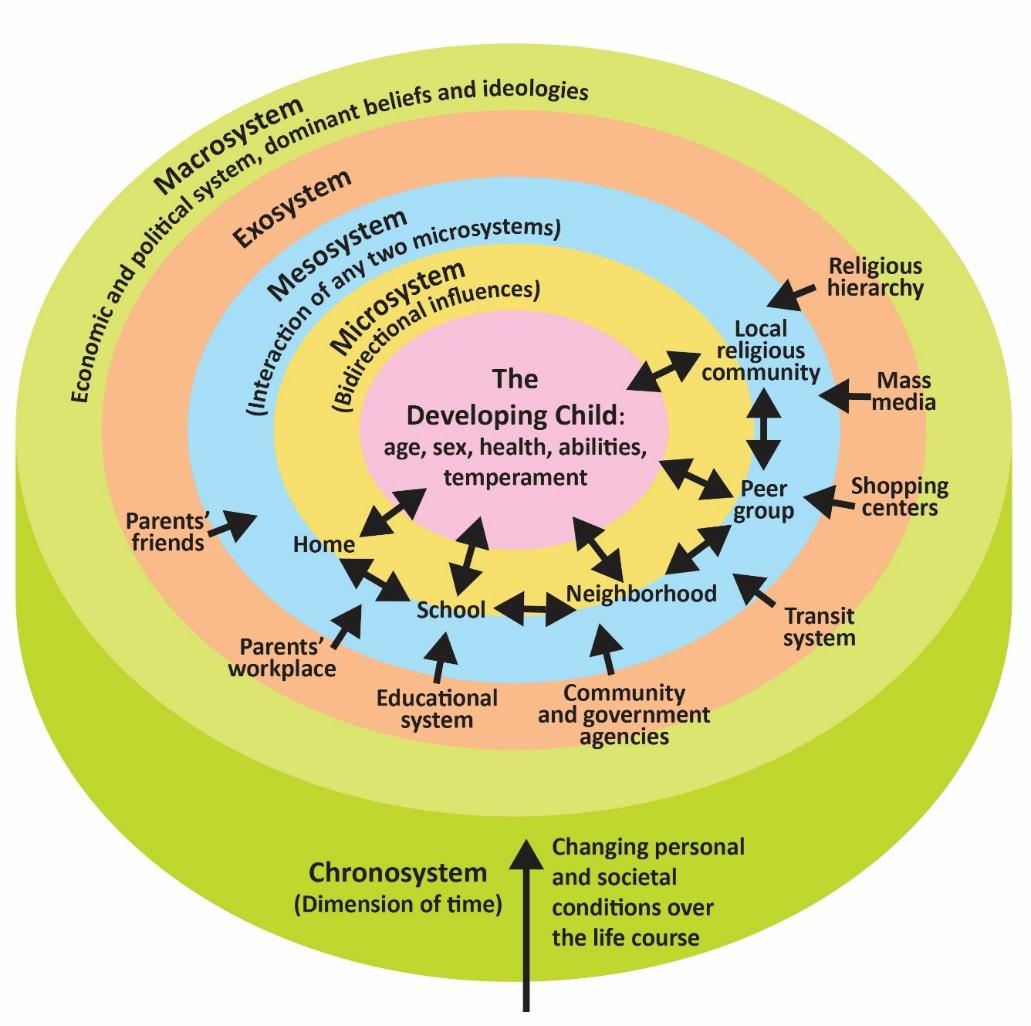
The model is able to account for multiple face-to-face environments, or settings, within the microsystem of a person (for example, family, school, peers); how relations between settings (mesosystem) can affect what happens within them (for example, interactions between school and family); and how settings within which the individuals have no direct presence (exo- and macrosystem) can affect settings in their microsystems (for example, how parents’ experiences at their workplace affect their relationships within the family) (Bronfenbrenner, 1979). Thus, this model allows the analysis of the lives of people, “living organisms whose biopsychological characteristics, both as a species and as individuals, have as much to do with their development as do the environments in which they live their lives” (Bronfenbrenner, 1995, p. 8).
Microsystem
Microsystems impact a child directly. These are the people with whom the child interacts such as parents, peers, and teachers. The relationship between individuals and those around them need to be considered. For example, to appreciate what is going on with a student in math, the relationship between the student and teacher should be known.
Mesosystem
Mesosystems are interactions between those surrounding the individual. The relationship between parents and schools, for example will indirectly affect the child.
Exosystem
Larger institutions such as the mass media or the healthcare system are referred to as the exosystem. These have an impact on families and peers and schools who operate under policies and regulations found in these institutions.
Macrosystem
We find cultural values and beliefs at the level of macrosystems. These larger ideals and expectations inform institutions that will ultimately impact the individual.
Chronosystem
All of this happens in an historical context referred to as the chronosystem. Cultural values change over time, as do policies of educational institutions or governments in certain political climates. Development occurs at a point in time.[2]
The Bioecological Model by Bronfenbrenner looked at patterns of development across time as well as the interactions between the development of the child and the environment. The implications of the Model include the social and political policies and practices affecting children, families, and parenting. The Bioecological Model as depicted in Figure 7.1 serves as a visual organizer to both summarize and unpack key concepts and themes as they related to individual development, teaching and learning, and educational practices. As teachers and educators strive to become evidence-based practitioners, the goal of learning this Model is to understand the theoretical and research foundations that inform the work in supporting students' well-being, teaching and learning and identify and use other factors/resources such as parents, family, peers, to provide positive influence on students’ learning and development.[3]
Link to Learning
Watch this video that describes Bronfenbrenner’s ecological systems model and the ways it influenced policies and resources like Head Start to learn more.
Check-in Time!
What chronosystem events have impacted your life so far?
Family Systems Theory
When understanding the family, the Family Systems Theory has proven to be very powerful. Family Systems Theory comes under the Functional Theory umbrella and shares the functional approach of considering the dysfunctions and functions of complex groups and organizations. Family Systems Theory claims that the family is understood best by conceptualizing it as a complex, dynamic, and changing collection of parts, subsystems and family members. Much like a mechanic would interface with the computer system of a broken down car to diagnose which systems are broken (transmission, electric, fuel, etc.) to repair it, a therapist or researcher would interact with family members to diagnose how and where the systems of the family are working and where they are in need of repair or intervention.
This theory also addresses the issue of boundaries. Boundaries are distinct emotional, psychological, or physical separateness between individuals, roles, and subsystems in the family. Boundaries are crucial to healthy family functioning.[4]
Check-in Time!
What is the main role you have in your family system? What boundaries do you have or wish you had?
Functionalism
When considering the role of family in society, functionalists uphold the notion that families are an important social institution and that they play a key role in stabilizing society. They also note that family members take on status roles in a marriage or family. The family—and its members—perform certain functions that facilitate the prosperity and development of society.
Sociologist George Murdock conducted a survey of 250 societies and determined that there are four universal residual functions of the family: sexual, reproductive, educational, and economic (Lee 1985). According to Murdock, the family (which for him includes the state of marriage) regulates sexual relations between individuals. He does not deny the existence or impact of premarital or extramarital sex, but states that the family offers a socially legitimate sexual outlet for adults (Lee 1985). This outlet gives way to reproduction, which is a necessary part of ensuring the survival of society.
Once children are born, the family plays a vital role in training them for adult life. As the primary agent of socialization and enculturation, the family teaches young children the ways of thinking and behaving that follow social and cultural norms, values, beliefs, and attitudes. For example, in some families, parents teach their children manners and civility believing a well-mannered child reflects a well-mannered parent.
Parents also teach children gender roles. Gender roles are an important part of the economic function of a family. In each family, there is a division of labor that consists of instrumental and expressive roles. Men tend to assume the instrumental roles in the family, which typically involve work outside of the family that provides financial support and establishes family status. Women tend to assume the expressive roles, which typically involve work inside of the family which provides emotional support and physical care for children (Crano and Aronoff 1978).
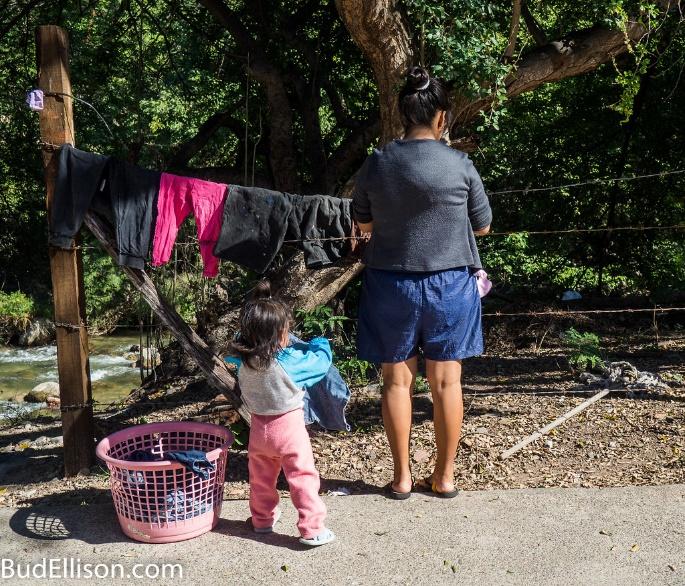
According to functionalists, the differentiation of the roles on the basis of sex ensures that families are well balanced and coordinated. When family members move outside of these roles, the family is thrown out of balance and must recalibrate in order to function properly. For example, if the father assumes an expressive role such as providing daytime care for the children, the mother must take on an instrumental role such as gaining paid employment outside of the home in order for the family to maintain balance and function.
Conflict Theory
Conflict theorists are quick to point out that U.S. families have been defined as private entities, the consequence of which has been to leave family matters to only those within the family. Many people in the United States are resistant to government intervention in the family: parents do not want the government to tell them how to raise their children or to become involved in domestic issues. Conflict theory highlights the role of power in family life and contends that the family is often not a haven but rather an arena where power struggles can occur. This exercise of power often entails the performance of family status roles. Conflict theorists may study conflicts as simple as the enforcement of rules from parent to child, or they may examine more serious issues such as domestic violence (spousal and child), sexual assault, marital rape, and incest.
The first study of marital power was performed in 1960. Researchers found that the person with the most access to value resources held the most power. As money is one of the most valuable resources, men who worked in paid labor outside of the home held more power than women who worked inside the home (Blood and Wolfe 1960). Even today, with more fluid family roles, conflict theorists find disputes over the division of household labor to be a common source of marital discord. Household labor offers no wages and, therefore, no power. Studies indicate that when men do more housework, women experience more satisfaction in their marriages, reducing the incidence of conflict (Coltrane 2000). In general, conflict theorists tend to study areas of marriage and life that involve inequalities or discrepancies in power and authority, as they are reflective of the larger social structure.
Check-in Time!
How does the division of chores impact or not impact your household?
Symbolic Interactionism
Interactionists view the world in terms of symbols and the meanings assigned to them (LaRossa and Reitzes 1993). The family itself is a symbol. To some, it is a father, mother, and children; to others, it is any union that involves respect and compassion. Interactionists stress that family is not an objective, concrete reality. Like other social phenomena, it is a social construct that is subject to the ebb and flow of social norms and ever-changing meanings.
Consider the meaning of other elements of family: in the past, “parent” was a symbol of a biological and emotional connection to a child. With more parent-child relationships developing through adoption, remarriage, or change in guardianship, the word “parent” today is less likely to be associated with a biological connection than with whoever is socially recognized as having the responsibility for a child’s upbringing. Similarly, the terms “mother” and “father” are no longer rigidly associated with the meanings of caregiver and breadwinner. These meanings are more free-flowing through changing family roles.
Interactionists also recognize how the family status roles of each member are socially constructed, playing an important part in how people perceive and interpret social behavior. Interactionists view the family as a group of role players or “actors” that come together to act out their parts in an effort to construct a family. These roles are up for interpretation. In the late nineteenth and early twentieth century, a “good father,” for example, was one who worked hard to provide financial security for his children. Today, for some, a “good father” is one who takes the time outside of work to promote his children’s emotional well-being, social skills, and intellectual growth—in some ways, a much more daunting task.[6]
[1] Image by Ian Joslin is licensed under CC BY 4.0
[2] Children’s Development by Ana R. Leon is licensed under CC BY 4.0
[3] Educational Learning Theories by Molly Y. Zhou and David Brow is licensed under CC BY-NC-SA (pg. 60-66)
[4] Intimate Relationships and Families by Ron Hammond and Paul Cheney is licensed under CC BY 4.0 (pg. 5-11)
[5] Image by Bud Ellison is licensed under CC BY 2.0
[6] Sociology - Reading: Theoretical Perspectives on Marriage and Family by Lumen Learning is licensed under CC BY 4.0
References
Adams, E. L., Marini, M. E., Stokes, J., Birch, L. L., Paul, I. M., & Savage, J. S. (2018). INSIGHT responsive parenting intervention reduces infant’s screen time and television exposure. The International Journal of Behavioral Nutrition and Physical Activity, 15(1), 24. https://doi.org/10.1186/s12966-018-0657-5
Berge, J. M., Mountain, S., Telke, S., Trofholz, A., Lingras, K., Dwivedi, R., & Zak-Hunter, L. (2020). Stressful life events and associations with child and family emotional and behavioral well-being in diverse immigrant and refugee populations. Families, Systems, & Health, 38(4), 380–395. dx.doi.org/10.1037/fsh0000524
Biblarz, T. J., & Gottainer, G. (2000). Family structure and children’s success: A comparison of widowed and divorced single-mother families. Journal of Marriage and Family, 62(2), 533–548. doi.org/10.1111/j.1741-3737.2000.00533.x
Bradley, R. H., & Caldwell, B. M. (1976). The relation of infants’ home environments to mental test performance at fifty-four months: A follow-up study. Child Development, 47(4), 1172–1174. doi.org/10.2307/1128457
Bronfenbrenner U. (1977). Toward an experimental ecology of human development. American Psychologist, 32(7), 513–531. doi.org/10.1037/0003-066X.32.7.513
Calarco, J. M., Meanwell, E., Anderson, E. M., & Knopf, A. S. (2021). By default: How mothers in different-sex dual-earner couples account for inequalities in pandemic parenting. Socius, 7, 1–15, 23780231211038783. doi.org/10.1177/23780231211038783
Chodura, S., Lohaus, A., Symanzik, T., Heinrichs, N., & Konrad, K. (2021). Foster parents’ parenting and the social-emotional development and adaptive functioning of children in foster care: A PRISMA-guided literature review and meta-analysis. Clinical Child and Family Psychology Review, 24(2), 326–347. https://doi.org/10.1007/s10567-020-00336-y
Choi, J. Y., Horm, D., Jeon, S., & Ryu, D. (2019). Do stability of care and teacher-child interaction quality predict child outcomes in early head start? Early Education and Development, 30(3), 337–356. doi.org/10.1080/10409289.2018.1546096
Chung, H. (2021). Shared care, father’s involvement in care and family well-being outcomes: A literature review. School of Social Policy, Sociology and Social Research, University of Kent. https://kar.kent.ac.uk/85742/11/Shar...ure_review.pdf
DeGroot, J. M., & Vik, T. A. (2020). “The Weight of Our Household Rests on My Shoulders”: Inequity in Family Work. Journal of Family Issues, 41(8), 1258–1281. doi.org/10.1177/0192513X19887767
Dowsett, C. J., Huston, A. C., Imes, A. E., & Gennetian, L. (2008). Structural and process features in three types of child care for children from high and low income families. Early Childhood Research Quarterly, 23(1), 69–93. https://doi.org/10.1016/j.ecresq.2007.06.003
Duch, H., Fisher, E. M., Ensari, I., & Harrington, A. (2013). Screen time use in children under 3 years old: A systematic review of correlates. The International Journal of Behavioral Nutrition and Physical Activity, 10(1), 1–10, 102. https://doi.org/10.1186/1479-5868-10-102
Dugan, A. G., & Barnes-Farrell, J. L. (2020). Working mothers’ second shift, personal resources, and self-care. Community, Work & Family, 23(1), 62–79. doi.org/10.1080/13668803.2018.1449732
Eadie, P., Page, J., Levickis, P., Elek, C., Murray, L., Wang, L., & Lloyd-Johnsen, C. (2022). Domains of quality in early childhood education and care: A scoping review of the extent and consistency of the literature. Educational Review, 76(4), 1057–1086. doi.org/10.1080/00131911.2022.2077704
Edwards, C. P., Ren, L., & Brown, J. (2015). Early contexts of learning: Family and community socialization during infancy and toddlerhood. The Oxford Handbook of Human Development and Culture. Oxford University Press. doi.org/10.1093/oxfordhb/9780199948550.013.11
Farr, R. H., & Vazquez, C. P. (2020). Stigma experiences, mental health, perceived parenting competence, and parent-child relationships among lesbian, gay, and heterosexual adoptive parents in the United States. Frontiers in Psychology, 11, 445. https://doi.org/10.3389/fpsyg.2020.00445
Ferguson, J., Lampkins, C., Moody, B., & Shpancer, N. (2020). Careful choices: Parents reflect on their childcare decisions. Child Care in Practice, 28(3), 368–380. doi.org/10.1080/13575279.2020.1765147
Fischer, I., Schober, P. S., & Nagengast, B. (2021). Parental relationship quality and children’s behavioral problems: Childcare quality as a protective factor? Journal of Family Research, 33(3), 703–733.
doi.org/10.20377/jfr-379http...l_relationship
_quality_and_children’s_behavioural_problems_Childcare_quality_as_a_protective_factor
Ginther, D. K., Pollak, R. A. (2004). Family structure and children’s educational outcomes: Blended families, stylized facts, and descriptive regression. Demography, 41(4), 671–696. doi.org/10.1353/dem.2004.0031
Green, B. L., Ayoub, C., Bartlett, J. D., Furrer, C., Chazan-Cohen, R., Buttitta, K., Von Ende, A., Koepp, A., & Regalbuto, E. (2020). Pathways to prevention: Early Head Start outcomes in the first three years lead to long-term reductions in child maltreatment. Children and Youth Services Review, 118, 105403. https://doi.org/10.1016/j.childyouth.2020.105403
Halfon, N., Aguilar, E., Stanley, L., Hotez, E., Block, E., & Janus, M. (2020). Measuring equity from the start: Disparities in the health development of US kindergartners: Study examines disparities in the health development of US kindergartners. Health Affairs, 39(10), 1702–1709. doi.org/10.1377/hlthaff.2020.00920
Heberle, A. E. & Chazan-Cohen, R. (2023). Longitudinal and reciprocal relations among parent and child outcomes for Black Early Head Start families. Early Education and Development, 34(2), 387–407. doi.org/10.1080/10409289.2022.2045461
Hur, E. H., Ardeleanu, K., Satchell, T. W., & Jeon, L. (2023). Why are they leaving? Understanding Associations between early childhood program policies and teacher turnover rates. Child Youth Care Forum, 52(2), 417–440. https://doi.org/10.1007/s10566-022-09693-x
Jeong, J., Franchett, E. E., Ramos de Oliveira, C. V., Rehmani, K., & Yousafzai, A. K. (2021). Parenting interventions to promote early child development in the first three years of life: A global systematic review and meta-analysis. PLoS Medicine, 18(5), e1003602. https://doi.org/10.1371/journal.pmed.1003602
Jones, P. C., Pendergast, L. L., Schaefer, B. A., Rasheed, M., Svensen, E., Scharf, R., Shrestha, R., Maphula, A., Roshan, R., Rasmussen, Z., Seidman, J. C., & Murray-Kolb, L. E. (2017). Measuring home environments across cultures: Invariance of the HOME scale across eight international sites from the MAL-ED study. Journal of School Psychology, 64, 109–127. https://doi.org/10.1016/j.jsp.2017.06.001
Keller, H. (2018). Parenting and socioemotional development in infancy and early childhood. Developmental Review, 50(A), 31–41. https://doi.org/10.1016/j.dr.2018.03.001
Keller, H., Yovsi, R., Borke, J., Kärtner, J., Jensen, H., & Papaligoura, Z. (2004). Developmental consequences of early parenting experiences: Self-recognition and self-regulation in three cultural communities. Child Development, 75(6), 1745–1760. doi.org/10.1111/j.1467-8624.2004.00814.x
Kracht, C. L., Redman, L. M., Bellando, J., Krukowski, R. A., & Andres, A. (2023). Association between maternal and infant screen time with child growth and development: a longitudinal study. Pediatric Obesity, 18(7), e13033. doi.org/10.1111/ijpo.13033
Leung, C. Y., & Suskind, D. L. (2020). What parents know matters: Parental knowledge at birth predicts caregiving behaviors at 9 months. The Journal of Pediatrics, 221, 72–80. https://doi.org/10.1016/j.jpeds.2019.12.021
Li, W. D. H., & Huang, J.-W. (2017). Housing the intergenerational families: Married couples coresident with parents in Taiwan. Journal of Family History, 42(1), 54–66. doi.org/10.1177/0363199016681607
Liel, C., Ulrich, S. M., Lorenz, S., Eickhorst, A., Fluke, J., & Walper, S. (2020). Risk factors for child abuse, neglect and exposure to intimate partner violence in early childhood: Findings in a representative cross-sectional sample in Germany. Child Abuse & Neglect, 106, 104487. https://doi.org/10.1016/j.chiabu.2020.104487
Mattelin, E., Paidar, K., Söderlind, N., Fröberg, F., & Korhonen, L. (2024). A systematic review of studies on resilience and risk and protective factors for health among refugee children in Nordic countries. European Child & Adolescent Psychiatry, 33(3), 667–700. https://doi.org/10.1007/s00787-022-01975-y
McDaniel, B. T., & Radesky, J. S. (2018). Technoference: Parent distraction with technology and associations with child behavior problems. Child Development, 89(1), 100–109. doi.org/10.1111/cdev.12822
Nomaguchi, K., & Milkie, M. A. (2020). Parenthood and well-being: A decade in review. Journal of Marriage and Family, 82(1), 198–223. doi.org/10.1111/jomf.12646
Okocha, A., Burke, N., & Lew-Williams, C. (2024). Infants and toddlers in the United States with more close relationships have larger vocabularies. Journal of Experimental Psychology: General. Advance online publication. doi.org/10.1037/xge0001609
Paine, A. L., Perra, O., Anthony, R., & Shelton, K. H. (2021). Charting the trajectories of adopted children’s emotional and behavioral problems: The impact of early adversity and postadoptive parental warmth. Development and Psychopathology, 33(3), 922–936. https://doi.org/10.1017/s0954579420000231
Patterson, C. J. (2024). Parental Sexual Orientation, Parental Gender Identity, and the Development of Young Children. In J. D. Osofsky, H. E. Fitzgerald, M. Keren, K. Puura (Eds.), WAIMH Handbook of Infant and Early Childhood Mental Health, vol. 1 (pp. 373–390). https://doi.org/10.1007/978-3-031-48627-2_22
Prime, H., Wade, M., & Browne, D. T. (2020). Risk and resilience in family well-being during the COVID-19 pandemic. American Psychologist, 75(5), 631–643. dx.doi.org/10.1037/amp0000660
Radesky, J. S., Weeks, H. M., Ball, R., Schaller, A., Yeo, S., Durnez, J., Tamayo-Rios, M., Epstein, M., Kirkorian, H., Coyne, S., & Barr, R. (2020). Young children’s use of smartphones and tablets. Pediatrics, 146(1), e20193518. doi.org/10.1542/peds.2019-3518
Roche, E., Rocha-Hidalgo, J., Piper, D., Strouse, G. A., Neely, L. I., Ryu, J., Myers, L. J., McClure, E., Troseth, G. L., Zosh, J. M., & Barr, R. (2022). Presence at a distance: Video chat supports intergenerational sensitivity and positive infant affect during COVID-19. Infancy, 27(6), 1008–1031. doi.org/10.1111/infa.12491
Sayer, L. C. (2016). Trends in women’s and men’s time use, 1965–2012: Back to the future? In S. McHale, V. King, J. Van Hook, & A. Booth (Eds.), Gender and couple relationships. National Symposium on Family Issues, 6, 43–77. http://dx.doi.org/10.1007/978-3-319-21635-5_2
Shrider, E. A. & Creamer, J. (2023). Poverty in the United States, 2022. United States Census Bureau. https://www.census.gov/library/publi...o/p60-280.html
Sundqvist, A., Barr, R., Heimann, M., Birberg-Thornberg, U., & Koch, F.-S. (2024). A longitudinal study of the relationship between children’s exposure to screen media and vocabulary development. Acta Paediatrica, 113(3), 517–522. doi.org/10.1111/apa.17047
Talmon, A., Ditzer, J., Talmon, A., & Tsur, N. (2024). Maltreatment in daycare settings: a review of empirical studies in the field. Trauma, Violence, & Abuse, 25(1), 512–525. doi.org/10.1177/15248380231155528
Tornello, S. L., & Patterson, C. J. (2018). Adult children of gay fathers: Parent-child relationship quality and mental health. Journal of Homosexuality, 65(9), 1152–1166. doi.org/10.1080/00918369.2017.1406218
Totsika V., & Sylva, K. (2004). The home observation for measurement of the environment revisited. Child and Adolescent Mental Health, 9(1), 25–35. doi.org/10.1046/j.1475-357x.2003.00073.x
Van Gasse, D., & Mortelmans, D. (2020). Single mothers’ perspectives on the combination of motherhood and work. Social Sciences, 9(5), 85. https://doi.org/10.3390/socsci9050085
Vandell, D. L., & Gülseven, Z. (2023). The study of Early Child Care and Youth Development (SECCYD): Studying development from infancy to adulthood. Annual Review of Developmental Psychology, 5(1), 331–354. https://doi.org/10.3390/socsci9050085
Vandell, D. L., Belsky, J., Burchinal, M., Steinberg, L., & Vandergrift, N. (2010). Do effects of early child care extend to age 15 years? Results from the NICHD Study of Early Child Care and Youth Development. Child Development, 81(3), 737–756. doi.org/10.1111/j.1467-8624.2010.01431.x
Wade, M., Parker, V., Tang, A., Fox, N. A., Zeanah, C. H., & Nelson, C. A. (2024). Linking caregiving quality during infancy to brain activity in early childhood and later executive function. Developmental Science, e13517. doi.org/10.1111/desc.13517
Wilson, B. D. M., & Bouton, L. J. A. (2024). LGBTQ parenting in the US. UCLA School of Law, Williams Institute. https://williamsinstitute.law.ucla.e...-parenting-us/
Yarger, H. A., Bernard, K., Caron, E. B., Wallin, A., & Dozier, M. (2020). Enhancing Parenting Quality for Young Children Adopted Internationally: Results of a Randomized Controlled Trial. Journal of Clinical Child and Adolescent, 49(3), 378–390. doi.org/10.1080/15374416.2018.1547972
Zaidman-Mograbi, R., le Roux, L., & Hall, H. (2020). The influence of culture on maternal attachment behaviors: A South African case study. Children Australia, 45(1), 30–39. http://dx.doi.org/10.1017/cha.2020.4
Footnotes
Copied from 5.3.1
Family Tasks: One of the ways to assess the quality of family life is to consider the tasks of families. Berger (2014) lists five family functions:
- Providing food, clothing and shelter
- Encouraging learning
- Developing self-esteem
- Nurturing friendships with peers
- Providing harmony and stability
Notice that in addition to providing food, shelter, and clothing, families are responsible for helping the child learn, relate to others, and have a confident sense of self. Hopefully, the family will provide a harmonious and stable environment for living. A good home environment is one in which the child's physical, cognitive, emotional, and social needs are adequately met. Sometimes families emphasize physical needs, but ignore cognitive or emotional needs. Other times, families pay close attention to physical needs and academic requirements, but may fail to nurture the child's friendships with peers or guide the child toward developing healthy relationships. Parents might want to consider how it feels to live in the household as a child. The tasks of families listed above are functions that can be fulfilled in a variety of family types-not just intact, two-parent households.
Parenting Styles: As discussed in upcoming pages, parenting styles affect the relationship parents have with their children. During middle and late childhood, children spend less time with parents and more time with peers, and consequently parents may have to modify their approach to parenting to accommodate the child's growing independence. The authoritative style, which incorporates reason and engaging in joint decision-making whenever possible may be the most effective approach (Berk, 2007). However, Asian-American, African-American, and Mexican-American parents are more likely than European-Americans to use an authoritarian style of parenting. This authoritarian style of parenting that using strict discipline and focuses on obedience is also tempered with acceptance and warmth on the part of the parents. Children raised in this manner tend to be confident, successful and happy (Chao, 2001; Stewart & Bond, 2002).
Living Arrangements: Certainly the living arrangements of children have changed significantly over the years. In 1960, 92% of children resided with married parents, while only 5% had parents who were divorced or separated and 1% resided with parents who had never been married. By 2008, 70% of children resided with married parents, 15% had parent who were divorced or separated, and by 2010, 14% resided with parents who had never married (Pew Research Center, 2010). By 2013 only 61% of children resided with married parents, and of those only 46% were being raised by both of their biological parents (Livingston, 2014).
Based on the 2010 United States Census, when just looking at households that contain spouses or unmarried partners with children, the majority of households with children are married, opposite sex couples (Lofquist, 2011). However, same sex couples have higher percentages of adopted children than opposite sex couples. Table 5.7 identifies the number of same sex and opposite sex households with children.
| Total Households | Married Opposite-Sex Couples | Unmarried Opposite-Sex Couples | Same-Sex Couples | |
|---|---|---|---|---|
| Households with children | 25,233,794 | 22,872,151 (90.6%) | 2,267,016 (8.9%) | 94,627 (0.4%) |
| Biological only | 90.80% | 88% | 72.80% | |
| Step only or adopted only | 4.40% | 5.20% | 21.20% | |
| Combination | 4.80% | 6.80% | 6% |
Lesbian and Gay Parenting: Research has consistently shown that the children of lesbian and gay parents are as successful as those of heterosexual parents, and consequently efforts are being made to ensure that gay and lesbian couples are provided with the same legal rights as heterosexual couples when adopting children (American Civil Liberties Union, 2016).
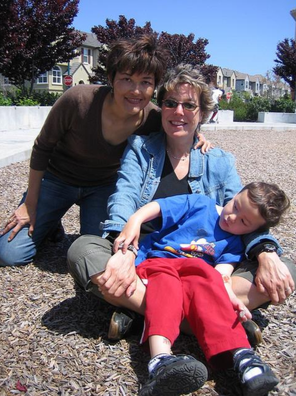
Patterson (2013) reviewed more than 25 years of social science research on the development of children raised by lesbian and gay parents and found no evidence of detrimental effects. In fact, research has demonstrated that children of lesbian and gay parents are as well-adjusted overall as those of heterosexual parents. Specifically, research comparing children based on parental sexual orientation has not shown any differences in the development of gender identity, gender role development, or sexual orientation. Additionally, there were no differences between the children of lesbian or gay parents and those of heterosexual parents in separation-individuation, behavior problems, self-concept, locus of control, moral judgment, school adjustment, intelligence, victimization, and substance use. Further, research has consistently found that children and adolescents of gay and lesbian parents report normal social relationships with family members, peers, and other adults. Patterson concluded that there is no evidence to support legal discrimination or policy bias against lesbian and gay parents.
Divorce: Using families in the National Institute of Child Health and Human Development (NICHD) Study of Early Child Care and Youth Development, Weaver and Schofield (2015) found that children from divorced families had significantly more behavior problems than those from a matched sample of children from non-divorced families. These problems were evident immediately after the separation and also in early and middle adolescence. An analysis of divorce factors indicated that children exhibited more externalizing behaviors if the family had fewer financial resources before the separation. It was hypothesized that the lower income and lack of educational and community resources contributed to the stress involved in the divorce. Additional factors contributing to children’s behavior problems included a post-divorce home that was less supportive and stimulating, and a mother that was less sensitive and more depressed.
Additional concerns include that the child will grieve the loss of the parent they no longer see as frequently. The child may also grieve about other family members that are no longer available. Very often, divorce means a change in the amount of money coming into the household. Children experience new constraints on spending or entertainment. School-aged children, especially, may notice that they can no longer have toys, clothing or other items to which they have grown accustomed. Or it may mean that there is less eating out or being able to afford participation in extracurricular activities. The custodial parent may experience stress at not being able to rely on child support payments or having the same level of income as before. This can affect decisions regarding healthcare, vacations, rents, mortgages and other expenditures, and the stress can result in less happiness and relaxation in the home. The parent who has to take on more work may also be less available to the children. Children may also have to adjust to other changes accompanying a divorce. The divorce might mean moving to a new home and changing schools or friends. It might mean leaving a neighborhood that has meant a lot to them as well.
Relationships of adult children of divorce are identified as more problematic than those adults from intact homes. For 25 years, Hetherington and Kelly (2002) followed children of divorce and those whose parents stayed together. The results indicated that 25% of adults whose parents had divorced experienced social, emotional, or psychological problems compared with only 10% of those whose parents remained married. For example, children of divorce have more difficulty forming and sustaining intimate relationships as young adults, are more dissatisfied with their marriage, and consequently more likely to get divorced themselves (Arkowitz & Lilienfeld, 2013). One of the most commonly cited long-term effects of divorce is that children of divorce may have lower levels of education or occupational status. This may be a consequence of lower income and resources for funding education rather than to divorce per se. In those households where economic hardship does not occur, there may be no impact on long-term economic status (Drexler, 2005).
According to Arkowitz and Lilienfeld (2013), long-term harm from parental divorce is not inevitable, however, and children can navigate the experience successfully. A variety of factors can positively contribute to the child’s adjustment. For example, children manage better when parents limit conflict, and provide warmth, emotional support and appropriate discipline. Further, children cope better when they reside with a well-functioning parent and have access to social support from peers and other adults. Those at a higher socioeconomic status may fare better because some of the negative consequences of divorce are a result of financial hardship rather than divorce per se (Drexler, 2005).
Although they may experience more problems than children from non-divorced families, most children of divorce lead happy, well-adjusted lives and develop strong, positive relationships with their custodial parent (Seccombe & Warner, 2004). In the United States and Canada, most children reside with their mother in single-parent households (Berk, 2007). Children from single- parent families talk to their mothers more often than children of two-parent families (McLanahan & Sandefur, 1994). In a study of college-age respondents, Arditti (1999) found that increasing closeness and a movement toward more democratic parenting styles was experienced. Others have also found that relationships between mothers and children become closer and stronger (Guttman, 1993) and suggest that greater equality and less rigid parenting is beneficial after divorce (Steward, Copeland, Chester, Malley, & Barenbaum, 1997).
Certain characteristics of the child can also facilitate post-divorce adjustment. Specifically, children with an easygoing temperament, who problem-solve well, and seek social support manage better after divorce. A further protective factor for children is intelligence (Weaver & Schofield, 2015). Children with higher IQ scores appear to be buffered from the effects of divorce. Children may be given more opportunity to discover their own abilities and gain independence that fosters self-esteem. If divorce means a reduction in tension, the child may feel relief. Overall, not all children of divorce suffer negative consequences and should not be subjected to stigma or social disapproval (Hetherington & Kelly, 2002). Furstenberg and Cherlin (1991) believe that the primary factor influencing the way that children adjust to divorce is the way the custodial parent adjusts to the divorce. If that parent is adjusting well, the children will benefit. This may explain a good deal of the variation we find in children of divorce.
Is cohabitation and remarriage more difficult than divorce for the child? The remarriage of a parent may be a more difficult adjustment for a child than the divorce of a parent (Seccombe & Warner, 2004). Parents and children typically have different ideas of how the stepparent should act. Parents and stepparents are more likely to see the stepparent's role as that of parent. A more democratic style of parenting may become more authoritarian after a parent remarries. Biological parents are more likely to continue to be involved with their children jointly when neither parent has remarried. They are least likely to jointly be involved if the father has remarried and the mother has not. Cohabitation can be difficult for children to adjust to because cohabiting relationships in the United States tend to be short-lived. About 50 percent last less than 2 years (Brown, 2000). The child who starts a relationship with the parent's live-in partner may have to sever this relationship later. Even in long-term cohabiting relationships, once it is over, continued contact with the child is rare.
Blended Families: About 60 percent of divorced parents remarry within a few years (Berk, 2007). Largely due to high rates of divorce and remarriage, we have seen the number of blended families in America grow considerably, although rates of remarriage are declining (Seccombe & Warner, 2004). Blended families are not new. In the 1700-1800s there were many blended families, but they were created because someone died and remarried. Most blended families today are a result of divorce and remarriage, and such origins lead to new considerations. Blended families are different from intact families and more complex in a number of ways that can pose unique challenges to those who seek to form successful blended family relationships (Visher & Visher, 1985). Children may be a part of two households, each with different rules that can be confusing.

Members in blended families may not be as sure that others care and may require more demonstrations of affection for reassurance. For example, stepparents expect more gratitude and acknowledgment from the stepchild than they would with a biological child. Stepchildren experience more uncertainty/insecurity in their relationship with the parent and fear the parents will see them as sources of tension. Stepparents may feel guilty for a lack of feelings they may initially have toward their partner's children. Children who are required to respond to the parent's new mate as though they were the child's "real" parent often react with hostility, rebellion, or withdrawal. This occurs especially if there has not been time for the relationship to develop.