

7.11: Identity Formation
- Page ID
- 60490

\( \newcommand{\vecs}[1]{\overset { \scriptstyle \rightharpoonup} {\mathbf{#1}} } \)
\( \newcommand{\vecd}[1]{\overset{-\!-\!\rightharpoonup}{\vphantom{a}\smash {#1}}} \)
\( \newcommand{\dsum}{\displaystyle\sum\limits} \)
\( \newcommand{\dint}{\displaystyle\int\limits} \)
\( \newcommand{\dlim}{\displaystyle\lim\limits} \)
\( \newcommand{\id}{\mathrm{id}}\) \( \newcommand{\Span}{\mathrm{span}}\)
( \newcommand{\kernel}{\mathrm{null}\,}\) \( \newcommand{\range}{\mathrm{range}\,}\)
\( \newcommand{\RealPart}{\mathrm{Re}}\) \( \newcommand{\ImaginaryPart}{\mathrm{Im}}\)
\( \newcommand{\Argument}{\mathrm{Arg}}\) \( \newcommand{\norm}[1]{\| #1 \|}\)
\( \newcommand{\inner}[2]{\langle #1, #2 \rangle}\)
\( \newcommand{\Span}{\mathrm{span}}\)
\( \newcommand{\id}{\mathrm{id}}\)
\( \newcommand{\Span}{\mathrm{span}}\)
\( \newcommand{\kernel}{\mathrm{null}\,}\)
\( \newcommand{\range}{\mathrm{range}\,}\)
\( \newcommand{\RealPart}{\mathrm{Re}}\)
\( \newcommand{\ImaginaryPart}{\mathrm{Im}}\)
\( \newcommand{\Argument}{\mathrm{Arg}}\)
\( \newcommand{\norm}[1]{\| #1 \|}\)
\( \newcommand{\inner}[2]{\langle #1, #2 \rangle}\)
\( \newcommand{\Span}{\mathrm{span}}\) \( \newcommand{\AA}{\unicode[.8,0]{x212B}}\)
\( \newcommand{\vectorA}[1]{\vec{#1}} % arrow\)
\( \newcommand{\vectorAt}[1]{\vec{\text{#1}}} % arrow\)
\( \newcommand{\vectorB}[1]{\overset { \scriptstyle \rightharpoonup} {\mathbf{#1}} } \)
\( \newcommand{\vectorC}[1]{\textbf{#1}} \)
\( \newcommand{\vectorD}[1]{\overrightarrow{#1}} \)
\( \newcommand{\vectorDt}[1]{\overrightarrow{\text{#1}}} \)
\( \newcommand{\vectE}[1]{\overset{-\!-\!\rightharpoonup}{\vphantom{a}\smash{\mathbf {#1}}}} \)
\( \newcommand{\vecs}[1]{\overset { \scriptstyle \rightharpoonup} {\mathbf{#1}} } \)
\(\newcommand{\longvect}{\overrightarrow}\)
\( \newcommand{\vecd}[1]{\overset{-\!-\!\rightharpoonup}{\vphantom{a}\smash {#1}}} \)
\(\newcommand{\ket}[1]{\left| #1 \right>}\)
\(\newcommand{\bra}[1]{\left< #1 \right|}\)
\(\newcommand{\braket}[2]{\left< #1 \vphantom{#2} \right| \left. #2 \vphantom{#1} \right>}\)
\(\newcommand{\braopket}[3]{\left< #1 \vphantom{#2}\vphantom{#3} \right| #2 \vphantom{#1}\vphantom{#3} \left| #3 \vphantom{#1}\vphantom{#2} \right>}\)
\(\newcommand{\qmvec}[1]{\mathbf{\vec{#1}}}\)
\(\newcommand{\op}[1]{\hat{\mathbf{#1}}}\)
\(\newcommand{\expect}[1]{\langle #1 \rangle}\)
\(\newcommand{\dfn}[1]{\emph{\textbf{#1}}}\)
Psychosocial Development
Identity Development

Self-Concept
Self-Esteem
Identity Formation: Who am I?
- Vocational identity: While adolescents in earlier generations envisioned themselves as working in a particular job, and often worked as an apprentice or part-time in such occupations as teenagers, this is rarely the case today. Vocational identity takes longer to develop, as most of today’s occupations require specific skills and knowledge that will require additional education or are acquired on the job itself. In addition, many of the jobs held by teens are not in occupations that most teens will seek as adults.
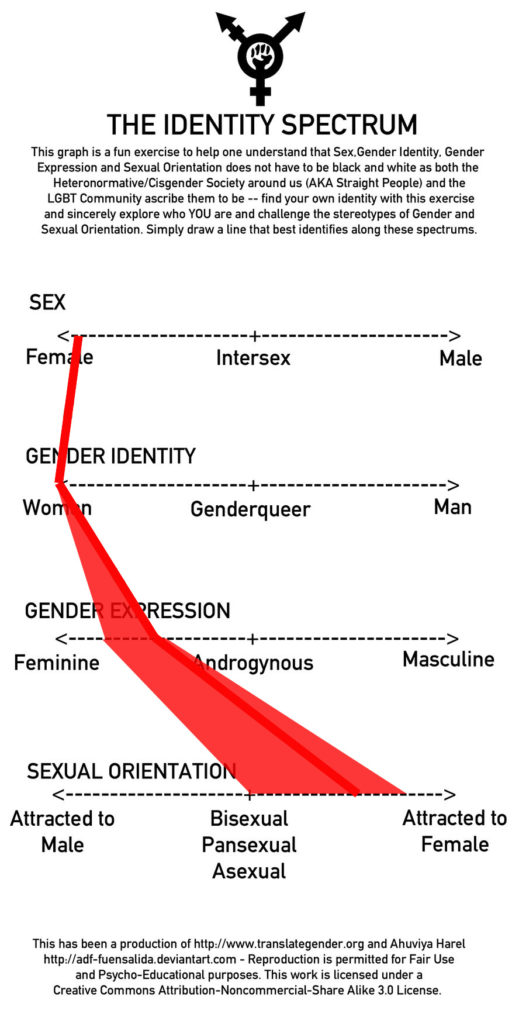
Figure 2. This identity spectrum shows the fluidity between sex, gender identity, gender expression, and sexual orientation.
- cisgender
- an umbrella terms used to describe people whose sense of personal identity and gender corresponds with their birth sex
- foreclosure
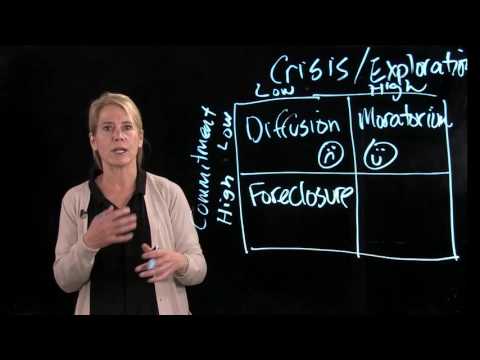
- term for premature identity formation, which occurs when an adolescent adopts his or her parents’ or society’s role and values without questioning or analysis, according to Marcia’s theory
- gender
- a term that refers to social or cultural distinctions of behaviors that are considered male or female
- gender dysphoria
- a condition listed in the DSM-5 in which people whose gender at birth is contrary to the one they identify with. This condition replaces “gender identity disorder”
- gender expression
- how one demonstrates gender (based on traditional gender role norms related to clothing, behavior, and interactions); can be feminine, masculine, androgynous, or somewhere along a spectrum
- gender identity
- the way that one thinks about gender and self-identifies, can be woman, man, or genderqueer
- identity achievement
- Erikson’s term for the attainment of identity, or the point at which a person understands who he or she is as a unique individual, in accord with past experiences and future plans; already questioned and made commitment according to Marcia’s theory
- identity vs. role confusion
- Erikson’s term for the fifth stage of development, in which the person tries to figure out “Who am I?” but is confused as to which of many possible roles to adopt
- moratorium
- an adolescent’s choice of a socially acceptable way to postpone making identity-achievement decisions. Going to college is a common example. Engaged in questioning, but not yet making a commitment, according to Marcia’s theory
- role confusion
- a situation in which an adolescent does not seem to know or care what his or her identity is. (Sometimes called identity diffusion or role diffusion)
- self-concept
- our individual perceptions of our behavior, abilities, and unique characteristics. It is essentially a mental picture of who you are as a person. For example, beliefs such as “I am a good friend” or “I am a kind person” are part of an overall self-concept
- self-esteem
- considered an important component of emotional health, self-esteem encompasses both self-confidence and self-acceptance. It is the way individuals perceive themselves and their self-value
- sex
- a term that denotes the presence of physical or physiological differences between males and females
- transgender
- a term used to describe people whose sense of personal identity does not correspond with their birth sex