Despite its simplicity and powerful explanatory potential, realism faces substantial challenges from alternative theoretical approaches, such as liberalism (Chapter 4) and constructivism (Chapter 5). In this section, we will explore two of the most compelling critiques of realism.
Unpredictable Events
The first criticism of realism stems from its inability to explain—or predict—some of the most important global events that have profound implications for the international system. Realists argue that states, driven by the quest for power and security, operate in an anarchic system where survival is the primary objective. The theory’s focus on the balance of power as a central determinant of international politics suggests that the behavior of states can be understood by looking at their relative capabilities—namely, military strength and economic power.
However, in practice, this approach has been unable to account for dramatic events that do not fit into its predictions. For example, consider the sudden collapse of the Soviet Union in 1991 under the leadership of Mikhail Gorbachev. Realism would have suggested that the Soviet Union, as one of the two superpowers during the Cold War, should have remained a central player in the global order. After all, its military and nuclear capabilities were immense, and it controlled vast resources. With that much raw power, the theory would predict that the Soviet Union would persist as a major global actor, likely continuing its competition with the U.S. for influence and power.
Yet, the Soviet Union collapsed quickly and without the kind of violent conflict or military confrontation that realism would have anticipated. From a realist perspective, the breakup of the Soviet Union–ultimately separating into 15 independent states–should not have happened.
.png?revision=1)
.png?revision=1)
.png?revision=1)
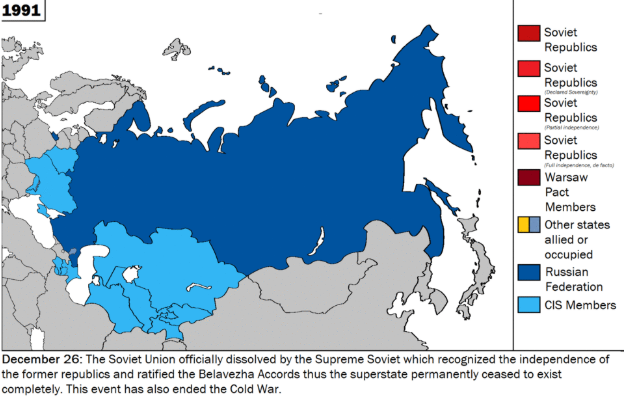
Image \(\PageIndex{1}\): Territorial maps compare the day Mikhail Gorbachev assumed power of the Soviet Union in 1985 with two pivotal days toward the end of December 1991, illustrating the sudden and rapid dissolution of the Soviet Union after decades of unification. (Source: “USSR Map timeline” by FreshCorp619 is licensed under CC BY-SA 4.0.)
As the map above illustrates, when Mikhail Gorbachev took power in 1985, the Soviet Union traversed vast territory, yet faced major political and economic crises. Despite reform efforts aimed at promoting openness ("glasnost") and restructuring ("perestroika"), the Soviet Union continued to struggle. In 1991, numerous independence referendums were held across the territory; an attempted coup d'état against Gorbachev occurred; and, on December 25, Gorbachev resigned, handing powers over to Boris Yeltsin, the new President of the Russian Federation. The following day, the Soviet Union officially dissolved, resulting in the recognition of independence for the former Soviet republics and the creation of a regional intergovernmental organization, the Commonwealth of Independent States (CIS).
The dissolution of a superpower, so rapid and unexpected, challenges the very foundations of realist thought. Realists were left without a convincing explanation for this event, highlighting a key weakness of the theory: Realism cannot fully account for the complexities of domestic political factors, ideology, or the internal dynamics of states. While realism emphasizes external power struggles, it fails to provide the tools necessary to understand why or how states might change internally in ways that drastically affect international affairs.
Defining National Interest
The second major critique of realism concerns its vagueness around the concept of “national interest.” National interest is a core idea in realist theory, as it helps explain why states engage in certain behaviors to ensure their survival and security in an anarchic international system. However, the problem lies in the lack of clarity about what exactly constitutes a state’s national interest. If realism is to be a useful theory, it must offer a clear, consistent definition of national interest that can guide our understanding of state actions. Yet, realists struggle to provide such a definition.
The idea of national interest is subjective and can vary greatly depending on who is defining it. For instance, the national interest of a military general in Washington, D.C. might focus on providing safety for U.S. military forces abroad, while the national interest of a single mother in rural Alabama might center around affordable healthcare and the safety of her children. Realism struggles to explain how these vastly different perspectives on national interest are supposed to fit within its framework or why one understanding of national interest should prevail over the other.

Image \(\PageIndex{2}\): The decades-long protests in the U.S. over the controversial Keystone XL Pipeline project illustrate myriad competing conceptions of “national interest.” Beyond military security, and depending on who defines it, the national interest may encompass energy security, business interests, environmental concerns, indigenous land rights, and national credibility and leadership in global affairs (among other concerns). (Source: “Tar Sands Action 8/22/11” by chesapeakeclimate is licensed under CC BY-SA 2.0.)
Realist theorists often take a rather simplistic view of national interest, assuming that it is mainly about state security. But this leaves out many important considerations, such as economic interests, environmental concerns, or the desire for cultural or ideological influence. Moreover, realism typically frames national interest as something externally-driven, shaped by the international environment, rather than something that could be shaped internally by domestic factors, public opinion, or political ideologies. This makes the concept of national interest in realism highly ambiguous and, at times, difficult to apply in real-world scenarios.


