While Chapter 3 introduced realism, this is not the only theoretical approach to international relations. Liberalism is another major theoretical approach, and it emerged as the default model for international politics at the turn of the 21st century. Liberalism is a theory that explains state behavior and the configuration of the international system by emphasizing the mutual benefits of cooperation and international institutions. The recommendations stemming from liberalism shape our governments, our economies, and how states and other actors conduct international affairs. In this chapter, we will examine the development of liberalism, discuss its implications for state behavior within international politics, compare the assumptions of liberalism and realism, and analyze liberalism’s critiques.
Development of Liberalism
Liberalism emerged from the Enlightenment in the 17th and 18th centuries. Unlike realism’s pessimistic view of human nature, liberalism stems from the view that human nature is generally good and, with sufficient laws and institutions, cooperation is possible. John Locke, Adam Smith, and Immanuel Kant are prominent theorists from this tradition who contributed to liberal thinking regarding individual rights, economics, and the pursuit of peace.

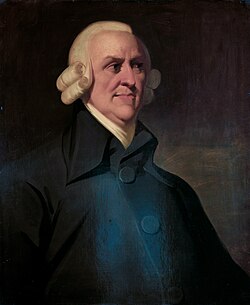

Image \(\PageIndex{1}\): From left to right, portrait of John Locke, Adam Smith, and Immanuel Kant. (Sources, from left to right: “John Locke” by Godfrey Kneller is in the public domain; "Adam Smith: The Muir portrait" by Unknown Artist is in the Public domain; Immanuel Kant, painted portrait, c1790, By Unknown, possibly Elisabeth von Stägemann (Anton Graff school) - original from the Norwegian Digital Learning Arena (NDLA), Public Domain.)
John Locke (1632-1704) argued against the realist perspective; as articulated by Hobbes, the cruel state of nature requires an all-powerful sovereign to provide peace. Yet in Locke’s view, humans have natural rights to life, liberty, and property. In society, people voluntarily agree to the social contract, giving up some freedoms in exchange for protection of those natural rights. However, if this agreed upon authority fails to provide these rights and protections, then the people have the right to disobey their society’s laws—in other words, if authority systems do not hold up their end of the bargain, individuals do not have to either. Locke’s recognition of individual rights and state accountability were foundational to the development of classical liberalism, and we see these rights cemented in most democratic constitutions today.
Beyond individual rights, Adam Smith (1723-1790) contributed to liberal economic thinking. Smith argued that state-managed economies, a prominent feature in his time, were not able to produce consistent economic growth. He instead argued that allowing businesses and individuals to operate autonomously would promote economic growth. Through a free market system, business owners voluntarily enter into agreements with each other out of self-interest, and free trade allows businesses to specialize in producing goods and services based on efficiency. This leads to a system, led by the “invisible hand” of the market, centered on the efficient production of goods and services. Smith’s belief that self-interest guides market interactions and allows for the development of wealth is a foundational concept behind liberal economics, and it is a justification for free market capitalism (for additional discussion of economic liberalism, see Chapter 12).
Immanuel Kant (1724-1804), a third major liberal thinker, argued that states could achieve peace by embracing reason and self-interest. He argued that states should make the actions of their leaders accountable to the public, and that they should commit to shared principles of sovereignty and self-determination. With these shared principles, states should establish international institutions to mediate disputes. Kant’s belief that peace comes from shared values and institutions was essential for the development of institutional liberalism and international law, and it is the foundation for the United Nations (UN).
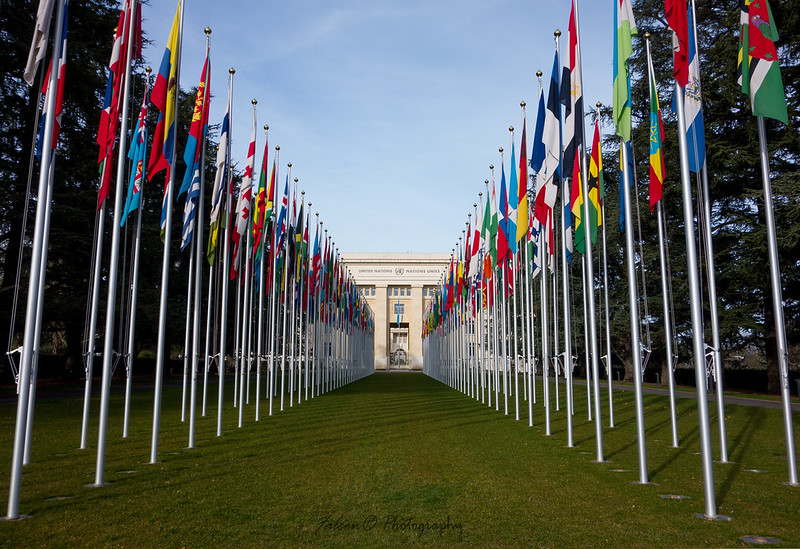
Image \(\PageIndex{2}\): Flags of member states at the UN Office in Geneva symbolize liberal principles of internationally shared values and institutions. (Source: “United Nations Office at Geneva” by Falcon_33 is licensed under CC BY-SA 2.0.)
For many years, theorists debated these principles, but they had limited impact on the international stage. In the wake of World War I, however, the President of the United States (U.S.), Woodrow Wilson, created a 14-point plan advocating for the creation of a League of Nations to manage international disputes. This plan stemmed from liberal principles, but its popularity was short-lived; the international community’s failure to prevent World War II discredited liberal ideas.
Liberalism did not reemerge as an important perspective for international affairs until the rebuilding of Western Europe after World War II, when a desire to avoid nuclear war between the U.S. and the Soviet Union motivated states. Decades later, the collapse of the Soviet Union and dominance of the U.S. led many developing states to adopt democratic forms of government in the 1980s and 1990s. Even some authoritarian regimes sought to legitimize their actions with liberal principles of accountability and responsibility to their citizens in the form of elected bodies.
In the late 20th century, many states with diverse economic systems—from the welfare state of the United Kingdom (U.K.) to the state-led economy of China—embraced economic reform following decades of stagnant growth. States across the world lowered taxes, privatized industries, and expanded trade with foreign markets. Liberal principles served as the foundation to establish institutions including the UN, the World Trade Organization (WTO), and the European Union (EU). The vast majority of states signed on to human rights treaties, laws surrounding environmental protections, and treaties banning certain types of military conduct.
The 21st century has been far more challenging for liberal ideas. The wars in Iraq and Afghanistan made people question the feasibility of liberal ideas and increased skepticism of international institutions. The 2008 Great Recession and Eurozone crisis left millions unemployed, and states adopted austerity programs to try and get public debt under control. This led many to question the supposed benefits of greater integration and the financial benefits of continued economic liberalization. Political regimes that had seemed to be slowly liberalizing, such as China and Russia, changed course. Moreover, domestic nationalist movements that view other states and peoples as threats, rather than collaborators, increasingly challenge liberal democratic states.


