Learning Objectives
By the end of this chapter, you will be able to:
- Define human rights.
- Identify where and how international law and institutions address human rights.
- Explain the roles that intergovernmental organizations and nongovernmental organizations perform in monitoring, reporting, and adjudicating human rights abuses.
- Distinguish between types of abuses of human rights, such as crimes against humanity, genocide, and ethnic cleansing.
- Describe the Responsibility to Protect (R2P).
- Analyze how the protection of human rights conflicts with the norms of sovereignty and non-intervention.
Note
The author adapted and remixed the following section from three existing sources:
- Bellamy, A.J. (2016). “Protecting People.” In S. McGlinchey (Ed.), International Relations (pp. 123-134) [CC BY-NC 4.0]. E-International Relations.
- Michel, K. (2018). “Week 11: Human Rights.” In Introduction to International Relations. Canvas Commons [CC BY-NC 4.0].
- Morton, J. and S. Maesel. “Empowering International Human Security Regimes.” In A. Lautensach and S. Lautensach (Eds.), Human Security in World Affairs - Problems and Opportunities 2e [CC BY-NC 4.0]. LibreTexts.
Established in 1945, the Charter of the United Nations (UN) set out to “save succeeding generations from the scourge of war” and “uphold faith in fundamental human rights.” Signed three years later, in 1948, the Universal Declaration of Human Rights (UDHR) called for states to work together to ensure that all enjoy “freedom from fear” and “freedom from want.”
And yet, more than 75 years after the UDHR’s signing, continued violations of human rights frequently occur. Finding ways to protect people from harm is therefore a major contemporary debate. Too often the international community does too little, too late to protect people from atrocities, civil wars, and other human-made ills. In the 20th century, wars between states killed tens of millions of people, while governments killed an even higher number of their own citizens. Facts like these pose a major challenge for the way we think about international relations.
The contemporary international system organizes itself as a society of states that enjoy exclusive jurisdiction over particular pieces of territory. That is, these states have sovereignty, the principle under which each state is fundamentally equal in legal terms and free to act independently without the consent of any higher authority. These sovereign states enjoy the right of non-intervention, enshrined in Article 2(4) of the UN Charter, which prohibits “the threat or use of force against the territorial integrity or political independence of any state.”
This system assumes that states exist primarily to protect the security of their citizens; the security of the state is therefore worth protecting through the principle of non-intervention because states provide security to individuals. But, as countless examples show, not every state protects the well-being of its population.
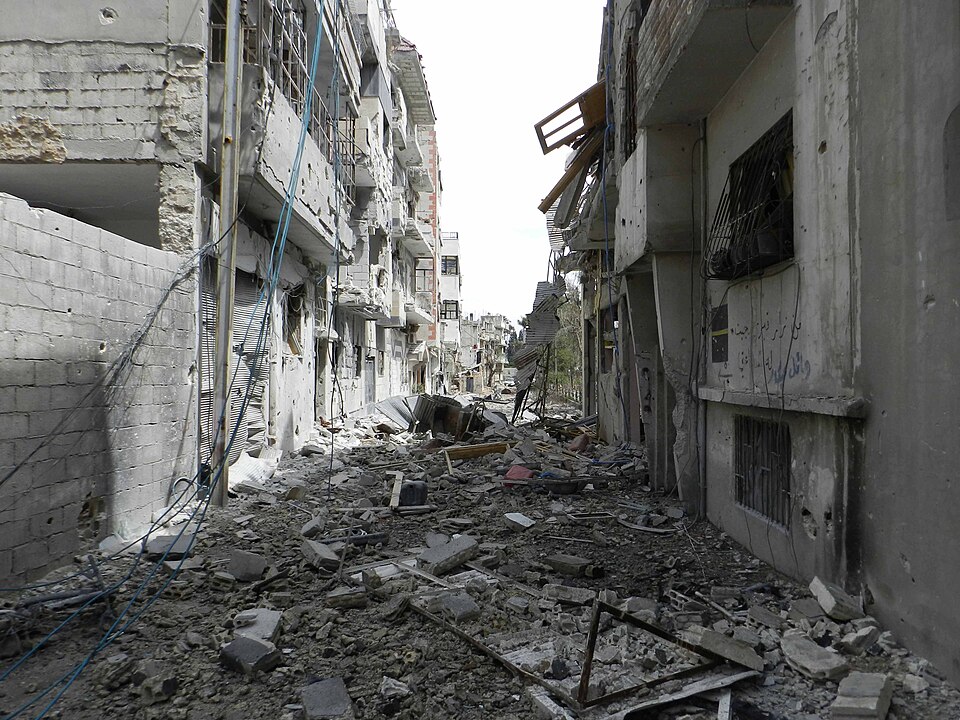.jpg?revision=1)
Image \(\PageIndex{1}\): Destruction in Bab Dreeb area in Homs, Syria in 2012. (Source: "Destruction in Homs (4)" by Bo yaser is licensed under CC BY-SA 3.0.)
From recent examples like Syria, to numerous examples from the past century, threats to individual security tend to come more from a person’s own state than from other states. Instances like these raise questions about whether there are circumstances in which the international community should privilege the security of individuals over the security of states.
What are human rights?
While the foundation of the international system and modern international law is the sovereign state, human rights became a subject of international regulatory efforts after World War II. This shift transformed the individual from the mere object of international law to one of its subjects.
As the UN defines, “human rights are rights inherent to all human beings, regardless of race, sex, nationality, ethnicity, language, religion, or any other status. Human rights include the right to life and liberty, freedom from slavery and torture, freedom of opinion and expression, the right to work and education, and many more. Everyone is entitled to these rights, without discrimination.”
The UDHR expands this definition, recognizing equal and inalienable rights as the foundations for freedom, justice, and peace. The UDHR’s 30 articles—including (as select examples) the right to equal protection of the law (Article 7); the right to seek asylum (Article 14); the right to a nationality (Article 15); the right to freedom of thought, conscience, and religion (Article 18); and the right to rest and leisure (Article 24)—provided a strong basis for the drafting of numerous human rights treaties.

Image \(\PageIndex{2}\): Eleanor Roosevelt, first chair of the UN Commission on Human Rights, was instrumental in drafting the UDHR. It was signed in 1948. (Source: “Eleanor Roosevelt UDHR” by FDR Presidential Library & Museum is licensed under CC BY 2.0.)
Some of these key human rights documents include the Convention on the Prevention and the Punishment of Genocide (1948); the Convention to End Racial Discrimination (1965); the International Covenant on Civil and Political Rights (1966); the International Covenant on Economic, Social, and Cultural Rights (1966); the Convention on the Elimination of All Forms of Discrimination Against Women (1979); the Convention Against Torture and Other Cruel, Inhuman or Degrading Treatment or Punishment (1984); the Convention on the Rights of the Child (1989); and the Convention on the Rights of Persons with Disabilities (2007).1
Table 11.1 lists select provisions illustrating the different focuses of the International Covenant on Civil and Political Rights (ICCPR) and the International Covenant on Economic, Social, and Cultural Rights (ICESCR). Often referred to as “the International Covenants,” when taken together with the UDHR, these three documents form the International Bill of Human Rights.
Table 11.1. Select Rights Covered by the ICCPR and ICESCR (Office of the United Nations High Commissioner for Human Rights)
| ICCPR |
ICESCR |
| Right to life |
Right to work |
| Freedom from torture and slavery |
Right to just and favorable conditions at work |
| Right to liberty and security of person |
Right to form trade unions |
| Right to be treated with humanity in detention |
Right to strike |
| Freedom of movement, religion and belief, expression, and association |
Right to social security |
| Right to fair trial |
Freedom of children from social and economic exploitation |
| Right to peaceful assembly |
Right to an adequate standard of living |
| Right to equality before the law |
Freedom from hunger |
| Minority rights |
Right to health |
The protection of human rights requires more than the drafting of treaties to meaningfully impact international relations. In a perfect world, states would internalize protections for human rights and police themselves to ensure their respect. In a world of sovereign, independent states, however, the international community must collectively ensure that states act in accordance with prevailing human rights documents.
How successful is the international community in this endeavor? The following sections will examine theoretical perspectives, legal principles, implementation methods, accountability mechanisms, and ongoing challenges in the protection of human rights.
1The years in parentheses reflect the years in which the documents were signed.


