

1: Semi-dependent capitalism - Russia
- Last updated
- Save as PDF
- Page ID
- 181795

- Ruslan Dzarasov
- UCL Press
\( \newcommand{\vecs}[1]{\overset { \scriptstyle \rightharpoonup} {\mathbf{#1}} } \)
\( \newcommand{\vecd}[1]{\overset{-\!-\!\rightharpoonup}{\vphantom{a}\smash {#1}}} \)
\( \newcommand{\dsum}{\displaystyle\sum\limits} \)
\( \newcommand{\dint}{\displaystyle\int\limits} \)
\( \newcommand{\dlim}{\displaystyle\lim\limits} \)
\( \newcommand{\id}{\mathrm{id}}\) \( \newcommand{\Span}{\mathrm{span}}\)
( \newcommand{\kernel}{\mathrm{null}\,}\) \( \newcommand{\range}{\mathrm{range}\,}\)
\( \newcommand{\RealPart}{\mathrm{Re}}\) \( \newcommand{\ImaginaryPart}{\mathrm{Im}}\)
\( \newcommand{\Argument}{\mathrm{Arg}}\) \( \newcommand{\norm}[1]{\| #1 \|}\)
\( \newcommand{\inner}[2]{\langle #1, #2 \rangle}\)
\( \newcommand{\Span}{\mathrm{span}}\)
\( \newcommand{\id}{\mathrm{id}}\)
\( \newcommand{\Span}{\mathrm{span}}\)
\( \newcommand{\kernel}{\mathrm{null}\,}\)
\( \newcommand{\range}{\mathrm{range}\,}\)
\( \newcommand{\RealPart}{\mathrm{Re}}\)
\( \newcommand{\ImaginaryPart}{\mathrm{Im}}\)
\( \newcommand{\Argument}{\mathrm{Arg}}\)
\( \newcommand{\norm}[1]{\| #1 \|}\)
\( \newcommand{\inner}[2]{\langle #1, #2 \rangle}\)
\( \newcommand{\Span}{\mathrm{span}}\) \( \newcommand{\AA}{\unicode[.8,0]{x212B}}\)
\( \newcommand{\vectorA}[1]{\vec{#1}} % arrow\)
\( \newcommand{\vectorAt}[1]{\vec{\text{#1}}} % arrow\)
\( \newcommand{\vectorB}[1]{\overset { \scriptstyle \rightharpoonup} {\mathbf{#1}} } \)
\( \newcommand{\vectorC}[1]{\textbf{#1}} \)
\( \newcommand{\vectorD}[1]{\overrightarrow{#1}} \)
\( \newcommand{\vectorDt}[1]{\overrightarrow{\text{#1}}} \)
\( \newcommand{\vectE}[1]{\overset{-\!-\!\rightharpoonup}{\vphantom{a}\smash{\mathbf {#1}}}} \)
\( \newcommand{\vecs}[1]{\overset { \scriptstyle \rightharpoonup} {\mathbf{#1}} } \)
\(\newcommand{\longvect}{\overrightarrow}\)
\( \newcommand{\vecd}[1]{\overset{-\!-\!\rightharpoonup}{\vphantom{a}\smash {#1}}} \)
\(\newcommand{\avec}{\mathbf a}\) \(\newcommand{\bvec}{\mathbf b}\) \(\newcommand{\cvec}{\mathbf c}\) \(\newcommand{\dvec}{\mathbf d}\) \(\newcommand{\dtil}{\widetilde{\mathbf d}}\) \(\newcommand{\evec}{\mathbf e}\) \(\newcommand{\fvec}{\mathbf f}\) \(\newcommand{\nvec}{\mathbf n}\) \(\newcommand{\pvec}{\mathbf p}\) \(\newcommand{\qvec}{\mathbf q}\) \(\newcommand{\svec}{\mathbf s}\) \(\newcommand{\tvec}{\mathbf t}\) \(\newcommand{\uvec}{\mathbf u}\) \(\newcommand{\vvec}{\mathbf v}\) \(\newcommand{\wvec}{\mathbf w}\) \(\newcommand{\xvec}{\mathbf x}\) \(\newcommand{\yvec}{\mathbf y}\) \(\newcommand{\zvec}{\mathbf z}\) \(\newcommand{\rvec}{\mathbf r}\) \(\newcommand{\mvec}{\mathbf m}\) \(\newcommand{\zerovec}{\mathbf 0}\) \(\newcommand{\onevec}{\mathbf 1}\) \(\newcommand{\real}{\mathbb R}\) \(\newcommand{\twovec}[2]{\left[\begin{array}{r}#1 \\ #2 \end{array}\right]}\) \(\newcommand{\ctwovec}[2]{\left[\begin{array}{c}#1 \\ #2 \end{array}\right]}\) \(\newcommand{\threevec}[3]{\left[\begin{array}{r}#1 \\ #2 \\ #3 \end{array}\right]}\) \(\newcommand{\cthreevec}[3]{\left[\begin{array}{c}#1 \\ #2 \\ #3 \end{array}\right]}\) \(\newcommand{\fourvec}[4]{\left[\begin{array}{r}#1 \\ #2 \\ #3 \\ #4 \end{array}\right]}\) \(\newcommand{\cfourvec}[4]{\left[\begin{array}{c}#1 \\ #2 \\ #3 \\ #4 \end{array}\right]}\) \(\newcommand{\fivevec}[5]{\left[\begin{array}{r}#1 \\ #2 \\ #3 \\ #4 \\ #5 \\ \end{array}\right]}\) \(\newcommand{\cfivevec}[5]{\left[\begin{array}{c}#1 \\ #2 \\ #3 \\ #4 \\ #5 \\ \end{array}\right]}\) \(\newcommand{\mattwo}[4]{\left[\begin{array}{rr}#1 \amp #2 \\ #3 \amp #4 \\ \end{array}\right]}\) \(\newcommand{\laspan}[1]{\text{Span}\{#1\}}\) \(\newcommand{\bcal}{\cal B}\) \(\newcommand{\ccal}{\cal C}\) \(\newcommand{\scal}{\cal S}\) \(\newcommand{\wcal}{\cal W}\) \(\newcommand{\ecal}{\cal E}\) \(\newcommand{\coords}[2]{\left\{#1\right\}_{#2}}\) \(\newcommand{\gray}[1]{\color{gray}{#1}}\) \(\newcommand{\lgray}[1]{\color{lightgray}{#1}}\) \(\newcommand{\rank}{\operatorname{rank}}\) \(\newcommand{\row}{\text{Row}}\) \(\newcommand{\col}{\text{Col}}\) \(\renewcommand{\row}{\text{Row}}\) \(\newcommand{\nul}{\text{Nul}}\) \(\newcommand{\var}{\text{Var}}\) \(\newcommand{\corr}{\text{corr}}\) \(\newcommand{\len}[1]{\left|#1\right|}\) \(\newcommand{\bbar}{\overline{\bvec}}\) \(\newcommand{\bhat}{\widehat{\bvec}}\) \(\newcommand{\bperp}{\bvec^\perp}\) \(\newcommand{\xhat}{\widehat{\xvec}}\) \(\newcommand{\vhat}{\widehat{\vvec}}\) \(\newcommand{\uhat}{\widehat{\uvec}}\) \(\newcommand{\what}{\widehat{\wvec}}\) \(\newcommand{\Sighat}{\widehat{\Sigma}}\) \(\newcommand{\lt}{<}\) \(\newcommand{\gt}{>}\) \(\newcommand{\amp}{&}\) \(\definecolor{fillinmathshade}{gray}{0.9}\)Modern Russian society can be defined as a semi-dependent form of capitalism. This means that on the one hand, it depends heavily on the core capitalist countries, while on the other, it aspires to play a regional hegemonic role. All contradictions in Russia's economy, domestic and foreign policy stem from this intermediate position in the capitalist world- system.
Creeping Stalinism: The economic foundation of post-Soviet society
The roots of the present-day model of capitalism in Russia lie in two major factors: (1) degeneration of the Soviet bureaucracy, and (2) the influence of global financialised capitalism.
Leon Trotsky in his insightful work The Revolution Betrayed demonstrated that contrary to Stalin's proposition, Soviet society was by no means socialist. Actually, it was no more than a transitional formation which amounted merely to an attempt at constructing socialism. In the absence of a victorious world revolution, this society could well revert to capitalism. Trotsky also singled out the source of this degeneration, in the special position of the ruling bureaucracy: 'Privileges are worth little if they cannot be handed on to one's children by way of inheritance. Therefore, the privileged bureaucracy will sooner or later seek to take ownership of the enterprises it now manages, to turn them into private property.'1
Cambridge University Professor David Lane speaks of two main social groupings which aided in the transition of the Soviet system to capitalism: the 'administrative class', consisting of the Soviet bureaucracy, and the 'appropriating class', made up of the intelligentsia who had an interest in using markets to benefit from their professional knowledge.2 To these two social categories can be added the black-market entrepreneurs who had gradually developed behind the ostensibly monolithic façade of the Soviet system.3 In the course of Gorbachev's Perestroika, these groupings tacitly formed a powerful pro-capitalist social bloc, which facilitated the demise of the Soviet system and its transition to capitalism.
A no less important factor shaping the new social system was the unprecedented Western influence on the process of transformation in the former Soviet republics. The defeat of the Soviet Union in the Cold War had compromised the socialist system of values, helping to create a situation in which Russian society uncritically adopted a bourgeois system of values which presupposed the broad introduction of private property. It was against the backdrop of its victory in the Cold War that ruling groups in the West, above all in the United States, were able to exert a decisive behind-the-scenes influence on the formation of the post-Soviet societies.
This formation was based on the principles of the notorious Washington Consensus, which underlay the policies pursued by Western (primarily American) financial organisations in their dealings with developing countries.4 As the American researcher Janine Wedel argued, the Russian reforms were mapped out by a few Harvard University experts with close links to the US government. They were implemented in Russia by the politically dominant group of pro-Western politicians belonging to the close coterie of the first Russian president, Boris Yeltsin.5
It follows from the above that implementation of the Russian reforms saw the desire of Soviet state functionaries to become private-property owners merging with the ambition of the Western ruling elite to impose their system of values on their historical adversary.
The foundations of the new social system were laid by privatisation. Its nature can be seen in the materials of an official report by the Accounting Chamber of the Russian Federation.6 The report states that privatisation was based neither on the selection of particular state assets whose effectiveness might have been increased by their transfer to private hands, nor on the creation of equal opportunities for all layers of the population. As a result, the preconditions were created for countless breaches of the law during the privatisation process. In the course of this process, an enormous transfer of wealth from the state to the private sector was carried out. Its scale can be gauged from the fact that the privatisations yielded the government less than 5 per cent of the market price of the former state enterprises.7 An important dimension of this process was that privatisation further strengthened informal control over the assets of the new owners (see more on this below). This was only the continuation of informal control over state enterprises enjoyed by the Soviet bureaucracy from Stalin's time.
Other reform policies had the same thrust. The liberalising of prices - that is, their freeing from control by the state - in fact facilitated transfer of labour income into private hands through price increases on the part of the new owners. To fight inflation, the authorities started the so-called financial stabilisation approach, reduced to restrictive monetary policy. The money stock was squeezed at the expense of real wages, pensions and social transfer payments. All this resulted in the enormous decline in aggregate demand, leading in turn to an equally great decrease in gross domestic product (GDP).
To better understand the nature of the post-Soviet social system, one should focus on the aims of the new capitalist elite in terms of the type of income that they extract from the assets under their control, which reflects a particular model of corporate governance established in modern Russia. It is highly authoritarian in nature, because it is based on a high rate of concentration of property rights.8 However, the real concentration of power at Russian enterprises is even greater than is assumed by the formal concentration of property rights. The most important feature of the Russian model of corporate governance is that it is largely based on informal control.
Dominant groups controlling Russian productive assets developed a sophisticated network of power relations, allowing them to influence both the internal and external environment of their enterprises. One should call the network of these predominantly informal institutions an 'infrastructure of control'. Its external elements typically include a sophisticated chain of offshore firms disguising the real owners of enterprises; ties to corrupt state functionaries lobbying for their business interests; and protection provided by so-called roofs - state law enforcement agencies, private security firms and criminal structures. The main aim of the external elements of the infrastructure of control is to protect the 'property rights' of the established dominant groups against encroachments by hostile groups. The internal elements of the infrastructure include top-down management with a highly centralised decision-making process; overgrown departments of monitoring and control; and internal security services. These institutions were designed to suppress worker protests and opportunist actions by hired employees. The whole infrastructure of control ensures reliable control on the part of owners over the financial flows of their enterprises.9 It follows from the above that the highly authoritarian character of Russian big business assumes extra-economic compulsion.
The largely informal character of the Russian model of corporate governance has numerous and vital consequences for business strategies, social relations and national economic development. It is impossible to fix legally informal control over enterprises, and hence it is equally impossible to bequeath it to inheritors. However, informal control can always be challenged. Waves of property redistribution between rival groups of dominant owners roll regularly across the landscape of Russian big business. The majority of these takeovers are hostile in nature and carried out with the help of coercion from state organs and/or criminal groups. Alternatively, the state can use so-called state corporations to transfer property from alien to friendly business groups. This means that ownership and control in Russian business are fundamentally unstable.
One of the most important results of this instability of property rights in modern Russia is the shift of the typical corporate strategy to a short-term time horizon. This determined short-term rent as the predominant type of income maximised by the majority of Russian corporations. This rent can be quantitatively defined as 'free cash flow' net of interest payments on loans and also dividends of non-controlling shareholders. Rent extraction assumes offshore figurehead trading intermediaries. The latter are usually registered in some offshore jurisdictions with a favourable tax regime. Typically, Russian owners do not supply the products of the controlled enterprises directly to the domestic market. First, they sell goods to their own offshore trading companies at prices lower than the market level. Intermediaries later resell the products at market prices. As a result, profit is accumulated in the accounts of the trade intermediaries and later is transferred to private accounts of the final beneficiaries. Alternatively, the latter can establish firms supplying raw materials, parts and/or equipment to the controlled enterprises at prices higher than the market level. The result is the same. Funds are withdrawn from enterprises and transferred to private offshore accounts. This system was especially evident on the eve of the global financial meltdown of 2008, when oil revenues of Russian capitalism were at their highest. According to some data, 90 per cent of Russian big business is registered in offshore sites and 80 per cent of the deals in Russian securities are carried out through the same jurisdictions.10 According to the Russian Central Bank, in the period from 1994 to the first quarter of 2018, the net export of private capital from Russia amounted to $714 billion.11
The rent type of incomes appropriated by Russian capitalists should be distinguished from the entrepreneurial profit dominating economies of the centre. The latter depends on the difference between costs and revenues. The rent in question only partially depends on this factor because it is extracted due to control over the firm's financial flows. The above means that sources of this income may be formed at the expense of wages, salaries of rank-and-file managers, investment funds, depreciation funds, violation of contractual commitments, and tax evasion - sometimes even embezzlement of loans and any other kinds of financial flows. Some of these sources represent costs rather than revenues. Dependence of this short-term rent extraction on the largely informal infrastructure of control makes this type of income close to Marxian feudal rent, which is appropriated by extra-economic coercion. Hence, the rent of Russian capitalists should be placed somewhere in between the entrepreneurial profit of the centre and the feudal rent of the periphery. The aims of Russian firms reflect the semi-peripheral nature of Russian capitalism.
Figure \(\PageIndex{1}\) shows in generalised form the impact of the transition to peripheral (or semi-peripheral) capitalism on the social and economic development of the former Soviet republics. All of the former Soviet republics lag behind the USSR in terms of both Human Development Index (HDI) and per capita GDP rankings, with Estonia being the only exception. (And even Estonia is behind the USSR in terms of per capita gross national income (GNI) rank.)
Split elite and authoritarian state
Beginning in the mid-2000s, Western analysts started actively discussing the return of Russia to the authoritarian path of development and resumption of the Cold War.12 Such a change is usually regarded as a result of the personal influence of Vladimir Putin, especially in connection with his past KGB experience. In fact, the political system of modern Russia, like its foreign policy, is only the natural result of the new social-economic system of semi-peripheral capitalism, which replaced the Soviet system.
According to the famous theory of hegemony developed by Antonio Gramsci, the mechanism of democracy under capitalism assumes a certain compromise of the ruling class with subjugated classes and social groups. It includes the observation of certain social-economic rights of the labouring classes, petty bourgeoisie and intellectual circles.13 This service is provided by the social welfare state. It allows the ruling class to present its own interests in society as national interests shared by everyone. An important precondition of this social compromise is formation of the general class consciousness of capitalists in a given society, which assumes limiting the interests of individual capitalists when they contradict the general, whole-class interests. Only with this backdrop can a relatively independent (from particular representatives of the ruling class) democratic state appear.14
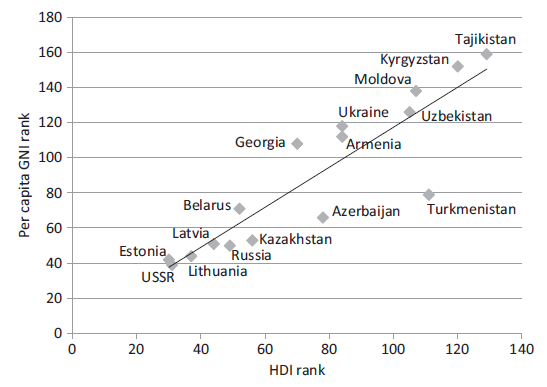
Table \(\PageIndex{1}\): Rankings corresponding to Figure \(\PageIndex{1}\)
|
USSR |
Estonia |
Lithuania |
Latvia |
Russia |
Belarus |
Kazakhstan |
Georgia |
Azerbaijan | Armenia | Ukraine | Uzbekistan | Moldova | Turkmenistan | Kyrgyzstan | |
| HDI rank |
31 |
30 |
37 |
44 |
49 |
52 |
56 |
70 |
78 | 84 | 84 | 105 | 107 | 111 | 120 |
| Per capita GNI rank |
39 |
42 |
44 |
51 |
50 |
71 |
53 |
108 |
66 | 112 | 118 | 126 | 138 | 79 | 152 |
The modern semi-peripheral capitalism established in Russia is a far cry from the preconditions for bourgeois democracy. As mentioned above, its private ownership is based on an infrastructure of control - that is, on supra-economic coercion and violence. This type of private property, reflecting the joint effect of degeneration of the Soviet system and Western influence (see above), became the major institution strengthening the violation of human rights in modern Russia. First, these are rights of hired labour. Distribution of the national income is determined by the power of big capital in its coarse form. It implies transfer of part of the income created by the labour of the Russian population (and in the case of oil revenues, by labour in other countries) to the world financial markets. Such a regime is incompatible with a genuine democracy. Indeed, under a democratic regime people would not tolerate not only some particular politicians, but the social system of peripheral capitalism as such. Thus, the foundations of the authoritarian political regime are rooted not in past experiences of Mr Putin, but in the nature of the new social system which was partially inherited from the degeneration of the Soviet system and formed under the crucial influence of the West.
As is well known, the radical market reforms of the early 1990s, and privatisation in particular, were challenged by the Russian Supreme Soviet - the first truly democratically elected parliament in modern Russian history. This led to an eventual showdown between the parliament and President Yeltsin, supported by the West, in October 1993. It was a decisive moment for the fate of democracy in modern Russia. For the sake of going forward with radical market reforms, the liberal pro-Western power elite resorted to shooting up the first legally elected parliament in modern Russian history.15 It is worth mentioning that Yeltsin's edict, which disbanded the Supreme Soviet, justified this move by the Supreme Soviet's 'direct resistance to implementation of social and economic reforms'.16 The parliamentary opposition, while pursuing its own aims, at the same time protested against the radical market reforms on behalf of the wider Russian public. Shooting up the parliament removed the last obstacles on the way to formation of the new capitalist class - notorious Russian oligarchs - and secured the authoritarian political regime favourable to their economic power and corresponding to it. It is exactly the type of pseudo-democratic power free from the societal control necessary to establish the external elements of the infrastructure of control. The shooting up of the democratically elected parliament, whatever conservative trends it demonstrated, was an undisguised act of civil war. It was carried out with the tacit support of the American administration. The memoirs of Strobe Talbott, the deputy US Secretary of State responsible for policy towards Russia in the Clinton administration, testify that in the moment of this acute crisis the US administration was concerned only with preserving in power Mr Yeltsin, who was making important unilateral concessions in vital strategic issues.17 Results of this 'victory' were fixed in the new authoritarian Constitution which cut the rights of the State Duma and the new Russian Parliament, and disproportionately extended presidential power.
Mr Putin only applied the mechanism of authoritarianism created by his powerful predecessor with the full support of the West. It is important to emphasise that this mechanism itself reflects the objective character of the social-class relations established in the country in post-Soviet times. More than that, present Russian capitalism has inner features which prevent its democratic evolution.
As was shown above, due to the fundamental instability of its control over assets, Russian big business is oriented towards short-term rent rather than long-term growth. This creates obstacles for the process of recognition of general interests by the Russian property-owning class. That is why such aims as modernisation, social stability, a worthy place at the world market and the like are not shared by all business groups. The recurring process of redistribution of property rights demonstrates the constant 'war of all against all' in the milieu of big business. Essentially, Russian oligarchs represent a mechanical aggregation of rival, hostile groups. Such a situation prevents the development of the joint class consciousness of the current Russian bourgeois class in a meaningful form. In the absence of the joint interests of the ruling class, there is no real place for genuine social compromise with other social classes and groups. It appears that there are no socio-economic foundations for the hegemony of the current Russian bourgeoisie.
There are no preconditions for the formation of a relatively independent bourgeois state either. The principle of 'equidistance of power from oligarchs' proclaimed by Putin is no more than a slogan. A number of his cronies joined the Forbes 'Golden hundred' of Russians, when Mr Putin came to power.18 The external elements of the infrastructure of control, 'roofs' provided by the state functionaries and lobbyist structures, mean that in fact they have a double system of responsibilities. Ostensibly they are responsible to the state hierarchy, while actually they stick to the interests of business groups to which they are linked by informal networks of power and money relations. External elements of control are very costly, but they are vital to preserve control over enterprises. From this it follows that bribes (which facilitate informal links between power and money) are intrinsic to the system and represent part of the investment of capital by Russian big business. That is why it is impossible to overcome corruption in the society of semi-peripheral capitalism without challenging this social system as such.
Thus, modern Russia demonstrates an atomised proprietary class and fragmented state. Having come into being in the 1990s, it was followed by economic decline and plummeting living standards that threatened the disintegration of the very fabric of society. This was saliently demonstrated by the 'parade of sovereignties' (which means that many Russian regions proclaimed their independence from the central power) which rolled over Russia in the early 1990s. All this was only a window of opportunity for the local elites' takeover of the former state assets in 'their' territories. It was this growing vacuum of power which was stopped by Mr Putin's strengthening of his personal power regime.
Putin carried out an administrative reform strengthening control of the central government bodies in the hierarchy of power; cancelled election of the regional heads, replacing it by direct appointment; increased expenditures on the military, secret services and law enforcement agencies; ousted from the country a few powerful oligarchs who challenged his personal power, and so on. In the absence of real preconditions for bourgeois democracy and any influential social protest movements, Putin's authoritarianism helped to fill the vacuum of power and stopped the anarchic disintegration of the country. This explains his popularity among the Russian population. However important in their time, these achievements are only relative and temporary.
One must say that Putin's reforms left intact the foundations of the social system established in Russia after the fall of the Soviet system. The US expert on Russia, Marshall Goldman, wittily called modern Russia 'Petrostate'.19 Indeed, the relative political and social stability of our society achieved in the 2000s rested on partial redistribution of oil revenues. It was this which allowed a significant increase of expenditures on defence, the state apparatus, education and healthcare. Subsidies to some regions, which were largely embezzled, bought loyalty of the local elites. However, these measures do not solve the long-term problems of the inefficient social system.
Indeed, the domestic policy of the Russian state is ambiguous and contradictory. One of the most salient contradictions in modern Russia is the fact that the sharp anti-American rhetoric of the mass media coexists with staunchly neo-liberal economic policy based on American recipes. Even more than that, government bodies responsible for economic policy are headed by pro-American functionaries. Their main instruments of economic policy are (a) restrictive monetary policy and (b) a balanced budget approach. These are seen as the main preconditions for financial stabilisation which is expected to facilitate economic growth. Restrictive monetary policy is designed to suppress inflation, but it also serves to establish a foreign currency rate favourable for exporters. To prevent appreciation of the rouble, the Russian Central Bank buys 'excess' foreign currency and invests it in the world financial markets (largely in US assets). The budget deficit is decreased at the expense of cutting expenditures on the national economy, national defence, education, science and healthcare. Obviously, it is a conventional neo-liberal agenda. It was not changed even under the conditions of anti-Russian economic sanctions imposed on the country in retaliation for its firm position in the Ukraine crisis (see the next section).
In obvious contradiction to this approach stands the so-called manual management of the national economy on the part of the Kremlin group, which entails 'point management' of the presidential administration. The Kremlin group is an influential state body in modern Russia that sometimes challenges the government, infringing on its sphere of influence. A number of Russian oligarchs dependent on the Kremlin act as vehicles of the latter's economic policy. Dependent structures of big business are unofficially, but earnestly 'advised' to invest in one or another project considered important for national economic development by the Kremlin administration. This policy corresponds to Putin's international strategy (see below). For instance, under current conditions pro-Kremlin oligarchs are guided to create enterprises in the Russian Far East to supply raw materials and semi-processed products to China. Another important vehicle of the Kremlin's economic policy is represented by 'state corporations'. These bulky and rigid structures represent state holdings whose assets were appropriated under strong pressure from the state. They are notoriously inefficient but increase the economic influence of the Kremlin.
Obviously, 'manual management' goes against the conventional principles of the neo-liberal approach of the Russian government. Economic policy eventually reflects some compromise between two approaches intermediated by Putin. Naturally, this compromise fails to provide any clearly articulated long-term strategy of economic or social development of the country. The very fact of the deep split in the Russian elite reflects the essential properties of semi-peripheral capitalism. They also condition a contradictory approach to foreign policy.
Neo-revisionist foreign policy: The clash of capitalisms?
One may single out two groups of the Russian ruling class, who cooperate and compete in shaping Russian domestic and foreign policy. They can be defined according to the direction of their integrationist strategy. 'Atlantic integrationists' are oriented towards strengthening their ties with the West. Their opponents can be called 'Eurasian integrationists', because they try to entrench Russia's independent stance in the world arena. The first group is largely represented by notorious Russian oligarchs, who extract their rent in Russia and then invest large parts of it in the West. Even when they buy enterprises abroad, these are savings rather than investments because their profitability is usually much lower than that of their Russian assets. (This does not mean that Russian business is more efficient. Big business simply redistributes income in its favour using noneconomic means.) Trying by all means to integrate into the Western ruling elite, these oligarchs are dependent on the West. The second group largely consists of oligarchs associated with the so-called Kremlin group. Functionaries from law enforcement agencies occupy a prominent position in this group. The two orientations of Russian foreign policy are only another dimension of the split peculiar to the ruling class of a semi-peripheral capitalism. Russian foreign policy is determined by behind-the-scenes collusion and compromise of these two powerful groups. This explains its inconsistency and wavering.
Mainstream Western political analysts depict Russian foreign policy as a revisionist one, attempting to undermine the current world economic order. It is substantiated by the fact that it allegedly tries to restore the Soviet Union in a new form. In December 2012, then US Secretary of State Hillary Clinton condemned Russia for the alleged attempt 'to re-Sovietize the region' of the former USSR: 'It's not going to be called that. It's going to be called customs union, it will be called Eurasian Union and all of that,' she explained. 'But let's make no mistake about it. We know what the goal is and we are trying to figure out effective ways to slow down or prevent it.'20 However, Russian policy is by no means a revisionist one. In fact, Putin challenges neither Western domination in the world in general, nor US hegemony in particular. He is rather trying to defend Russian national interests in the existing framework of the current world order. According to Richard Sakwa from Kent University (UK), such a strategy, based on an attempt to change the practice of Western domination rather than undermine it, should be called 'neo-revisionist'.21
This can be seen from the recent history of Russian foreign policy. In his first tenure in power (2000-4) Putin's policy more or less continued the 'Yes' diplomacy of his predecessor in relations with the West. He made a few important unilateral concessions, signing the Strategic Arms Reduction Treaty (START, 2002), which contained conditions unilaterally favourable for the United States; closing Russian military bases in Vietnam; closing the electronic surveillance centre in Cuba; helping to establish US military bases in Central Asia; and cooperating on Afghanistan and in some other issues. In response, the then-new Russian president expected that the West would recognise the leading role of Russia in the former Soviet space. However, this never happened. What followed was seen in Moscow as creeping but persistent strategic encirclement of Russia; the most treacherous was considered the expansion of NATO to the East despite oral guarantees that this military bloc would never move 'an inch' to the East. Quite important was the US decision to deploy an anti-missile defence system in Europe allegedly directed against the menace of North Korean forces, but obviously against Russia. One of the most threatening developments to Russian interests was a number of 'coloured revolutions' organised by the United States in the former Soviet space. Against this backdrop, the invitation to join NATO granted to Ukraine 'represented a fundamental threat to Russia's national security. It would have rendered Russia indefensible and threatened to destabilise the Russian Federation itself. When the United States went so far as to suggest that Georgia be included as well, bringing NATO deeper into the Caucasus, the Russian conclusion - publicly stated - was that the United States in particular intended to encircle and break Russia'.22
A clear signal that Moscow was reconsidering its policy of unilateral concessions was sent to the West by Putin in his famous 'Munich speech', made at the 43rd Munich Security Conference in 2007. The Russian president condemned the US policy of establishing a 'unipolar world' and reminded the West of its obligations on the non-expansion of NATO.23 Despite the fact that the speech did not contain any aggressive statements, the very claim of Russian leadership to an independent international policy annoyed the Western political establishment.24 The next year, dramatic events in the Caucasus put this new strategy to a severe test.
In August 2008, the pro-American Georgian regime of Mikheil Saak'ashvili invaded the breakaway republic of South Ossetia in the Southern Caucasus. This had been an autonomous region, while Abkhazia had been an autonomous republic in Soviet Georgia. Both proclaimed independence and had been attempting to join Russia ever since the breakdown of the Soviet Union, on the same moral and judicial grounds by which Georgia received its own independence. The military attempt to suppress the maverick region followed after tacit support and encouragement on the part of the United States, despite unofficial warnings on the part of Russia that this would not be tolerated.25 The Russian army quickly interfered, putting an abrupt end to the Georgian adventure and securing independence for the two republics. As was observed by the well-informed British Times newspaper, the reasons for this clash were deeper than just local ethnic conflict: 'Oil may not be the cause of the war between Georgia and Russia, but it is a central element in the wider geo-strategic picture, and a source of incendiary tension that has helped to inflame the area.'26
The Eurasian Economic Union (EAEU) is an international organisation of regional economic integration formed in 2015 by Belarus, Kazakhstan and the Russian Federation, and joined the same year by Armenia and Kyrgyzstan. The EAEU proclaims the free movement of goods, services, capital and workforce, and conducts a coordinated, agreed policy in particular sectors of the economy. Post-Soviet republics view the concept of Eurasian integration as a way of mobilising their joint resources for modernisation of their countries confronted with strong external challenges, defined in terms of both geopolitics and geoeconomics.27 The EAEU population amounts to 183.8 million, its joint GDP to $1.8 trillion; industrial production in 2017 was 2.2 per cent of world output; and foreign trade with the outside world in 2014 was $877.6 billion (3.7 per cent of world exports and 2.3 per cent of world imports).28 The world share of EAEU economies is quite modest. Nevertheless, integration has facilitated mutually beneficial economic (especially trade) relations. Russia is the main driving force behind the EAEU. However, while its share in foreign trade of the fellow-members of the union is great, their share in Russia's imports is low.29 This means that for Russia, geopolitical aspects of the union are more important than economic aspects. Indeed, it is the most important Russian initiative of recent years in the former Soviet space.
Even more challenging was the Ukraine crisis, which erupted in late 2013. This country plays the key role in Mr Putin's design of the EAEU project and in any attempt to restore Russia's role in the former Soviet space. According to a US military expert, Ukraine plays an enormously significant role in energy resources transportation to the West and helps to prevent the revival of anything like a superpower in the former USSR.30 This made Ukraine a battleground for the strategic clash of Russia and the West long before the Maidan uprising of 2013-14. The United States had long exercised their 'soft power' in this country, which cost them $5 billion, according to the famous confession of the then US Deputy Secretary of State Victoria Nuland.31 The Maidan uprising itself was quite justified as an expression of people's outrage against the corruption and gross inefficiency of the country's leadership. However, it was exploited and directed from behind the scenes by the West, mainly by America. Russian interference was both predictable and justified as defence of Russian interests against Western interference behind the façade of a new coloured revolution. Reunification of Crimea was a pre-emptive strike, which thwarted the ousting of the Russian navy from its major naval base on the Black Sea in Sevastopol.32 However, Russian support of the Donbas uprising of the pro-Russian population against the dictatorship of the Ukrainian nationalists was limited, since Putin abstained from open recognition of the two breakaway republics and from granting them full-scale military support.33
The Russian role in the Syrian conflict should be seen in connection with the Ukraine crisis. For a long time, Russia was working behind the scenes to form the alliance of Iran, Hezbollah and Syria in support of the friendly Assad regime.34 However, Russian direct involvement was facilitated by the stalemate of the Ukraine crisis. Putin needed some tool to divert the US military, economic and political resources from Central Europe to some other region more important for American interests. He found Syria, saving Assad from destruction and turning back the course of the Syrian civil war. Doing this, the Russian president attempted to compel the West to recognise Russia as an indispensable player in the international arena.
Putin's foreign policy is quite pragmatic, pursuing economic interests rather than cherishing imperial dreams. In particular, the above-mentioned 'manual management' is used by the Kremlin group in the Russian Far East to join the supply chain of Chinese industry. A number of enterprises are established in the region to supply raw materials and semi-processed goods to the industrial heart of China. The problem is that these goods are already being supplied to China by Australia, and extraction of Australian mineral resources is controlled by powerful Western financial groups. The Kremlin suggests a certain share in Russian business in this region to these financial groups to placate them and obtain their support for the project. An additional dimension of this policy is the Kremlin's hope to enlist the support of powerful segments of the Western elite in broader areas of international policy.35 It is the type of scheming pertinent to Mr Putin. He would never make such a blunder as poisoning former KGB defectors by chemical warfare agents or direct interference in the US elections. Mr Putin prefers much subtler ways of behind-the-scenes influence, which leaves no traces.
However clever and skilful such types of scheming may seem, it can promote Russian interests only in the short or at most medium term because it fails to address the roots of Russian problems - the deficiencies of a semi-peripheral capitalism.
Conclusion
Summing up the above, one must note that Russian capitalism is a far cry from what was dreamed about by the Soviet population on the eve of transition to the new social system. The image of the new society was appealing because of its pledge of democracy, economic prosperity and human rights. However, radical market reforms produced semi-dependent capitalism. Its economy is based on transfer of part of the wealth created by the labour of its population to the dominant capitalist countries. It is the real condition of access to the capitalist world-system. As a result of this, the Russian economy, and economies of all other former Soviet republics as well, inevitably suffer backwardness, economic inefficiency and the mass impoverishment of the population. Big business is based on rent-seeking behaviour, undermining the accumulation of capital and economic growth. The high rate of exploitation of labour is incompatible with human rights and real democracy. The authoritarian state is the only alternative to social chaos. Under conditions of the Great Stagnation,36 the struggle for redistribution of global wealth exacerbates. This increases the number of international conflicts in which Russia is involved. Under such conditions, inefficient, semi-dependent Russian capitalism is unable to defend national interests in the framework of the existing world order.
1Lev Trotskii, Predannaia revoliutsiia. Chto takoe SSSR i kuda on idet? (Moscow: Moskovskii rabochii, 1991 [1936]), 210.
2David Lane, Elites and Classes in the Transformation of State Socialism (New Brunswick, NJ: Transaction Publishers, 2011), 43.
3Stanislav Menshikov, The Anatomy of Russian Capitalism (Washington, DC: Executive Intelligence Review News Service, 2007), 9.
4By the 1990s, world experience already had demonstrated that the formula of 'liberalisation plus stabilisation' (that is, privatisation and a restrictive monetary policy) served to aggravate poverty and misery in the developing countries. Michael Chossudovsky, The Globalisation of Poverty: Impact of IMF and World Bank Reforms (London: Zed Books, 1997).
5Janine Wedel, Collision and Collusion: The Strange Case of Western Aid to Eastern Europe (New York: Palgrave, 2001), ch. 4.
6Sergei Stepashin, ed., Analiz protsessov privatizatsii gosudarstvennoy sobstvennosti v Rossiiskoi Federatsii za period 1993-2003 gody (Moscow: Olita, 2004).
7Stanislav Menshikov, Anatomiia rossiiskogo kapitalizma (Moscow, Mezhdunarodnye Otnosheniia, 2004), 61-62.
8Tatyana Dolgopyatova, 'Evolution of the Corporate Control Models in the Russian Companies: New Trends and Factors', SUHSE Working Paper WP1/2005/04 (Moscow: State University-Higher School of Economics, 2005).
9Ruslan Dzarasov, 'Insider Control and Investment Behaviour of Russian Corporations' (PhD thesis, Staffordshire University, UK, 2007), 78.
10Robert Nigmatulin, ed., Modernizatsiia Rossii: problemy i puti ikh resheniia (Moscow: ZATS Modernizatsiia, 2012), 53.
11'The net inflow/outflow of private capital (according to the data of the Balance of Payments of Russian Federation)', Central Bank of the Russian Federation, accessed 17 August 2018, http://www.cbr.ru/statistics/?PrtId=svs.
12Edward Lucas, The New Cold War: How the Kremlin Menaces both Russia and the West (New York: Palgrave Macmillan, 2008).
13Joseph V. Femia, Gramsci's Political Thought: Hegemony, Consciousness, and the Revolutionary Process (Oxford: Clarendon Press, 1981).
14Ralph Miliband, Marxism and Politics. Marxist Introductions. (Oxford: Oxford University Press, 1977).
15Antonio Rubbi, Yeltseniada: Pervoye desiatiletye postsovetskoi Rossii (Moscow: Mezhdunarodnye otnoshenia, 2004), 188-205.
16Moskva. Osen'-93: Khronika Protivostoianiia (Moscow: Respublika, 1995), vii.
17Strobe Talbott, The Russia Hand: A Memoir of Presidential Diplomacy (New York: Random House, 2002).
18Boris Nemtsov and Vladimir Milov, Putin 10 Let. Itogy (Moscow: Solidarnost', 2010), 6.
19Marshall Goldman, Petrostate: Putin, Power and the New Russia (New York: Oxford University Press, 2008).
20Bradley Klapper, 'Clinton fears efforts to "re-Sovietize" in Europe', The Seattle Times, 6 December 2012, accessed 29 August 2018, www.seattletimes.com/nation-world/clinton -fears-efforts-to-re-sovietize-in-europe/.
21Richard Sakwa, Frontline Ukraine: Crisis in the Borderlands (London: I.B. Tauris, 2015).
22George Friedman, 'The Russo-Georgian War and the Balance of Power', Geopolitical Intelligence Report, 12 August 2008, accessed 26 November 2018, worldview.stratfor.com/article /russo-georgian-war-and-balance-power.
23Vladimir Putin, 'Vystuplenie i diskussiia na Miunkhenskoi konferentsii po voprosam politiki bezopasnosti 10 fevralia 2007 g', Prezident Rossii, 10 February 2007, accessed 4 September 2018, www.kremlin.ru/events/president/transcripts/24034.
24Thom Shanker and Mark Landler, 'Putin Says U.S. is Undermining Global Stability', New York Times, 11 February 2007.
25Thomas Omestad, 'Putin's Russia Acts as a Great Power Again', US News & World Report, 22 August 2008.
26Ben Macintyre, 'Georgian Oil Pipeline: The Frontline', The Times, 13 August 2008.
27See papers written by leaders of Russia, Belarus and Kazakhstan who initiated the EAEU: Vladimir Putin, 'Novyi integratsionnyi proekt dlia Evrazii - budushchee, kotoroe rozhdaetsia segodnia', Izvestiia, 3 October 2011; A. Lukashenko, 'O sud'bakh nashei integratsii', Izvestiia, 17 October 2011; N. Nazarbaev, 'Evraziiskii Soyuz - ot idei k istorii budushchego', Izvestiia, 25 October 2011.
28Eurasian Economic Union, 'EAEU, 2016', accessed 4 September 2018, www.eaeunion.org/#about.
29Elena Ustyuzhanina, 'The Eurasian Union and Global Value Chains', European Politics and Society 17, supp. 1 [The Eurasian Project in Global Perspective] (2016): 35-45.
30R. Craig Nation, NATO's Relations with Russia and Ukraine (Carlisle, PA: U.S. Army War College, 2000).
31Victoria Nuland, 'Victoria Nuland Admits Washington Has Spent $5 Billion to "Subvert Ukraine"', 9 February 2014, accessed 7 May 2018, http://www.youtube.com/watch?v=U2fYcHLouXY.
32Rodolfo Ragonesi, 'The Crimean Question', Times of Malta . com, 14 April 2014, accessed 7 May 2016, www.timesofmalta.com/articles/view/20140414/opinion/The-Crimean-question.514876.
33Richard Sakwa, Frontline Ukraine: Crisis in the Borderlands (London: I.B. Tauris, 2015).
34Talal Nizameddin, 'Squaring the Middle East Triangle in Lebanon: Russia and the Iran-SyriaHezbollah Nexus', The Slavonic and East European Review 86, no. 3 (July 2008): 475-500.
35Personal communication of the author with an expert in Russian big business in the Far East, who requested that his identity not be disclosed.
36This refers to the view that recent sources of economic growth are becoming exhausted. See Tyler Cowen, The Great Stagnation (New York: Dutton, 2011).
Bibliography
Chossudovsky, Michael. The Globalisation of Poverty: Impact of IMF and World Bank Reforms. London: Zed Books, TWN Third World Network, 1997.
Cowen, Tyler. The Great Stagnation. New York: Dutton, 2011.
Dolgopyatova, Tatyana. 'Evolution of the Corporate Control Models in the Russian Companies: New Trends and Factors'. SUHSE Working Paper WP1/2005/04. Moscow: State University- Higher School of Economics, 2005.
Dzarasov, Ruslan. 'Insider Control and Investment Behaviour of Russian Corporations'. PhD thesis, Staffordshire University, UK, 2007.
Eurasian Economic Union. 'EAEU, 2016'. Accessed 4 September 2018, www.eaeunion.org/#about.
Femia, Joseph V. Gramsci's Political Thought: Hegemony, Consciousness, and the Revolutionary Process. Oxford: Clarendon Press, 1981.
Friedman, George. 'The Russo-Georgian War and the Balance of Power'. Geopolitical Intelligence Report, 12 August 2008. Accessed 26 November 2018, worldview.stratfor.com/article/russo-georgian-war-and-balance-power.
Goldman, Marshall. Petrostate: Putin, Power and the New Russia. New York: Oxford University Press, 2008.
Human Development Report 1990 (New York: Oxford University Press, 1990).
Human Development Report 2016: Human Development for Everyone (Washington, DC: Communications Development Incorporated, 2016).
Klapper, Bradley. 'Clinton Fears Efforts to "re-Sovietize" in Europe'. The Seattle Times, 6 December 2012. Accessed 29 August 2018, www.seattletimes.com/nation-world/clinton-fears-efforts-to-re-sovietize-in-europe/.
Kotz, David, and Fred Weir. Russia's Path from Gorbachev to Putin: The Demise of the Soviet System and the New Russia. Abingdon, UK: Routledge, 2007.
Lane, David. Elites and Classes in the Transformation of State Socialism. New Brunswick, NJ: Transaction Publishers, 2011.
Lucas, Edward. The New Cold War: How the Kremlin Menaces both Russia and the West. New York: Palgrave Macmillan, 2008.
Lukashenko, A. 'O sud'bakh nashei integratsii'. Izvestiia, 17 October 2011.
Macintyre, Ben. 'Georgian Oil Pipeline: The Frontline'. The Times, 13 August 2008.
Menshikov, Stanislav. Anatomiia rossiiskogo kapitalizma. Moscow: Mezhdunarodnye otnoshenia, 2004.
Menshikov, Stanislav. The Anatomy of Russian Capitalism. Washington, DC: Executive Intelligence Review News Service, 2007.
Miliband, Ralph. Marxism and Politics. Marxist Introductions. Oxford: Oxford University Press, 1977.
Morozov, Sergei. Diplomatiia Putina. Moscow: Izdatel'stvo 'Krylov', 2008.
Moskva. Osen'-93: Khronika Protivostoianiia. Moscow: Respublika, 1995.
Nation, R. Craig. NATO's Relations with Russia and Ukraine. Carlisle, PA: U.S. Army War College, 2000.
Nazarbaev, N. 'Evraziiskii Soyuz - ot idei k istorii budushchego'. Izvestiia, 25 October 2011. Nemtsov, Boris, and Vladimir Milov. Putin 10 Let. Itogy. Moscow: Solidarnost', 2010.
Nigmatulin, Robert, ed. Modernizatsiia Rossii: problemy i puti ikh resheniia. Moscow: ZATS Modernizatsiia, 2012.
Nizameddin, Talal. 'Squaring the Middle East Triangle in Lebanon: Russia and the Iran-Syria-Hezbollah Nexus'. The Slavonic and East European Review 86, no. 3 (July 2008): 475-500.
Nuland, Victoria. 'Victoria Nuland Admits Washington Has Spent $5 Billion to "Subvert Ukraine"'. 9 February 2014, accessed 7 May 2018, www.youtube.com/watch?v=U2fYcHLouXY.
Omestad, Thomas. 'Putin's Russia Acts as a Great Power Again'. US News & World Report, 22 August 2008.
Putin, Vladimir. 'Novyi integratsionnyi proekt dlia Evrazii - budushchee, kotoroe rozhdaetsia segodnia'. Izvestiia, 3 October 2011.
Putin, Vladimir. 'Vystuplenie i diskussiia na Miunkhenskoi konferentsii po voprosam politiki bezopasnosti 10 fevralia 2007 g'. Prezident Rossii, 10 February 2007. Accessed 4 September 2018, http://www.kremlin.ru/events/president/transcripts/24034.
Ragonesi, Rodolfo. 'The Crimean Question'. Times of Malta . com, 14 April 2014. Accessed 7 May 2016, www.timesofmalta.com/articles/view/20140414/opinion/The-Crimean-question.514876.
Reddaway, Peter, and Dmitri Glinski. The Tragedy of Russia's Reforms: Market Bolshevism against Democracy. Washington, DC: United States Institute of Peace Press, 2001.
Rubbi, Antonio. Yeltseniada: Pervoe desiatiletie postsovetskoi Rossii. Moscow: Mezhdunarodnye otnoshenia, 2004.
Sakwa, Richard. Frontline Ukraine: Crisis in the Borderlands. London: I.B. Tauris, 2015.
Shanker, Thom, and Mark Landler. 'Putin Says U.S. is Undermining Global Stability'. New York Times, 11 February 2007.
Stepashin, Sergei, ed. Analiz protsessov privatizatsii gosudarstvennoy sobstvennosti v Rossiiskoi Federatsii za period 1993-2003 gody. Moscow: Olita, 2004.
Talbott, Strobe. The Russia Hand: A Memoir of Presidential Diplomacy. New York: Random House, 2002.
Trotskii, Lev. Predannaia revoliutsiia. Chto takoe SSSR i kuda on idet? Moscow: Moskovskii Rabochii, 1991 [1936].
Ustyuzhanina, Elena. 'The Eurasian Union and Global Value Chains'. European Politics and Society 17, supp. 1 [The Eurasian Project in Global Perspective] (2016): 35-45.
Wedel, Janine R. 'Clique-Run Organizations and U.S. Economic Aid: An Institutional Analysis'. Demokratizatsiya: The Journal of Post-Soviet Democratization 4, no. 4 (Fall 1996).
Wedel, Janine R. Collision and Collusion. The Strange Case of Western Aid to Eastern Europe. New York: Palgrave, 2001.