China's politicians like to emphasise that they are building a socialist market economy based on the ideology of socialism with Chinese characteristics. Unlike other post-communist transitions to capitalism, China's radical economic transformations during the neo-liberal era did not generate a large pool of economic losers. On the contrary, over the last three decades, seven hundred million Chinese escaped poverty. Yet at the same time, China's impressive economic growth has been associated with the rise of a wealthy elite, which gradually is being co-opted by the party-state. Relying on elite-level and survey data, this study goes beyond socio-demographic characteristics and investigates whether party membership, education, beliefs in upward mobility and support for an interventionist state correlate with income levels. The final section discusses the implications of the observed trends for the future of the Chinese economic model.
From planned economy to socialist market economy
Xi Jinping is the General Secretary of the Communist Party of China (CPC) and President and 'core leader' of the People's Republic of China (PRC). In October 2017, in front of the delegates of the XIX Party Congress, Xi gave an important speech entitled 'Thought on Socialism with Chinese Characteristics for a New Era'. Soon thereafter, the phrase 'Xi Jinping Thought' was incorporated into the party and state constitutions, an honour reserved so far only to Mao Zedong and Deng Xiaoping. In his long speech, Xi promised to uphold socialism with Chinese characteristics in order to finish the country's 'socialist modernization and national rejuvenation' by 2050.1 The phrase 'socialism with Chinese characteristics' was coined by Deng Xiaoping three decades ago. Even though current officials mention it as the essential goal of the party-state, it is difficult to pinpoint its precise meaning. So far, the expression seems to refer to the transition of the Chinese planned economy to a socialist market economy, a hybrid system blending market and command economy elements.
During the last seven decades, China underwent two systemic transformations. From 1949 to 1976, under Mao's leadership, it largely followed the Soviet model of development. It collectivised agriculture, created its own heavy industry, eliminated private enterprises, controlled prices and monopolised foreign trade and state banking. These are classic command economy policies borrowed from the Soviet Union. After the Sino-Soviet split, China embarked on a course of gradual rapprochement with the United States. The stagnation of the early 1970s prompted some party officials to voice pro-market views, running against the prevailing statist ideology. Rejected by Mao, those market-friendly communists were quickly side-lined for their attempts to push the country onto the capitalist path.
After Mao's death, the reformers, including Deng Xiaoping, advanced to top positions in the party. Deng initiated the policy of reform and opening up (gaige kaifang), which remains the foundation of China's transition to market. The experiment of the special economic zones, though successful, generated fears among the ideological hardliners, who thought that the Middle Kingdom was moving toward capitalism. To defend his policy proposals against Maoist critiques, in 1982 Deng highlighted the need to adapt Western development models to local conditions:
In carrying out our modernization program, we must proceed from Chinese realities. Both in revolution and in construction, we should also learn from foreign countries and draw on their experience, but mechanical application of foreign experience and copying of foreign models will get us nowhere. We have had many lessons in this respect. We must integrate the universal truth of Marxism with the concrete realities of China, blaze a path of our own and build a socialism with Chinese characteristics.2
In 1983, Deng went even further suggesting that 'some people in rural areas and cities should be allowed to get rich before others'.3 Later on, at the XIV Party Congress, the party leaders officially endorsed the project of a socialist market economy. More recently, former CPC General Secretary Hu Jintao outlined in a key party congress speech that public ownership and the guiding role of the party in building a moderately prosperous society (xiaokang shehui) by 2020 remain two of the central elements of the existing economic system.4
Yet the evolution of China's socialist market economy remains a big unknown. It would be hazardous to speculate on its sustainability solely by deciphering the official party line. Within the development paradigm adopted by the party, the state will continue to play the major role in steering domestic economic transformation through five-year plans. Productivity gains and large-scale capital investment, combined with the propensity of Chinese households to save, have produced high rates of economic growth. In 2012, the private sector was responsible for 70 per cent of the country's manufacturing output and 80 per cent of the jobs in urban areas.5 So far, China's state-led development resembles the late-modernisation success stories of the 'four Asian tigers' - Hong Kong, Singapore, South Korea and Taiwan. During the next decade, the Chinese economy might slow down as the country abandons export-led growth and embraces a model of growth based on domestic consumption. Currently, China seems far from the chronic economic stagnation plaguing the command economies before their demise. As such, the idea that a communist-led China achieved economic growth without relying significantly on foreign direct investment and without dismantling the state, challenges the Washington consensus - the neo-liberal orthodoxy popular until recently among policymakers in some of the former Communist countries.6
When compared to other post-communist transitions, China's road to market differs in two respects. First, in some of the former communist countries, transitions to market have generated an anti-market backlash exploited by adept political entrepreneurs. By contrast, marketisation enjoys popular support in China. Some scholars characterised this phenomenon as "reforms without losers."7 According to World Bank data, in 1990, 756 million Chinese (66 per cent of the population) lived on less than US $1.90/day (i.e., below the international poverty line).8 A quarter of a century later, using the same benchmark, the same data show that only 10 million Chinese (0.7 per cent of the population) were poor. Indeed, the state has enacted economic reforms allowing more than 700 million individuals to escape poverty. In doing so, it has profoundly altered the fabric of society and created a pro-market constituency.
Second, China's leaders adopted a dual-track approach, developing labour-intensive sectors and supporting exports, while protecting inefficient sectors from international competition. Such an approach enabled the political elites to harvest the fruits of trade liberalisation and avoid massive layoffs. In 1998, preparing its WTO accession, China was constrained to launch deeper market reforms. But even then, the state exited competitive sectors and privatised the smaller state-owned enterprises (SOEs), while keeping the large ones under its control (zhua da fang xiao). As a result of this increase in efficiency, higher revenues allowed the state to compensate the groups negatively impacted by economic reforms. That is why the Chinese political elites could pursue further marketisation without having to fear an anti-market backlash.
The future of the market in China depends to a large extent on the level of acceptance it enjoys in society. Among elites, there is a solid consensus on the necessity to continue reforms. But the cosy relationship between the indigenous capitalists and state officials amidst rising income disparities led some scholars to expect an outburst of social unrest. Whyte rejects such expectations as unrealistic and demonstrates that 'China's social volcano of potential anger at growing distributive injustice was clearly still dormant in 2009.'9 Survey data from 2012 confirm that 75 per cent of Chinese support market reforms despite the growing inequality.10
Nevertheless, the transition to market did breed dissatisfaction. Some intellectuals criticised the continuing privatisation of state property and the conspicuous consumption prevalent among the wealthy elites. Cui Zhiyuan, Gan Yang, Wang Shaoguang and Wang Hui formed the New Left (xin zuopai), a loose group calling for alternative models of development that would mitigate the negative side effects of the pro- market policies.11 Likewise, discontent with reforms is simmering among those who religiously revere Mao Zedong. When Mao Yushi, a liberal economist, published an article criticising Mao's economic policies, diehard Maoists requested that state authorities put him on trial.12 Despite such scattered pockets of discontent, popular support in favour of further marketisation remains strong.
The rise of the billionaires
Economic growth has been accompanied by the rise in wealth and income inequality. So that by now, the concentration of wealth in China has reached levels comparable to those in advanced capitalist countries. In 2016, the country's official Gini coefficient of 0.47 stood above the coefficients of the former Communist states.13 Moreover, for several years, income inequality in China remained higher than in the United States. Since 2008, as a result of governmental efforts, income inequality has slightly declined, but it still surpasses the levels observed in most of the developed countries.
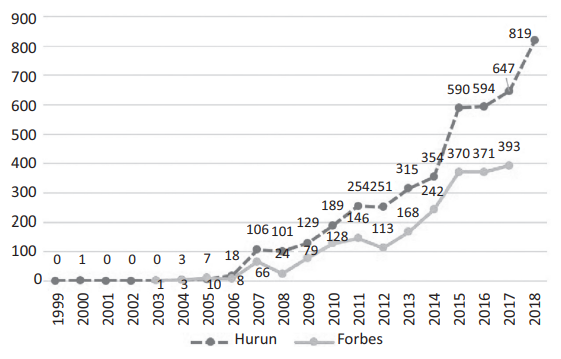
The newly emerged billionaires situated at the top of the wealth distribution benefitted most from the economic transformations. Two organisations - Hurun and Forbes - identify and rank the Chinese magnates. As shown in figure \(\PageIndex{1}\), their estimates diverge. Compared to Forbes, Hurun counts annually more Chinese billionaires. Despite some discrepancies, both graphs illustrate an unmistakable trend - the rapid rise of a national wealthy elite. In 2015, according to Hurun, more billionaires lived in China than in the United States.14
In the new context, private wealth may turn into a power resource. As certain individuals become extremely wealthy, they acquire more autonomy from the state and may use their resources to gain influence over regional officials. So far, the wealthy elites seem content to play the role of "allies of the state" rather than act as agents of change.15 But as Beijing continues to promote governors based in part on their economic performance, regional officials realise that the billionaires in their provinces are indispensable for the achievement of economic growth and the preservation of their power positions within the party-state.
Figure \(\PageIndex{1}\): The number of billionaires in China, 1999-2018. (Source: Graphs by author based on data from Rupert Hoogewerf, Hurun Report, Hong Kong/Shanghai, 2018. www.hurun.net/en/ArticleShow.aspx?nid=14678 (accessed 13 May 2018); Forbes Magazine, China's Rich List, 2003-2017, www.forbes.com/china-billionaires/ (accessed 13 May 2018).)
Over the last three decades, the relationship between the party-state and entrepreneurs evolved from suspicion to co-optation. The 1989 Tiananmen protests constituted a watershed moment in this regard. Some entrepreneurs provided food and transportation for demonstrators, thus irritating the party hardliners. Consequently, from 1989 to 2002, entrepreneurs were banned from joining the party. Moreover, pro-privatisation advocates such as Zhao Ziyang, the General Secretary of the Communist Party of China (CPC), were accused of over-empathising with the student protesters and lost their influence within the party. Interestingly enough, in 1991 the conservative faction was discussing the idea of establishing direct party ownership of state assets in order to prevent the formation of rival power centres.16 After a three-year hiatus, Deng's Southern Tour weakened the conservatives led by Chen Yun and market reforms accelerated again.17 In retrospect, it is noteworthy that the anti-market reaction after Tiananmen temporarily slowed down the transition to market, but did not lead to a wholesale reversal of reforms.
As the importance of the private sector grew, the mood in the party changed. To achieve a broader representation of societal interests, the party began courting and co-opting successful entrepreneurs. In 2002, the then CPC General Secretary Jiang Zemin formulated the doctrine of Three Represents, which encouraged the new social actors, among them businesspeople, to join the party.18 Five years later, 5 per cent of all party members were private entrepreneurs.19 In 2013, out of 85 million members, 25 million were farmers, herders and fishers; 20 million were management staff and technicians working in enterprises; 7 million were workers; and 7 million were state and party officials.20 The adoption of the Three Represents opened the doors of the CPC to the newly emerged billionaires, allowing the wealthy elites to gain representation in the party.
CPC's party-building strategy trailed the growth of the private sector as well. Non-public enterprises are required by law to set up party committees and cells. While the law has been in place for more than two decades, its strict implementation began a decade ago.21 In 2012, a party official triumphantly announced that 'party units have been established in about 983,000 private enterprises, including 47,000 foreign-funded companies'.22 Official data from 2017 show that the party has embedded itself in
1.88 million non-public enterprises and in 93 per cent of all SOEs.23 It follows then that the party has penetrated more than 10 per cent of all private enterprises. This pragmatic party-building strategy allowed CPC to establish its permanent presence in the private sector.
State institutions co-opt billionaires, too. Some of them become members of the National People's Congress (NPC) and the Chinese People's Political Consultative Conference (CPPCC), others join state-sponsored business associations. In 2008, 17 billionaires joined the NPC, while in 2013, the figure nearly doubled.24 I reviewed the biographies of the top 100 wealthiest individuals identified by Hurun in 2015 and found out that 58 per cent held politically important offices in the past. So far, most of them are recruited by provincial people's congresses and regional party officials via invitation.25 Overall, the selection process lacks transparency as it is not entirely clear what criteria are used to pick the future NPC and CPPCC delegates.
The two parallel processes - the co-optation of the wealthy elites by the party and the de facto colonisation of the private sector with party cells - point to the growing interdependence of the political and wealthy elites. However, despite the CPC efforts, China's wealthy do not feel secure. In 2013, 60 per cent of high-net-worth individuals were seriously thinking about investment migration.26 For now, in the absence of an inheritance tax in China, billionaires can easily transfer wealth to their children. The fuerdai, the second generation of wealthy Chinese, compete with their parents' generation in attracting media attention to their consumerist excesses at home and abroad.
To survive, socialism with Chinese characteristics needs more frugality. Besides the offspring of the wealthy elites, party cadres at higher levels engage in conspicuous status-confirming behaviour. CPC is not interested in the transformation of the party and state officials into a new class of mandarins. In 2012, Xi promoted the 'eight-point regulation', a nervous effort to subject the behaviour of the party cadres to a set of thrift and integrity rules. The guidelines ban spending on luxury goods, impose stricter standards on the use of public funds, specify limits on travel expenses, prompt officials to organise modest banquets, prohibit the construction of extravagant government buildings and control the frequency of public appearances of the nomenklatura.27 By October 2017, the party recorded a total of 193,168 thrift violations and reprimanded 145,059 officials for disregarding the policy.28 While the crackdown on conspicuous consumption will not stem the tide of consumerism sweeping nowadays across China, it might moderately improve the public's perception of party officials.
Does it pay to be a party member?
It is unclear whether the rising income inequality will perpetuate itself and block social mobility in the future. Hence, an intriguing aspect of China's economic transition concerns the determinants of income at the household level. Are demographic characteristics, political affiliation, and certain beliefs linked to higher income groups?
Previous studies have identified a variety of income predictors. Xin proved that party membership has a minor, but positive impact on household wealth.29 Xie and Jin demonstrate that employment with the party-state exerts a positive effect on household wealth.30 Besides political ties, education might figure as a determinant of income.31 Traditionally, parents in China put a high premium on education, regarding it as a contributing factor to social mobility. Western university degrees are preferred over domestic ones. High-ranking officials send their offspring to American and European universities. For example, President Xi Jinping's daughter studied at Harvard. The son of Wen Jiabao, China's former head of government, and other princelings graduated from universities in the West. Upon the careful analysis of party careers, a recent study found out that the CPC promotes educated individuals to higher party positions.32
To further explore whether party affiliation and education influence economic success in the general population, I used statistical techniques to analyse survey data recently published by the Pew Research Center.33 Table \(\PageIndex{1}\) displays the frequencies for each variable used in the analysis (see Appendix).
Since household income may be regarded as an important indicator of economic success, it figured as the dependent variable in this brief study. Respondents placed their household income within one of the following five brackets: 'less than 10,000 yuan' (14.4 per cent), '10,001-15,000 yuan' (4.9 per cent), '15,001-30,000 yuan' (25.9 per cent), '30,001-50,000 yuan' (14.7 per cent) and '50,001 and up' (36.2 per cent).34
Party membership and education figure as the main independent variables. Both party membership and education should be positively correlated with household income. Roughly 6 per cent of the respondents self-identified as party members, which corresponds to the percentage of party members in the overall population. Likewise, the level of education among respondents falls within one of the following seven categories: 'below primary school', 'primary school', 'junior school', 'high school', 'college', 'Bachelor's' and 'Master's'. Overall, 17 per cent of those interviewed received an undergraduate or graduate degree. To test whether other variables have an impact on household income, four demographic control variables were included in the analysis - gender, residence, region ('eastern', 'central' and 'western'), and ethnicity (Han and non-Han).35
Besides demographic characteristics, I was interested to test whether expectations about the role of the state in society are linked to income levels. To capture the preferences of the population regarding state intervention, survey respondents were asked the following question: What is more important in Chinese society: that everyone be free to pursue their life's goals without interference from the state or that the state plays an active role in society so as to guarantee that nobody is in need? Thirty-five per cent of the respondents prefer a less intrusive state (that is, freedom from state intervention), while 49 per cent opt for a stronger state providing for people in need (that is, equality). Even though most Chinese prefer state-sponsored redistribution and protection, one-third of the respondents opted for freedom from state intervention.
Beliefs in upward mobility may be associated with household income levels. To measure the belief in upward mobility, interviewees were asked the following question: How easy or difficult is it in China for a young person to get a better job and to become wealthier than his or her parents were - very easy, somewhat easy, somewhat difficult or very difficult? Fifty-seven per cent of respondents stated optimistically that it is easy/ somewhat easy to get a job and become wealthier than their parents.36
To test whether party membership, education, and mobility and statist beliefs predict household income levels, an ordered probit regression was implemented using STATA. I started the analysis with a baseline model and then entered additional variables of interest, as well as an interaction term. Table \(\PageIndex{2}\) (see Appendix) displays detailed estimates of the effects of each of the variables on income levels. Age, education, residence, region, party membership, belief in upward mobility, and the interaction term between party affiliation and orientation towards the state predict household income.37
To ease the interpretation of results, I plot in figure \(\PageIndex{2}\) the average marginal effects and predictive margins of the relevant predictors across the five income levels. Age has a negative effect on income, which is particularly notable at incomes above 30,000 yuan (figure \(\PageIndex{2A}\)). By contrast, education has a positive effect on income (figure \(\PageIndex{2B}\)). Specifically, education best predicts incomes above 50,000 yuan. Similarly, the chances to reach the upper income brackets are higher in cities and towns compared to villages. Given the existing literature on the urban-rural income gap, this finding is hardly surprising. Furthermore, in line with previous studies, regions matter as well. Compared to respondents situated in the Eastern region, those in the less developed Western and Central parts of the country are less likely to move up to higher income brackets.
Figure \(\PageIndex{2}\): The average marginal effects for age and education and the predictive margins for party affiliation across age groups. (Source: Author's interviews.)
Party membership has a significant and differentiated impact on income level. The odds ratio of 0.8 in Model 1 and Model 2 reveals that non-members compared to party members are 20 per cent less likely to have higher incomes. However, the predictive margins in figure \(\PageIndex{2D}\) point to the non-linear effect of party membership across different income levels. While party membership seems clearly to be a bonus for households with incomes over 50,000 yuan, it has a slight negative impact on those in the first (below 10,000) and third income brackets (15,000-30,000). No effect can be observed in the case of the second (large X) and fourth income group (squares).
To track how the effect of party membership changes with age, I have plotted the predictive margins of party membership on income across age groups in Figure \(\PageIndex{2C}\). For those in the highest income bracket, the bonus effect of party membership diminishes with age. By contrast, we observe a small increase in the impact of party membership on individuals in the first (under 10,000 yuan) and third income groups (15,000-30,000 yuan) over time.
The beliefs in upward mobility correlate incompletely with income levels. Such beliefs have no impact on the second and fourth income groups. On the other hand, the upper-income individuals think that it is relatively easy to climb up the economic ladder. Still, we cannot assert with certainty the direction of causality. It is not clear whether strong beliefs in upward mobility help these individuals reach the highest income bracket, or whether such beliefs are acquired after their income increases. When it comes to attitudes toward state intervention, the interaction term in Model 4 (see table \(\PageIndex{2}\)) between party membership and state intervention is significant beyond the 5 per cent level. Those in the lower income brackets who are unaffiliated with the party expect the state to protect those in need. Interestingly enough, this group exhibits stronger support for an interventionist welfare state compared to party members in the same income bracket.
Next, I was interested in exploring the relationship between social mobility beliefs and perceptions of economic change at the individual level. Intuitively, one would expect that the losers in the economic transition should hold weak beliefs in upward mobility. I ran a cross-tabulation to explore this conjecture (see figure \(\PageIndex{3}\)). To capture individual perceptions of economic change, survey participants were asked whether their financial situation has improved or deteriorated over the last five years. The majority of respondents mentioned that, compared to 2007, their financial situation was better in 2012. Sixty-two per cent of those who were better off stated that it was easier to find a job and get wealthy than during their parents' time. Surprisingly, 70 per cent of those who were worse off in 2012 believed that it was easy or somewhat easy to get wealthier than their parents. Thirty-seven per cent of those whose situation improved and 29 per cent of those worse off found it very difficult or somewhat difficult to get wealthy in China. If anything, compared to losers (that is, individuals whose economic situation deteriorated), the winners were slightly less confident that finding a job was easier than during their parents' time. Unexpectedly, we found that optimistic beliefs in intergenerational mobility remain resilient even when individuals face economic hardship.
Figure \(\PageIndex{3}\): Beliefs in intergenerational mobility and change in economic situation. (Source: Author's interviews.)
Implications for the future of the China model
State-sponsored capitalism in China today is stuck midway between a command economy and a market system. The five-year plans, the guiding role of the CPC, the state-controlled banking sector, the dominance of the large state-owned corporations, all remind us of the traditional command economy. On the other hand, the rise of billionaires, the privatisation reforms, the growing private sector, the conspicuous consumption of Western luxury goods, the hard-budget constraints for small and medium enterprises, the support of free trade in an era of increasing American protectionism, and the heavy investments in US treasury bonds, all feature as novel elements of the socialist market system. So far, this mixed economy has produced high levels of economic growth as well as sharp wealth disparities.
Four implications can be drawn from this exploration of China's un equal economic growth. First, it is important to call attention to the flexibility of the CPC in the absence of real political liberalisation. It has slowly but surely adapted to the new economic environment. Knowing that private entrepreneurs complain about unfair competition from state-owned enterprises, key businesspeople from the private sector were invited to connect with the party-state. The party even began setting up cells within the leading domestic and foreign private companies. However, it is not the emergence of the private sector per se, but the conspicuous consumption patterns pervasive among the wealthy elites and party cadres that raise the greatest problem for the CPC. In the long run, despite the party-state's incontestable success in reducing poverty, consumerist excesses among political and economic elites might give rise to the perception that the existing socio-economic inequalities are unfair. To counteract this byproduct of economic growth, CPC's frugality campaign aims at aligning the behaviour of party officials with the egalitarian ethos of the official ideology.
Second, the relationship between politicians and capitalists is one of asymmetrical interdependence. The new wealthy elites and the party-state are already bound together by a dense web of institutional and structural ties. More than half of the 100 wealthiest Chinese occupy or have occupied a public office, among them Jack Ma, the wealthiest Chinese and founder of Alibaba. Crucially, they are co-opted to public positions after, rather than before, they become wealthy. There are only several cases in which party-state officials became billionaires after 'plunging into the sea' of commerce (xiahai). In their relationship with the party-state, the wealthy elites enjoy a privileged position. While the party-state may use coercion and engage in selective nationalisation, it largely depends on the wealthy elites to achieve economic growth, maintain high employment levels, ensure political stability and expand the country's global reach. With the nomenklatura firmly in power, China's insecure capitalists are nudged to expand and invest globally. Some of them hedge their bets and acquire a second citizenship, but in the long run, this interdependent relationship between the party-state and the extremely rich will inevitably consolidate into one of the cornerstones of the Chinese economic model.
Third, despite the existence of corrupt practices, the Chinese system incorporates meritocratic elements. The preceding statistical analysis has revealed that education, among other factors, functions as the strongest predictor of income. Undoubtedly, guanxi (that is, informal networks), as numerous scholars have pointed out, play an important role in Chinese society. Still, education stands out as more important than party affiliation as a determinant of income. The crucial ramification of this finding is that in the midst of radical economic transformations, the party-state successfully shaped an environment in which income is at least partially a function of education. In other words, the existing system tends to reward highly educated individuals.
Finally, these findings have to be interpreted in light of Xi's Chinese Dream initiative (Zhongguo meng) and the larger theme of national rejuvenation (Zhonghua minzu weida fuxing). Leaving aside their ideological content, both initiatives aim at instilling pride in China's economic accomplishments, always contrasted with the 'hundred years of national humiliation'. It is not clear whether the population has bought into the promise of the Chinese Dream, an expression conjuring up the middle-class American Dream. In this sense, it is remarkable that most Chinese hold robust, optimistic beliefs in upward mobility. The strong beliefs in upward mobility remain resilient even when an individual experiences a deterioration of her economic situation. Most Chinese perceive sufficient opportunities for upward mobility within the current hybrid system. Despite unequal growth, most of the population supports the mixed economy, while continuing to hold durable statist beliefs. At the same time, the resilient optimistic beliefs regarding upward mobility in the context of rising wealth and income inequality may simply be a matter of perception. Americans, for instance, hold extremely strong beliefs in the meritocracy of their economic system in spite of its low social mobility when compared to other Western economies. Further research would need to elucidate how the strong beliefs in upward mobility among China's population contribute to the stability of the current economic and political system. Until then, such perceptions should be cautiously interpreted as indicators of an optimistic popular mood prevailing inside the Middle Kingdom during its rapid economic rise.
Appendix
Table \(\PageIndex{1}\): Frequencies of the independent and dependent variables (Source: Author's interviews)
Weighted N
Percent
Dependent Variable
Household annual income
Less than 10,000 yuan
319
12.0
10,001 to 15,000 yuan
134
5.0
15,001 to 30,000 yuan
721
27.1
30,001 to 50,000 yuan
413
15.5
50,001 and up
1071
40.3
Total
2658
100.0
Factor
Gender
Female
1349
50.8
Male
1309
49.2
Total
2658
100.0
CPC member
No
2504
94.2
Yes
154
5.8
Total
2658
100.0
Ethnicity
Han
2543
95.7
Non-Han
115
4.3
Total
2658
100.0
Region
East
1473
55.4
Centre
608
22.9
West
577
21.7
Total
2658
100.0
Belief in Upward Mobility
Somewhat easy
1272
47.9
Somewhat difficult
823
31.0
Very easy
368
13.8
Very difficult
195
7.3
Total
2658
100.0
Residence
City
1080
40.6
Town
469
17.6
Rural location
1109
41.7
Total
2658
100.0
State Intervention
Nobody in need
1550
58.3
Freedom to pursue life's goals without interference
1108
41.7
Total
2658
100.0
Covariates
Age (Range)
18-86
2658
100.0
Education
Below primary school
112
4.2
Primary school
388
14.6
Junior school
835
31.4
High school
872
32.8
College
305
11.5
Bachelor's degree
140
5.3
Master's degree
6
.2
Total
2658
100
Table \(\PageIndex{2}\): Determinants of income levels: Ordered probit regression results (Source: Author's interviews)
2Deng Xiaoping, 'Opening Speech at the Twelfth National Congress of the Communist Party of China', 1 September 1982, in Selected Works of Deng Xiaoping (1982-1992), vol. 3., ed. People's Daily, accessed 23 March 2018, http://www.people.com.cn/english/dengxp/contents3.html.
4Hu Jintao, 'Report at the 18th Party Congress', Xinhua News Agency, 8 November 2012, accessed 21 December 2015, news.xinhuanet.com/english/special/18cpcnc/2012-11/17/c_131981259_3.htm.
5Nicholas Lardy, 'The Changing Role of the Private Sector in China', Proceedings of RBA Annual Conference, in Structural Change in China: Implications for Australia and the World Reserve Bank of Australia, ed. Iris Day and John Simon (2016), 37-41.
6Thomas Piketty, Capital in the Twenty-First Century (Cambridge, MA: Belknap Press of Harvard University Press, 2014), 70.
7Lawrence J. Lau, Yingyi Qian, and Gérard Roland, 'Reform without Losers: An Interpretation of China's Dual-Track Approach to Transition'. Journal of Political Economy 108 (2000): 123; Justin Yifu Lin, Demystifying the Chinese Economy (Cambridge: Cambridge University Press, 2012), 9.
9Martin King Whyte and Dong-Kyun Im, 'Is the Social Volcano Still Dormant? Trends in Chinese Attitudes toward Inequality', Social Science Research 48, no. 1 (2014): 74.
15Jie Chen and Bruce J. Dickson, Allies of the State: China's Private Entrepreneurs and Democratic Change (Cambridge, MA: Harvard University Press, 2010), 25-35.
16Richard McGreggor, The Party: The Secret World of China's Communist Rulers (London: Penguin Books, 2010), 34-41.
17Ezra Vogel, Deng Xiaoping and the Transformation of China (Cambridge, MA: Harvard University Press, 2011), 664-90.
19Cheng Li, 'China's Communist Party State: The Structure and Dynamics of Power in Politics in China', in Politics in China, ed. William Joseph (Oxford: Oxford University Press, 2014), 178.
20'China's Communist Party Membership Exceeds 85 Million', Xinhua News Agency, 1 July 2013, accessed 1 May 2018, english.cpc.people.com.cn/206972/206974/8305636.html.
21TL (Scholar), interviewed by author, Taipei: National Chengchi University, 2 May 2016.
27'Central Government Convenes a Meeting Presided by Xi Jinping', People's Daily, 4 December 2012, accessed 18 April 2018, cpc.people.com.cn/n/2012/1205/c64094-19793530.html; 'China to Punish Extravagance in Official Galas', Xinhua News Agency, 15 August 2013, accessed 1 May 2018, english.cpc.people.com.cn/206972/206974/8365826.html.
29Meng Xin, 'Political Capital and Wealth Accumulation',in China: New Engine of World Growth, ed. Ross Garnaut and Ligang Song (Canberra: ANU Press, 2012), 327.
30Yu Xie and Yongai Jin, 'Household Wealth in China', Chinese Sociological Review 47 (2015): 203-29.
31Biwei Su and Almas Heshmati, Analysis of the Determinants of Income and Income Gap between Urban and Rural China, Discussion Paper 7162 (Bonn: Institute for the Study of Labor, January 2013): 10.
32Victor Shih, Christopher Adolph, and Mingxing Liu, 'Getting Ahead in the Communist Party: Explaining the Advancement of Central Committee Members in China', American Political Science Review 106 (2012): 166-87.
33From 18 March to 15 April 2012, 3,177 face-to-face interviews were conducted in Mandarin with individuals aged 18 years and older. The data were collected via a multi-stage cluster sample stratified by China's three economic zones - east, west and centre (except Tibet, Xinjiang, Hong Kong and Macao). The urban population, slightly overrepresented in the sample, comes from 12 cities and 12 towns located in the three regions. The survey's margin of error lies at +/− 4.3 per cent. Cases with missing information on certain variables were eliminated through list-wise deletion. The "Don't Know" and "No Response" categories of the outcome variable were coded as system-missing and excluded from the analysis. In all, 2,658 cases were suitable for the weighted regression analysis. See 'Pew Global Attitudes Survey', 18 March-20 April 2012.
34The incomes in the sample are slightly higher than those in the overall population. One potential reason for this minor discrepancy may be the overrepresentation of urban households. Since the distribution of income in the sample approximates the population incomes, the data were used without modifications. Out of the 3,177 respondents, 127 individuals either refused to answer the question on income or could not identify their income bracket. Hence, those cases were excluded from the analysis.
35In terms of ethnicity, 96 per cent of respondents declared themselves Han. Besides Han, 15 different ethnicities were mentioned by respondents. By collapsing all the minorities into a non-Han category, I created a binary variable called ethnicity. Han ethnics were coded as 1, while non-Han respondents were assigned a score of 2.
36In 2016, a Pew survey asked the following question: 'When children today in China grow up, do you think they will be better off or worse off financially than their parents?' Seventy-eight per cent of the respondents expected to be better off and only 11.5 per cent thought that their children will be 'worse off'. See Global Trends and Attitudes, Pew Research Center, Spring 2016.
37The explanatory power increased across the four models. The predictive power in Model 4 jumped from −3567.7 to the maximised log-likelihood value of −2777.9 at iteration 6. The likelihood ratio (LR) for the ordered probit model is significant at p < .001. The successive addition of predictors improves the likelihood ratio from 1736.2 (Model 1) to 1759.6 (Model 4).
Bibliography
Chen, Jie, and Bruce J. Dickson. Allies of the State: China's Private Entrepreneurs and Democratic Change. Cambridge, MA: Harvard University Press, 2010.
Lardy, Nicholas. 'The Changing Role of the Private Sector in China', Proceedings of RBA Annual Conference. In Structural Change in China:Implications for Australia and the World Reserve Bank of Australia. Edited by Iris Day and John Simon (2016).
Lau, Lawrence J., Yingyi Qian, and Gérard Roland. 'Reform without Losers: An Interpretation of China's Dual-Track Approach to Transition'. Journal of Political Economy 108 (2000): 121-43.
Li, Cheng. 'China's Communist Party State: The Structure and Dynamics of Power in Politics in China'. In Politics in China. Edited by William Joseph. Oxford: Oxford University Press, 2014.
Lin, Justin Yifu. Demystifying the Chinese Economy. Cambridge: Cambridge University Press, 2012.
McGreggor, Richard. The Party: The Secret World of China's Communist Rulers. London: Penguin Books, 2010.
National Bureau of Statistics. China Statistical Yearbook. Beijing: China Statistical Press. 2016.
Piketty, Thomas. Capital in the Twenty-First Century. Cambridge, MA: Belknap Press of Harvard University Press, 2014.
Shih, Victor, Christopher Adolph, and Mingxing Liu. 'Getting Ahead in the Communist Party: Explaining the Advancement of Central Committee Members in China'. American Political Science Review 106 (2012): 166-87.
Sicular, Terry. The Challenge of High Inequality in China. Policy Brief. Washington, DC: The World Bank, August 2013.
Stratford, Kate, and Arianna Cowling. Chinese Household Income, Consumption and Savings. Bulletin, Sydney: Reserve Bank of Australia, September 2016.
Su, Biwei, and Almas Heshmati. Analysis of the Determinants of Income and Income Gap between Urban and Rural China. Discussion Paper 7162. Bonn: Institute for the Study of Labor, 2013.
Vogel, Ezra. Deng Xiaoping and the Transformation of China. Cambridge, MA: Harvard University Press, 2011.
Wang, Chaohua, ed. One China, Many Paths. New York: Verso, 2003.
Whyte, Martin King, and Dong-Kyun Im. 'Is the Social Volcano Still Dormant? Trends in Chinese Attitudes toward Inequality'. Social Science Research 48, no. 1 (2014): 62-76.
Xie, Yu, and Yongai Jin. 'Household Wealth in China'. Chinese Sociological Review 47, no. 3 (2015): 203-29.
Xin, Meng. 'Political Capital and Wealth accumulation'. In China: New Engine of World Growth. Edited by Ross Garnaut and Ligang Song, 316-29. Canberra: ANU Press, 2012.