Social Sci LibreTexts

8.1: Genital Development

  • Page ID
    308832
  • \( \newcommand{\vecs}[1]{\overset { \scriptstyle \rightharpoonup} {\mathbf{#1}} } \)

    \( \newcommand{\vecd}[1]{\overset{-\!-\!\rightharpoonup}{\vphantom{a}\smash {#1}}} \)

    \( \newcommand{\dsum}{\displaystyle\sum\limits} \)

    \( \newcommand{\dint}{\displaystyle\int\limits} \)

    \( \newcommand{\dlim}{\displaystyle\lim\limits} \)

    \( \newcommand{\id}{\mathrm{id}}\) \( \newcommand{\Span}{\mathrm{span}}\)

    ( \newcommand{\kernel}{\mathrm{null}\,}\) \( \newcommand{\range}{\mathrm{range}\,}\)

    \( \newcommand{\RealPart}{\mathrm{Re}}\) \( \newcommand{\ImaginaryPart}{\mathrm{Im}}\)

    \( \newcommand{\Argument}{\mathrm{Arg}}\) \( \newcommand{\norm}[1]{\| #1 \|}\)

    \( \newcommand{\inner}[2]{\langle #1, #2 \rangle}\)

    \( \newcommand{\Span}{\mathrm{span}}\)

    \( \newcommand{\id}{\mathrm{id}}\)

    \( \newcommand{\Span}{\mathrm{span}}\)

    \( \newcommand{\kernel}{\mathrm{null}\,}\)

    \( \newcommand{\range}{\mathrm{range}\,}\)

    \( \newcommand{\RealPart}{\mathrm{Re}}\)

    \( \newcommand{\ImaginaryPart}{\mathrm{Im}}\)

    \( \newcommand{\Argument}{\mathrm{Arg}}\)

    \( \newcommand{\norm}[1]{\| #1 \|}\)

    \( \newcommand{\inner}[2]{\langle #1, #2 \rangle}\)

    \( \newcommand{\Span}{\mathrm{span}}\) \( \newcommand{\AA}{\unicode[.8,0]{x212B}}\)

    \( \newcommand{\vectorA}[1]{\vec{#1}}      % arrow\)

    \( \newcommand{\vectorAt}[1]{\vec{\text{#1}}}      % arrow\)

    \( \newcommand{\vectorB}[1]{\overset { \scriptstyle \rightharpoonup} {\mathbf{#1}} } \)

    \( \newcommand{\vectorC}[1]{\textbf{#1}} \)

    \( \newcommand{\vectorD}[1]{\overrightarrow{#1}} \)

    \( \newcommand{\vectorDt}[1]{\overrightarrow{\text{#1}}} \)

    \( \newcommand{\vectE}[1]{\overset{-\!-\!\rightharpoonup}{\vphantom{a}\smash{\mathbf {#1}}}} \)

    \( \newcommand{\vecs}[1]{\overset { \scriptstyle \rightharpoonup} {\mathbf{#1}} } \)

    \( \newcommand{\vecd}[1]{\overset{-\!-\!\rightharpoonup}{\vphantom{a}\smash {#1}}} \)

    \(\newcommand{\avec}{\mathbf a}\) \(\newcommand{\bvec}{\mathbf b}\) \(\newcommand{\cvec}{\mathbf c}\) \(\newcommand{\dvec}{\mathbf d}\) \(\newcommand{\dtil}{\widetilde{\mathbf d}}\) \(\newcommand{\evec}{\mathbf e}\) \(\newcommand{\fvec}{\mathbf f}\) \(\newcommand{\nvec}{\mathbf n}\) \(\newcommand{\pvec}{\mathbf p}\) \(\newcommand{\qvec}{\mathbf q}\) \(\newcommand{\svec}{\mathbf s}\) \(\newcommand{\tvec}{\mathbf t}\) \(\newcommand{\uvec}{\mathbf u}\) \(\newcommand{\vvec}{\mathbf v}\) \(\newcommand{\wvec}{\mathbf w}\) \(\newcommand{\xvec}{\mathbf x}\) \(\newcommand{\yvec}{\mathbf y}\) \(\newcommand{\zvec}{\mathbf z}\) \(\newcommand{\rvec}{\mathbf r}\) \(\newcommand{\mvec}{\mathbf m}\) \(\newcommand{\zerovec}{\mathbf 0}\) \(\newcommand{\onevec}{\mathbf 1}\) \(\newcommand{\real}{\mathbb R}\) \(\newcommand{\twovec}[2]{\left[\begin{array}{r}#1 \\ #2 \end{array}\right]}\) \(\newcommand{\ctwovec}[2]{\left[\begin{array}{c}#1 \\ #2 \end{array}\right]}\) \(\newcommand{\threevec}[3]{\left[\begin{array}{r}#1 \\ #2 \\ #3 \end{array}\right]}\) \(\newcommand{\cthreevec}[3]{\left[\begin{array}{c}#1 \\ #2 \\ #3 \end{array}\right]}\) \(\newcommand{\fourvec}[4]{\left[\begin{array}{r}#1 \\ #2 \\ #3 \\ #4 \end{array}\right]}\) \(\newcommand{\cfourvec}[4]{\left[\begin{array}{c}#1 \\ #2 \\ #3 \\ #4 \end{array}\right]}\) \(\newcommand{\fivevec}[5]{\left[\begin{array}{r}#1 \\ #2 \\ #3 \\ #4 \\ #5 \\ \end{array}\right]}\) \(\newcommand{\cfivevec}[5]{\left[\begin{array}{c}#1 \\ #2 \\ #3 \\ #4 \\ #5 \\ \end{array}\right]}\) \(\newcommand{\mattwo}[4]{\left[\begin{array}{rr}#1 \amp #2 \\ #3 \amp #4 \\ \end{array}\right]}\) \(\newcommand{\laspan}[1]{\text{Span}\{#1\}}\) \(\newcommand{\bcal}{\cal B}\) \(\newcommand{\ccal}{\cal C}\) \(\newcommand{\scal}{\cal S}\) \(\newcommand{\wcal}{\cal W}\) \(\newcommand{\ecal}{\cal E}\) \(\newcommand{\coords}[2]{\left\{#1\right\}_{#2}}\) \(\newcommand{\gray}[1]{\color{gray}{#1}}\) \(\newcommand{\lgray}[1]{\color{lightgray}{#1}}\) \(\newcommand{\rank}{\operatorname{rank}}\) \(\newcommand{\row}{\text{Row}}\) \(\newcommand{\col}{\text{Col}}\) \(\renewcommand{\row}{\text{Row}}\) \(\newcommand{\nul}{\text{Nul}}\) \(\newcommand{\var}{\text{Var}}\) \(\newcommand{\corr}{\text{corr}}\) \(\newcommand{\len}[1]{\left|#1\right|}\) \(\newcommand{\bbar}{\overline{\bvec}}\) \(\newcommand{\bhat}{\widehat{\bvec}}\) \(\newcommand{\bperp}{\bvec^\perp}\) \(\newcommand{\xhat}{\widehat{\xvec}}\) \(\newcommand{\vhat}{\widehat{\vvec}}\) \(\newcommand{\uhat}{\widehat{\uvec}}\) \(\newcommand{\what}{\widehat{\wvec}}\) \(\newcommand{\Sighat}{\widehat{\Sigma}}\) \(\newcommand{\lt}{<}\) \(\newcommand{\gt}{>}\) \(\newcommand{\amp}{&}\) \(\definecolor{fillinmathshade}{gray}{0.9}\)

    Many people think of male versus female reproductive and sexual body parts in terms of opposites. In sexual matters, men and women are very much alike from a physiological and biological point of view. We are even alike in our fetal development with our genitals developing from identical tissues, regardless of being male or female. Have you ever wondered why a pregnant woman can't get an accurate ultrasound until the second month to determine the fetus's sex being male or female? In part, technicians want to give the fetus enough time to develop genitals that coincide with the particular sex of the baby. More importantly, the fetus has identical genitals until about the \(5^{\text {th }}-6^{\text {th }}\) week. That means it would require a DNA test to distinguish which sex the fetus is up until that point.

    Sexually, males and females start with identical genital buds that usually form into the male or female reproductive organs. Figure 1 briefly discusses the development of male and female sexual parts from very similar genital pelvic tissues. Please note that sexual development is a natural yet extremely complex process that yields a mostly predictable outcome among newborns. That means most females are born with nearly identical sexual parts. Likewise most males are born with nearly identical parts.

    Table \(\PageIndex{1}\): Similar sexual developments in the male and female fetus

    Fetus

    Newborn Male

    Newborn Female

    Glans Area

    Glans Penis

    Clitoral Glans*

    Urethral Fold

    Urethral Meatus

    Urethral Meatus

    Urethral Groove &Lateral Buttress

    Shaft of Penis

    Labia Minora and Majora

    Anal Tubercal

    Anus and sphincter

    Anus and sphincter

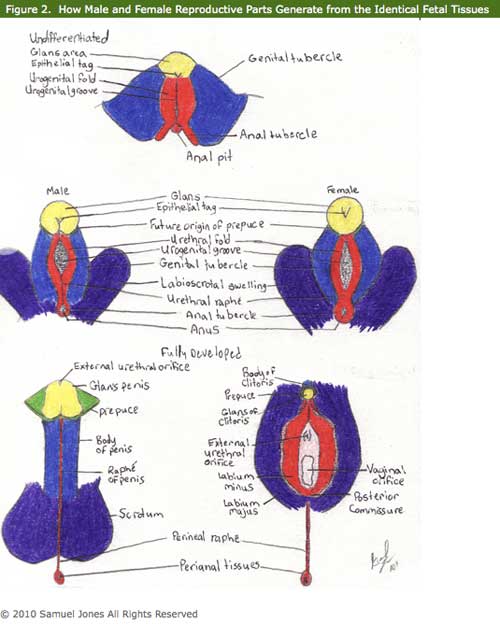
    With an XY male genetic configuration, the glans area will develop into the penis. The urethral fold will form the urethral meatus or opening in the penis. The urethral groove and lateral buttress will fold onto itself and fuse into the shaft of the penis with the urethra connecting the bladder to the urethral meatus or opening of the penis. The anal tubercle will form into the anus and external sphincter. The male glands (prostate, cowper's, and seminal vesicles) develop in another process as do the testicles, which develop inside the abdomen then drop into the scrotum. Figure \(\PageIndex{1}\) shows an artist's depiction of the tissues that biologists would use to identify the developing genitals of males and females.

    Diagram comparing male and female reproductive development from identical fetal tissues. Includes labeled parts like genital tubercle, urethral fold, and labioscrotal swelling. Shows transformation into male and female structures with illustrations.
    Figure \(\PageIndex{1}\). How Male and Female Reproductive Parts Generate from the Identical Fetal Tissues3

    For the XX female genetic configuration, the glans becomes the clitoral glans; the urethral fold becomes the urethral meatus; the urethral groove and lateral buttress become the labia minora and majora (labia means lips); and the anal tubercle becomes the anus and external sphincter. The vagina, cervix, ovaries, and uterus form from other tissues. Interestingly, ovaries develop inside the abdomen. These basic fetal tissues differentiate because of the X or Y. In adult sexual partners these sexual parts function in very similar ways even though their placement and structure differ.

    There are some variations when the actual physical sexual development does not follow expected patterns. Hermaphroditism is found among those variations and is reported in two forms. First, true hermaphroditism is an extremely rare condition wherein both reproductive organs of both males and females are in one person's body and functioning to some degree or another (this includes, penis, testicles, prostate gland, vagina, uterus, and ovaries). Second, pseudo-hermaphroditism (false or near Hermaphroditism) is a rare condition wherein some of both reproductive organs for males or females are present in one person's body, but neither male nor female organs are completely present and/or fully functioning.

    As is mentioned in Figure \(\PageIndex{1}\), not all fetal sexual development occurs uniformly. Though not discussed here in great detail, there are five common sexual development variations reported among newborns: Turner's syndrome, Klinefelter's Syndrome; Androgen Insensitivity Syndrome; Fetally Androgenized Females; and DHT-deficient Males. In most cases of fetal development, sexual development is predictable and follows the above mentioned pattern of originating from nearly identical tissues.


    Footnotes

    3. © 2010 Samuel Jones All Rights Reserved


    8.1: Genital Development is shared under a CC BY 4.0 license and was authored, remixed, and/or curated by LibreTexts.