

2: Marriage and Family Theories
- Page ID
- 231845

\( \newcommand{\vecs}[1]{\overset { \scriptstyle \rightharpoonup} {\mathbf{#1}} } \)
\( \newcommand{\vecd}[1]{\overset{-\!-\!\rightharpoonup}{\vphantom{a}\smash {#1}}} \)
\( \newcommand{\dsum}{\displaystyle\sum\limits} \)
\( \newcommand{\dint}{\displaystyle\int\limits} \)
\( \newcommand{\dlim}{\displaystyle\lim\limits} \)
\( \newcommand{\id}{\mathrm{id}}\) \( \newcommand{\Span}{\mathrm{span}}\)
( \newcommand{\kernel}{\mathrm{null}\,}\) \( \newcommand{\range}{\mathrm{range}\,}\)
\( \newcommand{\RealPart}{\mathrm{Re}}\) \( \newcommand{\ImaginaryPart}{\mathrm{Im}}\)
\( \newcommand{\Argument}{\mathrm{Arg}}\) \( \newcommand{\norm}[1]{\| #1 \|}\)
\( \newcommand{\inner}[2]{\langle #1, #2 \rangle}\)
\( \newcommand{\Span}{\mathrm{span}}\)
\( \newcommand{\id}{\mathrm{id}}\)
\( \newcommand{\Span}{\mathrm{span}}\)
\( \newcommand{\kernel}{\mathrm{null}\,}\)
\( \newcommand{\range}{\mathrm{range}\,}\)
\( \newcommand{\RealPart}{\mathrm{Re}}\)
\( \newcommand{\ImaginaryPart}{\mathrm{Im}}\)
\( \newcommand{\Argument}{\mathrm{Arg}}\)
\( \newcommand{\norm}[1]{\| #1 \|}\)
\( \newcommand{\inner}[2]{\langle #1, #2 \rangle}\)
\( \newcommand{\Span}{\mathrm{span}}\) \( \newcommand{\AA}{\unicode[.8,0]{x212B}}\)
\( \newcommand{\vectorA}[1]{\vec{#1}} % arrow\)
\( \newcommand{\vectorAt}[1]{\vec{\text{#1}}} % arrow\)
\( \newcommand{\vectorB}[1]{\overset { \scriptstyle \rightharpoonup} {\mathbf{#1}} } \)
\( \newcommand{\vectorC}[1]{\textbf{#1}} \)
\( \newcommand{\vectorD}[1]{\overrightarrow{#1}} \)
\( \newcommand{\vectorDt}[1]{\overrightarrow{\text{#1}}} \)
\( \newcommand{\vectE}[1]{\overset{-\!-\!\rightharpoonup}{\vphantom{a}\smash{\mathbf {#1}}}} \)
\( \newcommand{\vecs}[1]{\overset { \scriptstyle \rightharpoonup} {\mathbf{#1}} } \)
\(\newcommand{\longvect}{\overrightarrow}\)
\( \newcommand{\vecd}[1]{\overset{-\!-\!\rightharpoonup}{\vphantom{a}\smash {#1}}} \)
\(\newcommand{\ket}[1]{\left| #1 \right>}\)
\(\newcommand{\bra}[1]{\left< #1 \right|}\)
\(\newcommand{\braket}[2]{\left< #1 \vphantom{#2} \right| \left. #2 \vphantom{#1} \right>}\)
\(\newcommand{\braopket}[3]{\left< #1 \vphantom{#2}\vphantom{#3} \right| #2 \vphantom{#1}\vphantom{#3} \left| #3 \vphantom{#1}\vphantom{#2} \right>}\)
\(\newcommand{\qmvec}[1]{\mathbf{\vec{#1}}}\)
\(\newcommand{\op}[1]{\hat{\mathbf{#1}}}\)
\(\newcommand{\expect}[1]{\langle #1 \rangle}\)
\(\newcommand{\dfn}[1]{\emph{\textbf{#1}}}\)
Families are fundamental social units that shape individuals and societies. Understanding how families function, change, and influence society requires examining various theoretical perspectives. This chapter introduces key theories that scholars use to analyze marriage and family life, providing insights into roles, relationships, power dynamics, and societal influences.
Making Sense of Abstract Theories
Sociological theories are the core and underlying strength of the discipline. They guide researchers in their studies. They also guide practitioners in their intervention strategies. And they will provide you with a basic understanding of how to see the larger social picture in your own personal life. Theory is a set of interrelated concepts used to describe, explain, and predict how society and its parts are related to each other. The metaphor I've used for many years to illustrate the usefulness of a theory is what I call the “goggles metaphor.” Goggles are a set of inter-related parts that help us see things more clearly. Goggles work because the best scientific components work together to magnify, enlarge, clarify, and expand to our view the thing we are studying.
Theories are sets of inter-related concepts and ideas that have been scientifically tested and combined to magnify, enlarge, clarify, and expand our understanding of people, their behaviors, and their societies. Without theories, science would be a futile exercise in statistics. In the diagram below you can see the process by which a theory leads sociologist to perform a certain type of study with certain types of questions that can test the assumptions of the theory. Once the study is administered the findings and generalizations can be considered to see if they support the theory. If they do, similar studies will be performed to repeat and fine-tune the process. If the findings and generalizations do not support the theory, the sociologist rethinks and revisits the assumptions they made.
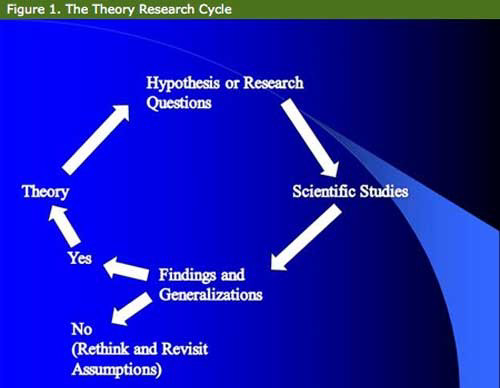
Here's a real-life scientific example. In the 1960's two researchers named Cumming and Henry studied the processes of aging. They devised a theory on aging that had assumptions built into it. These were simply put, that all elderly people realize the inevitability of death and begin to systematically disengage from their previous youthful roles while at the same time society prepares to disengage from them (see Maddox et al. 1987 The Encyclopedia of Aging, Springer Pub. NY) for much more detail. Cumming and Henry tested their theory on a large number of elderly persons. Findings and generalization consistently yielded a “no” in terms of support for this theory. For all intents and purposes this theory was abandoned and is only used in references such as these (for a more scientifically supported theory on aging Google “Activity Theory and/or Continuity Theory”). Theories have to be supported by research and they also provide a framework for how specific research should be conducted.
By the way theories can be used to study society-millions of people in a state, country, or even at the world level. When theories are used at this level they are referred to as Macro-level Theories, theories which best fit the study of massive numbers of people (typically Conflict and Functional theories). When theories are used to study small groups or individuals, say a couple, family, or team, they are referred to as being Micro-level Theories, theories which best fit the study of small groups and their members (typically Symbolic Interactionism or Social Exchange theories). In many cases, any of the four main theories can be applied at either the macro or micro levels.
There are really two distinct types of theories. First, Grand Theory is a theory which deals with the universal aspects of social processes or problems and is based on abstract ideas and concepts rather than on case specific evidence. These include Conflict, Functionalism, Symbolic Interactionism, and Social Exchange Theories; second, Middle-Range Theory is a theory derived from specific scientific findings and focuses on the interrelation of two or more concepts applied to a very specific social process or problem. Robert K. Merton (1910-2003) was a functional theory-based sociologist who taught the value of using smaller more specifically precise theories in trying to explain smaller and more specific social phenomena. These theories include Continuity, Activity, Differential Association, and Labeling theories. (see American Sociology Association, Theory Visit Example(opens in new window) (opens in a new window) [www.asatheory.org]).
Let's consider the 4 grand theories one at a time. Conflict Theory is a macro theory. Macro theory is a sociological theory designed to study the larger social, global, and societal level of sociological phenomena. This theory was founded by a German philosopher, economist, sociologist, and revolutionary (1818-1883). Marx was a witness to oppression perpetrated by society's elite members against the masses of poor. He had very little patience for the capitalistic ideals that undergirded these powerful acts of inhumane exploitation of the average person. To him struggle was innate to all human societies. Later another German named Max Weber (1864-1920; pronounced “Veybur”) further developed this sociological theory and refined it to a more moderate position. Weber studied capitalism further but argued against Marx's outright rejection of it.
Theoretical Frameworks
Figure 2. U.S. Family Structures by Race and Ethnicity (2023)

Structural Functionalism
This perspective views families as essential institutions that socialize children, provide emotional support, and maintain social stability. Families help society function by teaching norms and values.
When considering the role of family in society, functionalists uphold the notion that families are an important social institution and that they play a key role in stabilizing society. They also note that family members take on status roles in a marriage or family. The family—and its members—perform certain functions that facilitate the prosperity and development of society.
Sociologist George Murdock conducted a survey of 250 societies and determined that there are four universal residual functions of the family: sexual, reproductive, educational, and economic (Lee 1985). According to Murdock, the family (which for him includes the state of marriage) regulates sexual relations between individuals. He does not deny the existence or impact of premarital or extramarital sex, but states that the family offers a socially legitimate sexual outlet for adults (Lee 1985). This outlet gives way to reproduction, which is a necessary part of ensuring the survival of society.
Structural Functionalism and the Family
Structural functionalism is a macro-level perspective in sociology that views society as a system of interdependent parts working together to maintain stability. From this perspective, families are one of the most important social institutions because they contribute to the functioning and stability of society as a whole.
Functionalists argue that the family provides:
- Socialization of children – Families teach norms, values, language, and culture to the next generation.
- Emotional support – Families provide care, affection, and a sense of belonging.
- Social stability – Families regulate behavior, including sexual activity, and provide a structure for reproduction and caregiving.
- Status roles – Within families, members take on roles (parent, child, spouse) that contribute to order and predictability in society.
Murdock’s Four Universal Functions of the Family
Sociologist George Murdock studied 250 societies and concluded that the family is a universal institution because it fulfills four essential functions (Lee, 1985):
- Sexual – Families regulate sexual behavior by providing socially accepted outlets for sexual relationships.
- Reproductive – Families ensure the continuation of society through childbirth and child-rearing.
- Educational – Families teach children cultural norms, values, and skills, functioning as the primary agent of socialization.
- Economic – Families provide financial support, pool resources, and divide labor to meet the basic needs of members.
Murdock argued that without families fulfilling these core functions, societies would struggle to survive and prosper.

Functionalist View in Modern Context
Functionalists see the family as a stabilizing force, but critics point out that this perspective may idealize the family and overlook inequalities and conflicts. For example, families may reproduce gender inequality by assigning women most caregiving duties. Likewise, not all families meet the idealized functions; single-parent families, same-sex families, or blended families may function differently but still effectively contribute to society.
Even with these critiques, functionalism remains an influential framework because it highlights the essential roles families play in maintaining social order and supporting both individual members and society as a whole.
Economic Support
By far, economic support is the most common function of today's families. When your parents let you raid their pantry, wash clothes in their laundry, or replenish your checking account, that's economic support. For another young adult, say in New Guinea, if she captures a wild animal and cooks it on an open fire, that's also economic support in a different cultural context. I've always been amazed at how far family economic cooperation extends. Some families cooperate in business-like relationships. In Quebec, Montreal there is an established pattern of Italian immigrants who help family and friends emigrate from Italy to Canada. They subsidize each other's travel costs, help each other find employment once in Canada, and even privately fund some mortgages for one another. Each participant is expected to support others in the same manner. To partake in this form of economic cooperation is to assume a very business-like relationship.
Emotional Support
Emotional relationships are also very common, but you must understand there is a tremendous amount of cultural diversity in how intimacy is experienced in various families around the world. Intimacy is the social, emotional, spiritual, intellectual, and physical trust that is mutually shared between family members. Family members share confidences, advice, trust, secrets, and ongoing mutual concern. Many family scientists believe that intimacy in family relationships functions as a strong buffer to the ongoing stresses experienced by family members outside of the home.
Socialization
Socialization of children is covered in more detail in a Chapter Four. For now, keep in mind that children are born with the potential to be raised as humans. They will realize this potential if older family members or friends take the time to protect and nurture them into their cultural and societal roles. Today the family is the core of primary socialization.
But many other societal institutions contribute to the process including schools, religion, workplace, and media.
Sexuality and Reproduction Control
The family has traditionally asserted control of sexuality and reproduction. A few centuries ago the father and mother even selected the spouses for many of their children (they still do in many countries). Today, U.S. parents want their adult children to select their own spouses. Older family members tend to encourage pregnancy and childbirth only in marriage or a long-term relationship. Unwed mothers are mothers who are not legally married at the time of the child's birth. Being unwed brings up concerns of economic, emotional, social, and other forms of support for the mother that may or may not be present from the father. Many fathers reject their fatherly obligations in the case of unwed mothers.
When an unwed mother delivers the baby, it is often the older female family members who end up providing the functions of support for that child rather than the birth father.
Table 3 shows the unwed mother births for the US in 2000 and 2006. Most of the 4,266,000 live US births in 2006 were to married mothers. But about 1/10 of teen mothers and 38 percent of all mothers were unwed (retrieved 30 March 2009 from http://
www.census.gov/compendia/statab/tables/09s0077.pdf). This trend of increasing unwed birth rates suggests that more and more families have less control by sanctioning childbirth within marriage. On the other side of the coin, many of these unwed mothers marry the child's fathers and many of those marriages eventually end in divorce.
Taken from Statistical Abstracts of the US on 30 March 2009 from Table 87. Births to Teenage Mothers and Unmarried Women and Births With Low Birth Weight-States and Island Areas: 2000 to 2006 www.census.gov/compendia/stat...es/09s0087.pdf
Ascribed Status
Finally, ascribed status is there at birth. With your friends, have you noticed that one or two tend to be informally in charge of the details? You might be the one who calls everyone and makes reservations or buys the tickets for the others. If so, you would have
the informal role of “organizer.” Status is a socially defined position, or what you do in a role. There are three types of status considerations: Ascribed Status is present at birth (race, sex, or class), Achieved Status is attained through one's choices and efforts (college student, movie star, teacher, or athlete), and Master Status is a status which stands out above our other statuses and which distracts others from seeing who we really are.
You were born into your racial, cultural-ethnic, religious and economic statuses. That shaped to some degree the way you grew up and were socialized. By far in our modern societies, achieved status (which comes as a result of your own efforts) is more important than ascribed (which you're born with) for most members of society. Although the degree of achievement you attain often depends heavily on the level of support families give to you.
Another consideration about groups and our roles in them is the fact that one single role can place a rather heavy burden on you (e.g., student). Role strain is the burden one feels within any given role. And when one role comes into direct conflict with another or other roles you might experience role conflict. Role conflict is the conflict and burdens one feels when the expectations of one role compete with the expectations of another role.
Once children are born, the family plays a vital role in training them for adult life. As the primary agent of socialization and enculturation, the family teaches young children the ways of thinking and behaving that follow social and cultural norms, values, beliefs, and attitudes. For example, in some families, parents teach their children manners and civility believing a well-mannered child reflects a well-mannered parent.
Parents also teach children gender roles. Gender roles are an important part of the economic function of a family. In each family, there is a division of labor that consists of instrumental and expressive roles. Men tend to assume the instrumental roles in the family, which typically involve work outside of the family that provides financial support and establishes family status. Women tend to assume the expressive roles, which typically involve work inside of the family which provides emotional support and physical care for children (Crano and Aronoff 1978).
According to functionalists, the differentiation of the roles on the basis of sex ensures that families are well balanced and coordinated. When family members move outside of these roles, the family is thrown out of balance and must recalibrate in order to function properly. For example, if the father assumes an expressive role such as providing daytime care for the children, the mother must take on an instrumental role such as gaining paid employment outside of the home in order for the family to maintain balance and function.
Symbolic Interactionism

This theory looks at family as a social construct created through daily interactions. Family members assign meanings and create identities through their relationships.
Interactionists view the world in terms of symbols and the meanings assigned to them (LaRossa and Reitzes 1993). The family itself is a symbol. To some, it is a father, mother, and children; to others, it is any union that involves respect and compassion. Interactionists stress that family is not an objective, concrete reality. Like other social phenomena, it is a social construct that is subject to the ebb and flow of social norms and ever-changing meanings.
Consider the meaning of other elements of family: in the past, “parent” was a symbol of a biological and emotional connection to a child. With more parent-child relationships developing through adoption, remarriage, or change in guardianship, the word “parent” today is less likely to be associated with a biological connection than with whoever is socially recognized as having the responsibility for a child’s upbringing. Similarly, the terms “mother” and “father” are no longer rigidly associated with the meanings of caregiver and breadwinner. These meanings are more free-flowing through changing family roles.
Interactionists also recognize how the family status roles of each member are socially constructed, playing an important part in how people perceive and interpret social behavior. Interactionists view the family as a group of role players or “actors” that come together to act out their parts in an effort to construct a family. These roles are up for interpretation. In the late nineteenth and early twentieth century, a “good father,” for example, was one who worked hard to provide financial security for his children. Today, for some, a “good father” is one who takes the time outside of work to promote his children’s emotional well-being, social skills, and intellectual growth—in some ways, a much more daunting task.[6]
Conflict Theory
Conflict theorists emphasize how families can reproduce social inequalities, such as gender roles and economic disparities. Families can reinforce power dynamics and control resources.
Conflict theorists are quick to point out that U.S. families have been defined as private entities, the consequence of which has been to leave family matters to only those within the family. Many people in the United States are resistant to government intervention in the family: parents do not want the government to tell them how to raise their children or to become involved in domestic issues. Conflict theory highlights the role of power in family life and contends that the family is often not a haven but rather an arena where power struggles can occur. This exercise of power often entails the performance of family status roles. Conflict theorists may study conflicts as simple as the enforcement of rules from parent to child, or they may examine more serious issues such as domestic violence (spousal and child), sexual assault, marital rape, and incest.
The first study of marital power was performed in 1960. Researchers found that the person with the most access to value resources held the most power. As money is one of the most valuable resources, men who worked in paid labor outside of the home held more power than women who worked inside the home (Blood and Wolfe 1960). Even today, with more fluid family roles, conflict theorists find disputes over the division of household labor to be a common source of marital discord. Household labor offers no wages and, therefore, no power. Studies indicate that when men do more housework, women experience more satisfaction in their marriages, reducing the incidence of conflict (Coltrane 2000). In general, conflict theorists tend to study areas of marriage and life that involve inequalities or discrepancies in power and authority, as they are reflective of the larger social structure.
Check-in Time!
How does the division of chores impact or not impact your household?
Family Systems Theory
When understanding the family, the Family Systems Theory has proven to be very powerful. Family Systems Theory comes under the Functional Theory umbrella and shares the functional approach of considering the dysfunctions and functions of complex groups and organizations. Family Systems Theory claims that the family is understood best by conceptualizing it as a complex, dynamic, and changing collection of parts, subsystems and family members. Much like a mechanic would interface with the computer system of a broken down car to diagnose which systems are broken (transmission, electric, fuel, etc.) to repair it, a therapist or researcher would interact with family members to diagnose how and where the systems of the family are working and where they are in need of repair or intervention.
This theory also addresses the issue of boundaries. Boundaries are distinct emotional, psychological, or physical separateness between individuals, roles, and subsystems in the family. Boundaries are crucial to healthy family functioning.[4]
Check-in Time!
What is the main role in your family system? What boundaries do you have or wish you had?
Social Exchange Theory
This theory treats family relationships as negotiations where people exchange resources, affection, and support to maximize benefits. Social Exchange Theory views human relationships, including family and marriage, as a process of give-and-take where individuals seek to maximize rewards and minimize costs. In this perspective, family members interact much like participants in an ongoing negotiation. Each person brings resources to the relationship—such as affection, time, money, or household labor—and in return expects support, love, or other valued outcomes.
The theory assumes that:
- People are rational decision-makers, weighing costs and benefits of their actions.
- Relationships continue when the rewards (love, companionship, financial stability) outweigh the costs (conflict, stress, unmet needs).
- Individuals compare their current situation to alternatives. If they believe they could receive greater rewards elsewhere, or if the costs outweigh the benefits, the relationship may weaken or end.
Applications to Marriage and Family
- Marriage decisions: Some individuals may delay marriage until they feel the "exchange balance" is favorable (e.g., after achieving financial stability).
- Division of labor: Couples often negotiate tasks like housework or childcare. One partner may provide more financial resources while the other provides more caregiving; balance maintains stability.
- Power dynamics: The partner with more resources (income, education, or social status) may have greater influence in decision-making.
- Divorce: When costs such as conflict, lack of intimacy, or financial strain are perceived to outweigh the benefits, some couples choose to leave the relationship.

Critiques of the Theory
While Social Exchange Theory helps us see marriage and family life as a dynamic process of negotiation, critics point out that it can sometimes oversimplify human relationships. Love, commitment, cultural norms, and moral values may motivate people to stay in relationships even when the "cost-benefit analysis" appears unfavorable. Additionally, the theory often assumes equality in bargaining power, when in reality power differences shaped by gender, class, or culture may limit how much individuals can truly "negotiate."
Social Construction of Family
Families do not exist in a vacuum; they are shaped by culture, race, class, gender, and public policy. For example, immigrant communities often rely on “fictive kin” or non biological family members who provide support and social connection.
Historical policies like redlining, which segregated neighborhoods and denied loans to minority communities, have impacted family stability and wealth accumulation. These social constructions shape how families form, survive, and thrive
Social Construction of Family
Families do not exist in isolation; they are deeply influenced by social, cultural, economic, and political contexts. Sociologists describe family as a social construction, meaning that what counts as a family, how family roles are defined, and the ways families operate are shaped by society rather than being fixed or universal.
Cultural and Community Influences
Culture plays a significant role in shaping family structures. For instance, in many immigrant communities, families often include “fictive kin”—non-biological members who provide emotional, financial, and childcare support. These relationships demonstrate that family is not strictly defined by biology but by social and cultural ties that fulfill essential functions for its members.
Race and Class
Racial and socioeconomic factors strongly influence family life. Policies like redlining, which systematically denied mortgages and financial services to minority neighborhoods in the 20th century, have had long-lasting effects on family stability and wealth accumulation. Families in redlined areas faced limited access to homeownership, quality schools, and employment opportunities, which in turn affected the economic mobility of subsequent generations.
Gender Roles
Gender norms also shape family expectations. Historically, women have been expected to assume primary caregiving roles, while men were often positioned as financial providers. These roles are socially constructed and can change over time, as seen in the increasing number of dual-income households and evolving definitions of fatherhood and motherhood.
Public Policy
Public policies such as welfare programs, childcare subsidies, and parental leave regulations can either support or constrain family functioning. Access to healthcare, education, and housing stability are critical factors that influence how families form, survive, and thrive. Policies reflect societal values and often reinforce particular family ideals, which may not align with the lived realities of all communities.
Key Takeaway: Families are not static entities but dynamic systems shaped by cultural expectations, social norms, economic realities, and public policy. Understanding family as a social construction allows us to see the diversity of family forms and the structural forces that influence them.
Psychological Perspectives
Psychoanalyst Sigmund Freud (1856–1939) was one of the most influential modern scientists to put forth a theory about how people develop a sense of self. He believed that personality and sexual development were closely linked, and he divided the maturation process into psychosexual stages: oral, anal, phallic, latency, and genital. He posited that people’s self development is closely linked to early stages of development, like breastfeeding, toilet training, and sexual awareness (Freud 1905).
According to Freud, failure to properly engage in or disengage from a specific stage results in emotional and psychological consequences throughout adulthood. He linked this closely to the mother-child bond. An adult with an oral fixation may indulge in overeating or binge drinking. An anal fixation may produce a “neat freak” (hence the term “anal retentive”), while a person stuck in the phallic stage may be promiscuous or emotionally immature. Although no solid empirical evidence supports Freud’s theory, his ideas continue to contribute to the work of scholars in a variety of disciplines.
Psychologist Erik Erikson (1902–1994) created a theory of personality development based, in part, on the work of Freud. However, Erikson believed the personality continued to change over time and was never truly finished. His theory includes eight stages of development, beginning with birth and ending with death. According to Erikson, people move through these stages throughout their lives. In contrast to Freud’s focus on psychosexual stages and basic human urges, Erikson’s view of self development gave credit to more social aspects, like the way we negotiate between our own base desires and what is socially accepted (Erikson 1982). His theory also helps us understand that rather that just focusing on the child’s development, all members of the family are going through stages.
Jean Piaget (1896–1980) was a psychologist who specialized in child development, focusing specifically on the role of social interactions in their development. He recognized that the development of self evolved through a negotiation between the world as it exists in one’s mind and the world that exists as it is experienced socially (Piaget 1954).[7]
Lev Vygotsky (1896-1934) is best known for being an educational psychologist with a sociocultural theory. This theory suggests that social interaction leads to continuous step-by-step changes in children's thought and behavior that can vary greatly from culture to culture (Woolfolk, 1998). Basically, Vygotsky's theory suggests that development depends on interaction with people and the tools that the culture provides to help form their own view of their world.
All four of these thinkers have contributed to our modern understanding of self-development.
Check-in Time!
Of the four theorists reviewed above (Freud, Erikson, Piaget, and Vygotsky) which theorist’s ideas about development most closely match your own beliefs about how people develop and why?
[1] Image by Ian Joslin is licensed under CC BY 4.0
[2] Children’s Development by Ana R. Leon is licensed under CC BY 4.0
[3] Educational Learning Theories(opens in new window) by Molly Y. Zhou and David Brow is licensed under CC BY-NC-SA (pg. 60-66)
[4] Intimate Relationships and Families by Ron Hammond and Paul Cheney is licensed under CC BY 4.0 (pg. 5-11)
[5] Image by Bud Ellison is licensed under CC BY 2.0
[6] Sociology - Reading: Theoretical Perspectives on Marriage and Family(opens in new window) by Lumen Learning is licensed under CC BY 4.0
[7] Introduction to Sociology – 5.1: Theories of Development(opens in new window) by OpenStax(opens in new window) is licensed under CC BY 3.0
[8] View the list of educational resources [<a href="resources.html">View the list of educational resources<] by Martyn Wright(opens in new window) is licensed under CC BY 2.0
This page titled 1.1: Theories Developed for Understanding the Family(opens in new window) is shared under a CC BY 4.0(opens in new window) license and was authored, remixed, and/or curated by Rebecca Laff and Wendy Ruiz(opens in new window) via source content(opens in new window) that was edited to the style and standards of the LibreTexts platform.
- 1.1: Theories Developed for Understanding the Family by Rebecca Laff and Wendy Ruiz is licensed CC BY 4.0. Original source: View the list of educational resources [groups.google.com].
- OpenStax. (2021). Introduction to Sociology 3e. Chapter 14: Marriage and Family. OpenStax, Rice University. Retrieved from View the list of educational resources [openstax.org]
- Lumen Learning. Marriage and Family. In Introduction to Sociology. Retrieved from View the list of educational resources [courses.lumenlearning.com]
Review Questions
Write a brief response (or record an audio) to one prompt:
- Who counts as family for me, and why?
- How do legal definitions help or harm families like mine?
Share your response in small groups or as a class if comfortable.